WhatsApp Usernames Explained: Privacy Gains and Scam Risks
How WhatsApp’s shift from phone numbers to usernames changes privacy for users, and the brand and executive impersonation surface it opens for security teams.
Key Takeaways
- WhatsApp opened username reservations on June 29, ahead of a launch later this year: usernames will let people reach you without your phone number and hide yours on first contact. There is no directory and no search suggestions.
- For users, this is a real privacy gain: it decouples contact discovery from the phone number, the identifier behind mass enumeration of WhatsApp accounts.
- For defenders, it opens a new impersonation layer: reserved-name lists will not stop typosquats, lookalikes, or executive-adjacent handles, and the reservation window itself is phishing bait.
- The phone number stays the account anchor: SIM swap remains the takeover path, and the metadata layer is unchanged.
- Act during the reservation window: reserve corporate and executive handles, secure the linked Meta accounts, and extend brand and executive impersonation monitoring to WhatsApp handles now.
The Phone Number Was Always the Weak Point
On June 29, WhatsApp announced that users can now reserve a username ahead of a feature launch later this year. Once live, usernames will let anyone message you without knowing your phone number, and when you message someone for the first time, they will not see yours. There is no directory and no search suggestions; you need the exact handle to reach someone.
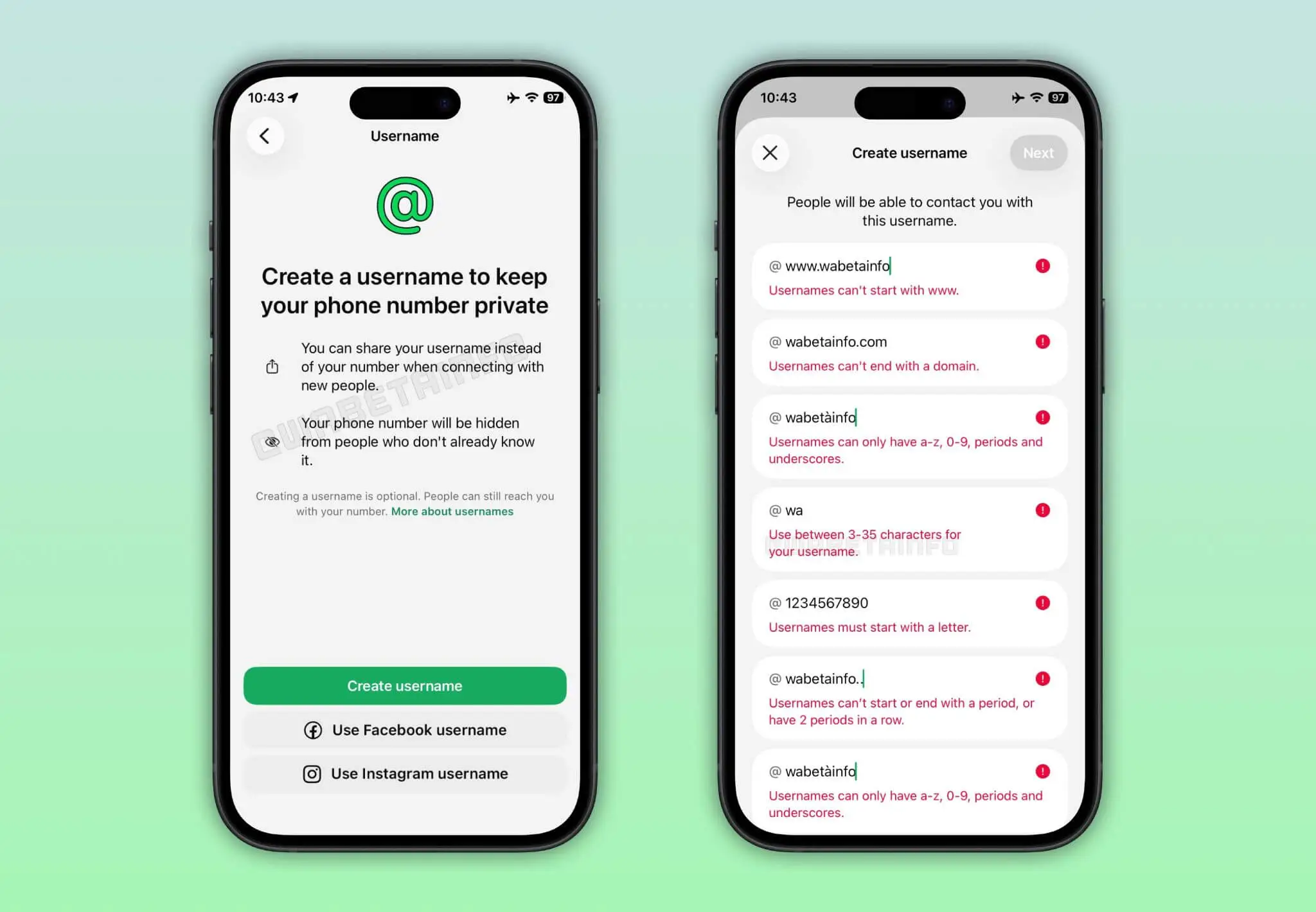
WhatsApp is working towards a public launch of the username feature (WABetaInfo)
The phone number as a universal identifier has always been WhatsApp’s core structural weakness, and usernames finally decouple contact discovery from it. The scale of that weakness is not theoretical: researchers recently enumerated 3.5 billion active WhatsApp accounts by probing 63 billion phone numbers without hitting rate limits (a gap Meta has since closed), pulling profile pictures, about texts, and device data along the way. Anything that reduces how freely people hand out the number feeding that kind of mapping is a real gain.
The design choices are sound: no public directory, no autocomplete, and an optional username key as a second factor for reachability. It follows Signal’s model rather than Telegram’s, and that distinction matters, because Telegram’s searchable handles became an OSINT, harassment, and cybercrime vector in their own right.
WhatsApp is framing this as a privacy win, and for individual users it mostly is. For brand protection, anti-fraud, and executive protection teams, it is a new attack surface arriving on a platform with over three billion users, and the risk window opened the day reservations did.
The Reservation Window Is a Squatting Window
WhatsApp is opening reservations early precisely because names collide at that scale. That same logic works for threat actors. Every day a company or executive has not reserved their handle is a day someone else can. We have seen this cycle on every platform that introduced handles late, from Telegram usernames to X gold-check handles to fediverse instances: a short land-grab phase, then a resale and abuse market.
Expect three squatting patterns:
- Exact-name squatting: brands and executives who moved too slowly, held for ransom or resold.
- Typosquats and lookalikes: @acme.corp vs @acmecorp, transposed letters, plausible department handles like @acme_support or @acme_hr. Usernames allow only lowercase letters, numbers, periods, and underscores, so the realistic lookalike vector is character substitution within that set: 0 for o, 1 for l, or an added or dropped period or underscore.
- Executive-adjacent handles: @firstname.lastname, @flastname_ceo. Most executives have never used WhatsApp corporately, which means nobody at the company thinks they need to defend a handle for them. Attackers will.
One mitigating detail worth noting: WhatsApp reserved an option for businesses and creators to claim their existing Instagram or Facebook username on WhatsApp. That is the single most useful control in the announcement, and it makes your Meta account security posture a hard dependency. If an attacker compromises the Instagram account, the WhatsApp handle claim can come with it.
Usernames Break the Phone-Number Trust Signal
Today, a first-contact WhatsApp message shows a phone number. It is a weak signal, but defenders and ordinary users lean on it constantly: an unexpected “CEO” message from a +234 number gets deleted; the same message from @ceo_lastname with the right profile photo will not.
Once usernames launch, first-time contacts will not see a phone number at all if the sender enabled their username. That removes the one out-of-band artifact recipients could sanity-check. The classic WhatsApp CEO-fraud playbook (urgent message, gift cards or a wire, “I’m in a meeting, don’t call”) gets meaningfully cheaper: no burner SIM per persona, no foreign country code giving the game away, and a handle that looks like the real person.
It also degrades the defender’s side. No directory means you cannot enumerate lookalike handles proactively the way you scan for typosquat domains or fake social profiles. Detection will mostly be reactive, driven by employee and customer reports, so your reporting pipeline matters more than your scanning tooling here.
The Account Anchor Does Not Move
A username sits on top of the account; it does not replace it. The phone number remains the anchor behind every handle, and that has three consequences defenders should not lose in the privacy framing. SIM swap is still the account-takeover path, so number security and two-step verification remain the strongest controls on the account itself. The enumeration surface does not disappear; it just becomes less visible, because the number is no longer the thing people hand out. And the metadata layer, who talks to whom and when, is untouched. Usernames change discovery and first-contact trust; nothing underneath moves.
What does move is the trust signal, and regulators flagged it within days. India, WhatsApp’s largest market, ordered Meta to pause the rollout over fears that hiding phone numbers could fuel impersonation and “digital arrest” scams. Early testing found lookalike handles for public institutions, including “indiamodi” and “rbi_verify,” still open to reserve, and Meta’s reserved-name safeguards do not explain which lookalikes get blocked and which do not. The account underneath is unchanged; the layer on top is already contested enough to stall the launch in WhatsApp’s biggest market.
The Announcement Itself Is a Lure
Any high-profile “act now to claim your name” announcement generates its own scam wave, and this one is close to ideal: urgency, scarcity, and a legitimate call to action that involves opening WhatsApp settings. Expect, within days rather than weeks:
- Fake reservation portals: phishing sites and app-store lookalikes offering to “reserve your WhatsApp username,” harvesting phone numbers and then the SMS verification code. That is a full WhatsApp account takeover, not just a lost handle. Hijacked accounts then feed the next round of contact-list fraud.
- Pressure-based smishing and email: “Someone is trying to claim your username,” “Your reserved username will be released in 24 hours, verify now.” The real reservation flow lives only inside the app (Settings > Account > Username); anything asking you to do it via a link is hostile.
If you monitor newly registered domains, terms like whatsapp-username, reserve-whatsapp, and localized equivalents belong on the watchlist now.
What to Do Now?
- Reserve defensively, now: corporate brand handles, product names, and support-desk names. Use the Instagram or Facebook claim path where you have established handles, and lock down those Meta accounts (strong auth, minimal admin set) first, since they are now the keys to the WhatsApp handle too.
- Cover executives: reserve handles for the C-suite and other high-profile staff, including the obvious name variants, even for executives who will never use them. A parked handle is cheap; a convincing fake CFO is not. Fold this into your existing VIP digital-protection program alongside social-profile monitoring.
- Prepare the takedown path: impersonation reporting will run through WhatsApp and Meta’s in-app and business channels. Establish that route and a point of contact before you need it, because reactive reporting is most of the detection story on a directory-less platform.
- Feed the SOC: add the username-reservation lure themes to phishing detection and user-awareness content now, during the reservation window, not at feature launch. The scam wave tracks the news cycle, not the rollout schedule.
The Net
Usernames are a genuine privacy improvement for users and a new social-engineering layer for defenders. The discovery surface gets quieter; the impersonation surface gets wider. Brand and executive impersonation monitoring should extend to WhatsApp handles now, during the reservation window, before the first campaigns mature.
Frequently asked questions
When Do WhatsApp Usernames Launch?
Reservations opened on June 29, 2026. The feature itself is expected to go live later in 2026.
Can Someone Message Me Without My Phone Number?
Once the feature is live, yes, if you set a username. First-time contacts will not see your number when you enable it, and you will not see theirs.
Is There a WhatsApp Username Directory To Search?
No. There is no directory and no search suggestions, so a handle cannot be discovered by browsing, only used if it is known exactly.
Do Usernames Stop SIM-Swap Account Takeover?
No. The phone number remains the account anchor, so SIM swap is still the takeover path. Keep two-step verification enabled.
How Do We Claim Our Brand’s WhatsApp Username?
Reserve it in the app under Settings > Account > Username. Businesses and creators can claim an existing Instagram or Facebook username; secure those Meta accounts first, since they now gate the WhatsApp handle.