CVE-2026-23918: Apache HTTP Server HTTP/2 Double Free With Possible RCE
CVE-2026-23918 is a vulnerability in Apache HTTP Server (httpd) that affects its HTTP/2 implementation and can lead to a double free during an HTTP/2 stream “early reset” condition.
Apache describes the impact as “Double Free and possible RCE,” meaning the worst case is remote code execution in the httpd process, with denial of service also plausible if exploitation only achieves a crash.
The fix is available now in Apache httpd 2.4.67, which makes this a patch-driven response item. This post covers what the vulnerability is, what is affected, what is known about exploitability, and what defenders should do immediately.
What Is CVE-2026-23918?
CVE-2026-23918 (CVSS 8.8) is a CWE-415 double free in Apache httpd’s HTTP/2 code path. In double-free conditions, software frees the same memory twice, which can corrupt heap structures and lead to a crash or, in some cases, attacker-controlled code execution.
Apache’s advisory explicitly notes “possible RCE,” so this should be treated as more than a reliability bug.
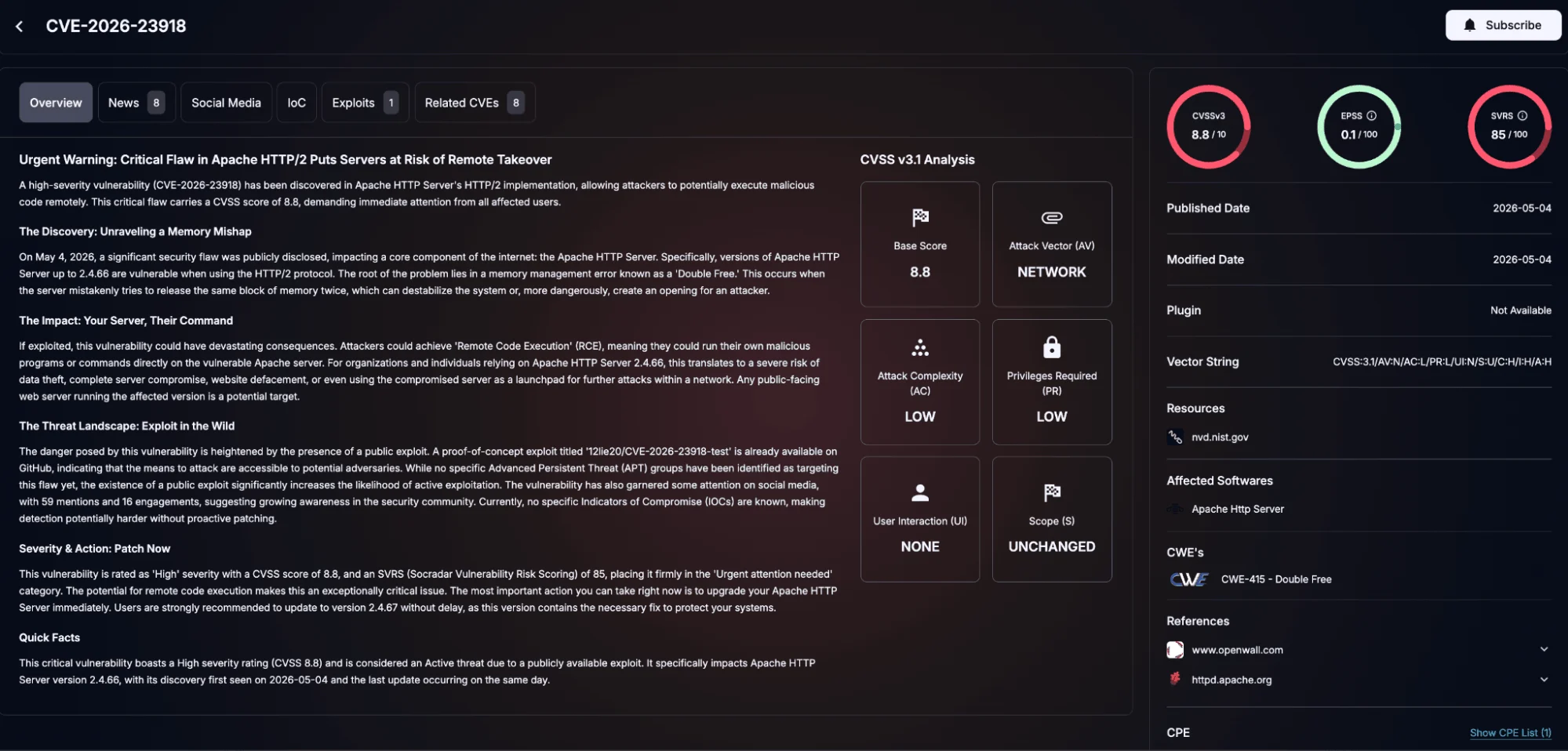
Details of CVE-2026-23918 (SOCRadar Vulnerability Intelligence)
Which Apache Versions & Configurations Are Affected?
The confirmed affected release is Apache HTTP Server 2.4.66 when HTTP/2 is in use. If you never deployed 2.4.66, or if your instances do not negotiate HTTP/2 connections, your practical exposure may be limited.
A key nuance from downstream analysis is that the underlying “core issue” may exist earlier, but it only becomes a double free in httpd 2.4.66 due to a memory allocator change in mod_http2 v2.0.33, which shipped with that release. For vulnerability management, prioritize locating 2.4.66 specifically, rather than assuming every 2.4.x build is equally impacted.
How Does Exploitation Work In Practical Terms?
Public descriptions tie exploitation to an HTTP/2 “early reset” scenario on a stream. In HTTP/2, clients and servers multiplex multiple streams over a single connection, and resets can occur when a stream gets canceled or terminated early. In the vulnerable path, that early reset can cause memory to be freed twice, creating heap corruption.
Heap corruption bugs tend to fall into an operational gray area:
- In the best case, the bug is “only” reliably exploitable for Denial of Service (DoS), causing the httpd worker process to crash and restart.
- In the worst case, heap corruption can be used for remote code execution, depending on allocator behavior, build options, and runtime hardening.
Early advisories did not include detailed trigger specifics or a complete exploit walkthrough, which limits what defenders can validate internally beyond upgrading and watching for instability.
Does Exploitation Require Authentication or Special Access?
Available scoring and advisory interpretations indicate exploitation occurs over the network, and at least one external advisory characterizes it as requiring only simple user authentication with low attack complexity. That does not necessarily mean “no auth” or “internet-wide wormable,” but it does mean teams should not treat this as internal-only by default.
Risk tends to be higher when any of the following are true:
- Your Apache front ends authenticate users (basic auth, app sessions, reverse proxy auth) and still allow attacker-controlled HTTP/2 traffic to reach httpd.
- Your Apache instances terminate TLS and negotiate HTTP/2 directly with clients.
- You host multi-tenant or user-driven content where attackers can create many connections and streams.
Is There Known Active Exploitation?
As of May 6, 2026, the official advisory does not mention exploitation. However, this status can change quickly, particularly in the case of memory corruption bugs on widely deployed servers.
How SOCRadar Supports Vulnerability Prioritization
Not every newly disclosed vulnerability creates the same level of risk. SOCRadar Cyber Threat Intelligence helps security teams track CVE details, exploit maturity, PoC activity, attacker discussions, related IOCs, and real-world exploitation signals. This helps organizations prioritize vulnerabilities based on active threat context, not only severity scores.
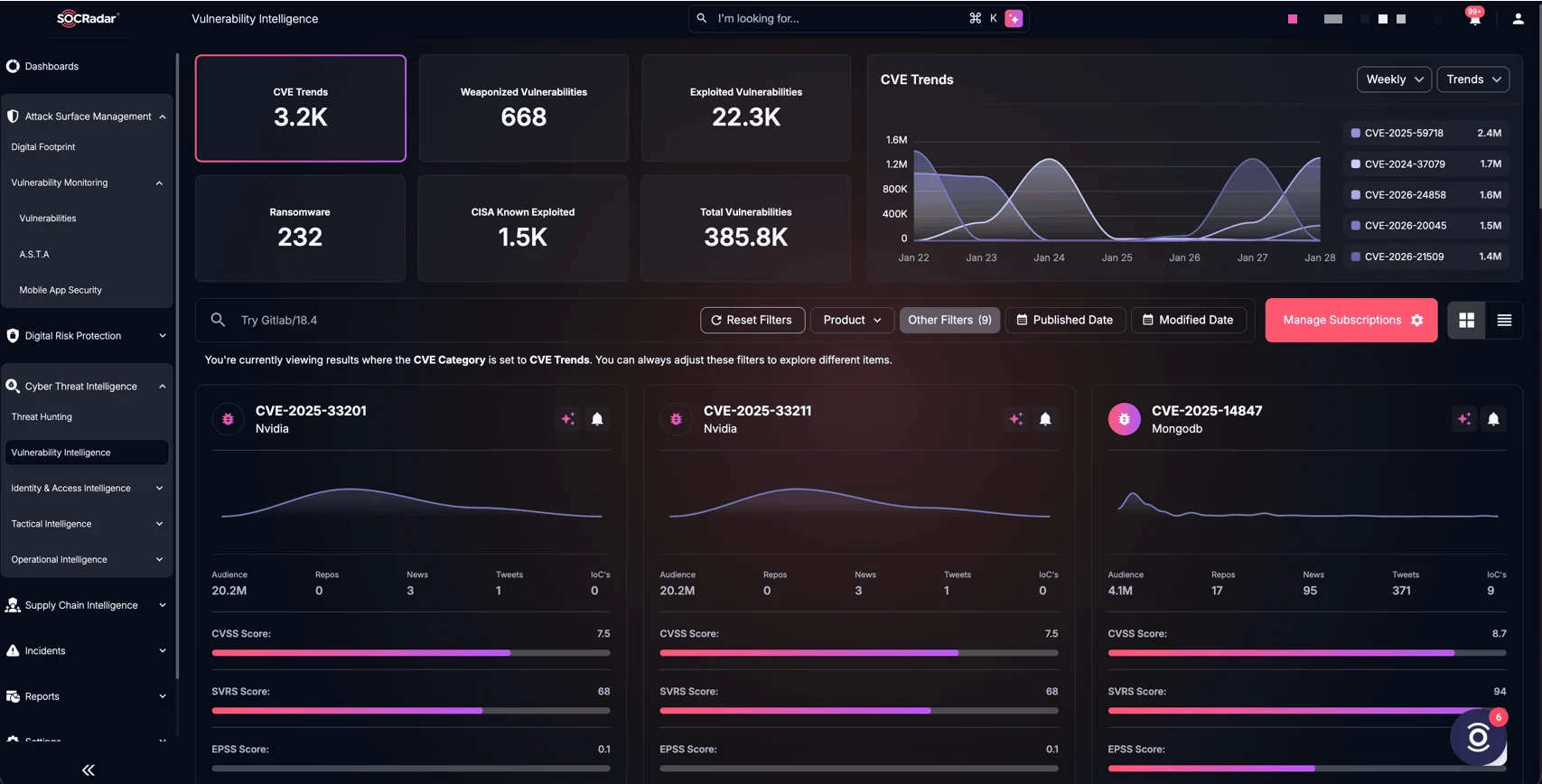
SOCRadar’s Vulnerability Intelligence
SOCRadar Attack Surface Management adds the exposure view by helping teams identify internet-facing assets, exposed services, and misconfigurations that may turn a vulnerability into an immediate risk.
What Should Defenders Do Now?
Upgrade first: move to Apache httpd 2.4.67+
Apache fixed CVE-2026-23918 in 2.4.67. Upgrading is the cleanest response because it removes the vulnerable code path rather than trying to contain it at the edge.
If you cannot patch immediately, disable HTTP/2 as a compensating control
If change windows block an immediate upgrade, temporarily disabling HTTP/2 reduces exposure because the vulnerable behavior is in the HTTP/2 implementation. This matters most for internet-facing services where an attacker can negotiate HTTP/2 and repeatedly attempt to trigger the bug.
Triage and scoping checklist for vulnerability managers and SOC teams
- Inventory all Apache deployments and identify any running 2.4.66.
- Confirm whether HTTP/2 is enabled and reachable (especially on public-facing VIPs and CDN origin paths).
- Prioritize patching for: 1) public-facing reverse proxies and web tiers, 2) authentication portals and SSO front ends, 3) high-traffic nodes where a DoS would be operationally painful.
- Until patched, watch for signals consistent with memory corruption, such as unexpected httpd child process crashes and restarts, or spikes in HTTP/2 connection resets or unusual client behavior patterns.