Stolen Credentials Aren’t the Real Problem – Turn Identity Alerts Into Real Defense
Credentials get reset. Multi-Factor Authentication (MFA) is enabled. The incident ticket is closed. Yet weeks later, the same account is abused again. For many security teams, this pattern is uncomfortably familiar. Remediation happens, but attackers regain access without triggering obvious alarms. What looks like an enforcement failure is often a visibility gap.
This gap between exposure and understanding is where most identity defenses lose momentum. To stop repeat compromises, security teams need to look beyond identity alerts and start examining the access paths attackers exploit.
Why Identity-Based Attacks Keep Working
Once attackers obtain valid credentials, they no longer need to “break in.” Authentication succeeds, access is granted, and malicious activity blends into normal behavior. As discussed in a previous blog, “Hackers Don’t Hack, They Log In,” this shift defines how modern attacks unfold.
What makes this problem harder is that credential exposure is rarely a single event. Access is collected quietly, stored, reused, and often resold on Dark Web marketplaces. Initial compromise and actual exploitation may be separated by weeks or months, making it difficult to link cause and effect once suspicious activity appears.
From a defensive standpoint, alerts often stop at identity confirmation: this user logged in successfully. What’s missing is how that access entered the attacker ecosystem.

This creates a decision gap. Security teams are expected to act quickly, yet they lack critical context about the exposure itself. Was the credential pulled from a years-old breach, or harvested hours ago? Was it collected passively, or extracted from an actively infected machine? Those details determine urgency, but they’re often missing.
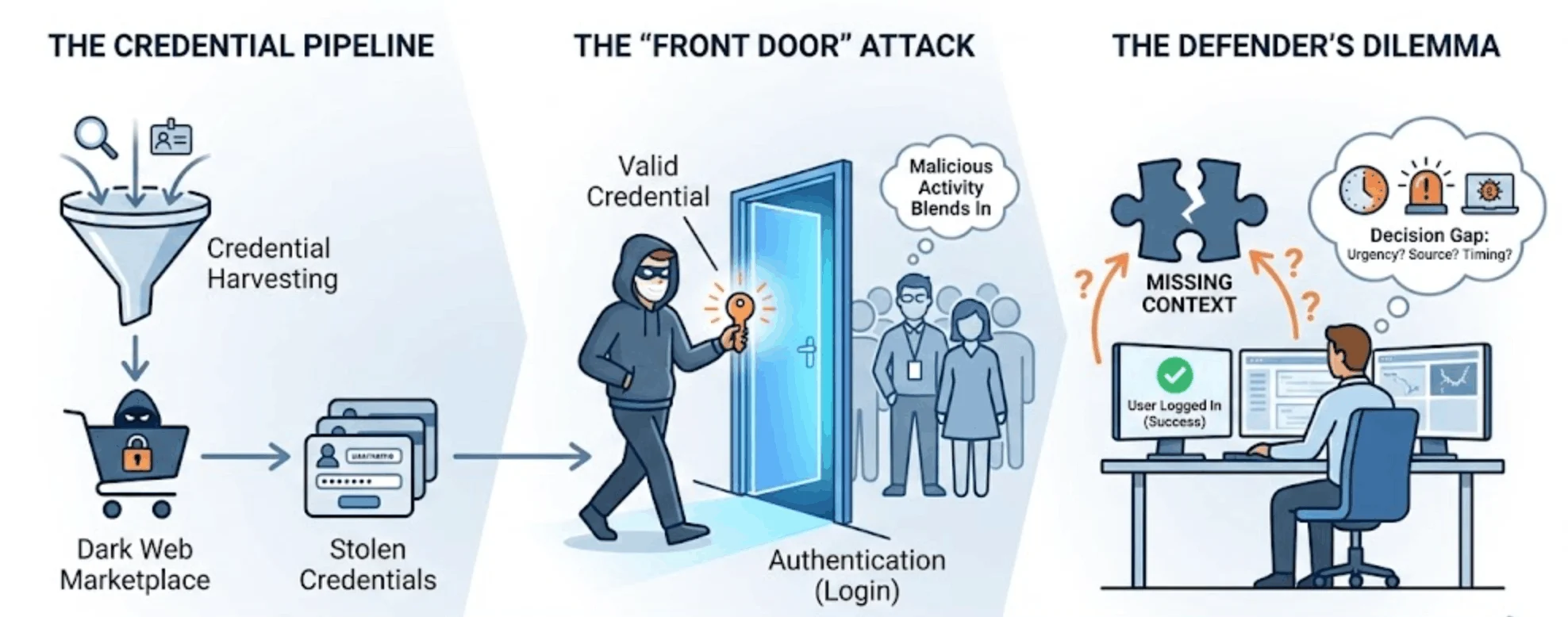
Common scenario in identity-based attacks
Turning Identity Alerts Into Access-Aware Decisions
In summary, an identity alert on its own rarely provides enough context to guide response. Without knowing when the data was collected, how it was obtained, or whether the source is still active, security teams are forced into standardized actions. Every alert looks urgent, or none of them do.
By connecting exposed identities to other details – such as collection method, malware source, timing, and device context – identity alerts gain operational meaning. Teams can quickly distinguish between historical exposure and active compromise, and respond accordingly. An alert tied to an active infostealer infection calls for immediate containment. One linked to an old breach may only require monitoring. Therefore, the difference lies in access context, not identity alone.
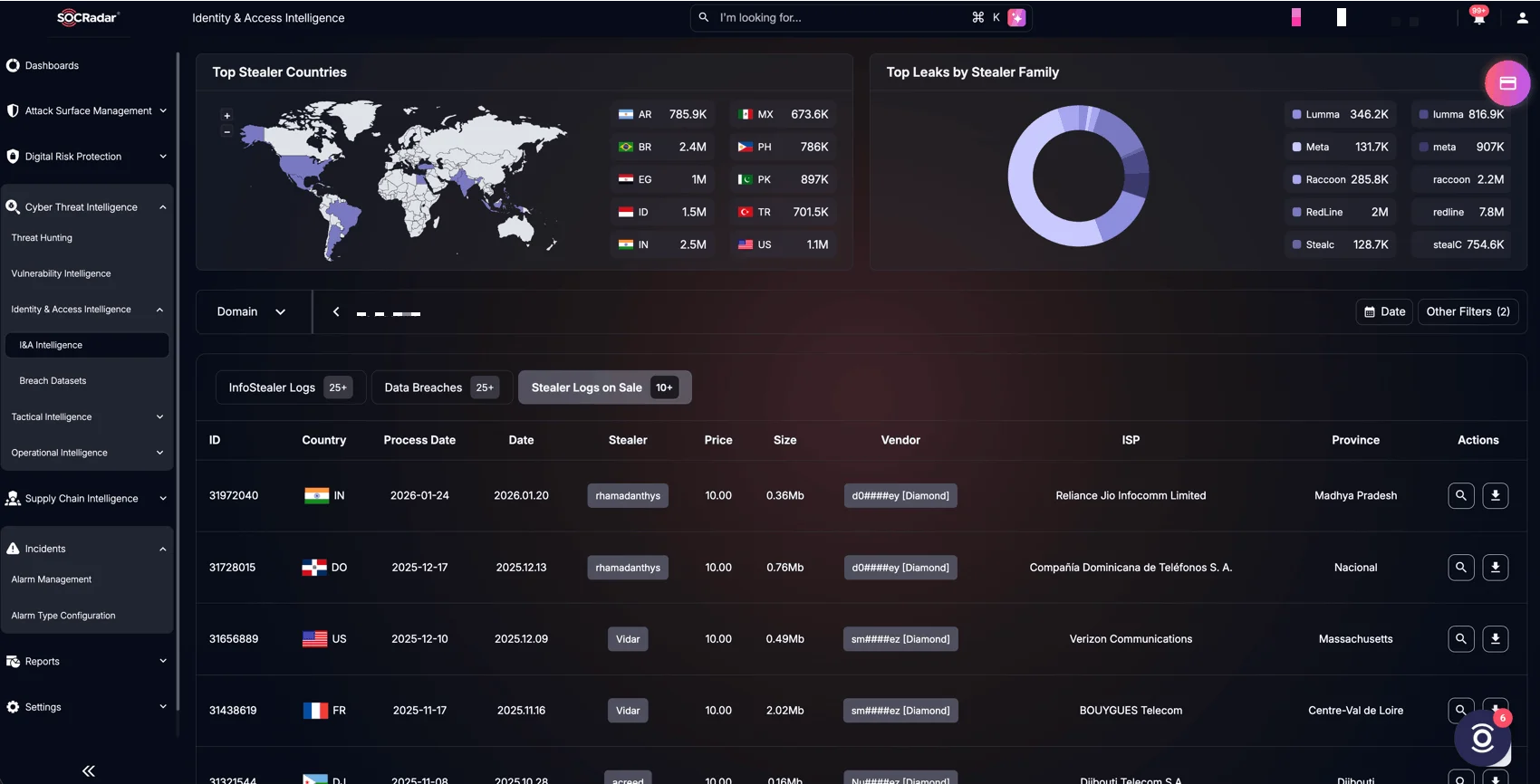
SOCRadar’s Identity & Access Intelligence module, Stealer Logs view
The Identity & Access Intelligence module is built around this shift. It turns identity exposure into decision-grade intelligence, helping your security team focus first on removing attacker access, then on safely restoring credentials. That’s how alerts stop being noise and start driving real defense.
A Practical Use Case: From Alert to Containment
Consider a common scenario. A security team receives an alert indicating that an employee’s credentials have appeared in a leak source. At first glance, it looks like a routine identity exposure. The username and password are valid, but there’s no sign of active misuse yet.
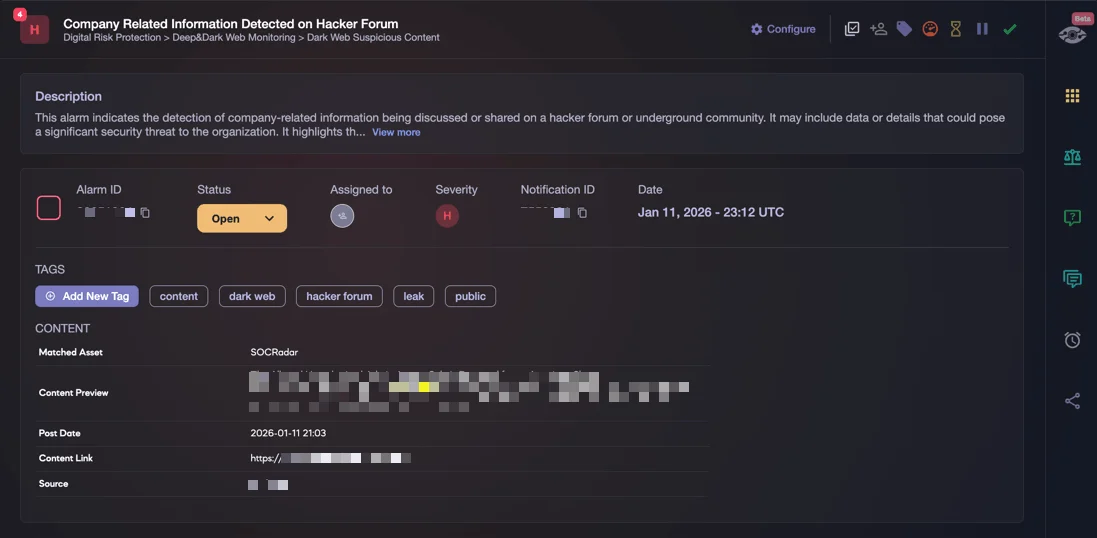
Alert: Company Related Information Detected on Hacker Forum (SOCRadar)
With Identity & Access Intelligence, the investigation doesn’t stop at the credential itself. Instead, the alert is immediately enriched with access-level context. The team can see that the credentials were harvested recently by an infostealer malware family, collected from a specific endpoint, and associated with active stealer activity rather than a historical breach. This instantly changes the priority.
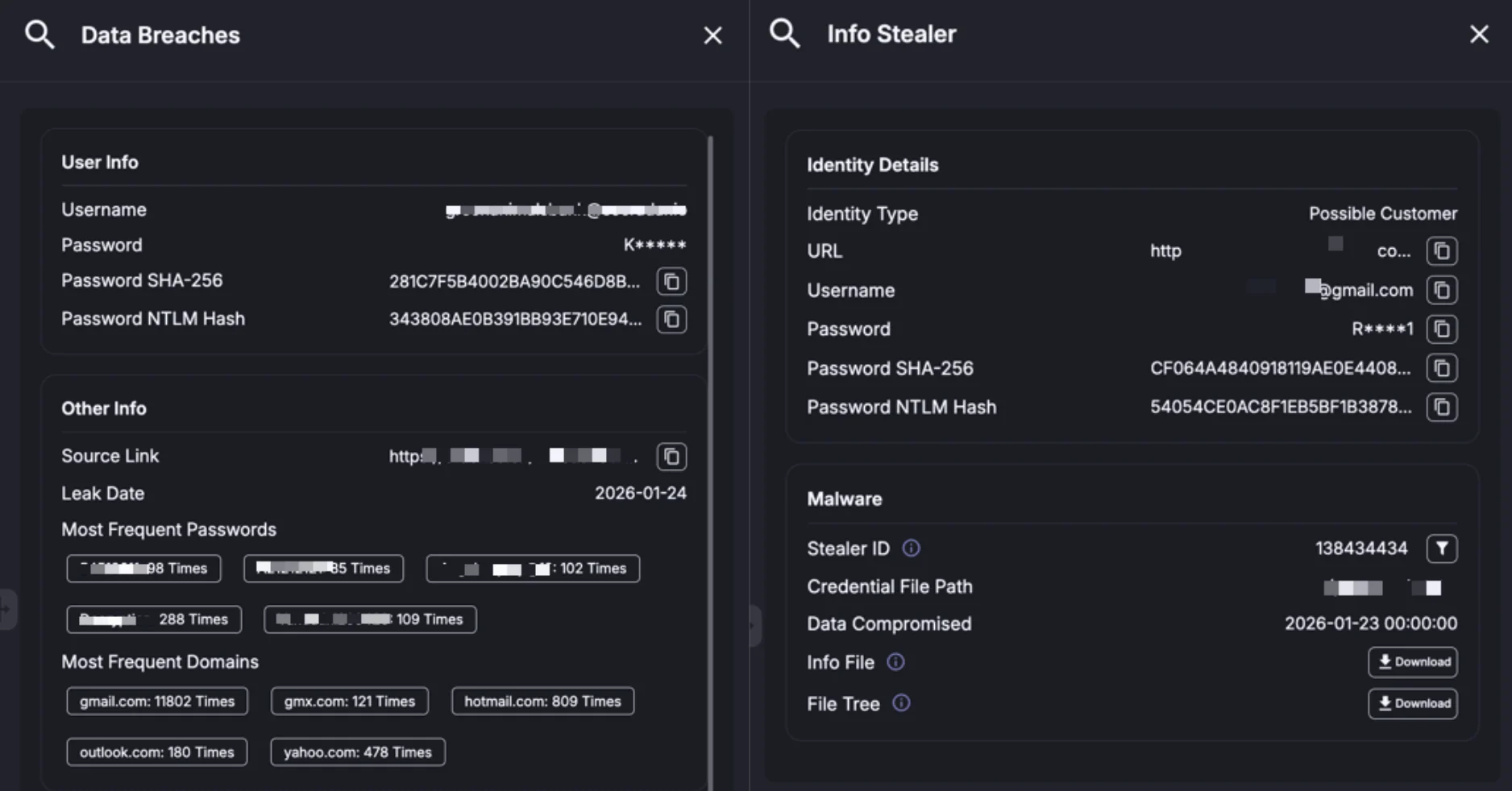
Details of credentials exposed through data breach & infostealers (SOCRadar)
Rather than resetting the password right away, the response shifts to containment. The affected device is isolated, endpoint telemetry is reviewed, and the malware responsible for the exposure is removed. Only after the access path is eliminated are credentials rotated and additional controls enforced.
Seeing the Full Exposure Picture With Breach and Stealer Data
In other cases, the same type of alert traces back to an old breach dataset with no indication of recent activity. There’s no active malware, no reused session data, and no signs of access testing. These exposures typically originate from large-scale breaches, leaked databases, or document dumps that resurface months or even years later. In such situations, a lighter response – credential rotation, monitoring, and documentation – is sufficient, avoiding unnecessary escalation while still closing the loop responsibly.
This is why Identity & Access Intelligence brings stealer logs and breach datasets together: to provide a complete exposure view and help teams distinguish between historical noise and active risk.
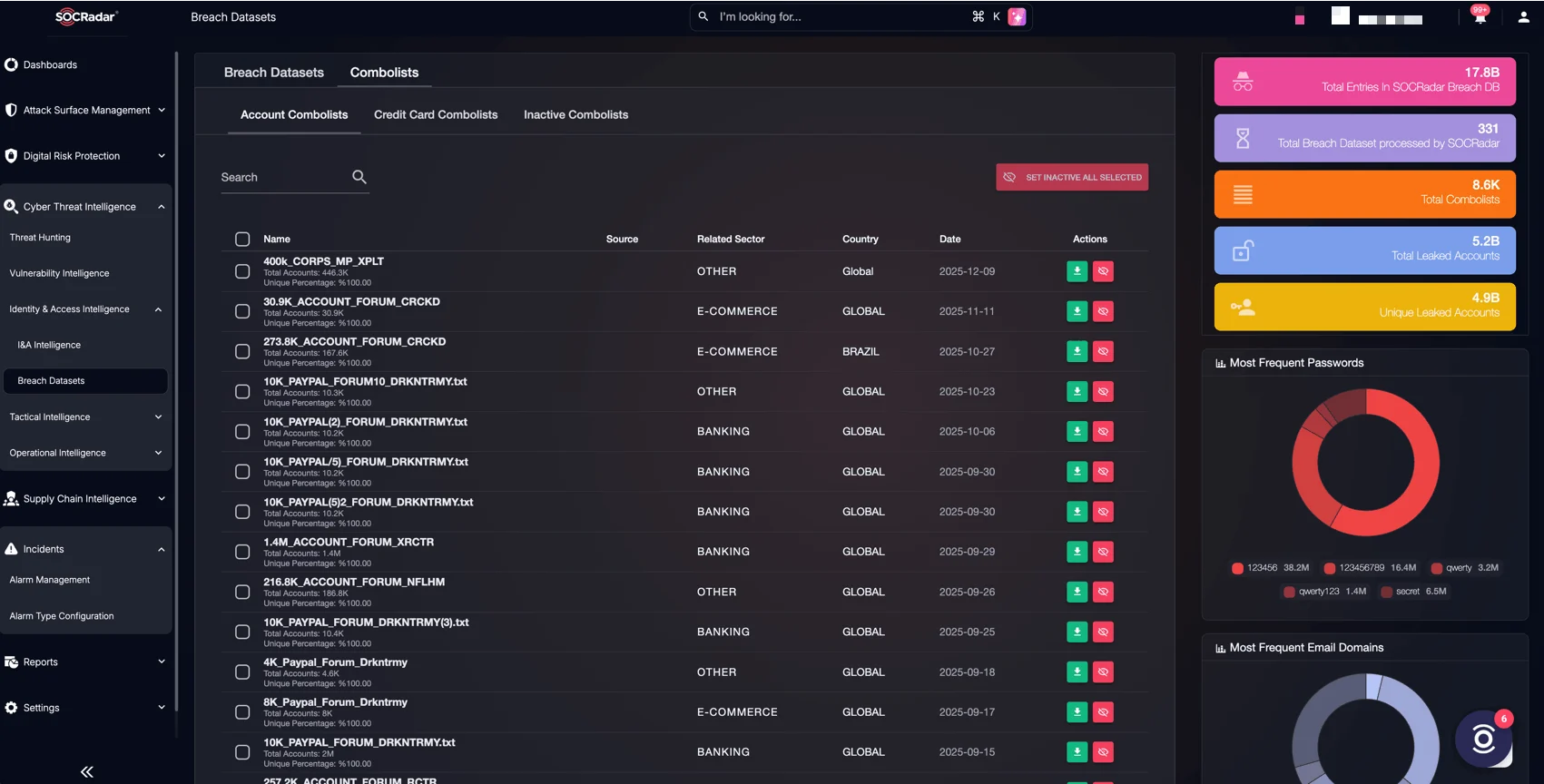
Search through breach datasets & combolists via SOCRadar’s platform
Stealer data answers the question of active risk: credentials captured directly from infected devices, often accompanied by session data, access URLs, and malware indicators. Breach datasets, on the other hand, provide historical and contextual risk: credentials, emails, and personal data exposed through third-party incidents, forgotten assets, or legacy platforms.
Applying Identity & Access Intelligence in Daily Security Workflows
Identity & Access Intelligence delivers the most value when it’s embedded into daily security workflows, not treated as a standalone alert feed. The goal is simple: act on exposure before it turns into access abuse.
Here’s how teams typically operationalize it.
1. Triage Identity Alerts With Access Context
Not every exposure requires the same response. The first step is to separate historical leaks from active risk by reviewing:
- Exposure timing
- Source type (stealer logs vs. breach datasets)
- Associated device or malware indicators
This allows teams to prioritize incidents that signal live access rather than background noise.
2. Contain Before You Rotate
When access context points to an active infection, remediation starts at the source:
- Isolate the affected endpoint
- Remove infostealer malware or persistence mechanisms
- Validate that access paths are no longer viable
Only after containment do teams rotate credentials or enforce additional controls. This order prevents immediate re-harvesting.
3. Align Response With Risk Level
Identity & Access Intelligence supports proportional response:
- Active stealer exposure → full incident workflow and containment
- Recent but inactive exposure → credential rotation and monitoring
- Historical breach exposure → documentation and policy review
This reduces alert fatigue while ensuring high-risk cases receive immediate attention.
4. Strengthen Controls Where Exposure Originates
Patterns matter. Repeated exposure tied to specific browsers, devices, or user groups often reveals:
- Gaps in endpoint protection
- Weak MFA coverage
- High-risk user behaviors or access paths
These insights help teams fix systemic issues instead of responding incident by incident.
5. Close the Loop With Continuous Monitoring
Identity & Access Intelligence is not a one-time check. Continuous monitoring ensures:
- Newly exposed credentials are flagged early
- Resurfacing identities are detected
- Changes in exposure patterns are caught before escalation
Platforms like SOCRadar Identity & Access Intelligence support this operational model by connecting identity exposure to access conditions, enabling teams to move from reactive cleanup to sustained defense.
Conclusion
Stolen credentials are rarely the root cause of identity-based incidents. They are a signal – one that points to deeper access issues that traditional identity alerts alone can’t explain.
As attackers continue to rely on legitimate access rather than noisy exploits, security teams need visibility that extends beyond who was exposed. Understanding how access was obtained, whether it’s still active, and what risk it represents right now is what turns alerts into effective action.
Identity & Access Intelligence enables that shift. By linking identity exposure to access-level context, it helps teams prioritize accurately, contain threats at the source, and avoid repeating the same remediation cycle. The result isn’t just faster response; it’s fewer incidents caused by unresolved access paths.
For organizations looking to move from reactive cleanup to real defense, the path forward is clear: stop treating credential exposure as an isolated event, and start managing identity risk as an access problem.