Notepad++ Infrastructure Hijacked in State-Linked Supply Chain Attack
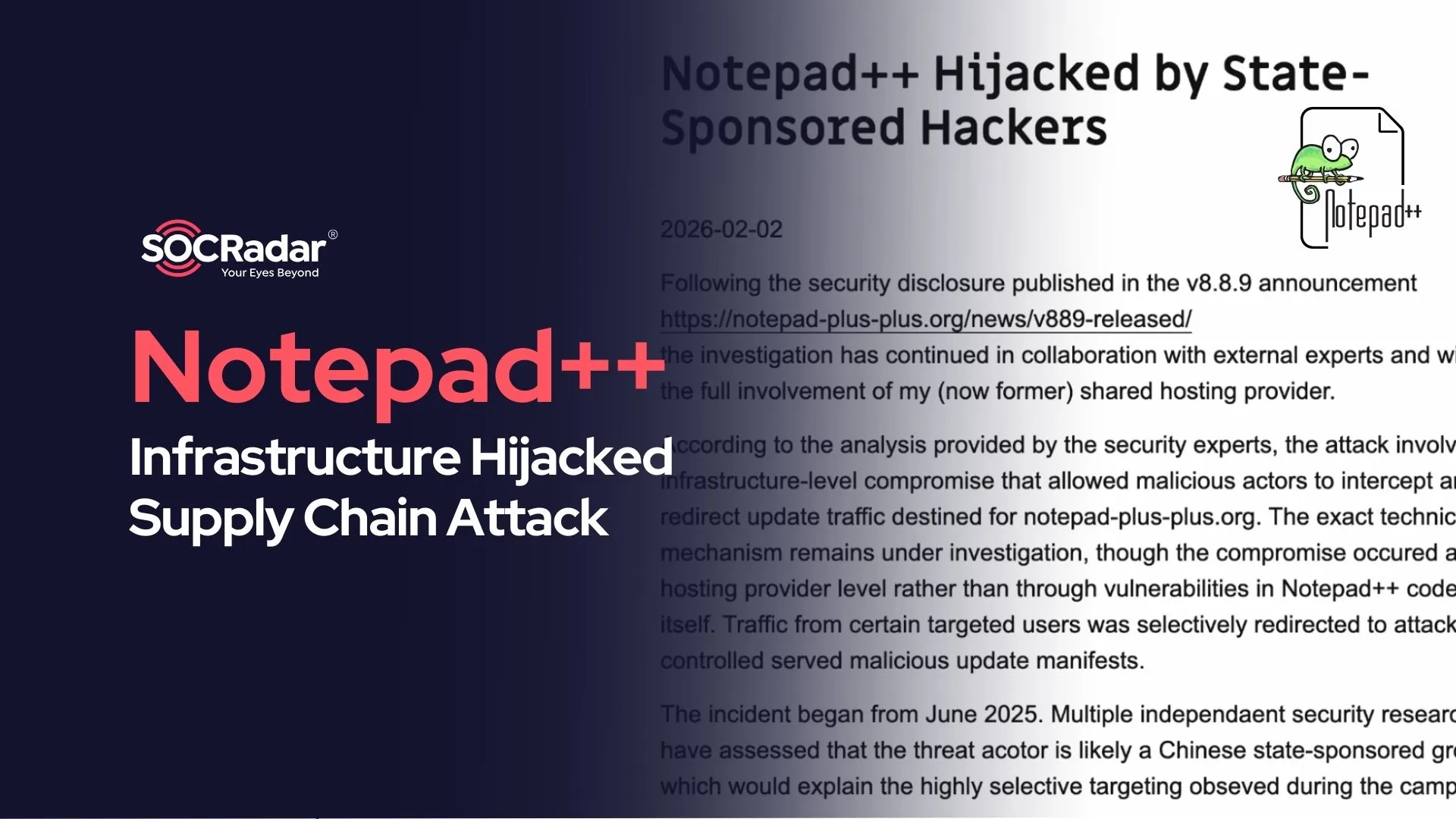
Notepad++, one of the most widely used open-source text editors, has disclosed a security incident that did not stem from a software vulnerability, but from how updates were delivered to users. The case underscores a growing risk area where trusted applications become targets through their surrounding infrastructure rather than their code.

Notepad++ disclosed an infrastructure-level compromise in which attackers hijacked update traffic and selectively redirected targeted users to malicious update servers, with investigations suggesting a likely state-sponsored threat actor rather than a flaw in Notepad++ source code.
What Happened to Notepad++ Update Infrastructure?
Notepad++ was impacted by an infrastructure-level compromise at a former shared hosting provider, which allowed attackers to intercept and selectively redirect update traffic to attacker-controlled servers. The issue did not originate from the Notepad++ codebase itself.

Was Notepad++ Source Code or Repository Compromised?
No. There is no evidence that Notepad++ source code, binaries, or repositories were breached. The attack exploited weaknesses in the hosting environment handling update delivery, not the application.
When Did the Notepad++ Compromise Occur?
Based on combined forensic analysis, the compromise likely started in June 2025. While direct server access appears to have ended on September 2, 2025, attackers retained internal service credentials, enabling traffic manipulation until December 2, 2025.
New technical analysis reveals the exact mechanism:
- Redirection: Targeted users were sent to a rogue server.
- Fake Installer: They downloaded a malicious NSIS installer (update.exe).
- DLL Side-Loading: This installer dropped a legitimate Bitdefender binary (BluetoothService.exe) which then side-loaded a malicious DLL (log.dll) to execute the payload.

The infection chain showing how legitimate binaries were abused to side-load the malicious DLL. (Rapid7)
What Malware Was Deployed?
Researchers have identified the payload as a previously undocumented backdoor named “Chrysalis”.
- It is a custom, feature-rich implant designed for espionage.
- It communicates with the C2 server api.skycloudcenter[.]com.
- The malware uses Microsoft Warbird, an advanced code protection framework, to hide its activities and evade detection.
How Was the Notepad++ Update Traffic Abused?
Attackers selectively redirected update requests from targeted users to malicious servers serving altered update manifests. This highly selective targeting strongly indicates a sophisticated threat actor rather than opportunistic cybercrime.
Who Is Suspected Behind the Notepad++ Attack?
Multiple independent security researchers assess the operation as likely conducted by a Chinese state-sponsored threat group, based on precision targeting, long-term persistence, and infrastructure-level access.
The campaign is now attributed with medium confidence to Lotus Blossom (also known as Billbug, Spring Dragon, or Thrip). This is a Chinese-linked APT group known for targeting government and critical infrastructure in Southeast Asia, which explains the highly selective nature of the targeting.

Lotus Blossom’s cyber threat intelligence profile, SOCRadar Threat Actor Intelligence
Why Was Notepad++ Specifically Targeted?
Logs show the attackers exclusively searched for and targeted the notepad-plus-plus.org domain, likely leveraging awareness of insufficient update verification mechanisms in older Notepad++ versions.
How Has Notepad++ Responded to the Incident?
Notepad++ migrated its website to a new hosting provider and released v8.8.9, enhancing update security with certificate and installer signature verification. Additional protections, including mandatory XML signature validation (XMLDSig), are expected to be enforced starting with v8.9.2.
Why Does the Notepad++ Incident Matter?
This case highlights how software supply chains can be compromised without touching application code. It serves as a critical warning that trusted infrastructure—like update servers—are prime targets for sophisticated actors like Lotus Blossom looking to bypass traditional perimeter defenses.
How Can SOCRadar Help Organizations Strengthen Attack Surface and Supply Chain Visibility?
SOCRadar supports security teams by providing continuous visibility across both the external attack surface and the software supply chain, helping organizations identify risk before it turns into exploitation.

SOCRadar Attack Surface Management (ASM)
From an Attack Surface Management (ASM) perspective, SOCRadar helps organizations discover and monitor internet-facing assets, third-party dependencies, and infrastructure changes that could be abused in hijacking or redirection scenarios. This includes tracking exposed services, misconfigurations, outdated components, and shadow assets that often emerge outside of formal IT inventories.

SOCRadar Supply Chain Intelligence
On the supply chain intelligence side, SOCRadar extends visibility beyond the organization itself. It enables monitoring of software ecosystems, update infrastructures, third-party services, and developer tooling that attackers increasingly target to achieve scale. By correlating supply chain exposures with real-world threat activity, underground discussions, and historical attack patterns, security teams gain early signals when trusted distribution paths or dependencies become high-risk.
Combined, these capabilities allow organizations to move from reactive incident response to proactive risk reduction. Instead of focusing only on individual vulnerabilities, teams can assess systemic exposure, prioritize remediation based on attacker interest, and strengthen resilience across both infrastructure and supply chains before abuse occurs.
Indicators of Compromise (IoCs)
Following Notepad’s initial report of inconclusive logs, relevant IoCs were provided here.
Hashes
- a511be5164dc1122fb5a7daa3eef9467e43d8458425b15a640235796006590c9
- 8ea8b83645fba6e23d48075a0d3fc73ad2ba515b4536710cda4f1f232718f53e
- 2da00de67720f5f13b17e9d985fe70f10f153da60c9ab1086fe58f069a156924
- 77bfea78def679aa1117f569a35e8fd1542df21f7e00e27f192c907e61d63a2e
- 3bdc4c0637591533f1d4198a72a33426c01f69bd2e15ceee547866f65e26b7ad
- 9276594e73cda1c69b7d265b3f08dc8fa84bf2d6599086b9acc0bb3745146600
- f4d829739f2d6ba7e3ede83dad428a0ced1a703ec582fc73a4eee3df3704629a
- 4a52570eeaf9d27722377865df312e295a7a23c3b6eb991944c2ecd707cc9906
- 831e1ea13a1bd405f5bda2b9d8f2265f7b1db6c668dd2165ccc8a9c4c15ea7dd
- 0a9b8df968df41920b6ff07785cbfebe8bda29e6b512c94a3b2a83d10014d2fd
- 4c2ea8193f4a5db63b897a2d3ce127cc5d89687f380b97a1d91e0c8db542e4f8
- e7cd605568c38bd6e0aba31045e1633205d0598c607a855e2e1bca4cca1c6eda
- 078a9e5c6c787e5532a7e728720cbafee9021bfec4a30e3c2be110748d7c43c5
- b4169a831292e245ebdffedd5820584d73b129411546e7d3eccf4663d5fc5be3
- 7add554a98d3a99b319f2127688356c1283ed073a084805f14e33b4f6a6126fd
- fcc2765305bcd213b7558025b2039df2265c3e0b6401e4833123c461df2de51a
Network Indicators
- 95.179[.]213.0
- api[.]skycloudcenter[.]com
- api[.]wiresguard[.]com
- 61.4[.]102.97
- 59.110[.]7.32
- 124.222[.]137.114
MITRE TTPs
| ATT&CK ID | Name |
| T1204.002 | User Execution: Malicious File |
| T1036 | Masquerading |
| T1027 | Obfuscated Files or Information |
| T1027.007 | Obfuscated Files or Information: Dynamic API Resolution |
| T1140 | Deobfuscate/Decode Files or Information |
| T1574.002 | DLL Side-Loading |
| T1106 | Native API |
| T1055 | Process Injection |
| T1620 | Reflective Code Loading |
| T1059.003 | Command and Scripting Interpreter: Windows Command Shell |
| T1083 | File and Directory Discovery |
| T1005 | Data from Local System |
| T1105 | Ingress Tool Transfer |
| T1041 | Exfiltration Over C2 Channel |
| T1071.001 | Application Layer Protocol: Web Protocols (HTTP/HTTPS) |
| T1573 | Encrypted Channel |
| T1547.001 | Boot or Logon Autostart Execution: Registry Run Keys |
| T1543.003 | Create or Modify System Process: Windows Service |
| T1480.002 | Execution Guardrails: Mutual Exclusion |
| T1070.004 | Indicator Removal on Host: File Deletion |