

Oct 13, 2026
Table Of Content
Related Articles


CVE-2026-97229: Critical GitLab RCE
Oct 13, 2026


CVE-2026-102255: Critical SonicWall SMA1000 SSRF
Oct 12, 2026

Critical Cisco NX-OS Flaws Threaten Nexus Switches
Oct 09, 2026

Aug 27, 2026
5 Mins Read

Summarize with:
Qilin Claims ATF Breach as Agency Confirms “Major Incident”
The Qilin Ransomware group listed the Bureau of Alcohol, Tobacco, Firearms and Explosives (ATF) on its Dark Web leak site on August 26, 2026, the same day the agency publicly confirmed a cybersecurity “major incident” affecting a standalone system.
This incident landed during a difficult stretch for U.S. federal law enforcement. Earlier in 2026, the FBI confirmed a breach of its Digital Collection System Network, and DHS disclosed a compromise of the Homeland Security Information Network (HSIN). ATF’s confirmation adds a third major federal law enforcement agency to that list within six months.
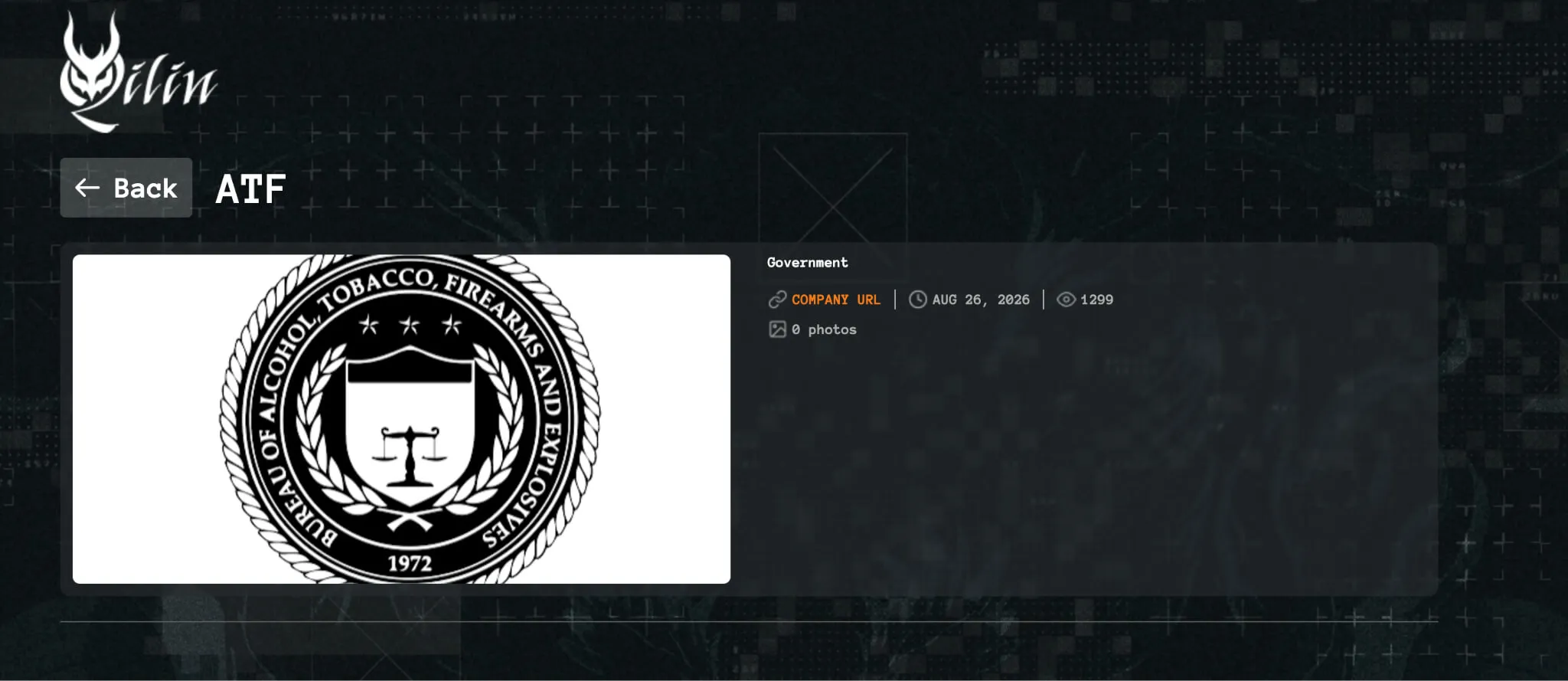
ATF Listing on Qilin Ransomware Leak Site
What Happened in the ATF Cybersecurity Incident?
On Wednesday, August 26, 2026, the ATF published a press release titled “ATF responds to cybersecurity incident.” The agency stated that a standalone system was compromised and that senior Justice Department officials designated the event a “major incident” under applicable federal guidelines.
ATF’s statement include:
- The affected system operates separately from the ATF enterprise network.
- There is no indication the incident affected the ATF enterprise network, the ATF eForms system, or any other ATF system.
- ATF immediately terminated connections to the affected environment upon discovery and launched incident-response and forensic activities in coordination with the DOJ.
- ATF operations and mission capability were not disrupted.
What ATF did not disclose: the name of the affected system, when the incident was discovered, whether any data was accessed or stolen, and whether officials believe Qilin was responsible.
Under FISMA and OMB guidance, a “major incident” is one that is likely to result in demonstrable harm to national security interests, foreign relations, the economy, public confidence, civil liberties, or public health and safety. A breach affecting 100,000 or more individuals may also qualify, subject to the applicable harm assessment. Once an agency has a reasonable basis to conclude that a major incident has occurred, it must notify the appropriate congressional committees within seven days, with additional reporting obligations applying to DHS and the agency’s Office of Inspector General.
ATF holds some of the most sensitive law enforcement and firearms data in the federal government, including the National Firearms Registration and Transfer Record (NFRTR) for NFA-regulated items, a large volume of digitized out-of-business dealer records, active investigative files, informant identities, and crime-gun tracing data through NIBIN.
However, ATF specifically stated that the enterprise network, the eForms system, and “any other ATF system” were unaffected, suggesting the breached standalone system is not one of these core repositories.
Has Qilin Claimed Responsibility?
Yes, but the claim is unsubstantiated. Qilin added ATF to its Dark Web data-leak site on Wednesday morning, August 26, 2026, alongside five other victims primarily from industrial and manufacturing sectors. The group posted no evidence, no file samples, no data-volume metrics, and no public ransom demand.
The timing coincidence between Qilin’s posting and ATF’s public disclosure drove the connection; however, ATF itself has not attributed its incident to Qilin.
It is important to keep in mind that RaaS groups sometimes list victims opportunistically or overstate their access. Until Qilin posts verifiable data samples or ATF/DOJ issues a formal attribution, the link between the two events remains circumstantial.
Who Is Qilin?
Qilin (also known as Agenda) is a Russian-speaking Ransomware-as-a-Service (RaaS) operation that has been active since mid-2022. The group emerged under the name “Agenda” in July 2022 and rebranded to Qilin the following September, coinciding with a shift from Go-based to Rust-based payloads. Despite the name referencing a Chinese mythological creature, researchers assess the operation as Russian-speaking, based on code artifacts and a policy of excluding CIS-country targets.
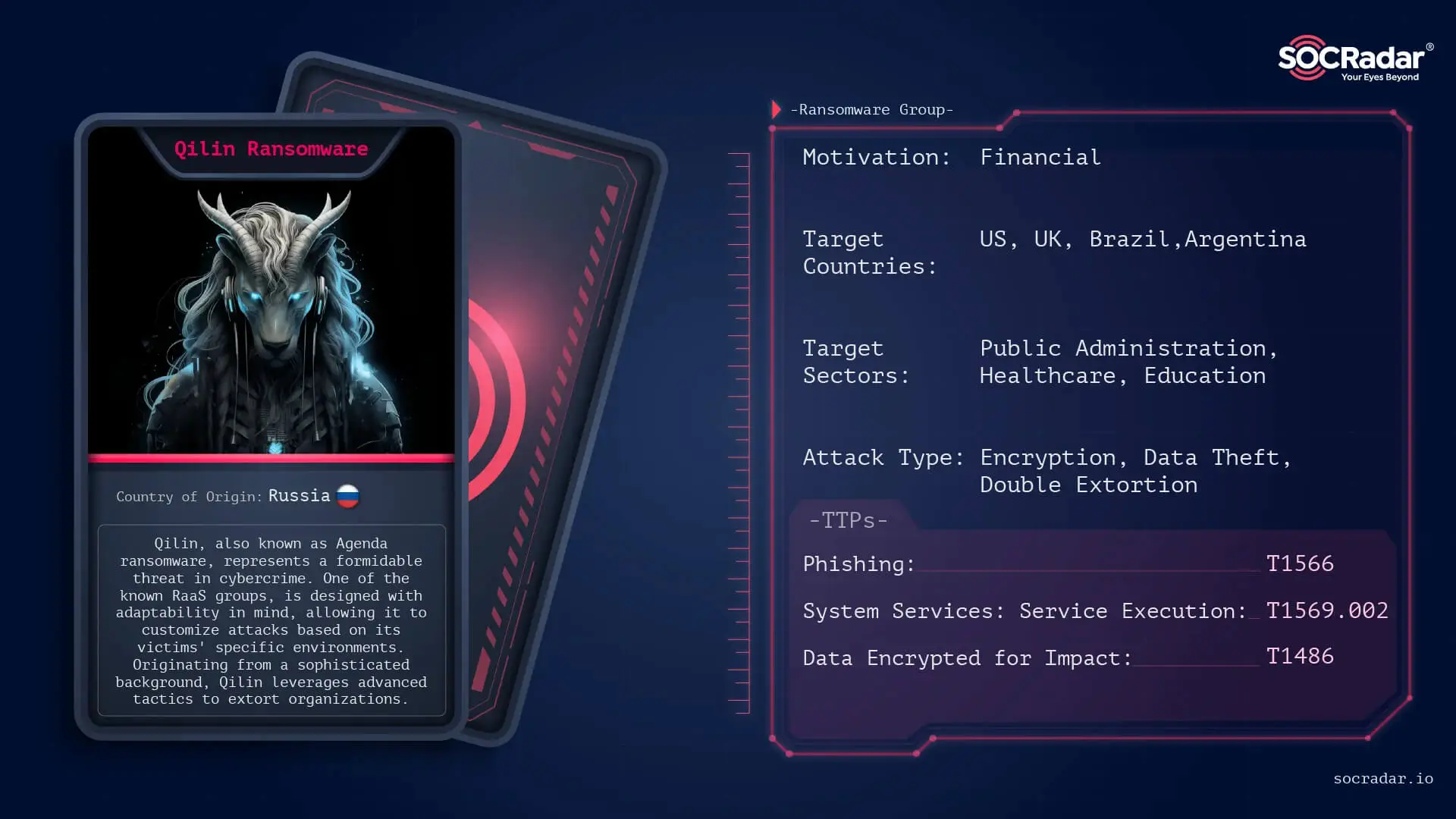
For a full profile of the group’s origin, modus operandi, victimology, and MITRE ATT&CK mapping, see our Dark Web Profile: Qilin (Agenda) Ransomware.
What Questions Remain?
Several unknowns remain as of publication:
- Attribution: Will ATF/DOJ formally attribute the incident to Qilin or to another actor?
- Scope: Which specific standalone system was compromised, and does it hold any firearms, investigative, or PII data?
- Data theft: Was data actually exfiltrated, or was this an encryption-only event? Qilin’s leak-site listing could indicate data exfiltration, but the absence of proof keeps this open.
- Evidence: Will Qilin publish verifiable data samples to back its claim?
- Entry vector: How did the attackers gain access? Qilin affiliates commonly use phishing, compromised VPN/RDP credentials, and exploitation of public-facing applications.
Track Qilin and Ransomware Activity With SOCRadar
SOCRadar Dark Web Monitoring enables security teams to track ransomware group activity, leak-site listings, and brand mentions across underground forums. Early detection of listings like the ATF claim gives defenders a critical head start for containment and response.
With SOCRadar’s, defenders gain access to updated IOCs, YARA rules, and contextual analysis for active ransomware groups including Qilin. The platform’s Attack Surface Management capabilities help identify exposed RDP, VPN endpoints, and vulnerable web applications that ransomware operators frequently exploit for initial access.
For a quick assessment of whether your domain appears in underground spaces, try our free Dark Web Report.