How U.S. Organizations Have One of the Largest Attack Surfaces Globally
The United States sits at the center of the modern digital economy. It leads in cloud adoption, SaaS deployment, financial innovation, and distributed workforce enablement. U.S. enterprises are among the most technologically mature in the world. But digital maturity carries a paradox. The same transformation that drives operational efficiency and global competitiveness also creates one of the largest and most complex attack surfaces anywhere in the world.
Today, U.S. organizations are not simply frequent victims of cyberattacks; they are structurally positioned as high-density, high-value digital targets. From ransomware operators and access brokers to credential harvesters and data resellers, adversaries consistently prioritize American enterprises.
Understanding why requires looking beyond individual incidents. It requires examining digital scale, cloud expansion, identity sprawl, underground monetization, and breach economics. Across multiple independent reports, the conclusion is remarkably consistent: the U.S. attack surface is expansive because the U.S. digital ecosystem is expansive.
The Structural Forces Behind the United States’ Expanding Attack Surface
The size of the U.S. attack surface is not accidental; it is the byproduct of several reinforcing structural forces, such as:
- Cloud-first digital transformation at scale
- Higher-than-average SaaS adoption
- Deep vendor and supply chain integration
- Normalized remote and hybrid work models
- Active underground monetization of the U.S.-linked data and access
Individually, these trends reflect digital maturity. Together, they create a compounding exposure effect. Cloud growth expands identity surfaces, identity sprawl increases credential risk, credential risk fuels access markets, and access markets sustain ransomware ecosystems. The result is a self-reinforcing cycle of digital expansion and adversary interest.
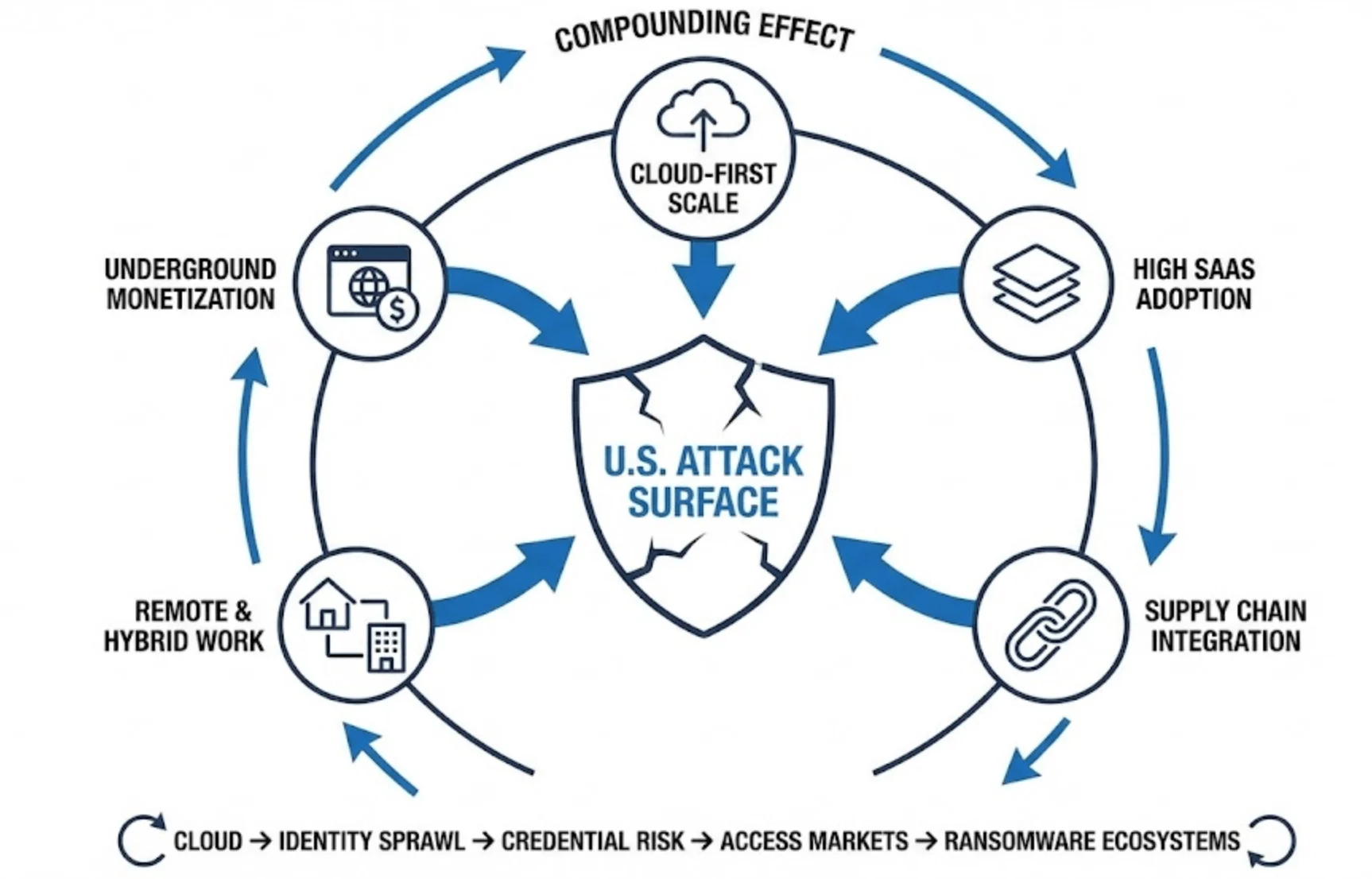
Factors that contribute to the U.S. attack surface
The sections that follow examine how each of these forces manifests in measurable data.
Ransomware Data Shows Clear Geographic Concentration
One of the clearest indicators of attack surface size is where threat actors focus their efforts. According to the Zscaler ThreatLabz Ransomware Report, 50% of global ransomware attacks targeted organizations in the United States, a proportion dramatically higher than any other country.
Threat actors gravitate toward environments where:
- Internet-facing assets are abundant
- Business interruption carries financial leverage
- The probability of payment is high
The United States offers all three.
Further reinforcing this scale, the FBI’s Internet Crime Complaint Center (IC3) recorded 859,532 complaints and more than $16 billion in reported losses in 2024, marking the highest annual financial impact ever documented by the bureau.
These figures represent more than fraud statistics. They reflect the extraordinary volume of digital transactions, interconnected infrastructure, and online dependency embedded within the U.S. economy. The scale of economic activity taking place across digital channels directly expands the potential attack surface of cyber incidents.
When disruption is costly, attackers pay attention.
SaaS Proliferation, Cloud Expansion, and the Identity Multiplier Effect
A major reason U.S. organizations maintain such a large attack surface is the scale of SaaS and cloud adoption, and the way that scale multiplies access paths.
According to the Okta Businesses at Work 2024 Report, organizations deploy an average of 93 applications, while U.S.-based companies deploy approximately 105 applications on average, among the highest globally. That matters because every new SaaS application typically introduces new logins, new roles, new integrations, and new service accounts, effectively creating more identity “front doors” into the environment.
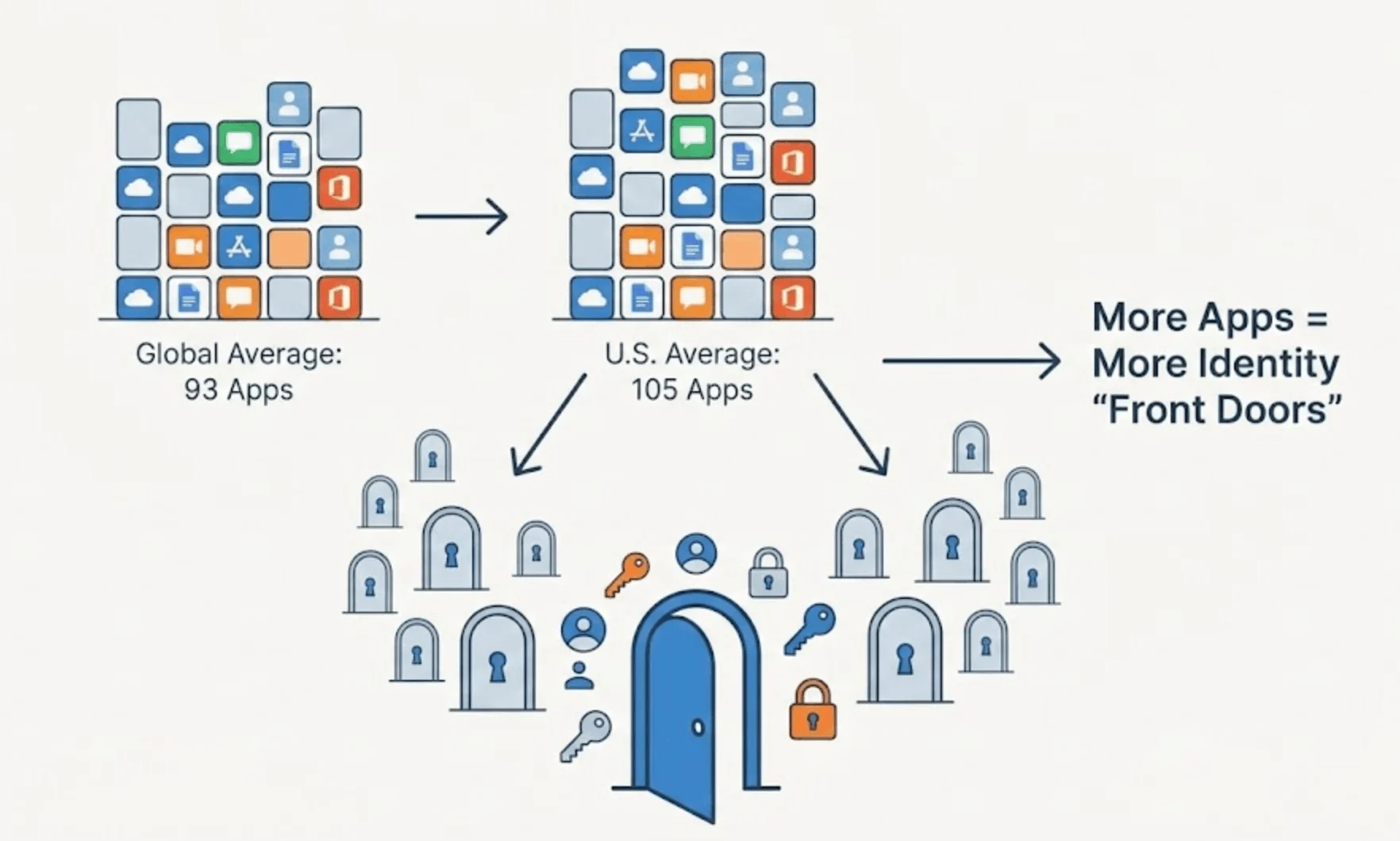
Average application counts deployed globally vs. in the U.S.
In detail, each additional application introduces:
- Authentication endpoints
- Administrative privilege structures
- API keys and service accounts
- Third-party OAuth connections
- Expanding identity dependencies
Over time, identity becomes the perimeter of the enterprise. The more SaaS platforms deployed, the more credentials exist. The more credentials exist, the greater the number of potential entry points.
Cloud growth accelerates the same pattern. Gartner estimated public cloud end-user spending reached $723.4 billion in 2025, up from $595.7 billion in 2024, and expects hybrid cloud adoption to continue rising through 2027. As cloud environments scale, infrastructure becomes increasingly dynamic: new instances are deployed continuously, development environments are exposed, subdomains are created and abandoned, and third-party integrations extend trust boundaries outward. The result is a distributed attack surface spanning SaaS platforms, cloud workloads, APIs, remote access systems, and vendor ecosystems.
Attackers are exploiting these access paths. The IBM Cost of a Data Breach Report 2025 shows stolen or compromised credentials account for 19% of breaches, with phishing close behind at 17%, a strong signal that modern compromise often starts with access, not a single perimeter breach.
The Underground Market Reveals the Scale of Opportunity in the U.S.
If an attack surface is large, it produces monetizable assets. Underground activity provides a revealing lens into this reality. The U.S. attack surface does not merely attract attacks; it fuels an economy.
According to the SOCRadar U.S. Threat Landscape Report 2026, 70.76% of dark web posts are sales-oriented. Additionally:
- 61.53% involve data or database leaks
- 29.31% involve direct access sales
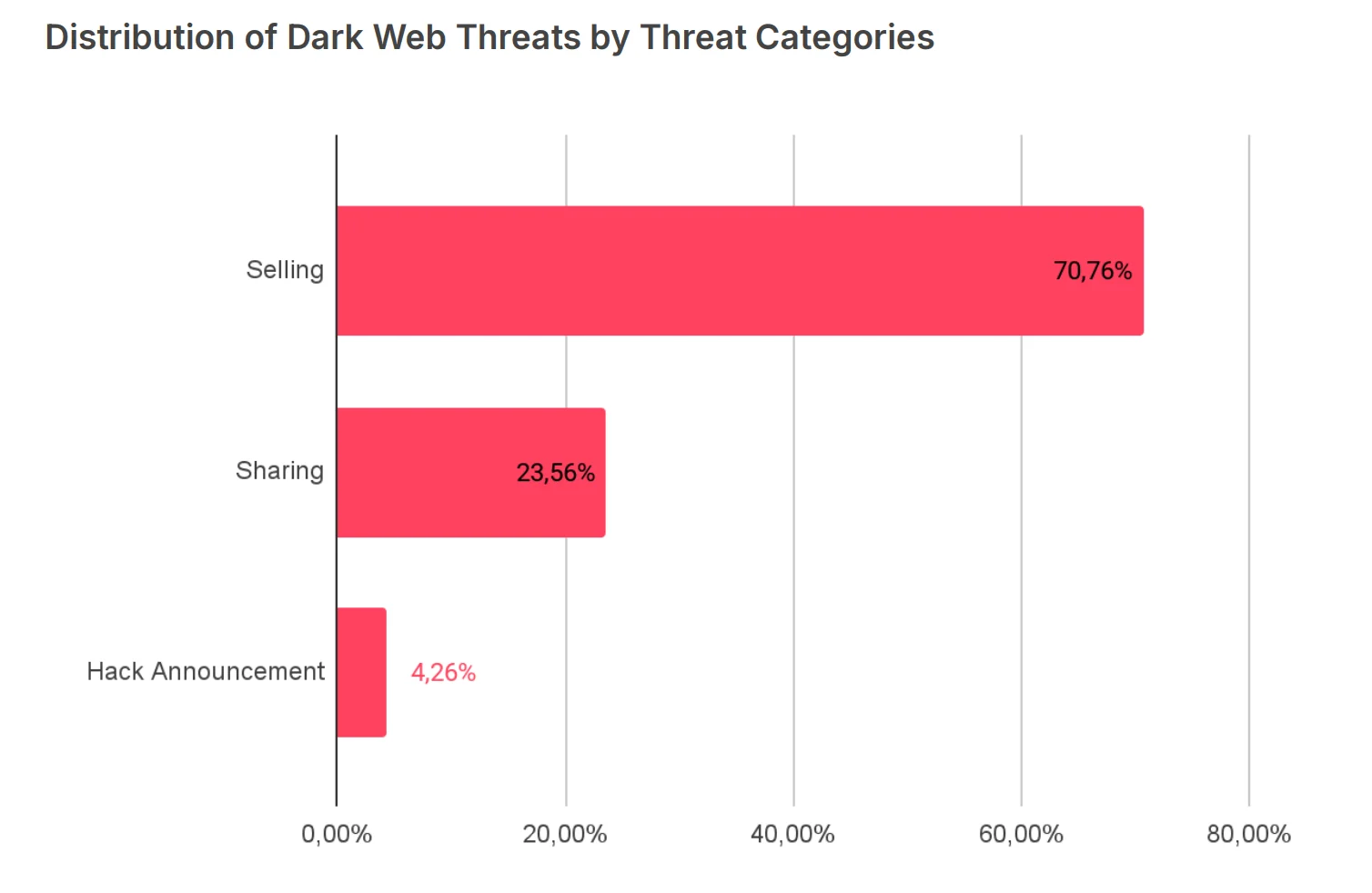
Distribution of Dark Web post types targeting the U.S. (SOCRadar’s 2026 U.S. Threat Landscape Report)
These figures illustrate a structured criminal supply chain. Breaches generate data. Initial access brokers package credentials and remote access. Ransomware affiliates purchase those footholds.
Multiple ransomware groups compete for U.S. targets rather than one dominant cartel controlling the space. It is a signal that the market is large enough to sustain broad participation.
Breach Costs Confirm the Financial Gravity
IBM reports that the United States has the highest average breach cost globally, $10.22 million per incident, while the global average is $4.44 million.
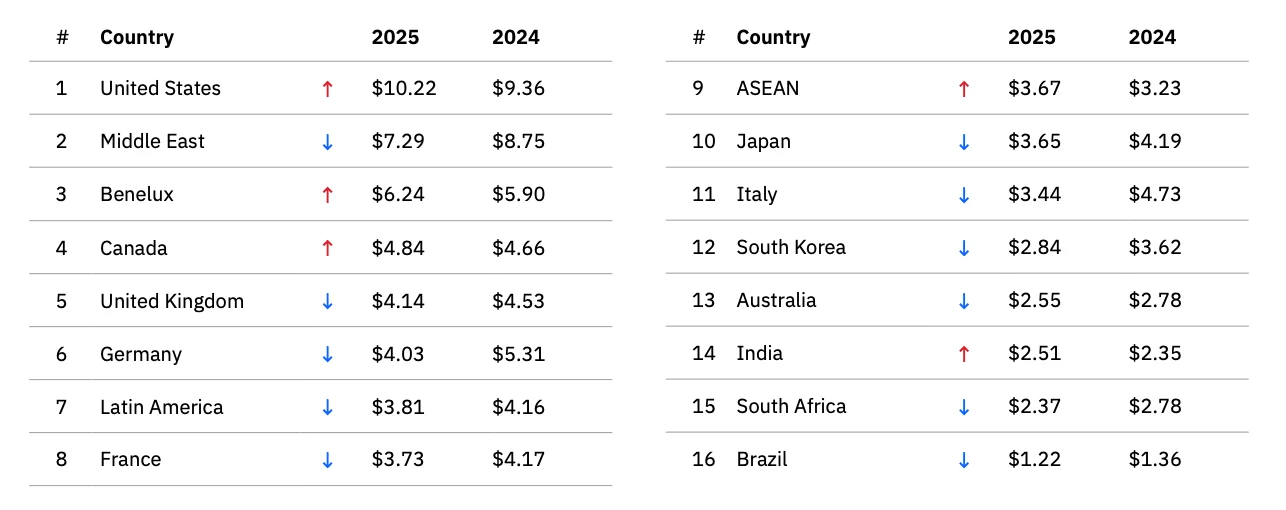
Average data breach costs in USD millions (IBM Cost of a Data Breach Report 2025)
High-value intellectual property, extensive customer databases, digitally dependent operations, and greater ransom payment likelihood increase return on investment for adversaries.
The economic density of the U.S. digital ecosystem amplifies both:
- The likelihood of targeting
- The financial impact when a breach succeeds
In other words, the attack surface is large not just because of infrastructure volume, but because of economic gravity.
Gaining Control of a Growing Attack Surface
The most critical danger in a large attack surface is not exposure alone; it is unawareness. Many organizations cannot confidently answer questions such as:
- How many internet-facing assets do we truly own?
- Which subsidiaries or brands expose unmanaged infrastructure?
- Where are forgotten subdomains or legacy services still accessible?
- Are credentials already circulating in underground markets?
Security teams often monitor internal systems effectively while lacking visibility into the external footprint adversaries see. In a distributed cloud and SaaS ecosystem, what attackers can enumerate often exceeds what organizations actively track.
Close the External Visibility Gap with SOCRadar’s ASM
As U.S. organizations expand their digital ecosystems, visibility must expand with them.
SOCRadar provides a unified external threat intelligence approach designed to help organizations understand and reduce exposure across their entire digital footprint. Through its integrated modules, security teams can:
- Attack Surface Management (ASM): Discover exposed digital assets across domains and IP ranges, identify shadow IT, and detect misconfigurations across internet-facing infrastructure to prevent exposure.
- Dark Web Monitoring: Track credential leaks, access sales, and underground discussions related to the organization.
- Supply Chain Intelligence: Identify third-party exposure risks that may introduce indirect attack vectors.
- Brand Protection: Detect phishing domains, impersonation attempts, and brand abuse targeting customers and partners.
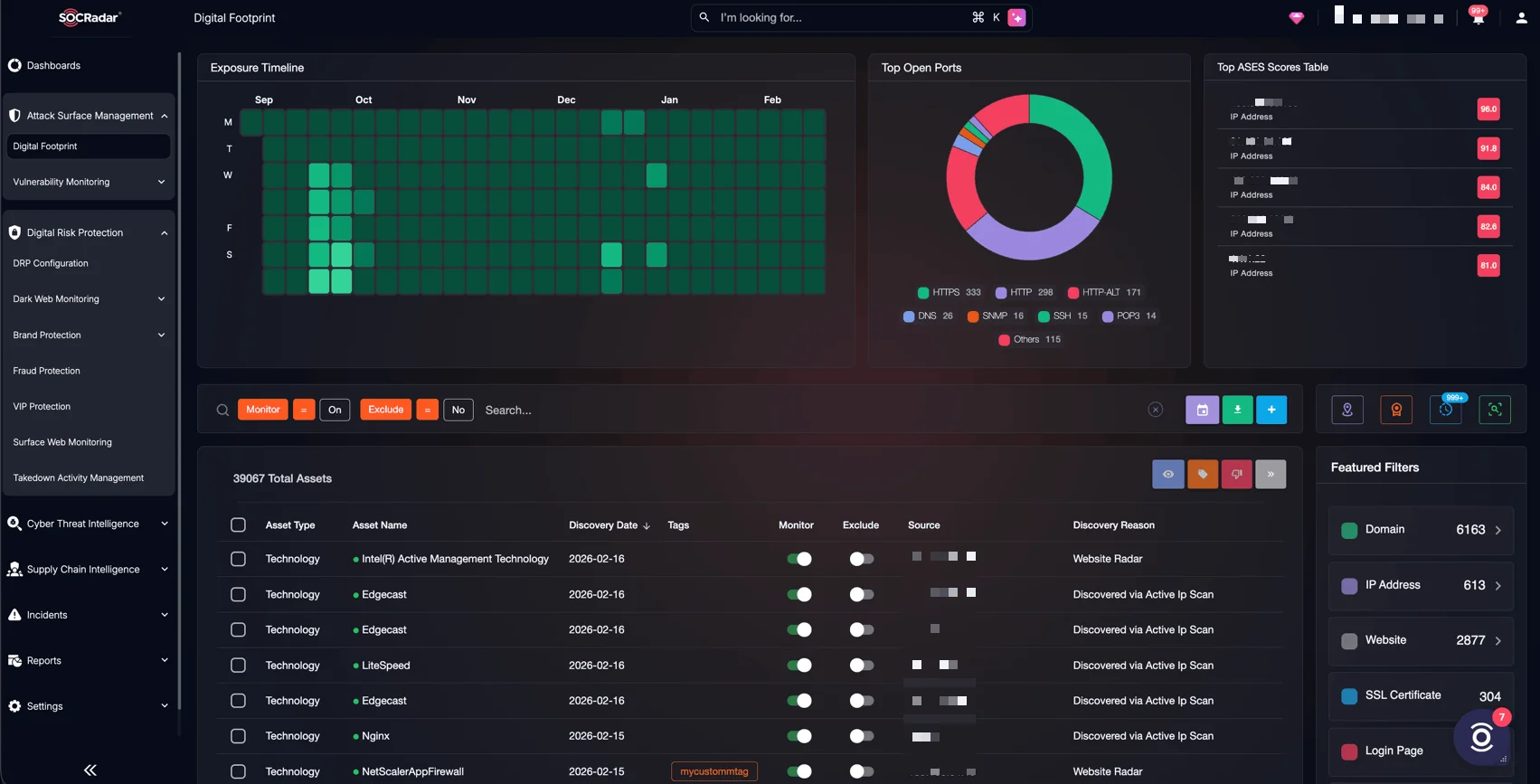
SOCRadar’s ASM, Digital Footprint
In an environment where exposure extends beyond traditional boundaries, integrated visibility across assets, identities, vendors, and underground markets is essential to reducing unknown risk.
Conclusion: Digital Dominance Comes With Exposure
Across ransomware targeting data, breach cost analysis, SaaS deployment statistics, and underground market activity, the conclusion is consistent: the United States maintains one of the largest attack surfaces globally because it operates one of the most expansive and digitally advanced economies in the world.
Half of global ransomware activity concentrates on U.S. organizations. Breach costs are the highest globally. Dark web marketplaces actively monetize American data and access. Cloud and SaaS adoption continue to accelerate.
Digital dominance drives growth, innovation, and efficiency; but it also increases exposure. For security leaders, the priority is no longer just strengthening internal defenses. It is achieving continuous, external visibility into the evolving digital footprint.
In a threat landscape where monetization is industrialized and credentials remain the primary entry vector, organizations that understand and actively manage their attack surface will be better positioned to withstand the pressure.