

| Category | ASM | EASM | CAASM |
| Scope | Full attack surface, including internal, external, and third-party exposure | External and internet-facing assets only | Internal assets, identities, services, and relationships |
| Focus | Continuous discovery, prioritization, and risk reduction across environments | External exposure monitoring and attacker-visible assets | Internal visibility, asset relationships, and inventory unification |
| Best For | Holistic security and exposure management programs | SOC teams, red teams, and external reconnaissance use cases | IT and security teams managing internal assets and dependencies |
| Includes | Cloud, SaaS, on-prem, identities, third-party, shadow IT | Domains, IPs, cloud services, certificates, public assets | Devices, users, applications, services |
Jun 24, 2026
14 Mins Read

Summarize with:
What Is Attack Surface Management (ASM)?
Attack Surface Management (ASM) is the continuous discovery, monitoring, and prioritization of an organization’s exposed digital assets, including cloud infrastructure, SaaS applications, internet-facing systems, identities, and third-party integrations. The goal is to identify and reduce vulnerabilities before attackers can exploit them.
Modern environments change faster than traditional security processes can track. New cloud resources are deployed in minutes, SaaS tools are adopted without security review, and old assets are often left online long after teams stop using them. Each change expands the attack surface, sometimes without anyone noticing. Attack Surface Management (ASM) helps security teams maintain visibility into that change and focus on the exposures that matter most.
Understanding the Attack Surface First
An attack surface is the sum of all the possible entry points an attacker could use to access an organization’s systems, applications, identities, or data. In practice, it includes any internet-facing asset, connection, credential, integration, or workflow that could be misused during an attack.
That surface is much larger than it used to be. A few years ago, many organizations could think in terms of a fixed perimeter. Today, the digital footprint is distributed across cloud platforms, remote endpoints, SaaS tools, APIs, subsidiaries, contractors, and third-party providers. Shadow IT and orphaned IT make the problem even harder. A forgotten subdomain, an expired certificate, an exposed storage bucket, or an untracked development environment can all become part of the attack surface.
This is why the attack surface is not static. It changes whenever a team launches a new service, registers a domain, adds a vendor integration, exposes a port, changes a DNS record, or stores sensitive data in the wrong place. Attackers do not care whether an asset is officially managed or not. If they can discover it and reach it, it becomes relevant.
Defining Attack Surface Management Clearly
Attack Surface Management (ASM) is the practice of continuously discovering, inventorying, analyzing, prioritizing, and monitoring the exposures that make up an organization’s attack surface. Unlike a one-time assessment, ASM is ongoing. It is designed to reflect the reality that exposed assets and vulnerabilities change constantly.
A useful way to think about Attack Surface Management (ASM) is that it answers three critical questions:
- What assets exist right now?
- Which of those assets are exposed, misconfigured, or risky?
- Which exposures should be addressed first?
Forrester defines ASM as the continuous discovery, identification, inventorying, and assessment of an organization’s IT asset estate. In practical terms, that means it helps teams find what they own, what they forgot, what attackers can see, and what needs remediation first.
It is also valuable because it approaches the environment from the attacker’s perspective. Security teams, ethical hackers, and red teaming exercises often reveal the same lesson: attackers exploit what is visible, reachable, and neglected. This helps organizations identify blind spots before someone else does.
Why Attack Surface Management Matters Now
Attack Surface Management (ASM) has become more important because most organizations no longer operate in a stable, easily mapped environment. Assets move across cloud providers. Departments adopt new services independently. Identities proliferate. Integrations expand. Third-party exposure grows. In many cases, security teams are expected to protect environments that change daily.
This is where it becomes operationally important. You cannot secure what you do not know exists. If a forgotten subdomain, exposed development server, leaked credential, or misconfigured SaaS integration is missing from inventory, it is missing from security controls too.
It also supports broader exposure management goals by helping organizations:
- Identify exposures before attackers do
- Prioritize remediation based on real risk
- Align security, IT, DevOps, and leadership around shared priorities
- Maintain a more consistent view of compliance and security posture
This compliance angle matters too. NIST emphasizes asset visibility and risk-based security controls, which ASM strengthens through continuous asset discovery and exposure tracking. GDPR requires organizations to protect personal data and reduce unnecessary exposure, which makes visibility into internet-facing assets especially important. ISO 27001 depends on maintaining an accurate understanding of assets, ownership, and risk treatment, and ASM helps support that operationally.
It also feeds into newer exposure-focused models such as Continuous Threat Exposure Management (CTEM) by providing the discovery and prioritization layer those programs depend on.
Types of Attack Surfaces
Attack surfaces usually fall into three broad categories. Understanding each one matters because they involve different risks and mitigation strategies.
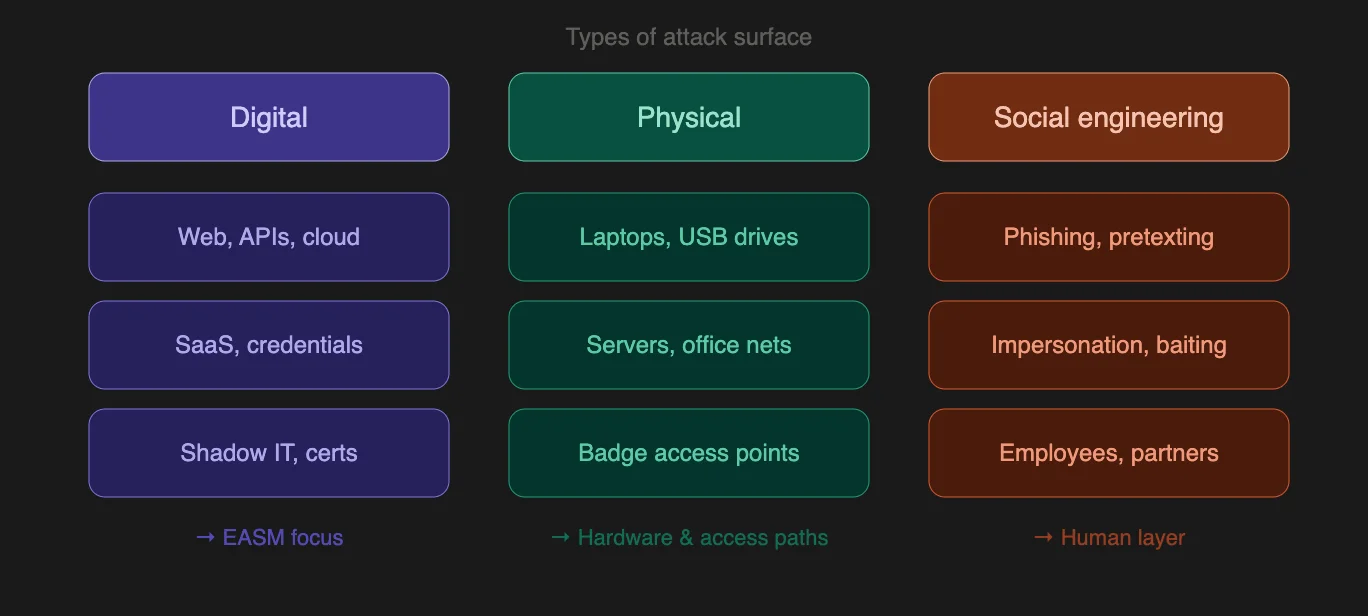
Types of Attack Surfaces
Digital Attack Surface
The digital attack surface includes internet-facing and digitally accessible assets such as websites, web applications, APIs, cloud storage, cloud workloads, exposed admin panels, SaaS applications, digital credentials, certificates, domains, subdomains, and third-party integrations. This is the area most often associated with External Attack Surface Management (EASM).
Digital exposures often come from misconfigurations, missing patches, exposed services, weak authentication, poor asset ownership, and shadow IT. Because this part of the attack surface changes quickly, it depends heavily on continuous monitoring and asset discovery.
Physical Attack Surface
The physical attack surface includes laptops, mobile devices, USB drives, servers, office networks, badge access points, and any hardware or physical access path that could be used to compromise systems or data. A stolen laptop with cached credentials or an exposed network port can create serious risk even when digital controls look strong.
Social Engineering Attack Surface
The social engineering attack surface is the human side of exposure. It includes phishing, pretexting, baiting, impersonation, and other manipulative tactics used to extract credentials or gain access. Employees, partners, contractors, and even customers can all become entry points when attackers use deception instead of direct exploitation.
How Attack Surface Management Works
Attack Surface Management (ASM) works as a continuous workflow rather than a periodic project. While platforms differ, the core process usually includes five functions.
1. Discovery
Discovery is the foundation of Attack Surface Management (ASM). The goal is to identify all assets that make up the attack surface, including known assets, unknown assets, third-party exposure, subsidiary assets, and even rogue or malicious assets impersonating the organization.
This can include websites, domains, IP ranges, exposed services, cloud assets, certificates, SaaS platforms, leaked credentials, and internet-facing infrastructure. Good discovery does not stop at the official asset list. It also looks for shadow IT, orphaned IT, typosquatted domains, fake social accounts, and unmanaged services attackers are likely to find first.
Subsidiary assets deserve special attention as well. After mergers, acquisitions, or regional expansions, organizations often inherit external assets that were never fully integrated into the parent company’s security workflows. Those assets can remain exposed long after the deal closes.
2. Classification and Analysis
After discovery, assets need to be organized and analyzed. Classification helps teams understand ownership, business criticality, exposure level, technical type, and compliance relevance. Analysis then examines those assets for issues such as missing patches, expired certificates, open ports, coding errors, exposed services, weak configurations, and risky external dependencies.
This stage is where raw visibility becomes useful context. A public-facing staging server and a production authentication system are not equal in importance. It helps teams see those differences clearly.
3. Prioritization
Not all findings deserve the same urgency. Prioritization is what makes this process actionable rather than overwhelming. Teams need to rank exposures based on exploitability, asset value, threat intelligence, business criticality, internet exposure, and potential impact.
This is where exposure management becomes more mature. A critical vulnerability on an internal low-value system may matter less than a medium-severity issue on a heavily exposed internet-facing asset tied to customer data. Dark web monitoring, exploit activity, and known attacker interest can all help refine that prioritization.
4. Remediation
Once risks are prioritized, organizations need to reduce exposure. Remediation can include applying patches, fixing misconfigurations, retiring orphaned assets, closing open ports, enforcing MFA, removing shadow IT, correcting access controls, updating DNS or certificates, and limiting unnecessary services.
It does not replace remediation workflows, but it improves them by making sure teams are fixing the right problems first.
5. Continuous Monitoring
The final stage is continuous monitoring. This is what separates it from one-off reviews. New assets appear constantly. Existing assets change. New vulnerabilities are disclosed every day. Threat actors continuously scan for weaknesses.
Continuous monitoring helps security teams detect those changes in real time and respond before they become incidents. It also supports long-term exposure management by keeping the inventory current rather than stale.
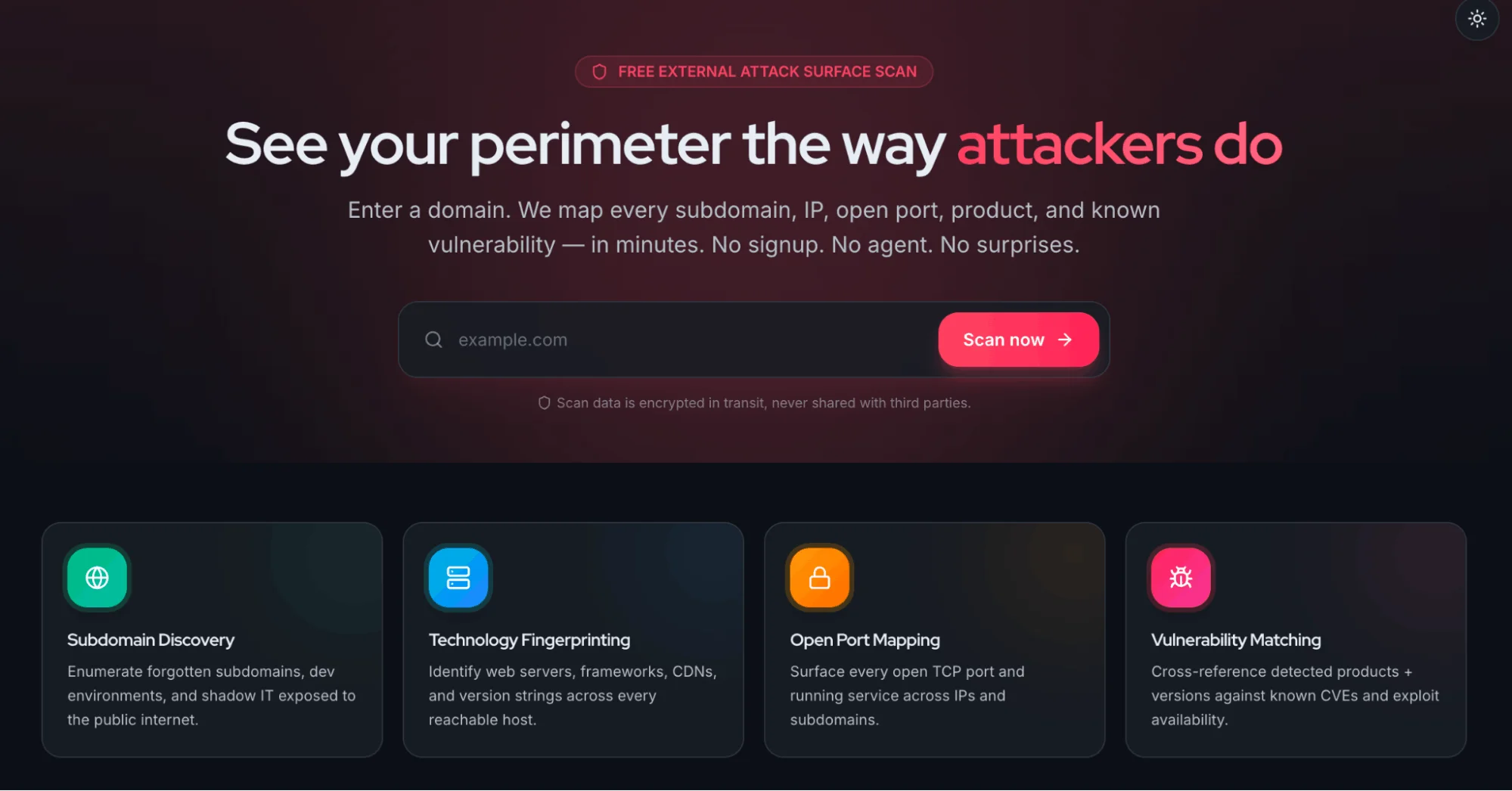
Check your organization’s external attack surface for free with SOCRadar’s External Attack Surface Scan.
ASM vs. EASM vs. CAASM
Attack Surface Management (ASM) is often discussed alongside EASM and CAASM, but they are not identical. Each serves a different scope.
EASM is especially useful when the priority is discovering what attackers can see from the outside. CAASM is useful when the priority is internal visibility and correlation across environments. ASM is broader and can connect both views into a more complete program.
This also ties into CTEM. Continuous Threat Exposure Management is a broader operating model focused on identifying, validating, prioritizing, and reducing exposures continuously. It plays a foundational role by supplying asset discovery and risk context.
Attack Surface Management for SOC Teams
SOC analysts benefit from Attack Surface Management (ASM) in practical ways that go beyond inventory. Security operations teams often struggle with context. An alert fires on an IP, domain, or hostname, but analysts do not immediately know whether the asset is external, business-critical, unknown, or already linked to other findings.
It helps by enriching alerts with external context. It allows SOC analysts to see whether an affected asset is internet-facing, whether it belongs to a trusted subsidiary, whether it has open ports, expired certificates, exposed services, or known weaknesses. That reduces time spent on basic triage.
It also supports threat intelligence workflows. When external asset data is correlated with threat intelligence, leaked credentials, or dark web monitoring, SOC teams get stronger prioritization. Instead of reacting to alerts in isolation, they can evaluate whether an exposed asset is also tied to active threat actor interest or current exploit activity.
This can reduce alert fatigue as well. Better prioritization means fewer low-context alerts and faster focus on the findings that matter most. SOCRadar’s External Attack Surface tool gives security teams a free, immediate view of exposed assets at their organization’s domain, including open ports, vulnerable services, certificate issues, and exposed subdomains. Use the free attack surface scan to understand what attackers can already see.
Key Challenges of Attack Surface Management
Despite its value, Attack Surface Management (ASM) is difficult to implement well. One challenge is distributed infrastructure. There is no longer a single perimeter to monitor. Assets live across cloud platforms, business units, third parties, and remote endpoints.
Another challenge is ownership. Assets often fall between security, IT, DevOps, marketing, subsidiaries, and vendors. When ownership is unclear, remediation slows down.
Shadow IT and orphaned IT are a challenge in their own right. These assets often sit outside formal processes, outside documented inventories, and sometimes outside security ownership entirely. That makes them especially difficult to track and especially attractive to attackers.
Continuous change is another major problem. Environments do not stand still long enough for manual inventory processes to keep up. Third-party and supply chain risk adds yet another layer, since organizations often depend on systems they do not fully control.
It only works well when visibility, prioritization, and accountability come together. Without that, teams may have more findings but not more control.
Attack Surface Management vs. Vulnerability Management
Attack Surface Management (ASM) and vulnerability management are related, but they solve different problems. Vulnerability management focuses on identifying and fixing weaknesses in assets you already know about. It assumes an inventory exists.
Attack Surface Management (ASM) starts earlier. It discovers assets first, including unknown and unmanaged ones, then evaluates their exposure and risk. In simple terms, vulnerability management asks, “What is wrong with the systems we track?” ASM asks, “What do we actually have, and which parts of it are exposed?”
A mature program usually needs both. One broadens visibility. The other deepens remediation.
Real-World Examples of Attack Surface Management
A practical way to understand Attack Surface Management (ASM) is through real-world scenarios.
Misconfigured Cloud Storage Bucket
A team may finish a project and leave a cloud storage bucket publicly accessible without realizing it. ASM can discover that exposure quickly and allow remediation before the data becomes part of a breach.
Takeaway: Continuous discovery helps reduce the chance that a simple cloud misconfiguration turns into a public incident.
Orphaned Subdomain Takeover
A company may stop using an old campaign domain or cloud service, but the DNS record remains active. An attacker can take over that abandoned resource and use it for phishing or malicious content. Continuous monitoring helps identify that risk before it damages the organization.
Takeaway: Orphaned assets are easy to forget, but they are also easy for attackers to find.
Zero-Day Prioritization Under Time Pressure
When a high-impact vulnerability is disclosed, Attack Surface Management (ASM) can help teams identify which exposed assets are affected first, then prioritize patching based on business criticality and internet exposure. That is far more useful than working from an outdated spreadsheet or a partial asset list.
Takeaway: Exposure context matters just as much as vulnerability severity when time is limited.
How to Reduce Your Attack Surface
Reducing exposure is an ongoing process. Attack Surface Management (ASM) supports that effort, but organizations still need practical controls.
Start by eliminating unnecessary services, unused domains, and orphaned assets. Enforce least-privilege access and MFA, especially on internet-facing systems and administrative workflows. Harden configurations, disable default credentials, and segment networks where possible. Conduct regular penetration testing and red teaming to validate whether identified exposures can actually be exploited.
It is also important to monitor for external signals. Threat intelligence and dark web monitoring can reveal leaked credentials, brand impersonation, phishing assets, or exposed data before attackers fully operationalize them. This is where exposure management becomes more proactive rather than purely reactive.
Frequently Asked Questions
What is attack surface management in cybersecurity?
Attack surface management in cybersecurity is the continuous process of discovering, monitoring, and prioritizing exposed assets so organizations can identify and reduce vulnerabilities before attackers exploit them. It covers cloud assets, SaaS, internet-facing services, identities, and third-party exposure.
What is the difference between ASM and EASM?
ASM covers the broader attack surface, including internal, external, and third-party exposure. EASM focuses only on attacker-visible internet-facing assets such as domains, IPs, certificates, and cloud services.
What is the difference between ASM and CAASM?
CAASM focuses on internal asset visibility and relationships across identities, devices, services, and applications. ASM is broader because it also addresses external exposure and attacker-visible risk.
Why is attack surface management important?
Attack surface management is important because environments change constantly. New cloud resources, SaaS tools, identities, and integrations appear every day. Without continuous visibility, organizations develop blind spots that attackers can find first.
What are examples of attack surface management?
Examples include finding a misconfigured public cloud bucket, detecting an orphaned subdomain, identifying leaked employee credentials through dark web monitoring, or spotting an exposed service before a threat actor exploits it.
How does ASM differ from traditional vulnerability management?
Traditional vulnerability management assumes you already know what assets you own. Attack Surface Management (ASM) first discovers unknown and unmanaged assets, then assesses their exposure and risk continuously.
Strengthen Visibility Across Your Exposure
SOCRadar Attack Surface Management helps organizations see what attackers see, reduce blind spots, and prioritize the exposures that matter most. For security teams, it is no longer enough to scan known assets occasionally. Modern environments require continuous discovery, risk prioritization, and monitoring across the full digital footprint.
With SOCRadar, organizations can connect Attack Surface Management (ASM) with threat intelligence, dark web monitoring, and broader exposure workflows to move from fragmented visibility to more practical, continuous exposure management.
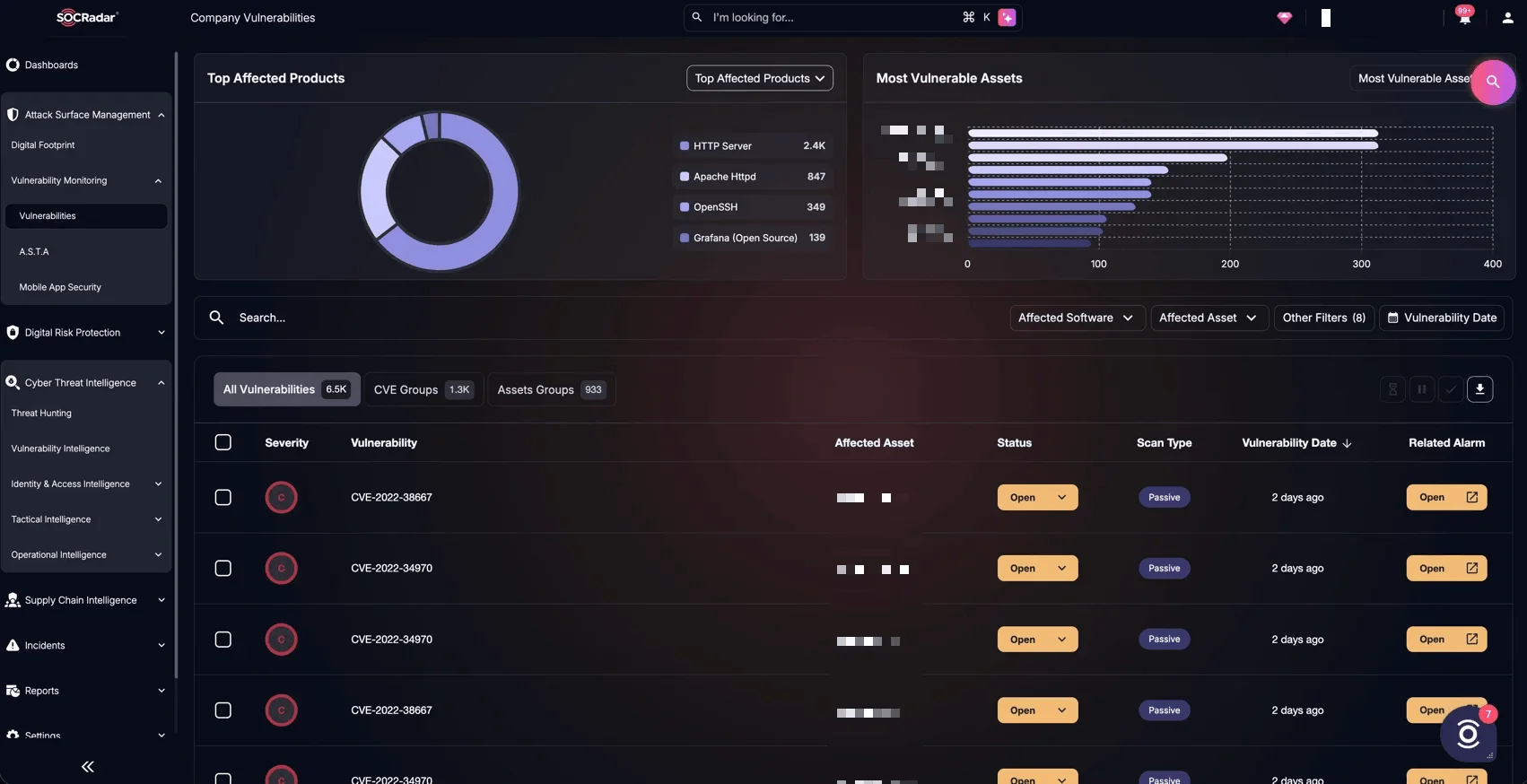
SOCRadar ASM Company Vulnerabilities module
Explore SOCRadar External Attack Surface Management, SOCRadar Dark Web Monitoring, SOCRadar Threat Intelligence, and the free attack surface scan to strengthen visibility across your environment.

Table Of Content
What Is Attack Surface Management (ASM)?
Understanding the Attack Surface First
Defining Attack Surface Management Clearly
Why Attack Surface Management Matters Now
Types of Attack Surfaces
How Attack Surface Management Works
ASM vs. EASM vs. CAASM
Attack Surface Management for SOC Teams
Key Challenges of Attack Surface Management
Attack Surface Management vs. Vulnerability Management
Real-World Examples of Attack Surface Management
How to Reduce Your Attack Surface
Frequently Asked Questions
Strengthen Visibility Across Your Exposure
Related Articles



AI Across the Attack Chain From Recon to Execution
Apr 15, 2026

How to Make a Digital Asset Inventory?
Feb 25, 2026