Get Your Free Report
Start for Free
SOCRadar® Cyber Intelligence Inc. | External Attack Surface Management (EASM)
May 14, 2026
7 Mins Read
May 15, 2026

What is External Attack Surface Management (EASM)?

External Attack Surface Management (EASM) is the process of continuously discovering, monitoring, and reducing the digital assets an organization exposes to the internet. These assets include domains, subdomains, IP ranges, cloud services, APIs, and third-party connections — many of which security teams may not even know exist. EASM gives organizations the attacker’s view of their own infrastructure so they can find and fix vulnerabilities before someone else does.

How Does External Attack Surface Management Work?

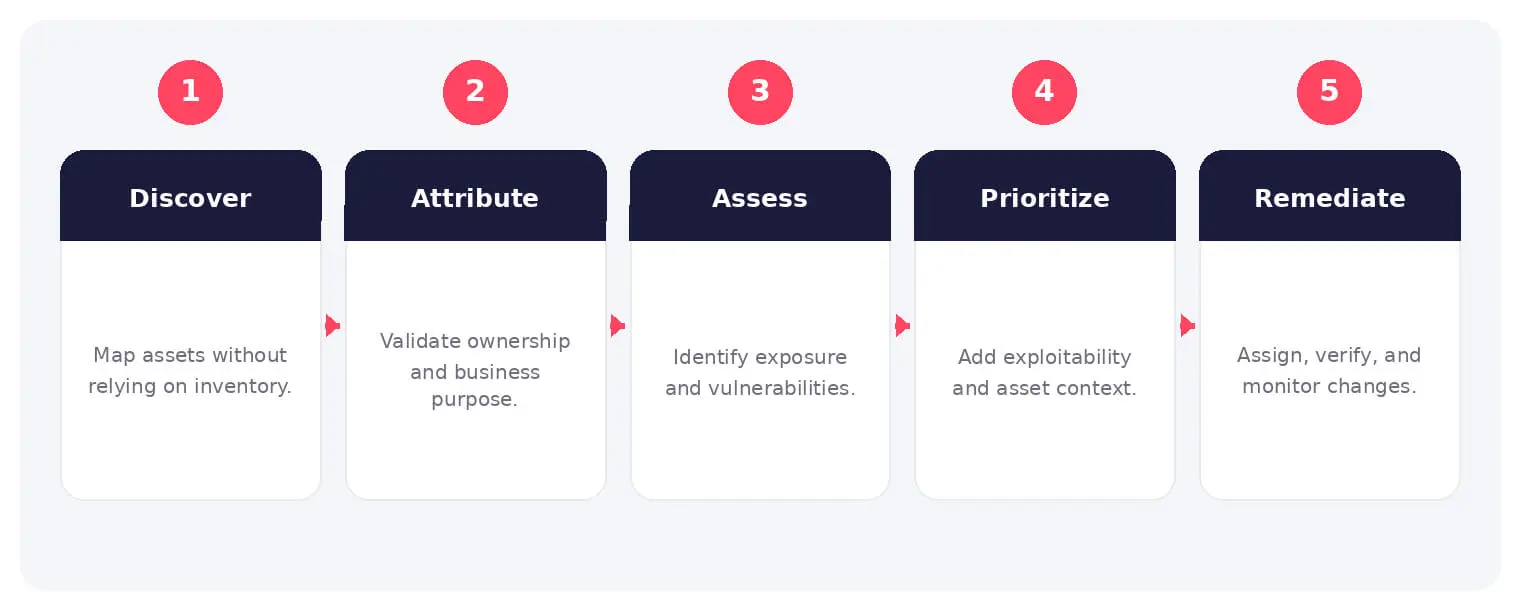
EASM follows a continuous cycle rather than a point-in-time assessment.

Infographic: How Does External Attack Surface Management Work

Discovery: Automated tools scan the internet to map everything associated with an organization — registered domains, cloud assets, exposed services, certificates, and more. This includes assets that were never formally inventoried, such as forgotten development servers or shadow IT.

Inventory and Classification: Discovered assets are catalogued and classified by type, ownership, and risk level. This creates a living inventory that updates as the organization’s digital footprint changes.

Risk Assessment: Each asset is evaluated for vulnerabilities, misconfigurations, and exposure. Common scoring frameworks like CVSS (Common Vulnerability Scoring System) and EPSS (Exploit Prediction Scoring System) help prioritize which issues need attention first.

Remediation and Monitoring: Security teams act on the highest-priority findings, while continuous monitoring watches for new assets or changes that introduce fresh risk.

Why is EASM Important?

Organizations today have far more internet-facing assets than most security teams realize. Cloud adoption, mergers and acquisitions, remote work infrastructure, and third-party integrations all expand the attack surface — often faster than security controls can keep up.

Attackers do not wait for quarterly audits. They continuously scan for exposed assets, unpatched systems, and misconfigured cloud storage. EASM matches that continuous cadence and gives defenders the same real-time visibility that attackers already have.

Benefits of EASM

  • Complete asset visibility:

Discovers assets security teams did not know existed, including shadow IT and forgotten infrastructure.

  • Faster vulnerability prioritization:

Combines asset context with vulnerability data to focus effort where it matters most.

  • Reduced exposure window:

Continuous monitoring shortens the time between a new exposure appearing and security teams acting on it.

  • Support for compliance:

Helps demonstrate to auditors that the organization actively monitors its external exposure.

  • Third-party risk insight:

Flags risks introduced by vendors and partners connected to your environment.

Internal vs. External Attack Surface Management

Internal ASM External ASM (EASM)
Scope Assets inside the network perimeter Internet-facing assets visible from outside
Perspective Inside-out Outside-in (attacker’s view)
Key focus Lateral movement risk, internal misconfigs Exposed services, leaked credentials, rogue assets
Discovery method Agent-based, network scanning Passive internet scanning, DNS enumeration

Most mature security programs need both. EASM handles what the outside world can see; internal ASM handles what an attacker can reach after they get in.

Main Challenges Around External Attack Surface Management

Asset sprawl:

Large organizations accumulate assets across dozens of cloud providers, regions, and subsidiaries. Keeping the inventory accurate is an ongoing challenge.

Shadow IT:

Development teams and business units frequently spin up cloud resources without involving security. EASM must catch these assets the same way an attacker would.

False positives:

Not every exposed asset is a real risk. Poor signal-to-noise ratio wastes analyst time and erodes trust in the tool.

Third-party coverage:

Your attack surface does not end at your own assets. Vendors and partners can introduce risk that is difficult to monitor.

Here are the two sections revised without long dashes:

Examples of an External Attack Surface

An organization’s external attack surface is larger than most security teams expect. Any internet-facing asset, whether actively maintained or long forgotten, is a potential entry point for attackers.

  • Public-facing web applications and APIs are the most targeted assets. Unpatched frameworks, broken authentication, and insecure API endpoints give attackers direct access to backend systems and sensitive data.
  • Subdomains hosting development or staging environments are frequently overlooked because they fall outside the scope of production security reviews. They often run older software versions and looser access controls, making them easy targets for reconnaissance and initial access.
  • Cloud storage buckets (S3, Azure Blob) with misconfigured permissions are among the most common causes of data exposure. A single misconfigured bucket set to public read can leak customer records, internal documents, or credentials.
  • Expired or misconfigured SSL certificates signal poor hygiene to attackers and can open the door to man-in-the-middle attacks or enable phishing campaigns that impersonate legitimate company domains.
  • Exposed remote desktop or VPN endpoints became widespread during the shift to remote work and remain a persistent risk. Brute-force attacks and credential stuffing against RDP and VPN login pages are routine in the threat landscape.
  • Open ports running unpatched services represent vulnerabilities that are trivial to discover with automated scanning tools. Attackers routinely sweep IP ranges looking for known CVEs on services like SSH, FTP, or database ports left exposed to the internet.
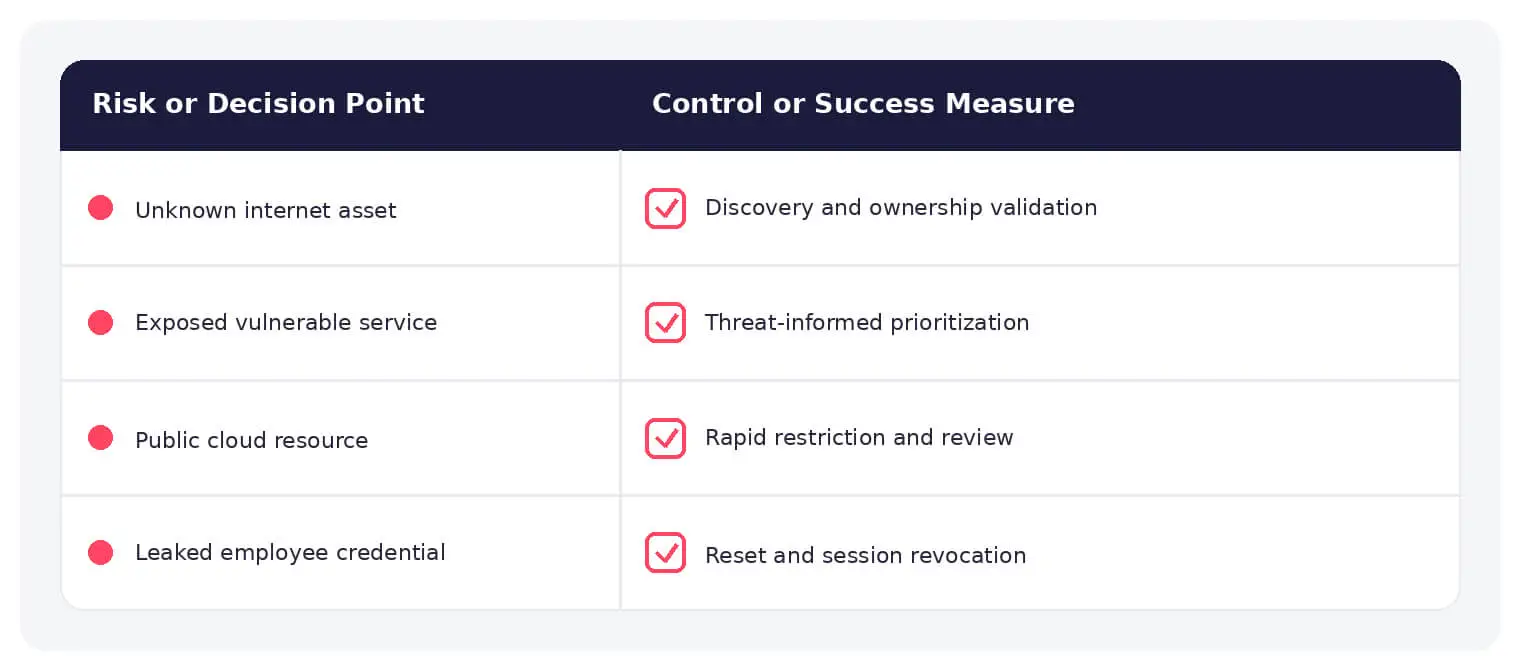
  • Leaked credentials appearing in paste sites or Dark Web Forums extend the attack surface beyond infrastructure. A single set of employee credentials from a third-party breach can be enough to compromise internal systems through credential reuse.

Key Features to Look for in an EASM Solution

Not all EASM tools are built the same. The following capabilities separate solutions that provide genuine security value from those that offer inventory without insight.

  • Continuous and automated asset discovery ensures the solution keeps pace with how quickly modern attack surfaces change. Point-in-time scans miss assets that appear between assessment cycles, so automation running around the clock is a baseline requirement.
  • Integration with vulnerability databases and threat intelligence feeds connects discovered assets to known exploit data. Without this, an inventory is just a list; with it, the platform can flag which exposed services are actively being targeted in the wild.
  • CVSS and EPSS scoring for prioritization helps security teams focus on what matters most. CVSS measures severity while EPSS predicts the probability of exploitation, and using both together produces a more actionable risk ranking than severity alone.
  • Dark Web and leaked credential monitoring catches exposure that lives outside your own infrastructure. If employee or customer credentials surface in a breach dump or paste site, the platform should surface that finding alongside technical vulnerabilities.
  • Third-party and supply chain visibility accounts for the risk introduced by vendors, partners, and SaaS tools. Attackers increasingly target the supply chain as a route into otherwise well-defended organizations.
  • Clear remediation workflows and reporting turns findings into action. A solution that surfaces risk without providing ownership assignment, ticket integration, or progress tracking creates alert fatigue rather than reducing it.
  • API access for integration with existing security tooling allows EASM findings to feed into SIEMs, SOARs, and ticketing systems. Standalone tools that cannot connect to the broader security stack tend to get deprioritized over time.

Comparing EASM with Other Solutions

Solution Primary Focus Key Difference from EASM
Vulnerability Management Known assets, internal scanning Requires you to already know the asset exists
Penetration Testing Point-in-time manual assessment Not continuous; misses assets added between tests
Threat Intelligence Threat actor tracking, IOCs Broader scope, not asset-specific
EASM External assets, attacker’s perspective Continuous, outside-in, discovers unknown assets

Frequently Asked Questions

Why does having an EASM capability improve your cybersecurity strategy?

Because you cannot protect what you do not know exists. EASM fills the gap between what your team thinks is exposed and what attackers can actually see and target.

What is CVSS and how is it used?

CVSS (Common Vulnerability Scoring System) is a standardized framework that scores vulnerabilities on a scale from 0 to 10 based on factors like exploitability and impact. EASM tools use CVSS scores to help teams prioritize which vulnerabilities to fix first.

What is EPSS and how is it used?

EPSS (Exploit Prediction Scoring System) estimates the probability that a given vulnerability will be exploited in the wild within the next 30 days. Combined with CVSS, it gives a more realistic picture of actual risk rather than theoretical severity alone.