CVE-2025-53786: CISA Issues Emergency Directive for Critical Microsoft Exchange Hybrid Vulnerability
On August 7, 2025, the U.S. Cybersecurity and Infrastructure Security Agency (CISA) issued an Emergency Directive in response to a newly disclosed Microsoft Exchange Server vulnerability.
The flaw, tracked as CVE-2025-53786, affects hybrid Exchange deployments and carries a high risk of privilege escalation from on-premises environments into connected cloud services.
While no active exploitation has been observed yet, both Microsoft and CISA warn that failure to act promptly could leave organizations exposed to complete compromise of their hybrid email infrastructure.
What Is CVE-2025-53786?
CVE-2025-53786 (CVSS 8.0) is an Elevation of Privilege vulnerability in hybrid Microsoft Exchange Server configurations, where on-premises Exchange instances are integrated with Exchange Online. In these setups, the on-premises and cloud environments share the same service principal.
If an attacker gains administrative access to an affected on-premises Exchange server, they could potentially escalate privileges into the connected Microsoft 365 cloud environment, without generating obvious logs or alerts.
The vulnerability’s attack complexity is stated as high in the Microsoft advisory, which means exploitation requires prior admin-level compromise, but the payoff for attackers is significant: potential full control over the organization’s Exchange Online environment.
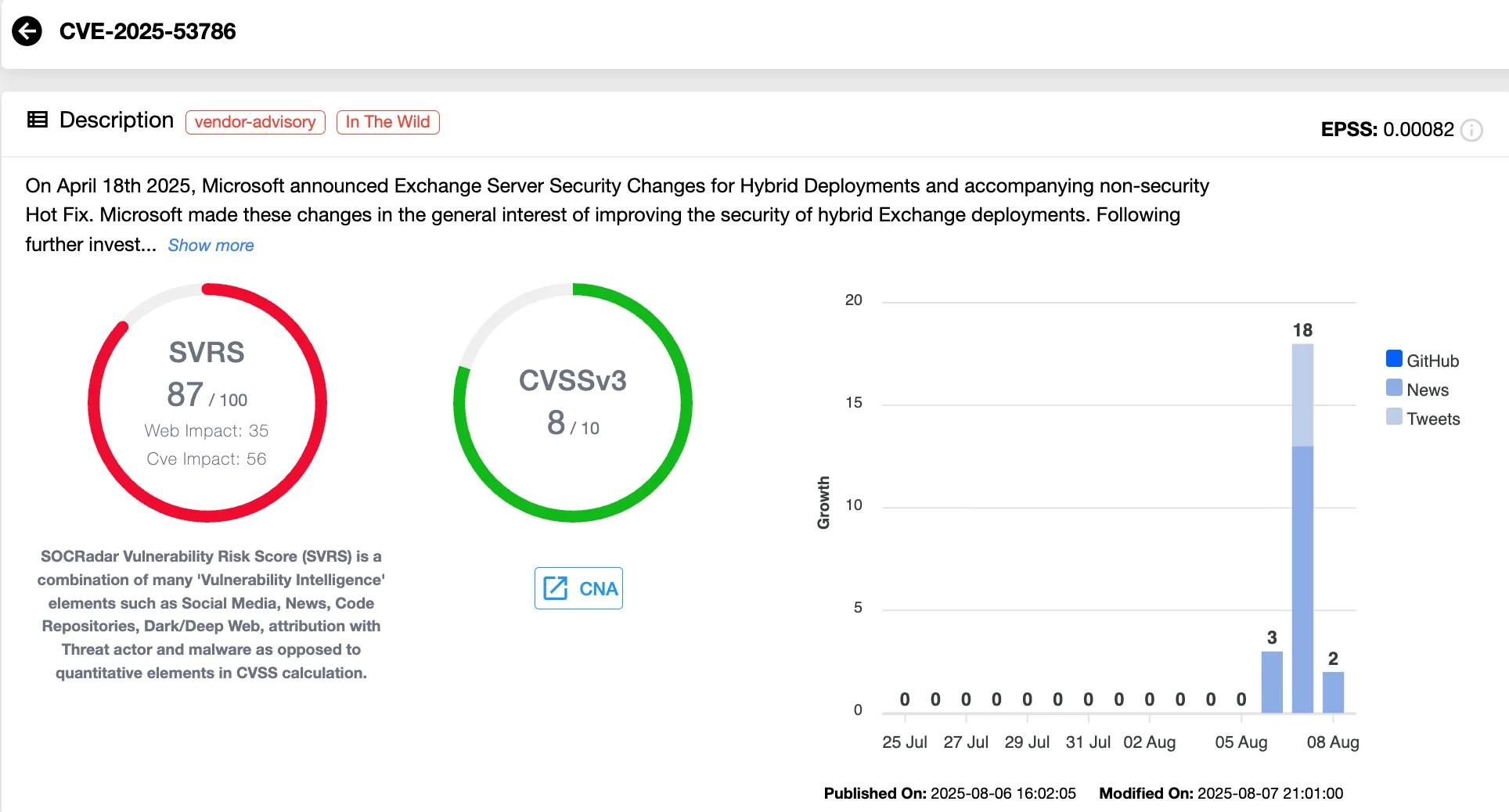
CVE-2025-53786 (SOCRadar Vulnerability Intelligence)
Microsoft identified the issue while reviewing security changes made in April 2025 for hybrid deployments, which were originally intended to improve overall protection. The company has since confirmed that following the April 18 security guidance, and applying the related Hot Fix, is necessary to mitigate the risk.
Who Is Affected?
The affected products are Microsoft Exchange Server 2019, Exchange Server 2016, and Exchange Server Subscription Edition. Your organization may be at risk if it:
- Runs Microsoft Exchange in a hybrid deployment with Exchange Online.
- Has ever configured Exchange hybrid or OAuth authentication and not fully disabled it.
- Uses unsupported or end-of-life Exchange versions still connected to the internet.
CISA’s Emergency Move: What It Means for Organizations
The escalation from a standard alert on August 6 to an Emergency Directive (ED 25-02) the next day underscores the urgency. CISA directs federal agencies to complete mitigation actions by 9:00 AM EDT on Monday, August 11, 2025, and to submit status reports by 5:00 PM EDT the same day.
Emergency Directives are legally binding for U.S. federal civilian agencies, but CISA’s recommendations often serve as a strong signal for the private sector as well.
The agency’s main concerns are:
- Impact on Identity Integrity – Exploitation could compromise authentication and authorization across hybrid environments.
- Ease of Escalation Post-Breach – Once an attacker has admin access on-premises, lateral movement to the cloud is possible without typical detection markers.
- Risk to Legacy Systems – End-of-life Exchange versions, if still connected to the internet, remain a prime target.
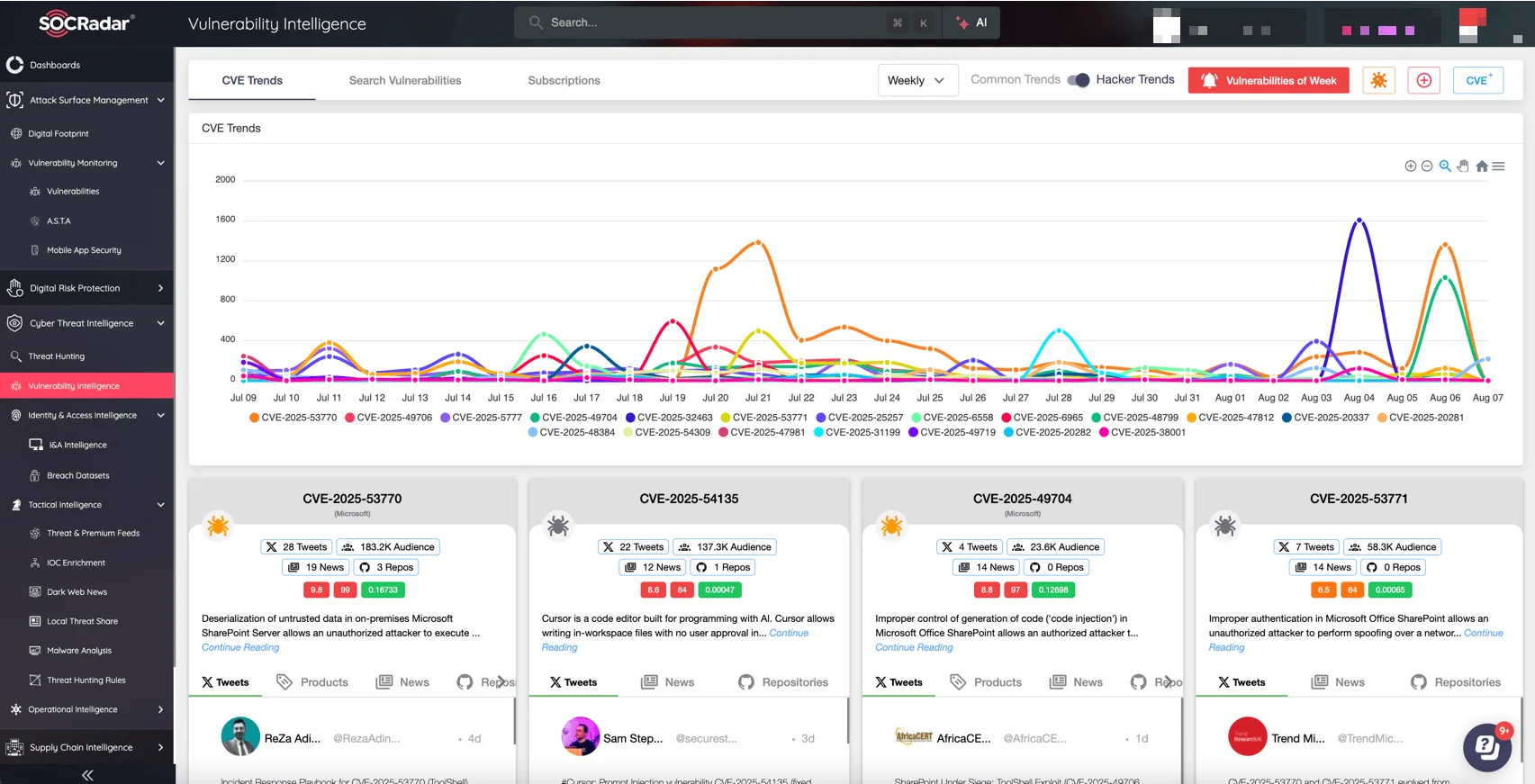
Track attacker trends and subscribe to specific CVE updates with SOCRadar’s Vulnerability Intelligence
Effective defense against threats like this starts with real-time insight into vulnerability developments and attacker behaviors. SOCRadar’s Cyber Threat Intelligence platform helps security teams track the latest CVE trends, assess their potential impact, and prioritize action.
Combined with SOCRadar’s Attack Surface Management (ASM), organizations can continuously map and monitor internet-facing assets, ensuring exposure points, like vulnerable Exchange servers, are identified and remediated before they are exploited.
How to Mitigate CVE-2025-53786
Both Microsoft and CISA recommend immediate action. Key mitigation steps include:
- Update and Patch
- Install the April 2025 Hot Fix (or newer) on all on-premises Exchange servers in hybrid configurations.
- Ensure your servers are running supported Cumulative Updates (CU14 or CU15 for Exchange 2019; CU23 for Exchange 2016). Use the Exchange Update Wizard to plan upgrades.
- Implement Dedicated Hybrid App
- Follow Microsoft’s Deploy dedicated Exchange hybrid app instructions to replace the legacy shared service principal with a dedicated one in Entra ID.
- After configuration, reset the service principal’s keyCredentials to remove any potentially compromised keys.
- Disconnect Vulnerable Servers
- Immediately disconnect End-of-Life Exchange servers from the internet.
- Consider disconnecting the “last Exchange server” if you have fully migrated to Exchange Online.
- Validate and Monitor
- Run the Exchange Server Health Checker to confirm update status and detect any configuration gaps.
- Monitor for abnormal authentication or mail flow behavior, especially in environments that recently transitioned service principals.
- Prepare for API Changes
- Plan for the deprecation of EWS calls from Exchange Server to Exchange Online. Microsoft will enforce the switch to Microsoft Graph API in October 2025, with additional permission updates in 2026.
Organizations should review Microsoft’s official advisory and CISA’s Emergency Directive for complete technical details. Swift action now will prevent attackers from exploiting a vulnerability that bridges your critical environments – your on-premises Exchange and your cloud-hosted Exchange Online.