

Oct 06, 2026

Apr 13, 2026
5 Mins Read

Summarize with:
CVE-2026-34621: Adobe Acrobat Reader Zero-Day Enables Arbitrary Code Execution via Crafted PDF
Adobe released an emergency update for Adobe Acrobat and Adobe Acrobat Reader on Windows and macOS to address CVE-2026-34621, a vulnerability that can lead to arbitrary code execution when a victim opens a crafted PDF. Adobe also confirmed it is exploited in the wild, which raises the priority for patching across end-user fleets. This post breaks down what’s affected, how exploitation is triggered, and what defenders should do immediately.
What Is CVE-2026-34621?
CVE-2026-34621 is a vulnerability in Adobe Acrobat and Acrobat Reader that Adobe says can be exploited to achieve arbitrary code execution. The underlying weakness is a form of prototype pollution, sometimes framed as improperly controlled modification of prototype attributes (commonly associated with CWE-1321).
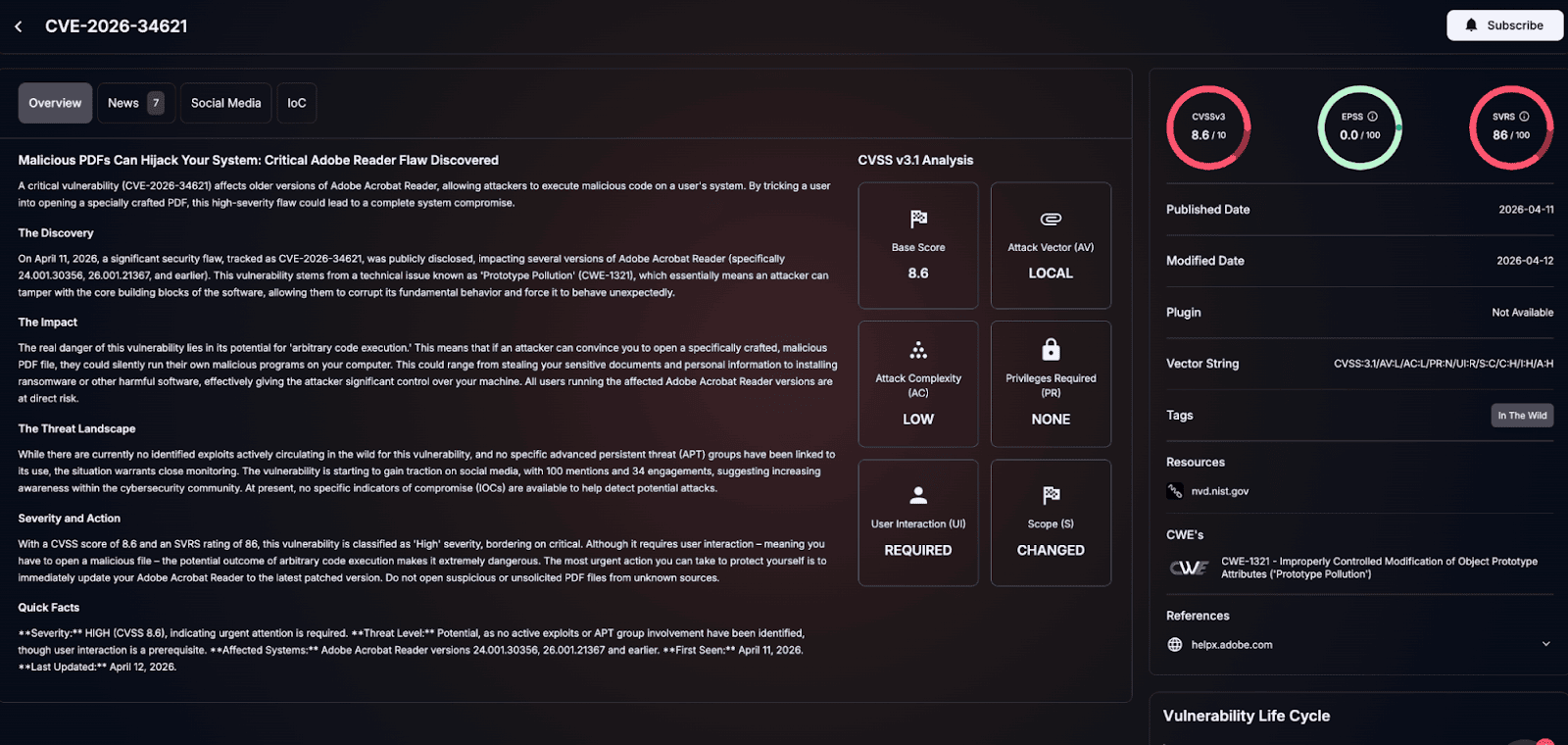
Details of CVE-2026-34621 (SOCRadar Vulnerability Intelligence)
This is a user-endpoint risk. If an attacker can get a target to open a malicious PDF, successful exploitation can result in code running in the context of the current user.
Which Adobe Acrobat & Reader Versions Are Affected?
Adobe advisory lists impacted versions across both the Continuous track and the Classic 2024 line on Windows and macOS. Affected builds include:
- Acrobat DC (Continuous): 26.001.21367 and earlier (Windows, macOS)
- Acrobat Reader DC (Continuous): 26.001.21367 and earlier (Windows, macOS)
- Acrobat 2024 (Classic 2024): 24.001.30356 and earlier (Windows, macOS)
The patched builds are:
- 26.001.21411 for Acrobat/Reader Continuous,
- 24.001.30362 (Windows),
- and 24.001.30360 (macOS) for Acrobat 2024.
If you manage Adobe updates centrally, validate fixed build numbers against Adobe’s release notes referenced by the bulletin before closing remediation tickets.
How Does Exploitation Work In Real Attacks?
The core trigger is straightforward: the victim opens a crafted PDF. From there, the exploit abuses the flaw to reach code execution.
Two nuances matter for defenders:
1. Is This A Remote Attack Or Does It Require Local File Opening?
While “PDF exploitation” often gets treated like a remote drive-by risk, reporting indicates Adobe adjusted scoring details to reflect that exploitation requires the user to open the malicious file locally. That still aligns with common delivery methods like email attachment phishing, chat-delivered files, and downloads from compromised sites.
2. What Behaviors Have Been Observed During Exploitation?
Researchers highlight potential use of privileged Acrobat JavaScript APIs during exploitation. One specific behavior mentioned is suspicious PDF logic invoking util.readFileIntoStream(), which can be used to read files accessible to the Reader process. Treat this as a triage clue rather than a definitive indicator, but it is a concrete place to start if you detonate suspicious PDFs in a sandbox or review Acrobat JavaScript activity.
Is CVE-2026-34621 Being Exploited In The Wild?
Yes. Adobe explicitly stated it is aware of CVE-2026-34621 being exploited in the wild, which is the key driver for prioritization.
There is also other reporting that exploitation may have started months earlier (claims ranging from November to December 2025).
The confirmed operational reality is that exploitation was active at the time Adobe issued the emergency update on Apr 11, 2026 (with the bulletin later showing an update on April 12, 2026).
Is There a PoC Exploit Available for CVE-2026-34621?
On April 11, 2026, SOCRadar detected a Dark Web forum post offering an Adobe Reader and Acrobat Proof-of-Concept (PoC) exploit that may be related to CVE-2026-34621. If weaponized, it could help attackers trigger arbitrary code execution through a malicious PDF file.
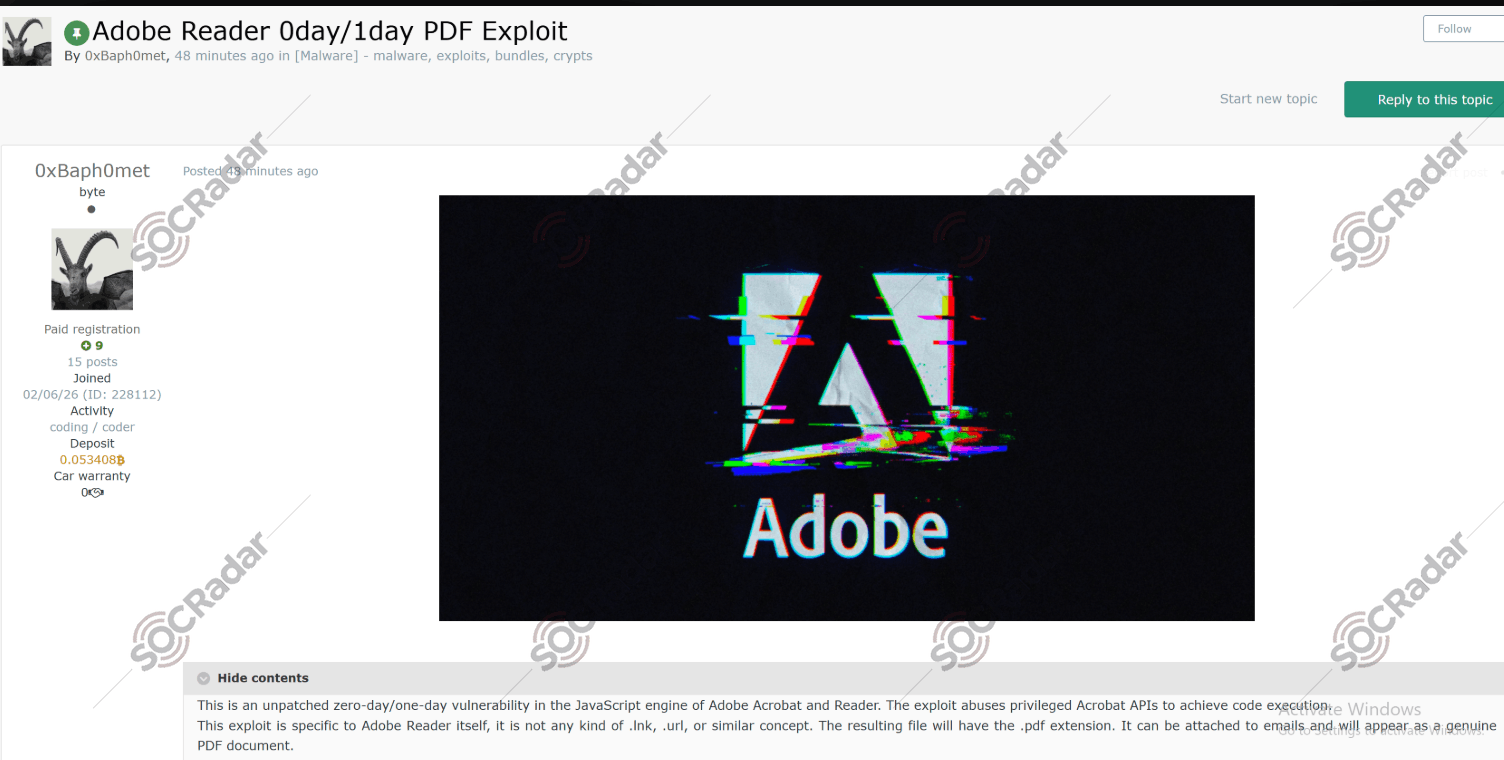
PoC exploit found on Dark Web for an Adobe Acrobat & Reader zero-day (SOCRadar Dark Web News)
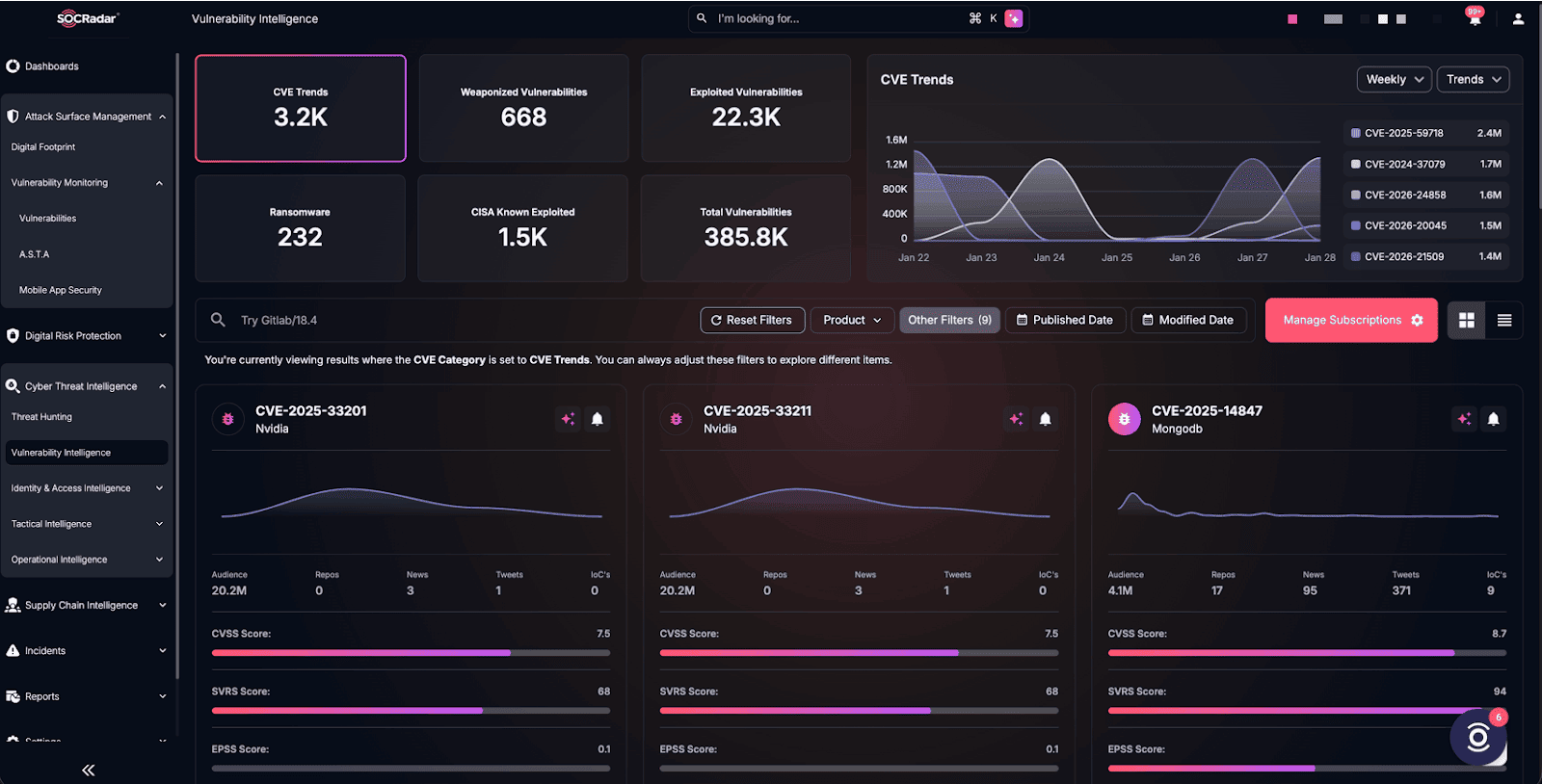
To help teams stay ahead of vulnerability risk, SOCRadar Dark Web Monitoring tracks exploit discussions, leaked PoCs, and other underground signals that may show rising attacker interest in a flaw. SOCRadar Cyber Threat Intelligence adds broader context by following threat actors, exploitation trends, and technical developments, helping security teams understand which vulnerabilities are gaining traction and may require faster action.
SOCRadar’s Vulnerability Intelligence
What Should Defenders Do Right Now?
Patch Immediately Across Endpoints
Prioritize deployment of Adobe’s emergency fix per APSB26-43 across:
- End-user workstations (especially high-risk roles)
- VDI images and golden templates
- Shared kiosk or jump-box systems that open PDFs
Because this is a user-interaction exploit, patch coverage on employee endpoints matters more than perimeter exposure.
Reduce Exposure From Untrusted PDFs While Patching Rolls Out
If your patch rollout will take time, focus on controls that reduce successful triggering:
- Tighten email and web controls for PDF attachments from untrusted sources.
- Encourage opening external PDFs in isolated workflows (browser-based viewers, sandboxed environments, or dedicated analysis VMs), where feasible.
- Review Acrobat/Reader configuration baselines, especially around scripting and privileged features, if your environment supports hardened settings.
Hunt For Suspicious PDF Behaviors and Post-Open Activity
Use the following as practical starting points for triage:
- PDFs that contain JavaScript and attempt privileged API calls such as util.readFileIntoStream().
- Endpoint telemetry showing Acrobat/Reader spawning unusual child processes or exhibiting atypical network activity shortly after a PDF open event.
- Repeated user reports of Acrobat/Reader crashes tied to specific PDFs, which sometimes correlates with exploit attempts.
Track PoC and IOC Developments Carefully
As mentioned, SOCRadar has identified a PoC on a Dark Web forum that may be linked to CVE-2026-34621. Because exploit material may already be circulating, security teams should closely monitor exploitation activity, watch for related indicators, and stay alert for signs of attempted abuse.

Table Of Content
CVE-2026-34621: Adobe Acrobat Reader Zero-Day Enables Arbitrary Code Execution via Crafted PDF
What Is CVE-2026-34621?
Which Adobe Acrobat & Reader Versions Are Affected?
How Does Exploitation Work In Real Attacks?
Is CVE-2026-34621 Being Exploited In The Wild?
Is There a PoC Exploit Available for CVE-2026-34621?
What Should Defenders Do Right Now?
Related Articles

CVE-2026-88779: Citrix NetScaler Zero-Day

CVE-2026-90970: GitLab AI Gateway RCE
Oct 05, 2026

FortiMail Zero-Day Under Active Exploitation
Oct 02, 2026

TeamViewer Fixes Five Remote Access Flaws
Oct 01, 2026

CVE-2026-76504: Cisco SD-WAN Flaw Exploited
Oct 01, 2026