

Oct 12, 2026
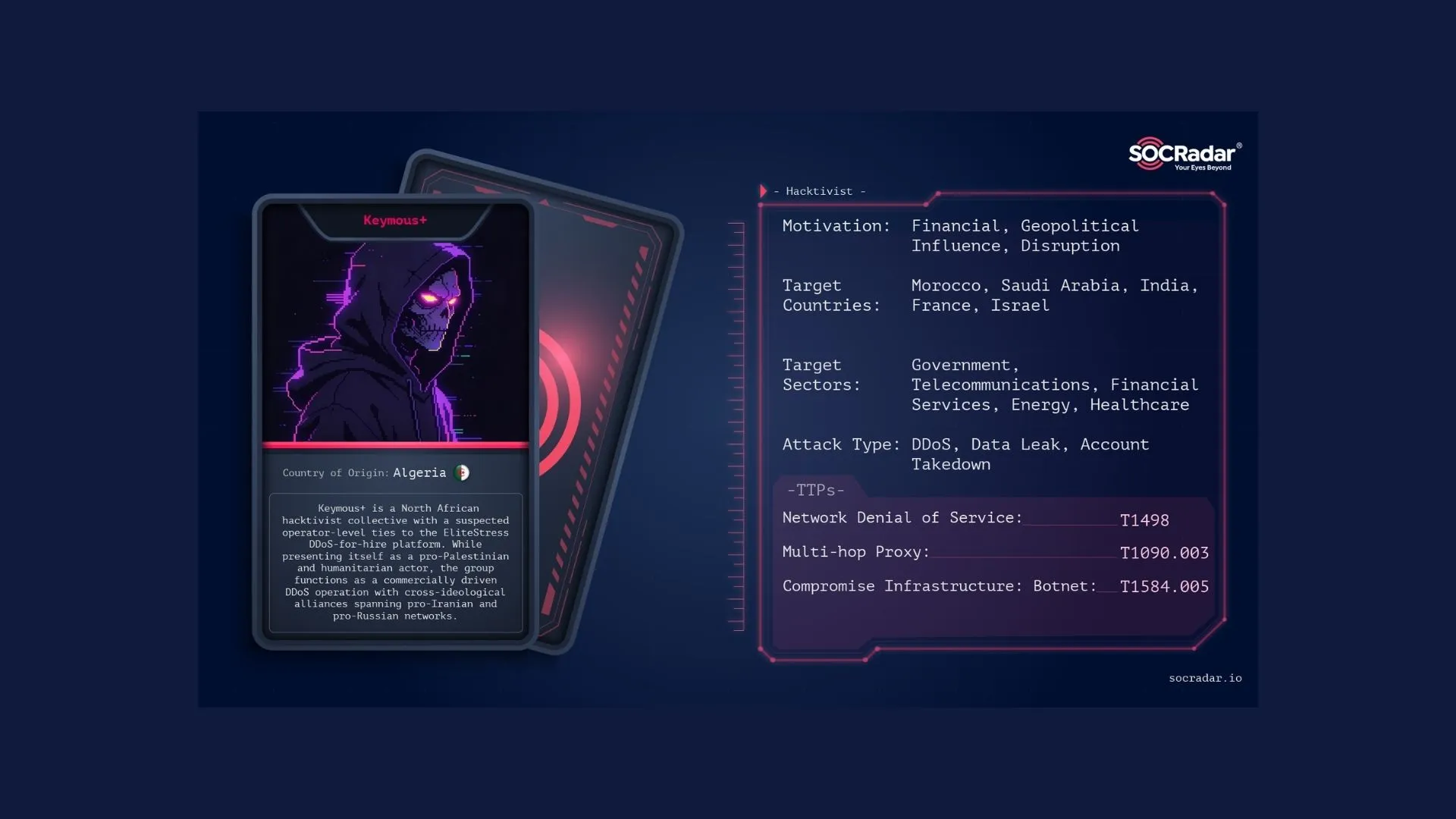
Table Of Content
Related Articles
Dark Web Profile: Blue Locker Ransomware
Sep 25, 2026

ShinyHunters Claims Access to FBI Systems
Sep 24, 2026

May 13, 2026
10 Mins Read
Sep 25, 2026

Summarize with:
Dark Web Profile: Keymous+
Keymous Plus, also known as Keymous+ threat group, markets itself as a hacktivist collective fighting for humanity. What intelligence investigations have documented is structurally different: a North African hybrid actor blending political performance with a commercial DDoS-as-a-Service platform, an alliance network spanning 70+ groups, and an operational tempo that has made it the single most prolific DDoS-claiming entity in global hacktivism. This profile covers the group’s origin, commercial architecture, targeting patterns, confirmed attack methodology, and defensive countermeasures.
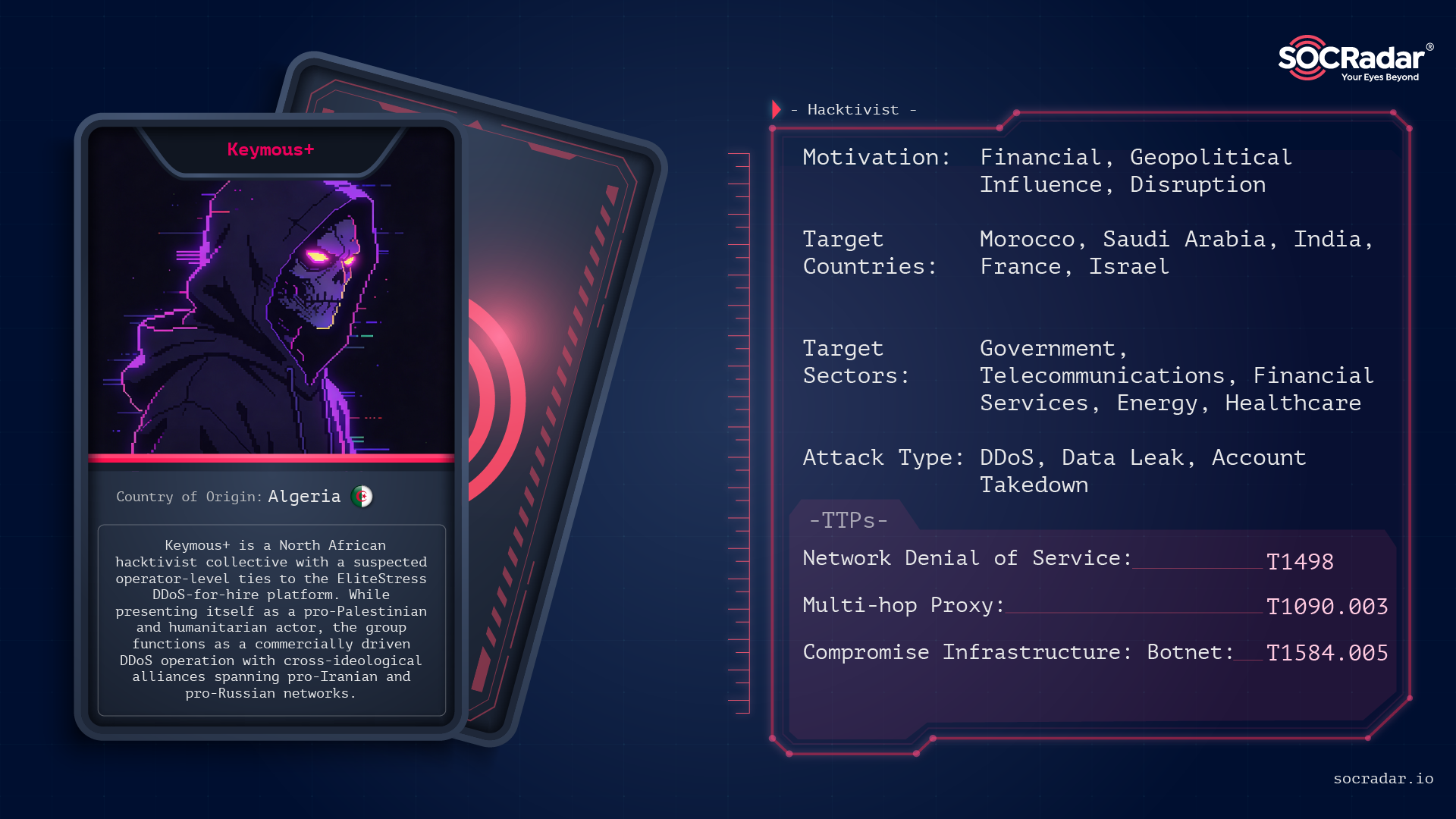
Threat Actor Card of Keymous+
Who Is Keymous+?
Keymous+ first appeared publicly in November 2023, with a DDoS claim against Morocco’s national e-Visa portal. Researchers attribute the group’s origins to Algeria, characterizing it as a small collective that coalesced around two simultaneous pressures: longstanding Algerian–Moroccan cyber tensions and the outbreak of the Gaza conflict in October 2023.
Keymous+ threat group’s logo
The Gaza conflict served as the group’s primary ideological catalyst at launch, with early operations framed explicitly as acts of solidarity with Palestinians and positioned under the “Hack for Humanity” banner. In a 2026 interview, a group representative stated that founding members were directly affected by the conflict, citing the loss of members in the war in Palestine as one of the motivations behind the collective’s formation. The group participated in #OpIsrael campaigns and directed initial targeting toward entities perceived as complicit in or supportive of Israeli military operations.
The group operates under several aliases and self-branded sub-identities. In the same interview, a representative stated that Keymous+ controls and manages multiple sub-groups, including Anonymous Algeria, DDOS54, and Hack for Humanity, framing these not as allied independents but as entities operating under the group’s direct coordination. Internally, the collective presents a two-track organizational structure: an “Alpha Team” focused on breaches and data leaks, and a “Beta Team” dedicated exclusively to DDoS operations. As of mid-2025, the Alpha Team appeared largely inactive based on Telegram activity, with Beta Team driving virtually all confirmed operations.
| Alpha Team
• Responsible for intrusion operations, data breaches, and leak campaigns • Historically targeted government and financial sector databases • Activity has ceased or gone dark as of late 2024 • May have been folded into Beta Team operations or gone underground |
Beta Team
• Primary operational arm; executes all DDoS campaigns • Posts attack proof via Check-Host.net on Telegram channels • Coordinates joint operations with allied hacktivist groups • Suspected of managing or operating the EliteStress DaaS platform |
The group maintains an extensive social media footprint across Telegram and X. Its primary English-language activity is concentrated on the KMPteam channel, with an official backup channel operating under the name Keymous_V2. An Arabic–French channel runs separately under keymous_team, alongside a high-subscriber mirror identified as keymous with approximately 31,781 subscribers. A dedicated contact and interaction bot operates as KeymousPlusBot. On X, the group is active under the handle KeymousTeam. No Discord server, GitHub repository, or .onion site has been publicly attributed to Keymous+ as of April 2026.
Beyond its hacktivist identity, researchers assess Keymous+ as having a suspected operator-level relationship with EliteStress, a commercial DDoS-for-hire platform detailed below.
One attribution conflict worth noting: a separate research thread maps a “Keymous Plus” cell within a Bangladesh-based pro-Iran cluster. Most analysts interpret this as reflecting distributed, multinational membership rather than a relocation of the group’s operational core, but the discrepancy remains unresolved in the public record.
What Is the Connection Between Keymous+ and EliteStress?
EliteStress is a commercial stresser and DDoS-as-a-service platform offering tiered subscriptions ranging from approximately €15 per day to €2,100 per month. Its capabilities include DNS amplification, UDP floods, HTTP/2 floods, spoofed SSH traffic, and ICMP flooding, all accessible through a Telegram bot interface that lowers the technical barrier for customers to near zero.
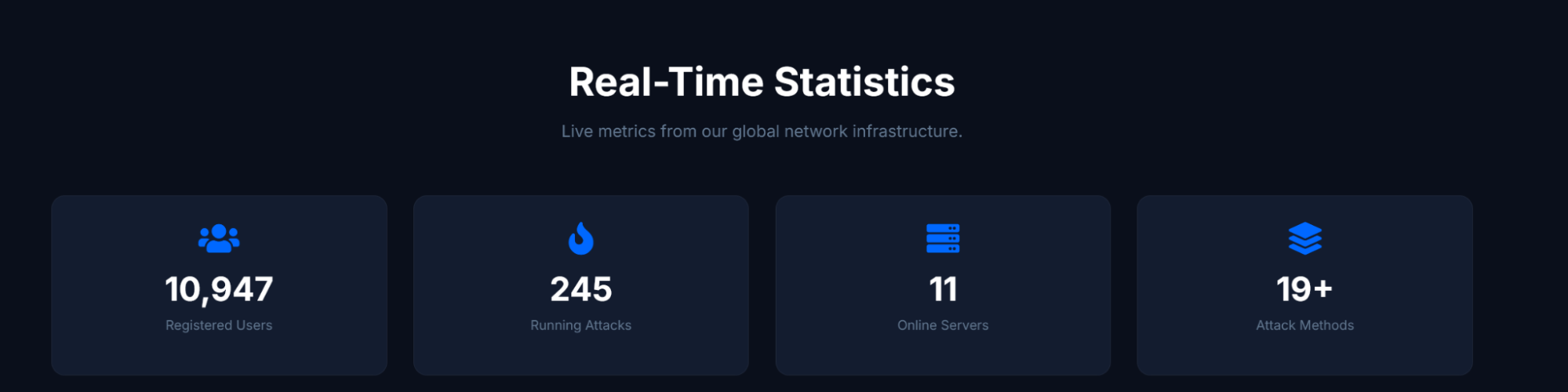
Real-time statistics for EliteStress
The platform’s connection to Keymous+ surfaced publicly in June 2025, when a group representative alluded on X to operating a “stressor platform” and the group’s official channels began actively promoting EliteStress to followers under a dedicated recruitment handle. Researchers note that Keymous+’s consistent public messaging around uptime guarantees, attack power, and service stability reads as vendor marketing rather than activist communication, and assess with high confidence that the group either operates EliteStress or is structurally embedded within it at an operator level. No ownership document or direct confession has been published.
EliteStress should not be conflated with MegaMedusa, the separate infrastructure of the Malaysian group RipperSec. No confirmed technical connection between Keymous+ and Mirai variants, Godzilla, or Abyssal tooling has been established. As of April 2026, EliteStress remained operational and absent from Operation PowerOFF’s seized-domain lists.
What Are Keymous+’s Targets?
Keymous+ targeting is neither random nor strictly ideological — it follows a pattern researchers describe as opportunistic alignment: geopolitical flashpoints set the general direction, and high-visibility public-facing infrastructure within that direction becomes the operational priority. Government agencies represent the largest confirmed victim category, followed by telecommunications, financial services, transportation and logistics, hospitality, healthcare, education, and energy.
Geographically, confirmed attack telemetry places Morocco, Saudi Arabia, Sudan, India, and France as the five most targeted countries. Secondary targeting spans the UAE, Israel, Denmark, Sweden, Germany, Spain, Belgium, the Netherlands, Italy, the United Kingdom, Ukraine, and the United States, reflecting both the group’s alliance obligations and its responsiveness to international news cycles.
The table below documents confirmed and researcher-attributed operations in chronological order:
| Nov 2023 | Group emerges publicly; first documented DDoS attack targeting Morocco’s e-Visa portal. Keymous+ establishes Telegram presence. |
| Q1 2024 | Expansion of targeting scope; attacks launched against government and financial targets in France, India, UAE, and Saudi Arabia. Alpha Team conducts early breach operations. |
| Q2 2024 | Strategic alliances established with NoName057(16), Mr Hamza, AnonSec, and Moroccan Dragons. Joint operations coordinated including “Red Eye Op.” EliteStress affiliation begins surfacing in research. |
| Q3 2024 | Participation in #OpIsrael and #OpIndia campaigns. Attack volume scales significantly. Alpha Team activity declines and goes dark. Beta Team assumes all operational responsibilities. |
| Q4 2024 | NETSCOUT ATLAS confirms 249 independently verified DDoS attacks in Feb–Sep 2024 window. Peak individual attack bandwidth reaches 11.8 Gbps; collaborative attacks hit 44 Gbps. |
| 2025 | Cumulative DDoS claim count surpasses 700. Keymous+ is ranked among the top 5 most active hacktivist DDoS actors globally by multiple threat intelligence vendors. |
| Mar 2026 | Following Operation Epic Fury (U.S.-Israeli strikes on Iranian targets), Keymous+ launches a large-scale retaliatory DDoS surge, claiming 26.8% of all global hacktivist DDoS activity in the post-conflict window across 110 organizations in 16 countries. |
How Does Keymous+ Execute an Attack?
Keymous+ operations follow a recognizable sequence that reflects both the group’s commercial infrastructure and its human-directed scheduling discipline.
- Target Selection and Announcement: Campaigns are initiated in direct response to geopolitical events rather than through sustained reconnaissance cycles. Once a target set is identified, the group announces intended victims on its Telegram channels in advance, functioning simultaneously as psychological pressure, proof of activity for paying customers, and recruitment signaling toward alliance partners. Defenders with Telegram monitoring in place can exploit this behavior as an early-warning indicator.
- Infrastructure Assembly: Attack traffic is sourced from a composite pool drawing on Tor exit nodes, public cloud instances, compromised IoT devices, commercial VPN and proxy services, and directly infected hosts. The majority of source IPs are spoofed through DDoS-for-hire control panels — including EliteStress — that offer dropdown ASN and IP-spoofing menus mimicking major providers. Each confirmed attack averaged over 42,000 unique source IPs, largely eliminating individual source addresses as actionable network-layer IOCs.
- Attack Execution: The group employs both reflection/amplification and direct flooding vectors, often in combination. Observed amplification protocols include CLDAP, DNS, NTP, memcached, SNMP, NetBIOS, rpcbind, L2TP, WS-DD, and chargen; direct flood methods span TCP SYN floods, UDP floods, DNS query floods, and Layer-7 HTTP/2 floods. According to the NETSCOUT, solo operations peaked at 11.8 Gbps; collaborative campaigns with DDoS54 reached 44 Gbps and 4.23 million packets per second using a multivector combination over an approximately 11-minute window.
- Timing: Over 30% of confirmed attacks cluster within a single hour at 06:00 UTC, corresponding to the morning operational window across Morocco, Saudi Arabia, and Sudan when government portals open, financial markets begin trading, and SOC teams are rotating shifts. Secondary peaks appear at 01:00, 10:00, and 12:00 UTC; activity drops to near zero between 22:00 and 04:00 UTC. Researchers characterize this pattern as deliberate scheduling designed for maximum visibility rather than sustained saturation.
- Proof of Impact and Amplification: Following an attack, the group posts check-host.net verification links directly to its Telegram channels as proof of downtime, serving a dual purpose: validating claims to alliance partners and functioning as marketing material for EliteStress’s commercial customer base. The roughly threefold gap between the group’s self-reported 700+ attacks and the 249 telemetry-confirmed events reflects a consistent pattern of mixing genuine operations with inflated claims and visibility-oriented marketing.
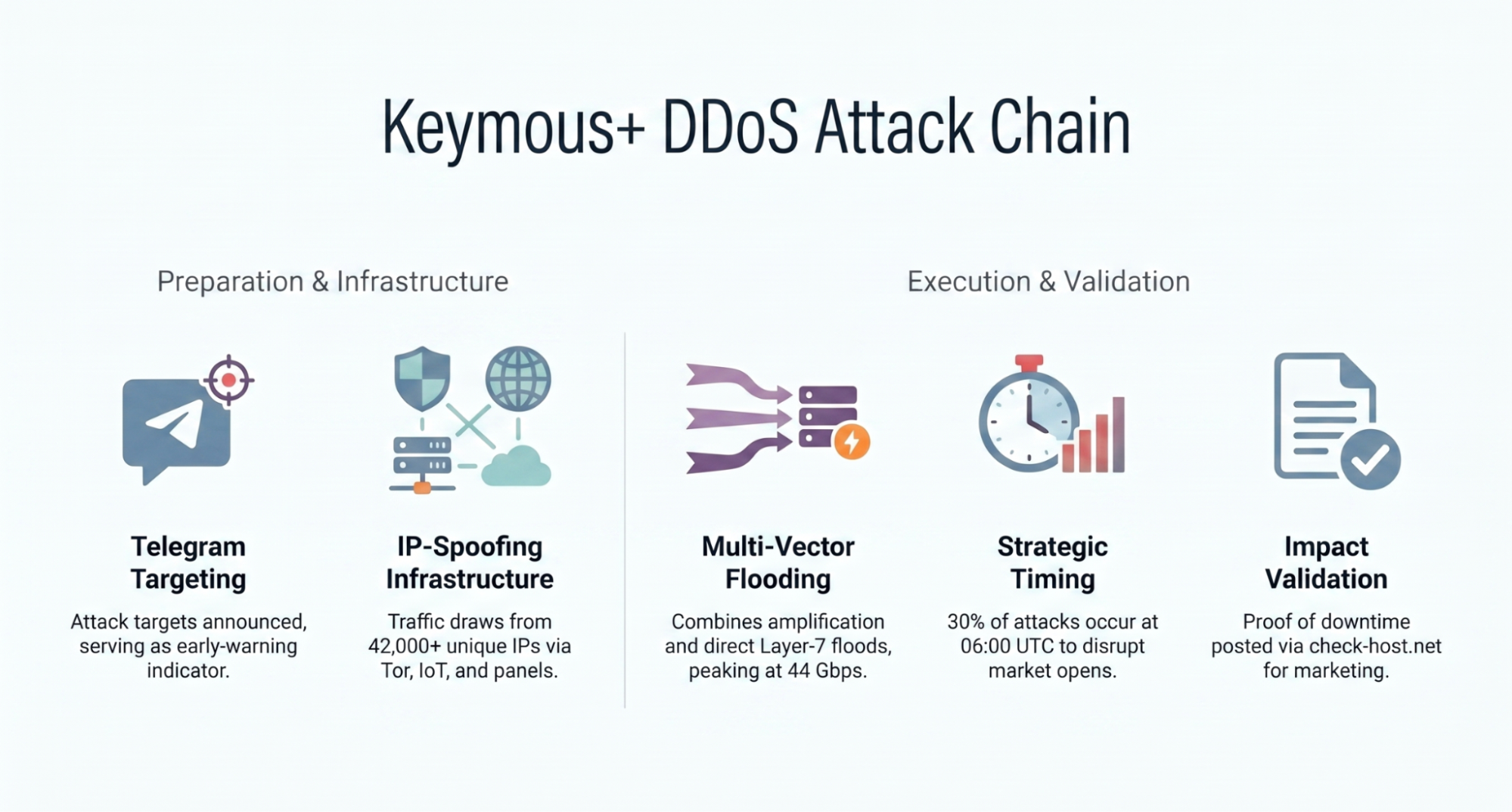
Keymous+ DDoS Attack Chain
How Can Organizations Defend Against Keymous+?
Defending against Keymous+ requires moving beyond conventional DDoS mitigation. The group’s spoofed source infrastructure, coalition-amplified bandwidth, and commercially driven operational tempo make static, signature-based, or IP-centric defenses insufficient on their own. Effective posture combines network-layer hardening with behavioral monitoring, capacity planning calibrated to coalition-scale events, and intelligence-led early warning built around the group’s predictable Telegram activity.
- Prioritize vector-based detection over IP blocking: Spoofed source addresses render IP blocklists largely ineffective. Detection logic should be tuned to amplification protocol signatures — particularly CLDAP, DNS, NTP, memcached, and SNMP reflection — alongside HTTP/2 flood patterns at Layer 7.
- Close amplification exposure: Audit external-facing services for open resolvers, misconfigured SNMP agents, and accessible memcached instances. Disabling or rate-limiting UDP-based services with no legitimate external requirement directly reduces the group’s preferred attack surface.
- Implement Telegram-based early warning: Keymous+ consistently announces targets before or immediately following attack initiation. Monitoring the group’s known channels for target mentions and check-host.net proof links provides a detection window that network sensors alone cannot replicate.
- Tune SOC posture around the 06:00 UTC window: Over 30% of confirmed attacks initiate at this hour. Organizations in Morocco, Saudi Arabia, Sudan, India, and France should maintain elevated monitoring posture during this window, with particular attention to shift handover procedures.
- Account for coalition amplification in capacity planning: The DDoS54 partnership produced a fourfold bandwidth increase overnight. Upstream mitigation agreements should be sized against the group’s coalition ceiling of 44 Gbps rather than its solo-operation baseline of 11.8 Gbps.
- Sector and geography prioritization: Government, telecommunications, financial services, and energy organizations across Morocco, Saudi Arabia, India, France, Israel, Kuwait, Jordan, and Pakistan should treat Keymous+ as an elevated and persistent threat given the group’s demonstrated targeting patterns through 2026.
MITRE ATT&CK TTPs
| Tactic | Technique | Technique Name | Observed Behavior |
| Impact | T1498 | Network Denial of Service | Primary attack method across all confirmed operations |
| Impact | T1498.001 | Direct Network Flood | TCP SYN, UDP, DNS query, and HTTP/2 floods |
| Impact | T1498.002 | Reflection Amplification | CLDAP, DNS, NTP, memcached, SNMP, NetBIOS, rpcbind, L2TP, WS-DD, chargen |
| Impact | T1499 | Endpoint Denial of Service | Layer-7 HTTP/2 flooding targeting web-facing infrastructure |
| Resource Development | T1583.003 | Acquire Infrastructure: Virtual Private Server | Public cloud instances used as attack source nodes |
| Resource Development | T1584.005 | Compromise Infrastructure: Botnet | Compromised IoT devices and infected hosts integrated into attack pools |
| Command and Control | T1090.003 | Multi-hop Proxy | Tor exit nodes and commercial VPN/proxy services are used to obscure source traffic |
| Collection | T1005 | Data from Local System | Alpha Team is reportedly responsible for breaches and local data collection prior to becoming inactive in mid-2025 |
| Exfiltration | T1567 | Exfiltration Over Web Service | Stolen Saudi banking sector data surfaced on Chinese cybercrime and leak forums following July 2025 operations |
| Persistence | T1133 | External Remote Services | Group claims persistent access to health systems across Africa and Asia; unverified by independent telemetry |
| Initial Access | T1078 | Valid Accounts | Implied by persistent access claims; no forensic confirmation available |