

| Provider | Type | Primary Strength | Best For | Website |
|---|---|---|---|---|
| Haboob | Local | MSOC, offensive security, IR, threat intel | Government, enterprise, incident response | haboob.sa |
| MIS / Al Moammar | Local | Managed SOC/MDR + systems integration | Large enterprise, government, multi-domain IT | mis.com.sa |
| SBM / Saudi Business Machines | Local | Managed SOC (“ATPC”), 24/7 monitoring | Enterprise, IBM-stack environments | sbm.com.sa |
| Security Matters | Local | Managed security (SIEM, threat hunting, vuln mgmt) | Mid-market and enterprise | securitymatterz.com |
| KPMG KSA | Global | Cyber advisory & GRC + global MDR; SACS-002 audit (no announced NCA MSOC license) | Advisory-led enterprises; pair with a licensed MSOC | kpmg.com/sa |
| SITE | Local | MSOC, MDR, IT & OT monitoring | Government, critical national infrastructure | site.sa |
| Sahara Net | Local | In-Kingdom SOC + cloud & connectivity | Security bundled with sovereign hosting | sahara.com |
| Innovative Solutions / IS | Regional | Managed SOC/MDR, advisory, cloud, payments | Enterprise, regulated sectors, payments | is.com.sa |
| Infratech | Local | NCA-licensed mSOC + offensive security | Enterprises wanting a licensed SOC + red team | infratech.com.sa |
| Cyberani | Local | IT & OT MSOC, MDR, DFIR (two MSOCs) | Energy/OT, government, critical infrastructure | cyberani.sa |
Jul 10, 2026
22 Mins Read

Summarize with:
Top 10 MSSPs in Saudi Arabia in 2026
Saudi Arabia’s cybersecurity market is expanding rapidly, with analyst estimates placing it at roughly USD 4 billion in 2025 and heading toward USD 8.9 billion by 2030 (a CAGR Ken Research puts at 14%), propelled by Vision 2030 digital transformation, one of the most assertive regulatory regimes in the region, and a threat landscape sharpened by the Kingdom’s strategic profile.
Saudi Arabia sits in Tier‑1 ‘Role‑modelling,’ the top band of the ITU Global Cybersecurity Index, with a near‑perfect score. In that environment, choosing a Managed Security Service Provider (MSSP) is one of the most consequential security decisions an organization will make.
This guide profiles 10 leading MSSPs active in Saudi Arabia in 2026. The providers are listed in no particular order. These providers stand out for different reasons: different service specializations, sector strengths, and organization sizes. Readers are encouraged to weigh them against their own operational context and obligations.
Why Saudi Arabia’s MSSP Market Matters in 2026
As the Gulf’s largest economy and a linchpin of global energy, Saudi Arabia is also one of the most heavily targeted cyber environments in the region. Regional geopolitical tensions directly affect the Kingdom, as seen during the 2025 Israel–Iran escalation, when Gulf states recorded a surge in hacktivism and intrusions. Long‑standing energy‑sector threats such as the 2012 Shamoon wiper at Saudi Aramco and the 2017 Triton attack on a petrochemical plant’s safety systems remain core operational‑technology (OT) risk reference points.
Several key forces are driving managed security (MSSP) demand in 2026:
Regulatory pressure. The NCA mandates a layered set of frameworks led by the Essential Cybersecurity Controls (ECC‑2:2024, 110 controls across four domains) and the Critical Systems Cybersecurity Controls binding on government and critical‑infrastructure operators. The NCNICC‑1:2025 controls extend these baselines to the private sector, dividing companies into Class A (large) and Class B (SMEs). SAMA binds financial institutions, while SDAIA enforces the PDPL with a 72‑hour breach‑notification window and fines up to SAR 5 million, having issued 48 enforcement decisions in its first year. And the NCA’s MSOC licensing tiers dictate eligibility only Tier‑1 licensees may serve government and critical infrastructure.
The NCA control “stack” at a glance:
- ECC Essential Cybersecurity Controls (the baseline)
- CSCC Critical Systems Cybersecurity Controls
- CCC Cloud Cybersecurity Controls
- OTCC Operational Technology Cybersecurity Controls
- DCC Data Cybersecurity Controls
- TCC Telework Cybersecurity Controls
- OSMACC Organizations’ Social Media Accounts Cybersecurity Controls
- NCNICC‑1:2025 controls for non‑CNI private‑sector entities
- MSOC licensing Tier‑1 (government/CNI) and Tier‑2 (wider private sector)
Talent shortage. The Kingdom’s cybersecurity workforce has grown to more than 21,000 professionals (NCA, 2024), yet demand continues to outstrip supply, and Saudization targets tighten local hiring further.. MSSPs meet the need for immediate, 24/7 coverage and mature expertise that organizations cannot realistically build in‑house.
Cloud and digital acceleration. Driven by the Cloud‑First Policy, hyperscalers including AWS, Google Cloud, and Oracle have launched in‑Kingdom regions, and the cloud market is projected to grow at a double‑digit annual rate (mid‑teens to low‑twenties percent) through 2030. Vision 2030 giga‑projects keep expanding the attack surface, while NCA controls push organizations toward continuous cloud monitoring.
Attack sophistication. Geopolitics and industrial infrastructure shape the threat profile, exposing energy and manufacturing to state‑aligned espionage, hacktivism, and OT/ICS attacks. Industrialized ransomware is rampant. A 2025 quarterly assessment logged 54 data breaches and 13 ransomware incidents across 11 groups (e.g., Everest, Qilin, DragonForce) amplified by AI‑enabled phishing and deepfakes. Against this blend, MSSPs that pair regional threat intelligence with genuine OT capability are meaningfully more effective than generic, off‑the‑shelf detection.
Check your organization’s current exposure with SOCRadar’s free Dark Web Report.
What Is an MSSP and Why You Need One in Saudi Arabia
A Managed Security Service Provider (MSSP) provides operational continuity through 24/7 monitoring, threat detection, and incident response via a Security Operations Center. In Saudi Arabia, outsourcing supports the round‑the‑clock resilience most organizations cannot realistically staff in‑house helping manage threats at all hours, navigate the PDPL’s limits on cross‑border data transfer, and meet its strict 72‑hour breach‑notification window.
Compliance obligations are expanding under the NCNICC‑1:2025 controls (published in early 2026), which extend baseline requirements to the wider private sector. Organizations increasingly require specialized services such as an NCA‑licensed 24/7 SOC/MSOC, Managed Detection and Response (MDR), and OT/ICS security, plus alignment with the SAMA framework and PDPL and, for the energy supply chain, Saudi Aramco’s SACS‑002 standard.
This support is critical as the Kingdom establishes global cybersecurity leadership such as hosting the Global Cybersecurity Forum in Riyadh (October 2025) while defending against sophisticated, geopolitically charged threats, including the June 2025 “Cyber Fattah” hacktivist data leak. A locally fluent MSSP is built to handle this combination of escalating regulations and active threats.
Quick Reference Table
Top 10 MSSPs in Saudi Arabia in 2026
1. Haboob
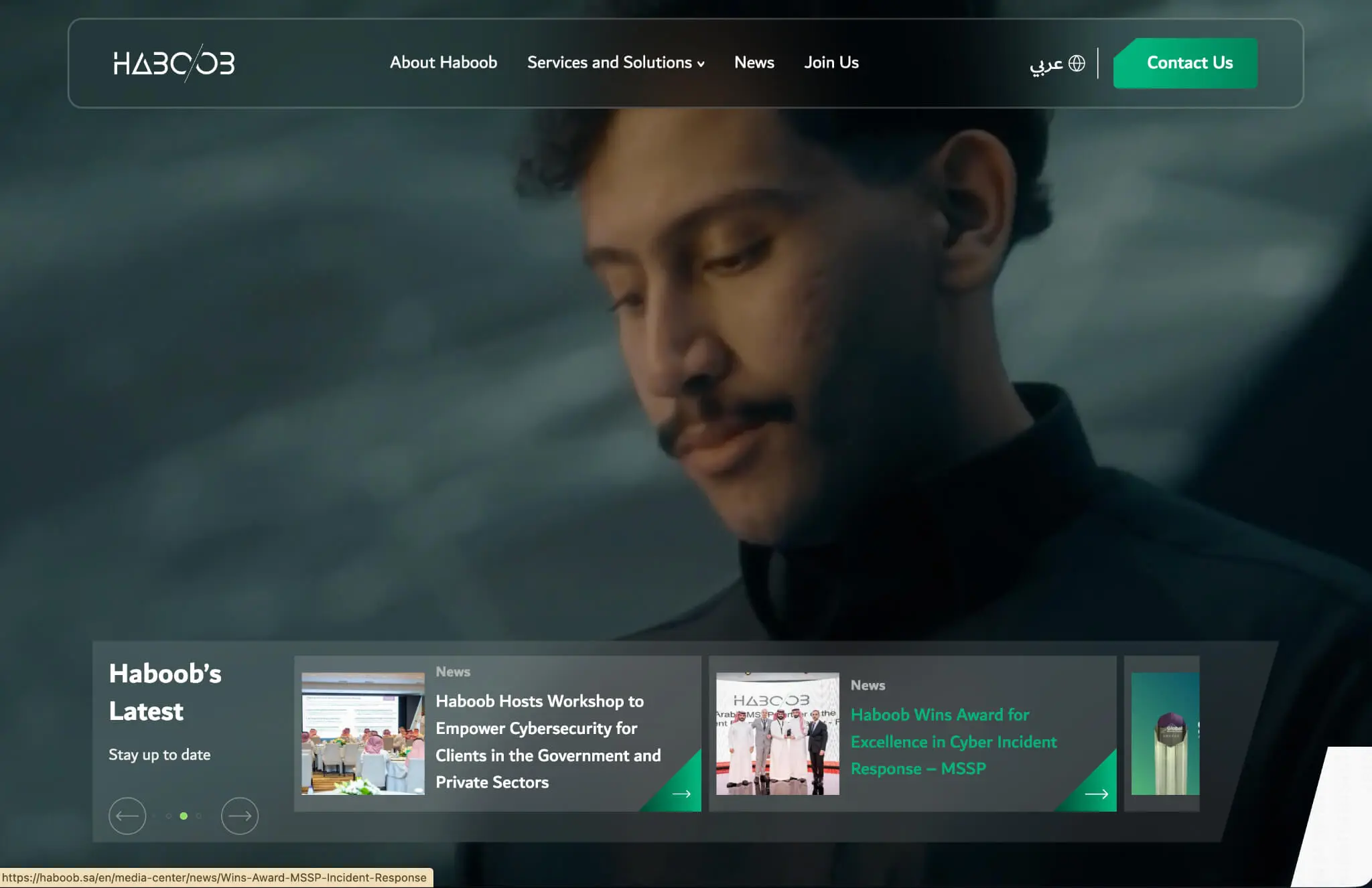
Haboob official website
Haboob is the cybersecurity company of the Saudi Federation for Cybersecurity, Programming and Drones (SAFCSP), and it blends strong offensive‑security roots with national‑grade managed services. It holds an NCA Tier‑1 MSOC license, runs a cloud‑based 24/7 MSOC, and carries CREST accreditation for its penetration-testing services alongside ISO 27001 and ISO 9001.
Its standing is backed by external recognition: Palo Alto Networks named Haboob its Saudi Arabia MSSP Partner of the Year, and it was honored as a 2025 Fastest‑Growing Cybersecurity Company. Haboob has also partnered with Google Cloud to deliver Chronicle‑based (“CyberShield”) detection in support of nationwide cyber defense. Its portfolio runs from MSOC and managed detection through compromise assessment and incident response, vulnerability assessment and penetration testing, GRC consultancy, and cybersecurity engineering, and the firm reports a base of 100+ clients.
With its federation roots and offensive‑to‑defensive range, Haboob suits government and enterprise buyers that want a Tier‑1‑licensed Saudi provider equally comfortable hunting threats and responding to live incidents.
Core Services: MSOC, MDR, Compromise Assessment & Incident Response, Vulnerability Assessment & Penetration Testing, GRC Consultancy, Cybersecurity Engineering, Technology Solutions
Ideal for: Government and enterprise organizations that want a Tier‑1‑licensed Saudi MSSP with deep offensive‑security expertise alongside 24/7 monitoring and incident response.
2. MIS / Al Moammar Information Systems
Website: mis.com.sa | Founded: 1979 | HQ: Riyadh (branches in Jeddah and Al‑Khobar) | Employees: ~1,200
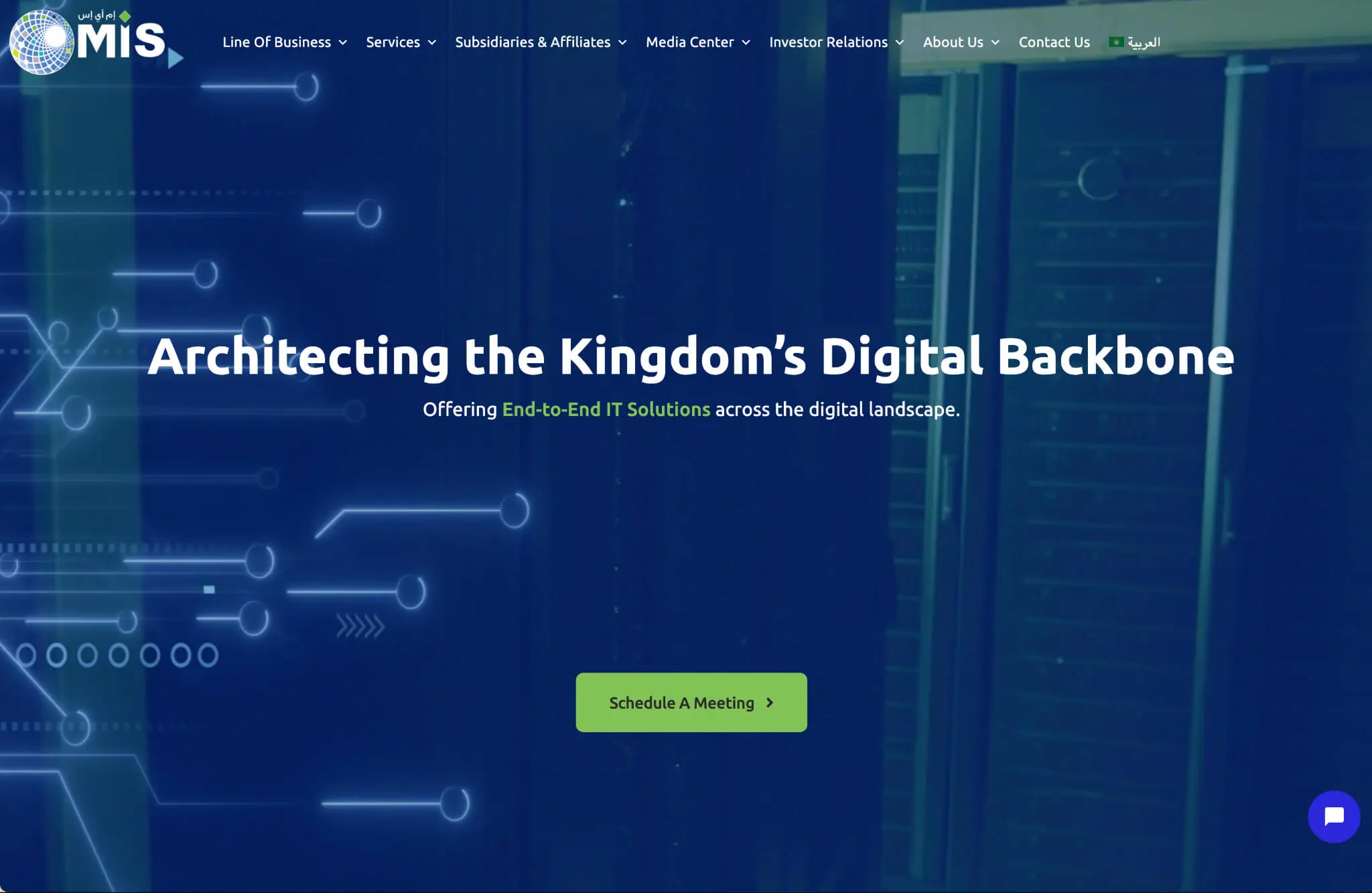
MIS official website
Al Moammar Information Systems (MIS) is one of Saudi Arabia’s largest and longest‑established systems integrators. Founded in 1979 and publicly listed on Tadawul under ticker 7200. Cybersecurity sits inside a much broader business that also spans critical digital infrastructure, IT solutions, cloud, data and AI, and managed services, giving MIS the scale and balance sheet of a listed national IT champion rather than a security pure‑play.
Its cybersecurity line of business runs a managed SOC and MDR alongside security consulting and solution integration, drawing on long‑standing partnerships with major technology vendors. For large enterprises and government bodies that prefer to consolidate security with a single, financially transparent, multi‑domain IT partner, MIS’s breadth and longevity are the core appeal.
Core Services: Managed SOC, MDR, Security Consulting, Security Solution Integration, Critical Digital Infrastructure, Cloud, Data & AI
Ideal for: Large enterprises and government organizations that want a listed, multi‑domain Saudi systems integrator able to deliver managed security as part of a broader technology relationship.
3. SBM / Saudi Business Machines
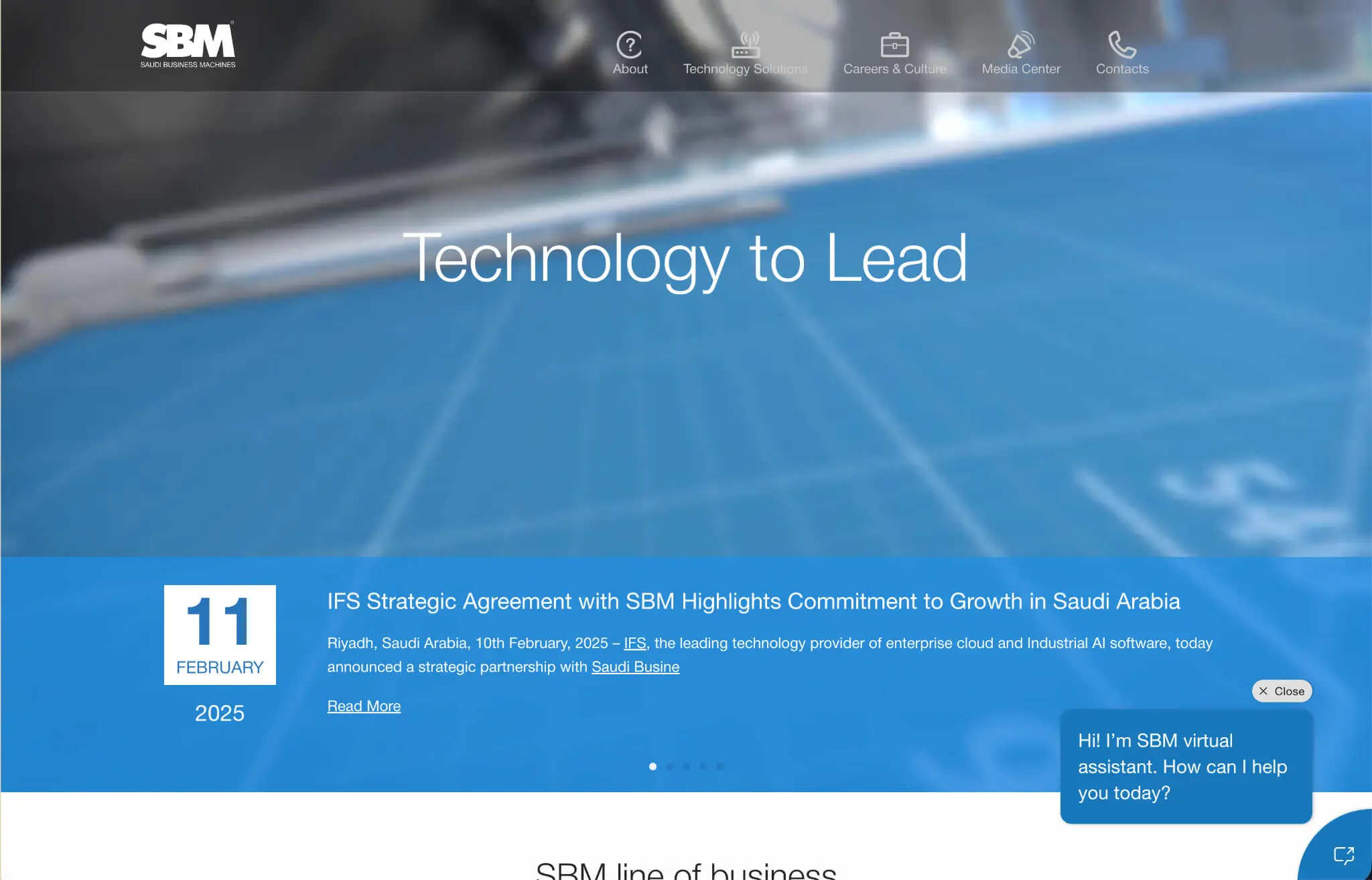
Saudi Business Machines official website
Saudi Business Machines (SBM) has been IBM’s General Marketing & Services Representative in the Kingdom since 1981, and it remains one of the country’s largest enterprise‑IT providers. Cybersecurity is one strand of an end‑to‑end portfolio that also covers cloud, infrastructure, and operations support, and it is naturally strong in IBM‑centric and large‑enterprise environments.
Through its cybersecurity unit, SBM delivers managed security services 24/7 monitoring, advanced threat protection, vulnerability management, and incident response backed by its own security operations center, along with consulting and infrastructure security (firewalls, IPS, web/email gateways, network access control). For organizations already standardized on IBM, or seeking a single large integrator for both IT and security, SBM’s enterprise depth is the draw.
Core Services: Managed Security Services (24/7 monitoring), Advanced Threat Protection, Incident Response, Vulnerability Management, Infrastructure Security, Security Consulting
Ideal for: Large enterprises, particularly those standardized on IBM technology that want managed security delivered by an established, full‑stack Saudi IT integrator.
4. Security Matterz
Website: securitymatterz.com | Founded: 2007 | HQ: Riyadh | Employees: ~150
Security Matterz official website
Security Matterz is an independent, Riyadh‑based pure‑play cybersecurity company that has operated since 2007, predating much of today’s Saudi market. It holds an NCA Tier‑2 MSOC licence and runs a locally operated SOC, positioning itself as a vendor‑agnostic managed‑security and consulting specialist rather than a broad IT integrator.
Its managed security services cover SIEM, threat hunting, vulnerability management, and compliance aligned to NCA and SAMA requirements, complemented by professional services (deployment of SIEM, SOAR, PAM, DLP, and Zero‑Trust technologies) and a consulting practice spanning risk, governance, and roadmaps. Security Matterz also runs a Cybersecurity Academy delivering CISSP, CISM, CISA, and ISO certification training, an in‑house talent‑building angle few peers offer.
Core Services: NCA Tier‑2 Managed SOC / MSS (SIEM, threat hunting, vulnerability management), Compliance (NCA/SAMA), Professional Services (SIEM/SOAR/PAM/DLP/Zero Trust), Security Consulting, Cybersecurity Training Academy
Ideal for: Mid‑market and enterprise organizations that want an independent, vendor‑agnostic Saudi MSSP with an NCA Tier‑2‑licensed SOC and in‑house training capability.
5. KPMG
Website: kpmg.com/sa | HQ: Riyadh (offices Kingdom‑wide) | Global cyber: 5 delivery centres, 9,300+ specialists
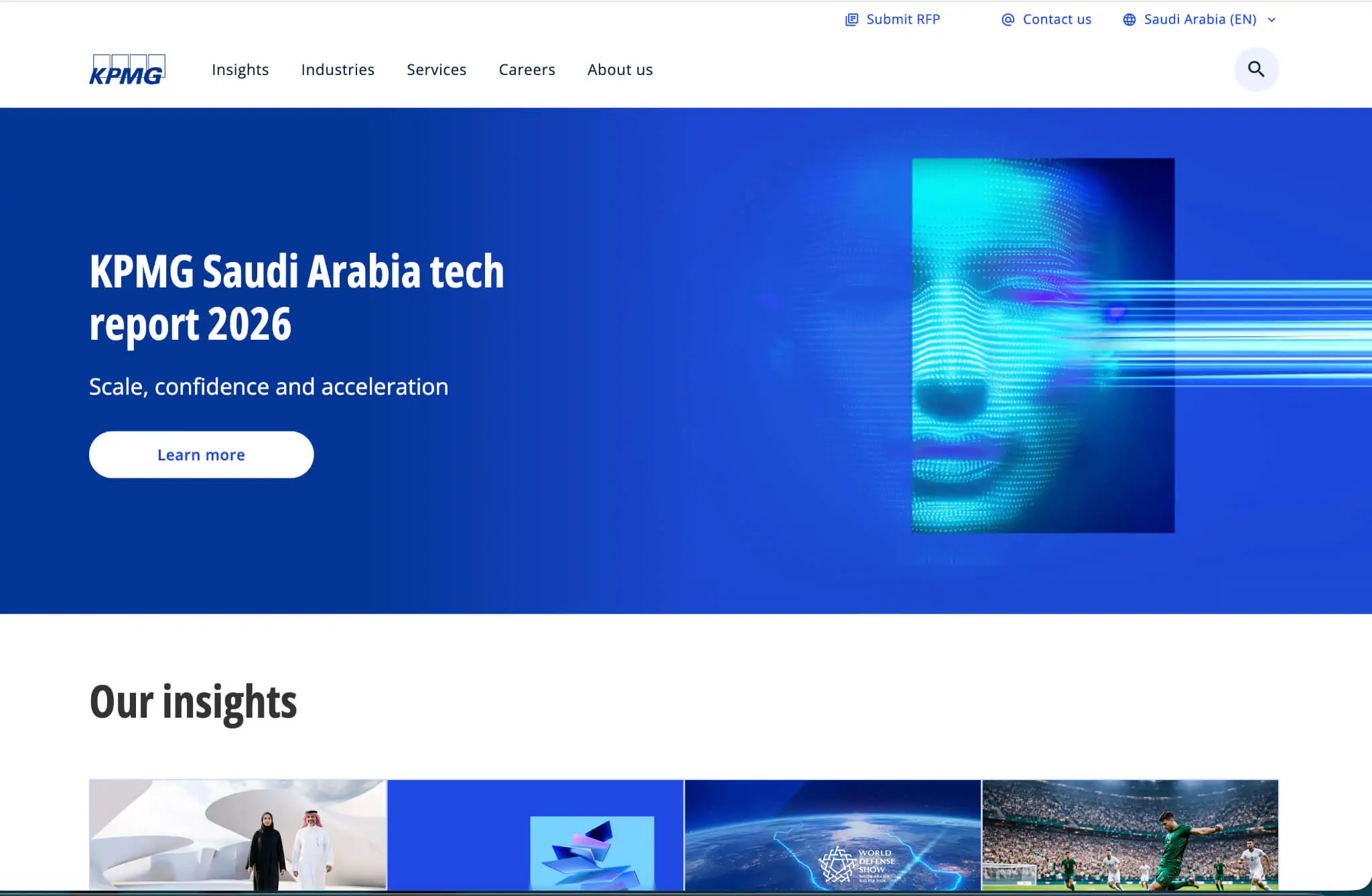
KPMG Saudi Arabia official website
KPMG runs one of the largest global cyber practices of any professional‑services firm, combining advisory and GRC with a 24/7 Managed Detection and Response (MDR) service delivered from five cyber delivery centres across the Americas, Europe, and Asia‑Pacific. In Saudi Arabia its strength is advisory and compliance depth NCA, SAMA, and PDPL programs and readiness and it is an authorized audit firm for Saudi Aramco’s third‑party cybersecurity standard (SACS‑002).
On the managed‑security side, KPMG does not appear among the NCA’s publicly announced MSOC licensees in the Kingdom; its MDR is delivered from global centres, and for in‑Kingdom, CNI‑grade operations it works through partners in 2025 it teamed with Cyberani (an NCA Tier‑1 licensee) on OT‑security talent and an industrial Digital Twin and simulation lab. Buyers with data‑residency or critical‑infrastructure mandates should confirm the delivery and residency model.
Core Services: Cyber Advisory & Strategy, GRC & Compliance (NCA/SAMA/PDPL), Managed Detection & Response (global delivery), Incident Response, SACS‑002 Audit, OT Security (with Cyberani) Ideal for: Enterprises wanting Big‑Four advisory depth and global MDR, typically paired with a locally‑licensed MSOC for in‑Kingdom, CNI‑grade delivery.
6. SITE (Saudi Information Technology Company)
Website: site.sa | Founded: 2017 | HQ: Riyadh | Employees: ~1,000
SITE is a PIF‑owned national technology and cybersecurity company, created to build and protect the Kingdom’s digital assets with Saudi‑developed capabilities. It holds an NCA Tier‑1 MSOC license and was rated a “Leading” company in the 2023 IDC MarketScape for Managed Security Services in the Gulf. Its certifications include PCI DSS v4.0, SOC 2, and the Cloud Security Alliance’s Trusted Cloud Service Provider mark.
Beyond day‑to‑day managed security, SITE has underpinned cyber resilience at some of the Kingdom’s highest‑profile events the Hajj seasons, the Future Investment Initiative, and Saudi Arabia’s G20 presidency. Its mandate is unusually broad for an MSSP: alongside MSOC and managed detection and response across IT and OT, it delivers cloud services, enterprise systems integration, and national cyber‑workforce development, having provided 750+ services to roughly 250 beneficiary organizations.
As a sovereign, PIF‑backed provider, SITE is aimed squarely at government and critical‑national‑infrastructure mandates, and at large public‑ and private‑sector programs that value a national champion with broad technology reach.
Core Services: MSOC, MDR, IT & OT Monitoring, Incident Response, Cloud Services, Enterprise/Systems Integration, Cyber‑Workforce Development
Ideal for: Government and critical‑national‑infrastructure programs and large national initiatives that want a sovereign, PIF‑backed provider combining Tier‑1 managed security with broad digital‑transformation capability.
7. Sahara Net
Website: sahara.com | Founded: 1989 | HQ: Dammam (branches in Riyadh, Jeddah, Jubail, Yanbu) | Employees: ~230
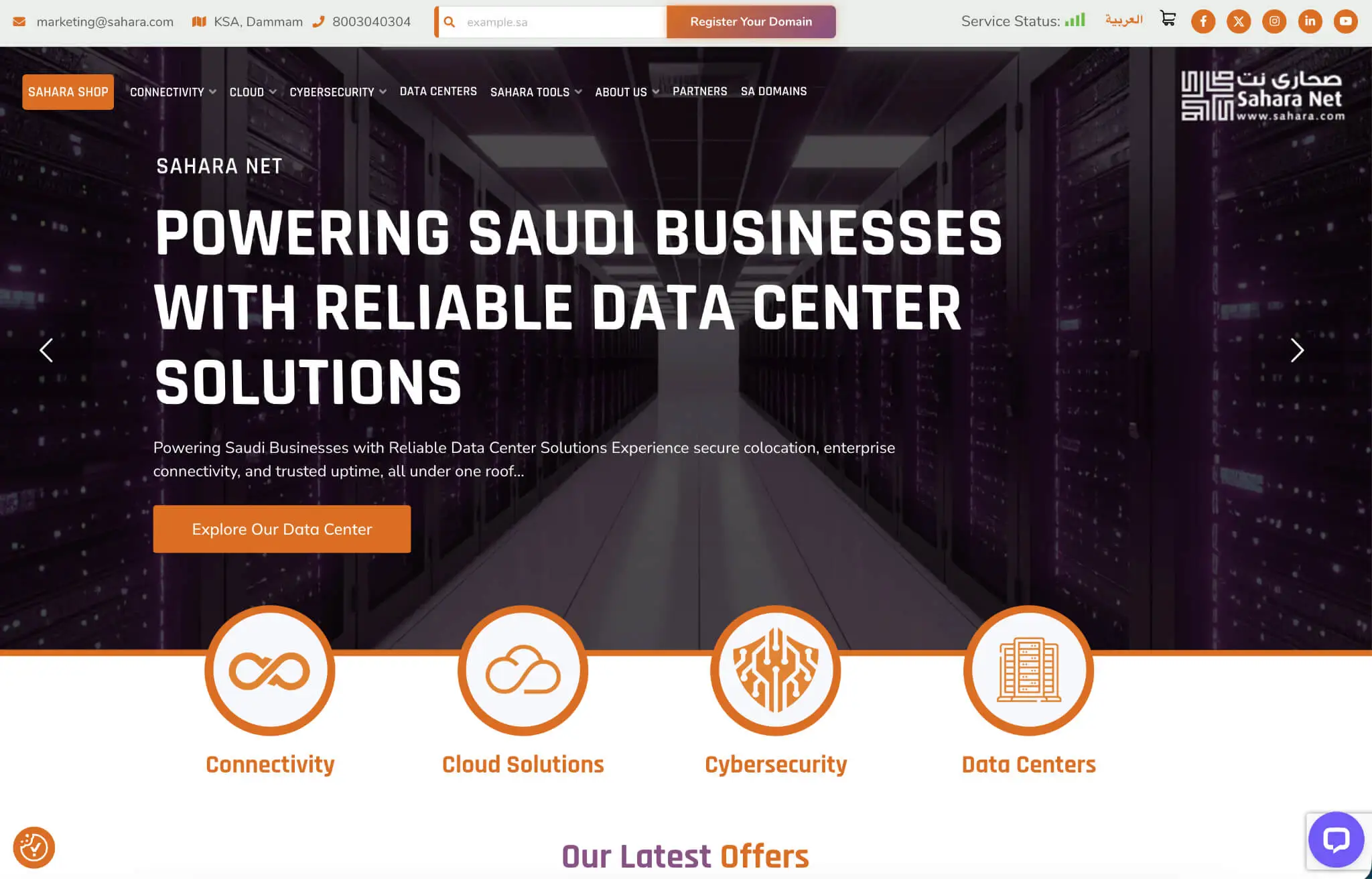
Sahara Net official website
Sahara Net is one of Saudi Arabia’s oldest ICT providers; it launched one of the Kingdom’s first public internet services in the mid‑1990s and has grown into a B2B provider of managed security, cloud, and connectivity. It operates a Security Operations Center located inside Saudi Arabia and owns local data centres, with services aligned to the Kingdom’s major regulators SAMA, CST, NCA, CMA, and SDAIA.
Its distinguishing feature is delivery under one roof: managed security bundled with in‑Kingdom hosting and connectivity from a single, long‑established local operator. The SOC is in‑Kingdom and regulator‑aligned, though Sahara Net is not among the NCA’s published MSOC licensees, so buyers with a formal MSOC‑licence requirement should confirm its current status.
Core Services: Managed Security / SOC, Cloud Computing, Connectivity, Hosting & Data Centres
Ideal for: Saudi organizations that want managed security bundled with sovereign in‑Kingdom hosting and connectivity from a veteran local ICT provider.
8. Innovative Solutions (IS)
Innovative Solutions official website
Innovative Solutions (IS) is a Riyadh‑headquartered cybersecurity and digital‑services company that has grown over two decades into one of the GCC’s larger commercial security providers, with operations in Saudi Arabia and the UAE and a reported 1,200+ clients across 4,000+ projects. It holds an NCA Tier‑2 MSOC license, authorizing it to deliver managed SOC services to organizations outside the government/critical‑infrastructure tier.
IS runs its managed SOC in flexible models, fully managed, co‑managed, hybrid, or cloud, alongside MDR, security advisory, cloud security, and AI security. A distinctive strength is digital trust and payments: IS holds ISO 27001 and ISO 22301 and is a Payment Application Qualified Security Assessor (PA‑QSA), which suits regulated and payment‑intensive sectors.
Core Services: Managed SOC (fully/co‑managed/hybrid/cloud), MDR, Security Advisory, Cloud Security, AI Security, Digital Payments & Trust
Ideal for: Enterprises and regulated or payment‑intensive organizations that want an NCA Tier‑2‑licensed commercial MSSP with flexible SOC models and strong payments/compliance credentials.
9. Infratech
Website: infratech.com.sa | Founded: 2012 | HQ: Riyadh
Infratech official website
Infratech is a Riyadh‑based, Saudi‑owned cybersecurity firm that operates an NCA‑licensed full‑scale Managed SOC (mSOC) and pairs defensive monitoring with strong offensive‑security capability. Its portfolio spans real‑time threat monitoring and SIEM management, incident response with SAMA/NCA compliance reporting, penetration testing and red‑team engagements, and GRC and risk consulting.
The firm holds a First‑Class Cybersecurity Contractor Classification under the Kingdom’s national contractor system, and in June 2025 it expanded its end‑to‑end cyber‑defense services, formally combining its licensed mSOC with advanced offensive capabilities. Its NCA mSOC licence is confirmed, though it is not among the six Tier‑1 licensees and its tier is not publicly specified.
Core Services: NCA‑licensed Managed SOC, Threat Monitoring & SIEM, Incident Response & Compliance (SAMA/NCA), Penetration Testing & Red Team, GRC & Risk Consulting
Ideal for: Saudi enterprises and public‑sector bodies that want a licensed local mSOC combined with genuine offensive‑security depth.
10. Cyberani
Website: cyberani.sa | Founded: 2021 | HQ: Riyadh (MSOCs in Riyadh and Dhahran) | Employees: ~250
Cyberani official website
Cyberani “Cyberani by Aramco Digital” is the cybersecurity company of Aramco Digital, pairing national‑scale backing with deep operational‑technology (OT) expertise drawn from the energy sector. It holds an NCA Tier‑1 MSOC license and runs two managed security operations centers, in Riyadh and Dhahran, covering both IT and OT environments. In 2025 it was named a Leader in the IDC MarketScape for Middle East Managed Detection and Response, one of 18 providers assessed.
Its credentials are unusually concrete for the region: a CREST‑accredited SOC and penetration‑testing practice, membership of FIRST (the global incident‑response community), and a reported 100% result across seven tactics in the MITRE ATT&CK evaluations. The portfolio spans MSOC and MDR, digital forensics and incident response (DFIR), threat intelligence, offensive security (vulnerability assessment, penetration testing, red teaming), and OT‑specific security, alongside GRC and integration services. Cyberani is also an authorized audit firm for Saudi Aramco’s third‑party cybersecurity standard (SACS‑002) directly useful to any supplier that must certify to do business with Aramco.
With Aramco Digital behind it and dual IT/OT MSOCs, Cyberani is a natural fit for energy and industrial operators, government, and critical‑infrastructure environments where operational‑technology risk is front of mind.
Core Services: IT & OT MSOC, MDR, DFIR & Incident Response, Threat Intelligence, Offensive Security (VA, Penetration Testing, Red Team), OT/ICS Security, GRC, Integration Services
Ideal for: Energy, industrial, government, and critical‑infrastructure organizations that need a Tier‑1‑licensed partner with genuine IT‑and‑OT depth and Aramco‑ecosystem credentials.
How to Choose the Right MSSP in Saudi Arabia
The ten providers above differ widely in license tier, focus, scale, and depth, and the right choice is rarely the “biggest” name; it is the one that fits your sector, your regulatory exposure, and the gaps you cannot staff internally. For a Saudi CISO who has to answer to a board, a sector regulator, and increasingly a procurement committee, a few dimensions matter more than the generic vendor checklist.
Start with the NCA MSOC license tier. This is the clearest first filter, and one unique to the Kingdom. Only Tier‑1 licensees may serve government entities and critical national infrastructure so if you operate in those domains, the shortlist is effectively the NCA’s six Tier-1 licensees three of which (Haboob, SITE, and Cyberani) are profiled in this guide.
Demand practical regulatory fluency, not a compliance brochure. Your provider should map its delivery to your specific obligations under the NCA’s ECC (and the newer NCNICC‑1:2025 if you are a private‑sector entity), the SAMA Cybersecurity Framework if you are a financial institution, and the PDPL including SDAIA’s 72‑hour breach‑notification workflow and Data Protection Officer support. Ask to see the audit‑ready evidence their service generates, because when the regulator or your board asks, you answer not the MSSP.
Insist on in‑Kingdom data residency and an Arabic‑speaking SOC. PDPL constrains cross‑border transfer of personal data, so where your telemetry is stored and processed is a compliance question, not just an architectural one. Ask where the analysts who will watch your environment actually sit, whether they operate on Saudi time, and whether reporting and out‑of‑hours escalation happen in Arabic.
Test for regional and OT‑aware threat intelligence. Generic global feeds underweight the threats that matter here. Ask for concrete, recent examples of locally relevant activity the provider detected and actioned and, if you run energy or industrial systems, probe for genuine OT/ICS capability rather than IT‑only monitoring relabeled as “OT‑ready.”
Match the provider’s strength to your actual gap. National-grade MSOC/MDR points to Haboob, SITE, or Cyberani; deep OT/energy needs to Cyberani; enterprise IT-integrated security to MIS / Al Moammar and SBM; advisory-led programs with global MDR to KPMG; security bundled with sovereign hosting to Sahara Net; and flexible commercial or mid-market engagements to Security Matterz, Innovative Solutions, and Infratech.
Check sector references and the Aramco supply‑chain bar. Ask for references from organizations of comparable size in your industry, and if you sell into or operate within the energy ecosystem, confirm the provider can support Saudi Aramco’s third‑party cybersecurity standard (SACS‑002). How a provider performs during a live incident, not in a proposal, is the most reliable predictor of the relationship you will have.
Weigh local presence and Saudization. On‑the‑ground teams, local accountability, and alignment with national workforce goals increasingly count both for response speed and, in government and semi‑government tenders, for eligibility and scoring.
Frequently Asked Questions
What is an MSSP, and how is it different from a traditional IT security vendor? An MSSP runs your security operations on an ongoing basis, 24/7 monitoring, threat detection, incident response, and compliance support rather than selling a product or performing a one‑off assessment. It takes day‑to‑day operational responsibility for spotting and stopping threats, usually through a 24/7 SOC.
MSSP, MDR, SOC‑as‑a‑Service what’s the difference? They overlap. A SOC (or SOC‑as‑a‑Service) is the monitoring facility and analysts; MDR adds active threat hunting and hands‑on containment rather than just alerting; “MSSP” is the umbrella term for a provider delivering managed security services, which usually include a SOC and often MDR plus vulnerability management and compliance. Most Saudi providers offer all three.
What is the NCA MSOC license, and why do the tiers matter? The National Cybersecurity Authority licenses Managed Security Operations Center providers in tiers. Tier‑1 licensees may serve all organizations, including government and critical national infrastructure; Tier‑2 licensees serve the private sector outside CNI. The tier tells you whether a provider is eligible to operate in your regulatory domain.
How do I verify an MSSP’s NCA license? Check the NCA’s official announcements and licensee listings, or ask the provider for its license reference and tier, and confirm it matches your needs. Don’t rely on a logo or marketing claim alone.
Do MSSPs help with NCA, SAMA, and PDPL compliance and how does regulation affect which one I choose? Yes. Most leading Saudi MSSPs map their delivery to the NCA’s ECC and NCNICC‑1:2025 controls, the SAMA Cybersecurity Framework for financial institutions, and the PDPL. Because an MSSP that handles your personal data is a “processor” under PDPL, its data‑processing agreement, in‑Kingdom residency, breach‑notification support, and audit‑ready evidence all factor into the choice.
Does my data have to stay inside the Kingdom? PDPL restricts cross‑border transfer of personal data, so where an MSSP stores and processes your data matters. Many Saudi providers run in‑Kingdom SOCs and data centers; confirm data residency and a PDPL‑compliant data‑processing agreement before signing.
How quickly must a data breach be reported in Saudi Arabia? Under PDPL, organizations must notify SDAIA within 72 hours of becoming aware of a personal‑data breach that could harm individuals, and notify those affected as well. A capable MSSP detects quickly and supports that notification workflow within the window.
Do I still need an MSSP if I have an in‑house team? Often, yes. Few organizations can fully staff a 24/7 SOC or retain scarce analysts especially against PDPL’s 72‑hour clock. A co‑managed model is common: the MSSP runs round‑the‑clock monitoring while your team focuses on strategy, architecture, and business context.
Which sectors most need an MSSP in Saudi Arabia? Government, energy and industrial (OT/ICS), SAMA‑regulated financial services, healthcare, and telecom carry the highest regulatory and threat exposure but with NCNICC‑1:2025 extending mandatory controls to the broader private sector, most organizations now have a baseline to meet.
Can an MSSP secure OT/ICS environments (energy, industrial)? Some can. Protecting industrial control systems requires different tooling and skills than IT monitoring, so look for providers with genuine OT/ICS capability and a dedicated OT SOC, for example, rather than IT‑only monitoring relabeled “OT‑ready.”
How much does an MSSP cost in Saudi Arabia? It varies widely with organization size, scope, and compliance needs; published estimates place managed security services roughly in the range of tens of thousands to a few hundred thousand SAR per year. Treat any figure as indicative and scope a quote against your own environment.
Are these ten the only MSSPs in Saudi Arabia? No. This guide highlights ten notable providers, but the market is larger the NCA has licensed further Tier‑1 and Tier‑2 MSOC providers, and many capable commercial firms operate without a public MSOC license. Use the selection criteria above to build a shortlist for your context.
Which providers are the largest or most credentialed? The NCA’s six Tier-1 MSOC licensees hold the highest national grade; three of them — Haboob, SITE, and Cyberani — are profiled in this guide. Cyberani was named a Leader in the 2025 IDC MarketScape for Middle East MDR, and SITE was rated a Leading company in the 2023 IDC MarketScape for Gulf Managed Security Services. Among commercial providers, Innovative Solutions and Security Matterz holds an NCA Tier-2 license.
What makes Saudi Arabia’s threat landscape distinct? As a major energy and government hub, the Kingdom’s highest‑stakes risk concentrates in operational technology and critical infrastructure, alongside industrializing ransomware and AI‑enabled phishing. Generic global detection underweights this mix, so regional, OT‑aware threat intelligence is a meaningful differentiator.
SOCRadar provides extended threat intelligence covering threat actors targeting Saudi Arabia, on Dark Web forums, Telegram channels, and data leak sites. Our Dark Web monitoring capabilities help detect early exposure of organizational data before that exposure escalates into a breach. Request a demo or run a free Dark Web scan to understand your current exposure baseline.

Table Of Content
Related Articles
PEEP: A Browser RAT Posing as a Chrome Extension
Sep 04, 2026
Exposing AnonyMousKIT: AI-Powered PhaaS Supply Chain
Aug 24, 2026