

Mar 10, 2026
Mar 25, 2026
8 Mins Read
Sep 13, 2026
Table Of Content
Key Takeaways
Planning and Use-Case Definition
Data Collection and Preparation
Model Selection and Development
Validation and Security Testing
Deployment and Release Controls
Monitoring, Change Management, and Incident Response
Retirement and Continuous Improvement
How SOCRadar Supports Secure AI Workflows
Frequently Asked Questions
Related Articles

SMS Bombing
Threat Actors
Jan 08, 2026
Dark Web Monitoring
Feb 19, 2026

Ransomware
Jan 31, 2026
OSINT Framework
Apr 17, 2026

AI Development Lifecycle
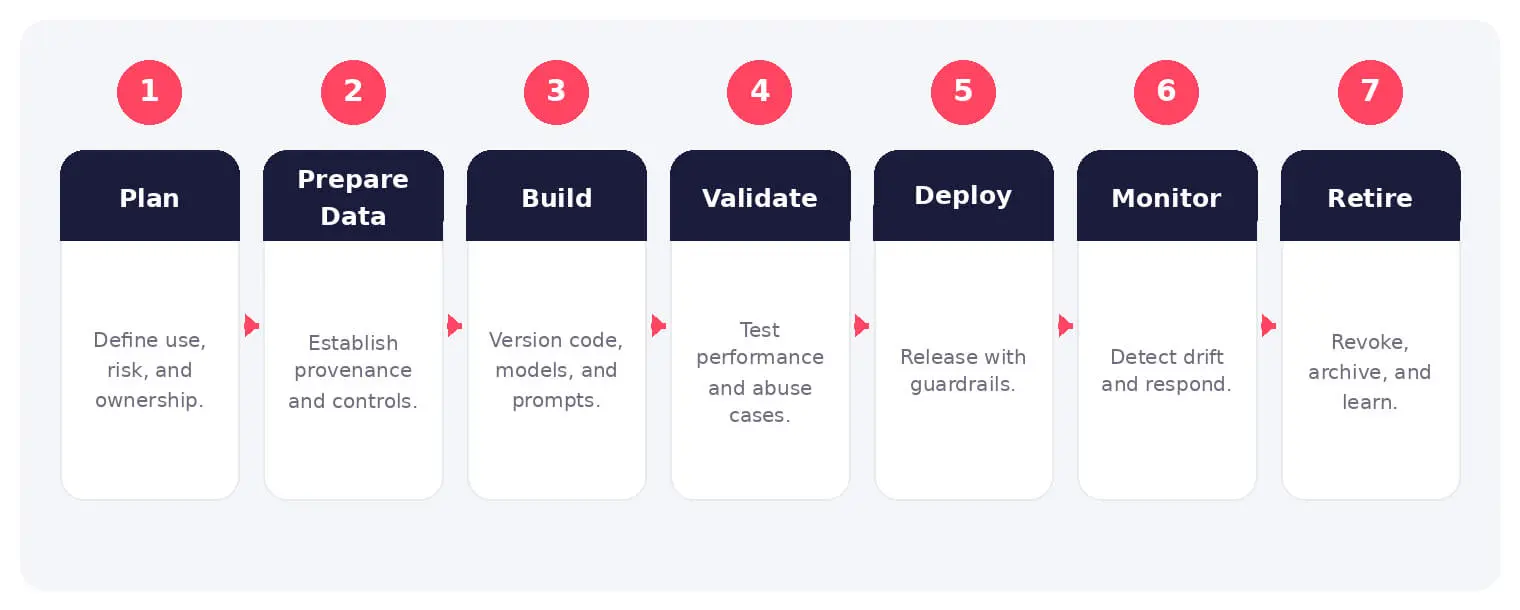
The AI development lifecycle is the structured process used to plan, build, validate, deploy, monitor, and retire an artificial intelligence system. It extends the software development lifecycle because model behavior also depends on data, training methods, prompts, retrieval sources, evaluation criteria, and changing operating conditions.
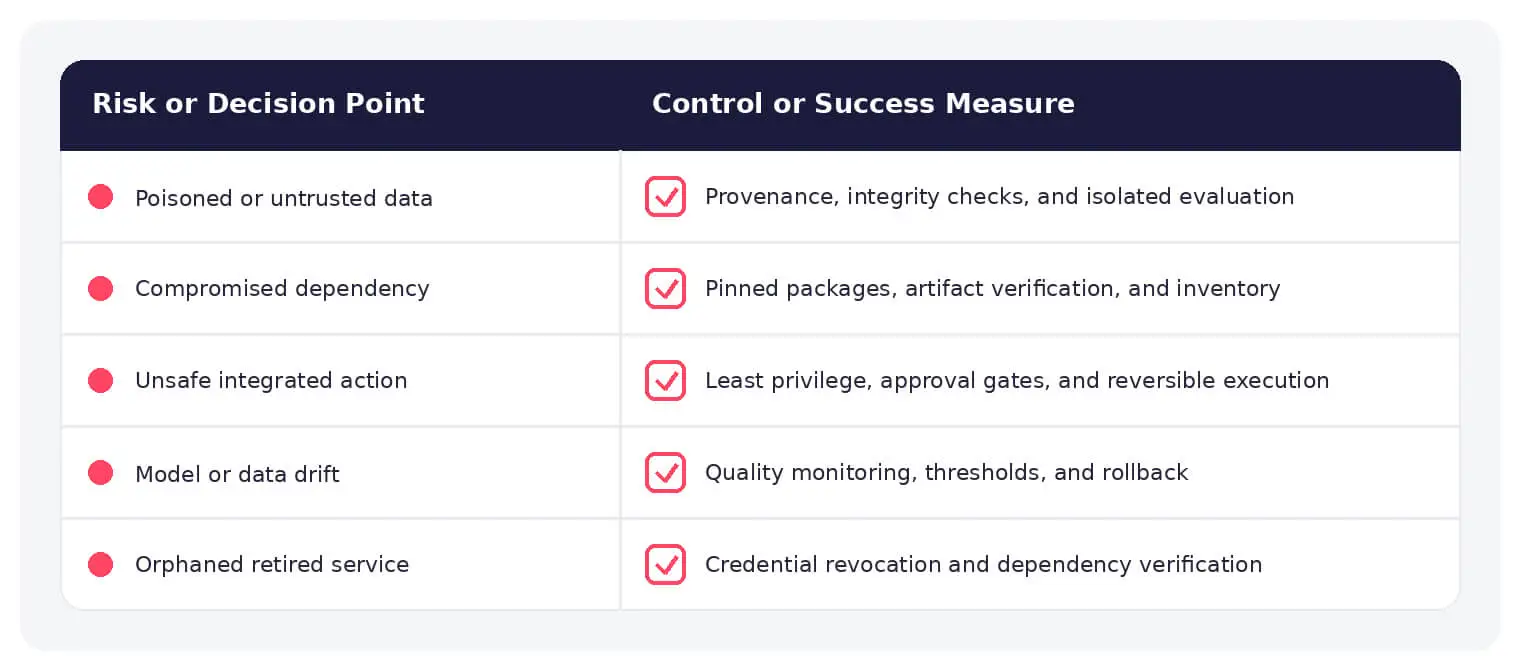
Security cannot be added only at deployment. Data poisoning may begin during collection, unsafe code can enter through dependencies, prompt injection can exploit production integrations, and model drift can weaken a system after release. Each lifecycle stage needs an owner, evidence, approval criteria, and a path to correction.
Key Takeaways
- The lifecycle begins with a defined problem, risk tier, owner, and acceptance criteria.
- Data provenance, quality, privacy, and access controls are security requirements.
- Validation must test performance, misuse, adversarial input, integration behavior, and recovery.
- Monitoring continues after release and must support rollback, retraining, and retirement.
Planning and Use-Case Definition
A lifecycle begins by defining the decision the AI system will support and the users affected by it. Teams should document intended use, prohibited use, expected inputs and outputs, business value, potential harm, human oversight, and the consequences of a wrong answer or unavailable system.
The use case should receive a risk tier before development starts. A summarization assistant has a different impact from a system that changes access rights or blocks infrastructure. The risk tier determines the required review, evaluation depth, monitoring, and approval authority.
Data Collection and Preparation
Training, evaluation, retrieval, and operational data need documented provenance. Teams should confirm that collection and use are lawful, remove unnecessary personal or confidential data, check representativeness, identify bias, and protect integrity throughout storage and transfer.
Development and evaluation sets should remain separate. Access should follow least privilege, and transformations should be reproducible. Security teams should test whether poisoned records, malicious documents, hidden instructions, or label manipulation can influence the system.
Model Selection and Development
The team should compare whether a rule, conventional model, retrieval system, large language model, or agent is appropriate for the problem. More capable models may increase cost, opacity, and attack surface without improving the target outcome.
Development controls include reviewed code, pinned dependencies, secret management, isolated environments, signed artifacts, and a software bill of materials where practical. Prompts, system instructions, retrieval configuration, tools, and permission scopes should be versioned alongside code because they can change behavior materially.
Validation and Security Testing
Validation should use data that reflects real operating conditions and important edge cases. Teams need task-specific measures rather than a single generic accuracy score. They should evaluate false positives, false negatives, calibration, robustness, latency, cost, and performance across relevant groups and environments.
Security testing should cover prompt injection, jailbreaks, data extraction, sensitive output, poisoned retrieval, evasion, dependency compromise, denial of service, and excessive agency. Tests must include the complete application, because a safe model can still become dangerous when connected to vulnerable tools or broad permissions.
Deployment and Release Controls
Deployment should use controlled environments, approved configurations, encrypted connections, least-privilege identities, and separation between development and production. A staged release or shadow mode lets teams compare model output with current decisions before users or systems depend on it.
The release package should include a model or system card, evaluation results, known limitations, approved use, incident contacts, monitoring thresholds, and rollback instructions. High-impact actions require explicit approval gates and idempotent, reversible execution where possible.
Monitoring, Change Management, and Incident Response
Production monitoring should track input drift, output quality, safety events, latency, cost, user overrides, tool calls, and changes in data sources. Logs need enough context to reconstruct a decision without retaining sensitive content longer than necessary.
A model, prompt, retrieval source, dependency, or permission change can alter risk and should trigger proportionate reevaluation. Incident plans should address harmful output, data exposure, compromised dependencies, poisoned knowledge sources, and unauthorized actions. Teams need the ability to disable a feature quickly while preserving evidence.
Retirement and Continuous Improvement
Retirement is part of the lifecycle. Teams should remove endpoints, revoke credentials, archive required records, delete data according to policy, notify dependent owners, and confirm that shadow integrations are not still calling the system.
Lessons from production errors, analyst feedback, and incidents should update evaluation datasets and design standards. Continuous improvement does not mean automatic retraining; every material change should pass through version control, testing, approval, and monitored release.
How SOCRadar Supports Secure AI Workflows
SOCRadar provides current external threat and exposure context that AI systems and analysts can use during validation and operations. Extended Threat Intelligence helps teams check indicators, exposed assets, threat activity, supplier risk, impersonation, and Dark Web findings against observed data.
Explore SOCRadar Extended Threat Intelligence or request a demo to add verified external intelligence to AI-assisted security workflows.
Frequently Asked Questions
What Stages Make Up the AI Development Lifecycle?
A complete lifecycle moves through seven stages:
- Planning and use-case definition
- Data collection and preparation
- Model selection and development
- Validation and security testing
- Deployment and release controls
- Monitoring, change management, and incident response
- Retirement and continuous improvement
Each stage should have a named owner, acceptance criteria, and recorded evidence before the system moves forward.
How Does the AI Development Lifecycle Differ From a Traditional SDLC?
Conventional software behavior is primarily determined by code, so code review and functional testing cover most of the risk. AI systems also depend on training and evaluation data, prompts, retrieval sources, model versions, and operating conditions, any of which can change behavior without a single code change. The lifecycle therefore adds data governance, model evaluation, drift monitoring, and oversight of autonomous actions on top of standard engineering controls.
Where Do Security Risks Enter the AI Development Lifecycle?
At every stage. Data poisoning can begin during collection, unsafe code can arrive through dependencies during development, prompt injection can exploit production integrations, and model drift can weaken behavior after release. This is why controls belong in planning, data handling, validation, and operations rather than only at deployment.
What Is a Risk Tier and Why Assign It Before Development?
A risk tier classifies how much harm a system could cause based on the decisions it supports and the users affected. A summarization assistant and a system that changes access rights or blocks infrastructure carry very different consequences. Assigning the tier early determines the required review depth, evaluation rigor, monitoring, and approval authority before teams invest in the build.
How Should Teams Secure Data Collection and Preparation?
Document the provenance of training, evaluation, retrieval, and operational data, and confirm that collection and use are lawful. Remove unnecessary personal or confidential data, check representativeness and bias, and protect integrity during storage and transfer. Keep development and evaluation sets separate, apply least-privilege access, and test whether poisoned records or hidden instructions can influence the system.
Which Attacks Should AI Security Testing Cover?
Validation should go beyond accuracy scores and test adversarial conditions such as:
- Prompt injection and jailbreak attempts
- Sensitive data extraction and unsafe output
- Poisoned retrieval content and training data manipulation
- Dependency compromise and denial of service
- Excessive agency, where the system acts beyond its intended scope
Test the complete application rather than the model alone, because a safe model connected to vulnerable tools or broad permissions can still cause harm.
What Is Shadow Mode and Why Deploy It Before Full Release?
In shadow mode, the new model runs alongside the current decision process, and its outputs are compared with production results without users or systems depending on them. This exposes performance gaps, unexpected behavior, and integration problems under real traffic. Teams often follow it with a staged release so that exposure grows only after the comparison looks sound.
What Warning Signs Suggest a Deployed AI System Needs Review?
Watch for input distribution drift, declining output quality, rising safety events, increased user overrides, unexplained changes in latency or cost, and tool calls or data sources that differ from the approved configuration. Any of these can indicate that the system no longer behaves as validated. Logs should retain enough context to reconstruct the affected decisions without holding sensitive content longer than necessary.
How Should Teams Respond to a Security Incident Involving an AI System?
Incident plans should cover harmful output, data exposure, compromised dependencies, poisoned knowledge sources, and unauthorized actions taken by the system. The immediate priorities are to disable or roll back the affected feature quickly while preserving logs and evidence for investigation. Findings should then update evaluation datasets and design standards before service is restored.
What Does Retiring an AI System Involve?
Retirement should be handled as a controlled change rather than an afterthought. Teams should remove endpoints, revoke credentials, archive required records, delete data according to policy, and notify dependent owners. It is also worth checking that shadow or forgotten integrations are no longer calling the retired system.
Does Continuous Improvement Require Automatic Retraining?
No. Continuous improvement means that lessons from incidents, production errors, and analyst feedback update evaluation datasets and design standards. Every material change should still pass through version control, testing, approval, and a monitored release, because uncontrolled retraining can introduce behavior changes that nobody has validated.