AI Hallucinations
AI hallucinations are statements or outputs that appear plausible but are false, fabricated, or unsupported by the available evidence. Large language models generate likely sequences of words; they do not automatically verify each claim against a source of truth.
A hallucination is not intentional deception. The risk comes from fluency and specificity: a false vulnerability, citation, command, or incident detail may sound authoritative enough to influence a decision. Cybersecurity teams need controls that make claims traceable and prevent unverified output from triggering consequential action.
Key Takeaways
- Hallucinations can invent facts, citations, packages, indicators, vulnerabilities, and remediation steps.
- Ambiguous prompts, missing context, weak retrieval, conflicting data, and pressure to answer increase risk.
- Retrieval-Augmented Generation reduces unsupported output but does not guarantee correctness.
- Decision-critical output needs sources, uncertainty signals, validation, and human approval.
How AI Hallucinations Occur?
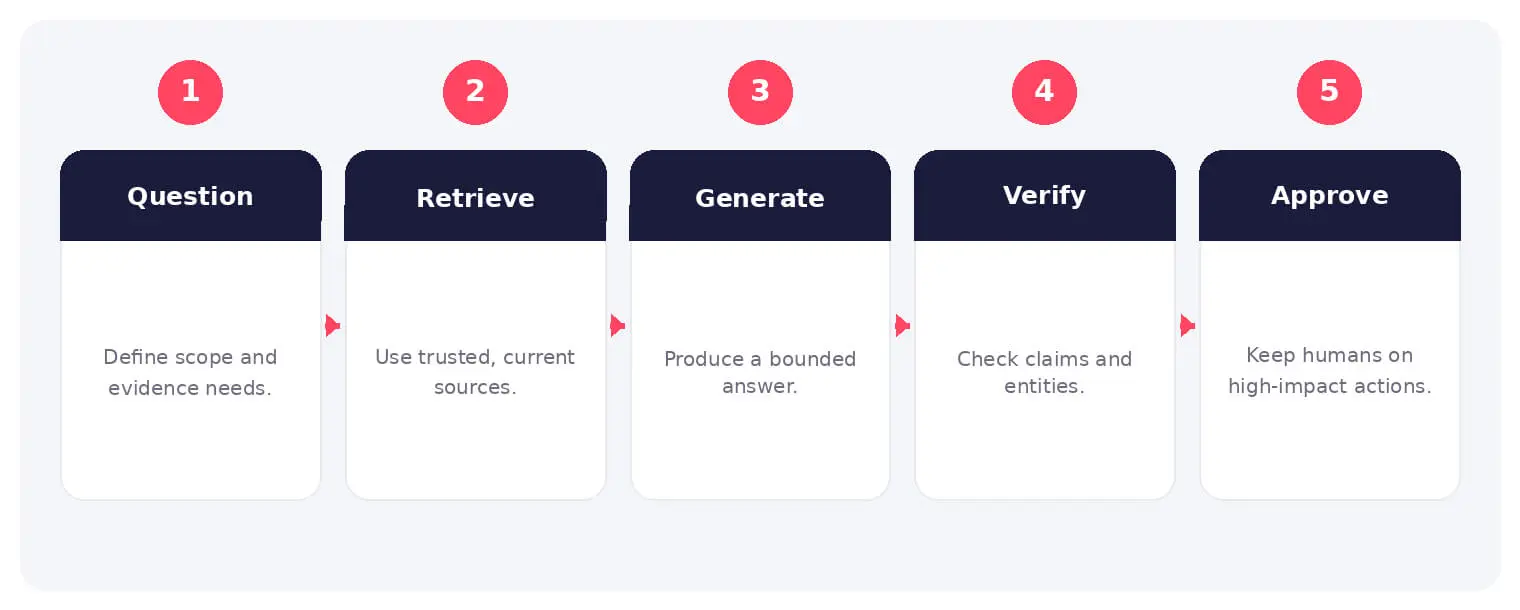
A generative model estimates which token should come next based on learned patterns and the context it receives. When reliable information is absent or conflicting, the model may continue with a statistically plausible completion. The result can be coherent while lacking factual support.
Hallucination risk rises with vague prompts, niche or recent subjects, incomplete retrieval, low-quality training data, long conversations, and requests that assume a false premise. Sampling settings can affect variability, but lowering creativity does not turn a language model into a fact-checking system.
Common Types and Real-World Examples
Fabricated citations resemble legitimate papers, advisories, or URLs but do not exist. Phantom code references nonexistent packages, methods, or parameters. Entity confusion blends people, products, campaigns, or events with similar names. Numerical hallucinations invent dates, counts, percentages, or severity scores.
In cybersecurity, a system may report a nonexistent CVE, attribute an indicator to the wrong actor, claim exploitation without evidence, or recommend an invalid command. It may also omit an important condition and present a generally correct statement as if it applied to every version or environment.
Why AI Hallucinations Matter in Cybersecurity
Security decisions are time-sensitive and often have production impact. A false positive can waste investigation time or disrupt a legitimate service. A false negative can leave a real threat unaddressed. Fabricated attribution can also create legal, reputational, and diplomatic risk.
Automation increases the potential impact. When model output flows directly into ticketing, blocking, remediation, or customer communication, one unsupported conclusion can propagate across systems. The more authority an AI system receives, the stronger its evidence, approval, logging, and rollback requirements must become.
Best Practices for Reducing AI Hallucinations
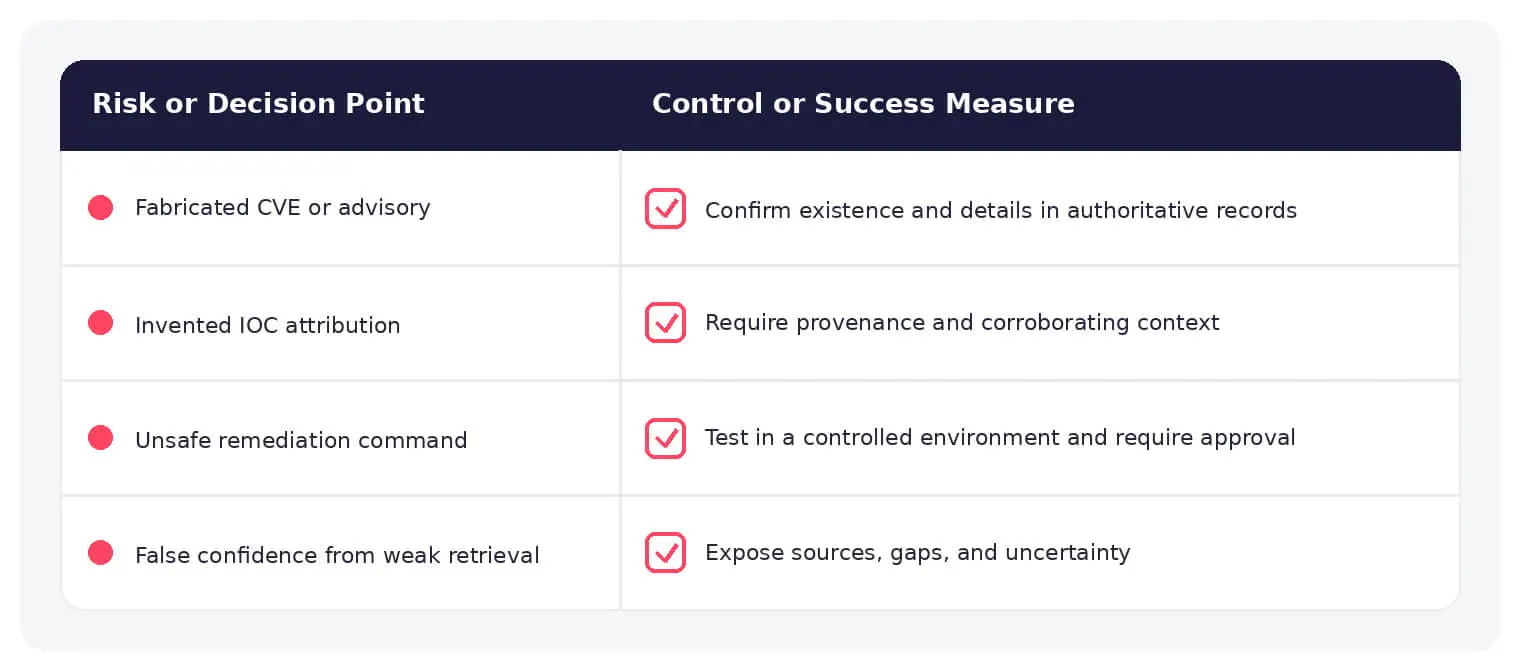
Ground answers in authoritative, current sources through retrieval and require the system to cite the evidence used. Retrieval sources should be curated, permission-aware, and protected from malicious instructions. A cited source still needs validation because the model may misread or misapply it.
Prompts should define scope, time, environment, expected format, and what the model must do when evidence is insufficient. Structured outputs can require a claim, source, confidence level, and missing information. For technical work, validate URLs, CVE IDs, versions, hashes, package names, and commands against authoritative records.
Use human review for high-impact decisions and separate generation from authorization. A second model may help detect inconsistencies, but independent tools or source checks provide stronger assurance. Track failure patterns by task so the team can improve retrieval, prompts, evaluation data, and escalation rules.
Detecting Hallucinated Security Content
Warning signs include unusually precise claims without sources, citations that do not resolve, inconsistent dates, impossible product versions, indicators without provenance, and confident answers to questions whose evidence is unavailable. Analysts should also check whether a response silently accepted an incorrect premise.
Automated validation can confirm syntax and existence for structured entities such as CVEs, domains, IP addresses, hashes, and package names. Factual accuracy still requires authoritative context. The system should distinguish verified findings, model inference, and unresolved uncertainty instead of blending them into one narrative.
How SOCRadar Can Help Validate AI-Generated Findings
SOCRadar Extended Threat Intelligence gives analysts current evidence about external assets, vulnerabilities, indicators, threat actors, impersonation, supplier exposure, and Dark Web activity. That context helps teams check AI-generated claims against observable intelligence before they prioritize or act.
Explore SOCRadar Extended Threat Intelligence or request a demo to add verified external context to AI-assisted investigations.
Frequently Asked Questions
What Counts as an AI Hallucination?
An AI hallucination is output that reads as plausible but is false, fabricated, or unsupported by the available evidence. A language model generates likely sequences of words rather than verifying each claim against a source of truth, so a nonexistent CVE or citation can sound as authoritative as a real one. It is not intentional deception; the risk comes from fluency and specificity influencing a real decision.
Why Do Language Models Produce Hallucinated Answers?
The model estimates which token should come next based on learned patterns and the context it receives. When reliable information is absent, ambiguous, or conflicting, it may continue with a statistically plausible completion that is coherent but lacks factual support. Vague prompts, niche or very recent subjects, incomplete retrieval, and questions built on a false premise all raise the likelihood.
What Are the Most Common Hallucination Types in Security Work?
Frequent examples include fabricated citations and URLs, phantom packages or code methods, entity confusion between similarly named actors or products, and invented dates, counts, or severity scores. In security contexts this can appear as a nonexistent CVE, wrong actor attribution, a claim of exploitation without evidence, or an invalid remediation command. A response may also present a generally correct statement as if it applied to every version or environment.
What Makes Hallucinations Especially Risky for Cybersecurity Teams?
Security decisions are time-sensitive and often affect production systems. A fabricated finding can waste investigation time or disrupt a legitimate service, while a missed real threat or a false attribution carries operational, legal, and reputational consequences. Because output can flow directly into ticketing, blocking, or remediation, one unsupported conclusion can propagate across systems.
What Warning Signs Suggest an AI Response Is Hallucinated?
Look for unusually precise claims without sources, citations that do not resolve, inconsistent dates, impossible product versions, and indicators without provenance. A confident answer where the underlying evidence is simply unavailable is another red flag. Analysts should also check whether the response silently accepted an incorrect premise built into the question.
How Should Analysts Verify Technical Claims in AI Output?
Check structured entities such as CVE IDs, hashes, package names, domains, and IP addresses against authoritative records, since automated checks can confirm syntax and existence. Material claims need comparison against current, authoritative context, because correct syntax alone does not establish factual accuracy. The output should separate verified findings, model inference, and unresolved uncertainty instead of blending them into one narrative.
How Does Retrieval-Augmented Generation Affect Hallucination Risk?
Retrieval-Augmented Generation grounds answers in supplied documents and reduces reliance on model memory, which lowers the frequency of unsupported output. It does not guarantee correctness: retrieval can return incomplete, outdated, unauthorized, or poisoned content, and the model can misread or misapply a valid source. Curated sources and claim-level validation remain necessary.
Is a Cited Source Enough to Trust an AI Answer?
A citation is a starting point, not proof. A model can reference a real document while quoting it out of context, omitting a stated condition, or mixing it with invented detail. Open the source, confirm it supports the specific claim, and verify that the source itself is authoritative and current.
Can Sampling Settings Such as Temperature Reduce Hallucinations?
Sampling settings affect how varied the output is, so lower-creativity configurations can make responses more consistent. They do not turn a language model into a fact-checking system, and a conservative model can still produce confident, unsupported claims. Configuration helps, but it is not a substitute for retrieval, validation, and human review on consequential decisions.
Why Do Automated Workflows Amplify the Impact of a Hallucination?
When model output feeds ticketing, blocking, remediation, or customer communication without a checkpoint, no one pauses to question the claim before action occurs. A single fabricated indicator or vulnerability can then trigger changes across multiple systems before the evidence is checked. The more authority an AI step receives, the stronger its evidence, approval, logging, and rollback requirements should be.

Oct 16, 2026
CVE-2026-102764: BeyondTrust Zero-Day Exploited
BeyondTrust has disclosed CVE-2026-102764, a critical Remote Support vulnerability exploited as a zero-day weeks before customers received a patch. The attack began…

Oct 15, 2026
Cisco Secure Email & PAN-OS Zero-Days Exploited
Cisco Secure Email & PAN-OS Zero-Days Exploited Cisco and Palo Alto Networks have patched two actively exploited zero-day vulnerabilities that can lead…

Oct 15, 2026
SOCRadar Splunk Integration: New MSSP and Vulnerability Apps
SOCRadar Splunk Integration: New MSSP and Vulnerability Apps Your analysts live in Splunk. Your external risk does not: SOCRadar alarms for dozens…
Intelligence in your inbox every Thursday.
Join 30,000+ security professionals reading SOCRadar research.
Subscribe