
What Are Money Mules?
Money mules are people or entities that receive, transfer, withdraw, convert, or otherwise move funds for criminals. Some knowingly participate, while others are deceived through fake jobs, romance scams, investment schemes, or requests to process payments on another person’s behalf.
Mules create distance between the victim and the organizers and are central to business email compromise, account takeover, carding, refund fraud, ransomware, and other cashout operations. Even an unwitting participant can face frozen accounts, debt, investigation, and legal consequences.
Key Takeaways
- Knowing professional mules is a central category or technique.
- Reliable assessment requires source, ownership, timing, and operational context.
- Detection should connect external evidence with identity, device, network, and business signals.
- Response should protect affected people and remove reusable access paths.
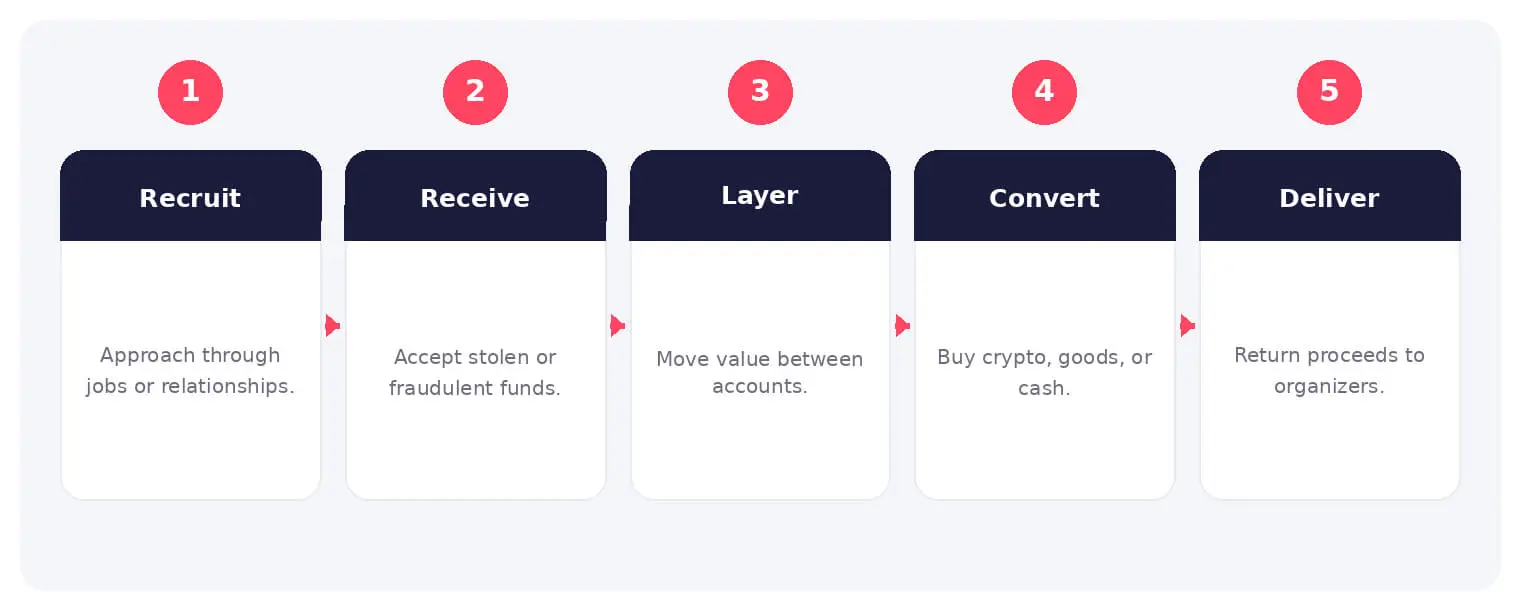
How Money Mules Works
The sequence above provides a practical operating model. Individual steps can overlap, repeat, or involve different people and services, so each stage should be validated against available evidence.
Mules create distance between the victim and the organizers and are central to business email compromise, account takeover, carding, refund fraud, ransomware, and other cashout operations. Even an unwitting participant can face frozen accounts, debt, investigation, and legal consequences.
Common Types and Techniques
- Knowing professional mules
- Unwitting job or romance-scam victims
- Complicit account holders and businesses
- Reshipping and cryptocurrency mules
Security, Privacy, and Business Risks
- Financial loss and account closure
- Money-laundering investigation and legal risk
- Identity theft and coercion of recruited victims
- Reduced recovery as funds move rapidly
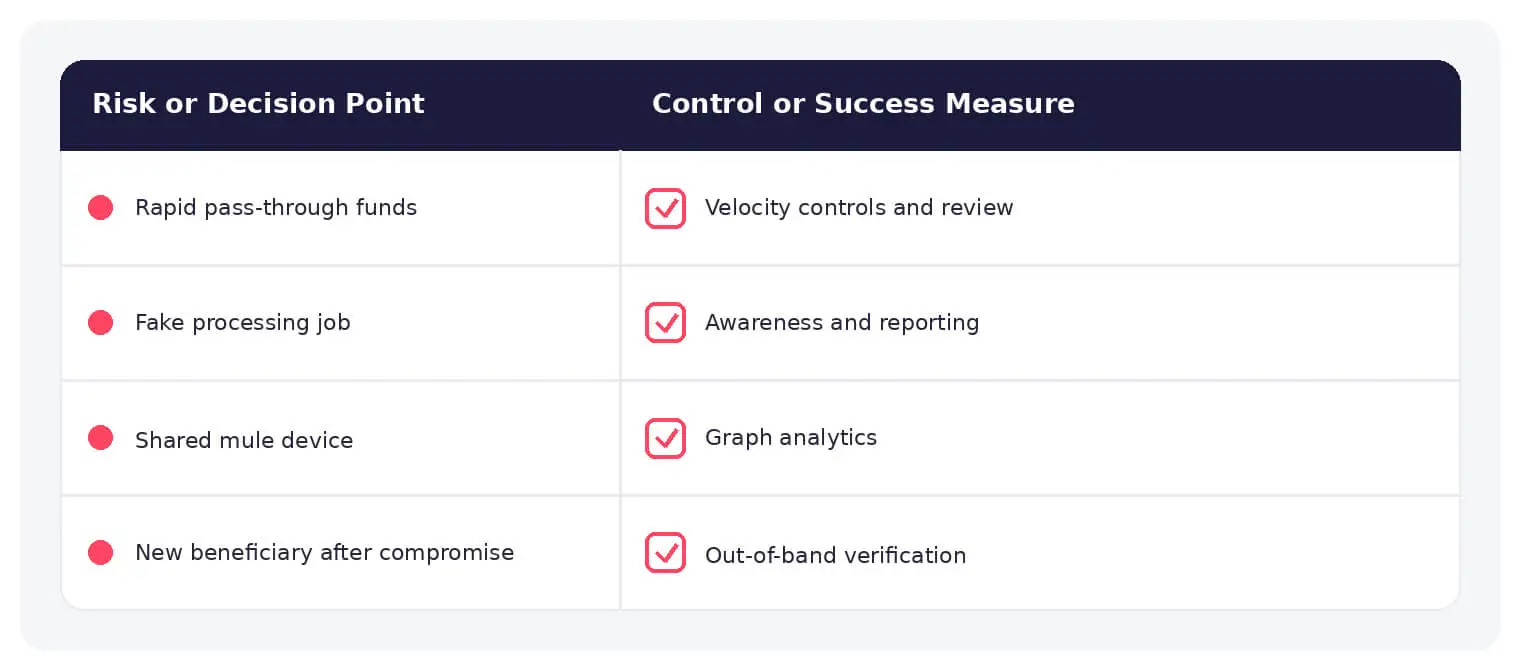
Warning Signs and Validation
Look for new beneficiaries, rapid pass-through transactions, many unrelated senders, immediate crypto or cash conversion, unusual device sharing, scripted account opening, and customers describing payment-processing jobs.
Prevention and Response
Educate customers and employees, verify unusual transfers, detect account and device networks, delay high-risk transactions, restrict newly added beneficiaries, support victims, and coordinate quickly with financial institutions and authorities.
How SOCRadar Can Help
SOCRadar combines external intelligence, Dark Web visibility, brand monitoring, attack-surface discovery, and contextual enrichment to help teams identify exposure and investigate activity connected to money mules.
Explore SOCRadar Dark Web Monitoring or request a demo to strengthen external threat detection and response.
Frequently Asked Questions
Who Typically Becomes a Money Mule?
Students, job seekers, people under financial pressure, and romance-scam victims are frequent targets, but recruiters also use complicit account holders, small businesses, and professional facilitators. Some participants know the funds are illicit, while many believe they are doing legitimate payment-processing work. No single profile fits, as recruitment campaigns target different age groups, regions, and financial situations.
How Do Criminals Recruit Money Mules?
Common channels include fake job ads, social media and messaging outreach, dating apps, and unsolicited offers to receive and forward payments for a commission. Romance and investment scams are also used to steer victims into transferring funds themselves. Recruitment often begins with a small, routine-looking transaction to build trust before larger sums appear.
What Does a Money Mule Actually Do?
A mule receives funds into a personal or business account and forwards them through bank transfers, cash withdrawals, cryptocurrency purchases, or peer-to-peer payments, usually keeping a small percentage. Layering multiple accounts and transfers obscures the connection between victims and organizers. Some mules also open accounts for others or share banking credentials and devices.
What Warning Signs Suggest a Job Offer Is a Mule Scam?
Red flags include requests to receive company payments in your personal account, instructions to keep a percentage of transferred funds, pressure to act quickly, and requests to convert money into cryptocurrency. Vague employer details and job descriptions that avoid naming a company are also common. Legitimate employers do not route their payments through strangers’ accounts.
What Account Patterns Are Typical of Mule Activity?
Fraud teams and analysts commonly look for the following indicators:
- Rapid pass-through transactions, with funds leaving shortly after arrival
- Deposits from many unrelated senders followed by consolidated outflows
- Recently added beneficiaries receiving large or urgent transfers
- Immediate conversion to cryptocurrency or repeated cash withdrawals
- The same device, IP address, or phone number linked to several accounts
No single signal is conclusive, so these patterns should be assessed together with customer history and context.
What Should You Do If You Suspect You Have Moved Criminal Funds?
Stop moving money immediately and notify your bank so it can flag, hold, or freeze the account. Preserve all messages, job postings, and transaction records, and report the incident to your national fraud or cybercrime reporting channel. Avoid spending any commission you received, since funds may have to be returned and your records can help clarify your role.
What Are the Consequences of Acting as a Money Mule?
Even unwitting mules can face frozen or closed accounts, repayment demands, a damaged banking history, and criminal investigation. In many jurisdictions, penalties depend on intent and knowledge, but claiming ignorance does not guarantee exemption from liability. A laundering-related record can also affect future employment and access to financial services.
Why Do Criminals Use Mules in Business Email Compromise?
Diverted BEC and invoice-fraud payments are typically moved through mule accounts within hours, which makes recalls difficult once the money has moved on. A single mule network can serve many campaigns, so one compromised payment process can fund multiple fraud operations. This is why out-of-band verification of payment-detail changes and immediate recall requests matter.
Can Funds Be Recovered After They Pass Through a Mule Account?
Recovery becomes substantially harder once funds are split across multiple accounts, withdrawn as cash, or converted to cryptocurrency. Fast reporting gives banks and authorities a better chance to freeze or recall transfers before further movement. Coordination between victims, financial institutions, and law enforcement is therefore time-critical.
Is a Money Mule the Same as a Money Launderer?
Not exactly. Money laundering is the broader process of disguising criminal proceeds, while a mule is usually one layer within that process, moving funds on someone else’s behalf. Many mules do not know the money’s origin, but a witting participant can be prosecuted as part of the laundering scheme.

Oct 16, 2026
CVE-2026-102764: BeyondTrust Zero-Day Exploited
BeyondTrust has disclosed CVE-2026-102764, a critical Remote Support vulnerability exploited as a zero-day weeks before customers received a patch. The attack began…

Oct 15, 2026
Cisco Secure Email & PAN-OS Zero-Days Exploited
Cisco Secure Email & PAN-OS Zero-Days Exploited Cisco and Palo Alto Networks have patched two actively exploited zero-day vulnerabilities that can lead…

Oct 15, 2026
SOCRadar Splunk Integration: New MSSP and Vulnerability Apps
SOCRadar Splunk Integration: New MSSP and Vulnerability Apps Your analysts live in Splunk. Your external risk does not: SOCRadar alarms for dozens…
Intelligence in your inbox every Thursday.
Join 30,000+ security professionals reading SOCRadar research.
Subscribe