




Jul 22, 2026
Table Of Content
How Private AI Compute Is Redefining the Future of Secure Intelligent Computing
What Is Private AI Compute and Why Does It Matter?
How Does Private AI Compute Keep Data Private?
What New Experiences Does Private AI Compute Enable?
Why Does Google Need Cloud Models for Privacy-Sensitive Tasks?
How Does Private AI Compute Fit Into Google’s Broader AI Responsibility Strategy?
What Could This Mean for the Future of Privacy-Driven AI?
Conclusion
Related Articles

CVE-2026-50522 PoC Fuels SharePoint Attacks

CVE-2026-6875 Hits ServiceNow AI Platform
Jul 21, 2026

SonicWall SMA Flaws Lead to KNUCKLEBALL Malware
Jul 21, 2026


Nov 13, 2025
5 Mins Read
Jul 08, 2026

How Private AI Compute Is Redefining the Future of Secure Intelligent Computing
AI systems are becoming more capable, more personal, and more deeply integrated into daily workflows. Yet as these models grow in intelligence, so does the need for stronger, more transparent privacy protections. Google’s newly announced Private AI Compute aims to address exactly that. It promises cloud-level AI performance while keeping user data securely isolated, which is an important leap forward for anyone relying on privacy-sensitive AI features.
What Is Private AI Compute and Why Does It Matter?
Private AI Compute is Google’s latest cloud-based AI processing architecture designed to offer Gemini-level reasoning, speed, and intelligence without sacrificing user privacy.
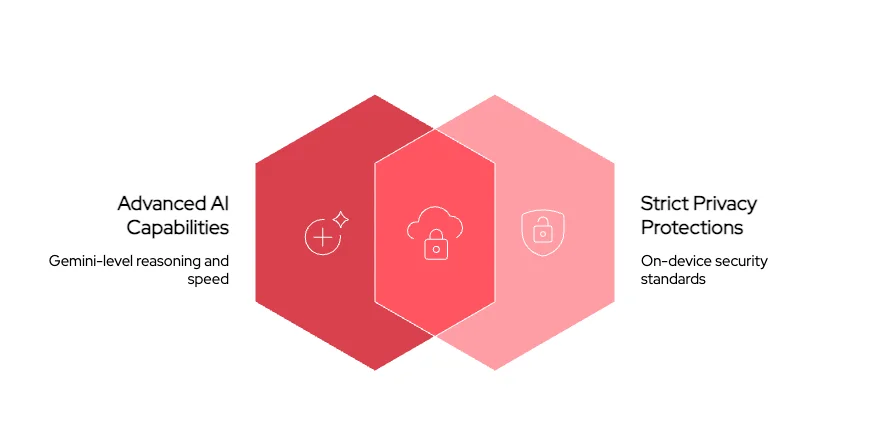
Google’s newly announced AI processing architecture combines advanced AI capabilities with strict privacy protections.
Traditionally, the most sensitive AI tasks have remained on-device because of their security requirements. However, these tasks are often computationally intensive, making on-device processing a limiting factor. With Private AI Compute, Google introduces a way to use advanced cloud capabilities while retaining strict privacy protections that mirror on-device security. This approach signals a shift in how companies may soon handle encrypted AI workloads, especially those requiring more power than mobile processors can supply.
How Does Private AI Compute Keep Data Private?
Google describes Private AI Compute as a fortified, hardware-secured environment that isolates user data throughout processing. This involves several integrated layers:
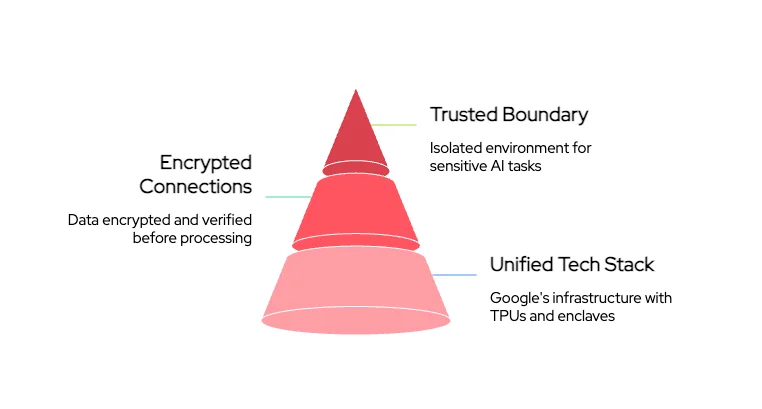
How does Google’s Private AI Compute keep your data private?
- One unified Google tech stack: This AI processing architecture runs on Google’s internal infrastructure, including custom TPUs and the Titanium Intelligence Enclaves that enforce hardware-backed isolation. These environments are similar to those used for Gmail and Search, but purpose-built for sensitive AI interactions.
- Encrypted, attested connections: Before any processing occurs, the user’s device verifies the integrity of the enclave through remote attestation. Only then is data encrypted and transmitted into the sealed environment. According to Google, not even internal employees can access this data. Its visibility is restricted purely to the user.
- A trusted boundary for sensitive tasks: Inside this sealed space, the system processes the types of insights that would typically stay on the device, such as personal suggestions, contextual cues, and transcription summaries.
What New Experiences Does Private AI Compute Enable?
The announcement highlights early examples on Google’s Pixel devices:
- Magic Cue becomes more proactive with real-time suggestions on the Pixel 10.
- The Recorder app can now summarize conversations across more languages, tasks that previously required cloud power but could not be performed securely off-device.
These early use cases show how Private AI Compute can extend the usefulness of on-device features without relaxing privacy expectations. As cloud models grow more capable, this hybrid approach will likely unlock future functionalities such as multilingual assistants, contextual automation, or always-on personal productivity cues.
Why Does Google Need Cloud Models for Privacy-Sensitive Tasks?
AI is quickly evolving from simple command-based agents into systems capable of anticipating user needs. That level of reasoning requires significantly more computational capacity and memory than mobile hardware can support, especially when running large models like Gemini.
Offloading these tasks securely to the cloud allows users to benefit from:
- Faster response times
- More accurate and contextual suggestions
- Greater multilingual and multimodal capability
- Lower device battery consumption
Private AI Compute is Google’s answer to bridging the performance–privacy gap without compromising either side.
How Does Private AI Compute Fit Into Google’s Broader AI Responsibility Strategy?
Google positioned it as part of its long-term Secure AI Framework, backed by its AI Principles and Privacy Principles. The initiative builds on decades of work in privacy-enhancing technologies such as differential privacy, federated learning, and encrypted computing.
This context signals that Private AI Compute is not a standalone release, but a cornerstone in Google’s vision of how next-generation AI should operate: powerful, helpful, and private by design.
What Could This Mean for the Future of Privacy-Driven AI?
If widely adopted, architectures like Private AI Compute could reshape how companies handle personal AI workloads. Potential future impacts include:
- Stronger industry standards for secure AI enclaves
- Wider adoption of hybrid on-device + cloud privacy models
- More trust in generative and anticipatory AI systems
- Better regional compliance as privacy regulations tighten
- Expansion of AI features previously considered too sensitive to process off-device
This evolution may also encourage competitors to adopt similar frameworks, accelerating progress across the broader AI ecosystem.
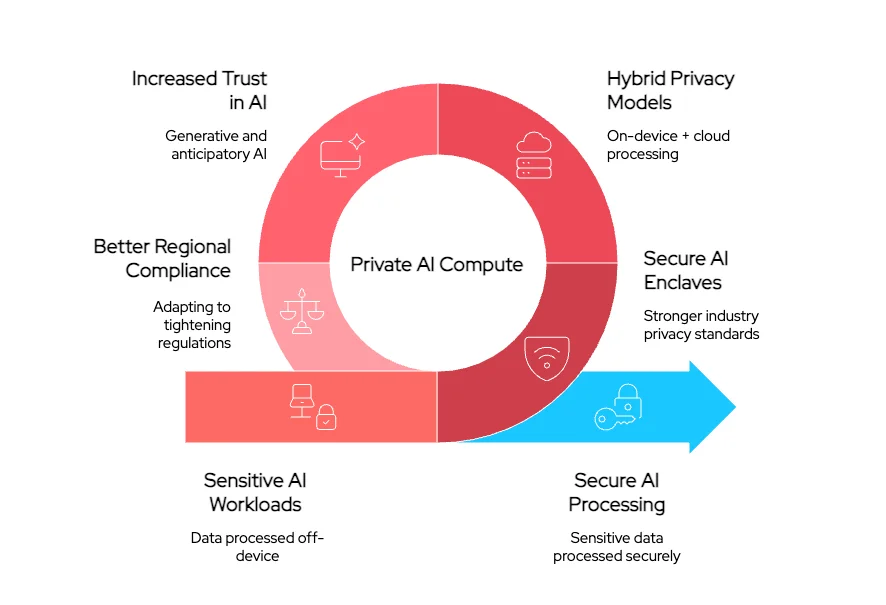
How could this privacy-driven AI solution reshape data handling?
Conclusion
Private AI Compute arrives at an important moment. Users want more capable AI, but they expect privacy guarantees that don’t weaken as models grow more powerful. Google’s new framework attempts to strike that balance, blending advanced cloud intelligence with hardware-level security measures.
If executed well, it could set a new benchmark for how cloud-based AI handles sensitive data, opening the door to smarter, safer, and more personalized digital experiences.
Google provides a detailed overview on its official blog. You can read more about the announcement here.



