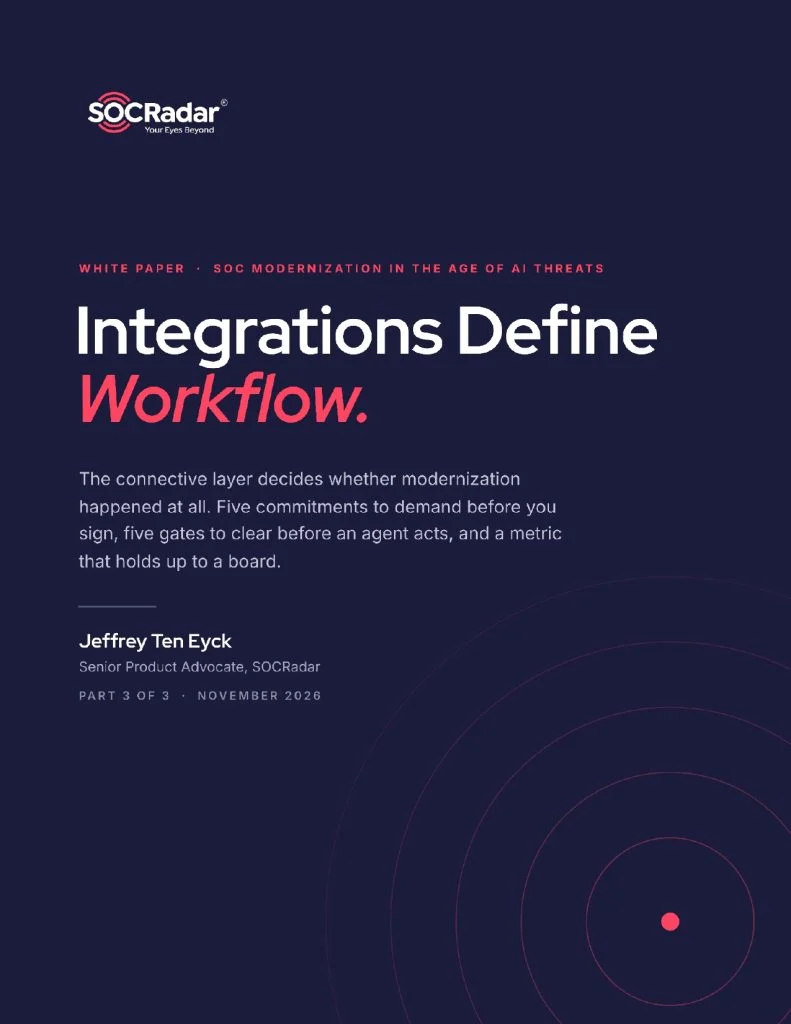
Integrations Define Workflow: The Missing Link in SOC Modernization
SOC modernization doesn’t fail because security tools lack capabilities. It fails when those tools cannot work together to turn intelligence into action.
Integrations Define Workflow, the third installment of the SOC Modernization in the Age of AI Threats series, examines why security investments often fall short of delivering operational improvements. While organizations continue expanding their security stacks, fragmented integrations, manual handoffs, and disconnected workflows create hidden costs that undermine efficiency. The whitepaper argues that successful modernization depends less on acquiring new capabilities and more on ensuring that existing tools can communicate, correlate intelligence, and support action without unnecessary human intervention.
The report explores the hidden integration tax created by fragmented security environments, where adding new intelligence sources can multiply engineering and maintenance requirements. It examines how unreliable API connections, inconsistent data models, and poorly managed credentials introduce both operational inefficiencies and security risks. The paper also addresses the growing role of agentic AI, explaining why autonomous security workflows require trustworthy integrations, clear governance, and verifiable decision-making. Through practical examples, vendor evaluation criteria, and measurable performance indicators, it provides a framework for building connected security operations that deliver results beyond tool adoption.
Key Highlights:
- Why disconnected tools and manual handoffs continue to limit SOC modernization efforts
- How the integration tax increases operational costs, engineering workloads, and security exposure
- Five essential API commitments for evaluating integration reliability, versioning, and long-term support
- The role of Model Context Protocol (MCP) in enabling AI agents to interact with security tools through standardized interfaces
- Five governance requirements for safe agentic operations, including transparency, auditability, policy enforcement, provenance, and human escalation
- How to measure modernization through closure rate without manual handling, rather than traditional alert volumes
- A practical SOC Modernization Playbook featuring three worksheets for assessing integrations, evaluating vendors, and measuring workflow improvements
Whether you’re a CISO, SOC manager, security architect, threat intelligence leader, or IT decision-maker, this whitepaper provides practical guidance for reducing integration complexity, improving operational efficiency, and building security workflows that translate intelligence into measurable outcomes.
➡️ Download the full whitepaper to discover how stronger integrations, reliable APIs, and governed AI workflows can help your organization reduce hidden costs and make SOC modernization deliver measurable results.
Fill in your details to access the complete intelligence brief.
Thank you. Your download is ready.
Download PDF
Experience the power of comprehensive
cybersecurity firsthand.
See SOCRadar in Action. Join 30,000+ security professionals who trust SOCRadar to protect their organizations.