

Oct 13, 2026
Feb 27, 2026
5 Mins Read

Summarize with:
Claude Code Security: What It Is, What It Isn’t?
When Anthropic released Claude Code Security on February 20, 2026, cybersecurity stocks dropped almost immediately. A few days later, Anthropic announced Claude could read and repair COBOL, and IBM shares fell 13% before recovering once the market processed the actual scope of the claim. COBOL has powered ATMs, airline ticketing, and government infrastructure since 1959, and IBM earns significant revenue maintaining those systems. The market feared AI could undercut that entirely. However, IBM clarified that reading COBOL is a different problem from replacing production systems built on it, and the stock bounced back.
What Is Claude Code Security?
Claude Code Security is a capability built into Claude Code, Anthropic’s agentic coding platform, currently in limited research preview for Enterprise and Team customers. It scans source codebases for vulnerabilities and proposes targeted patches for human review.
The difference from traditional scanners is in how it analyzes, not just what it looks for. Most Static Application Security Testing (SAST) tools match code against known vulnerability signatures. That works well for common issues like exposed credentials or deprecated encryption, but struggles with anything requiring contextual reasoning. Claude Code Security reads code the way a human security researcher would: understanding how components interact, tracing data flow, and reasoning about architectural risk rather than just pattern matching.
Every finding goes through a multi-stage verification process. Claude re-examines its own results, attempting to confirm or disprove them before they reach an analyst. Validated findings appear in a dashboard with severity ratings and confidence scores. Suggested patches are presented for human review. Nothing is applied automatically.
Where It Genuinely Advances the Field?
Traditional SAST tools are bound by their rule sets. They can flag a SQL injection pattern, but they cannot reason about a privilege escalation path created by how three microservices interact. That kind of analysis requires understanding architectural intent, and that is where Claude Code Security makes a real difference.
SOCRadar’s CISO, Ensar Seker, notes that the tool’s strongest value lies in vulnerability classes that static pattern matching structurally cannot reach: business logic flaws, broken authorization flows, authentication bypasses, and multi-step injection chains that span multiple modules. The key distinction is that AI reasoning models intent and context rather than syntax, which means it can surface issues in code that is technically valid but architecturally insecure.
In modern API-driven and microservice architectures, risk increasingly lives in how components interact rather than in isolated code. Tracing trust boundaries and privilege transitions across services is precisely where a reasoning-based approach has a structural edge.
On false positives: if findings are ranked by actual exploitability and business impact rather than pattern match volume, alert fatigue improves. But Ensar Seker flags that this depends heavily on implementation discipline. Poorly tuned systems can generate speculative, narrative-heavy output that makes noise worse, not better. The differentiator will be how precisely findings are scored and how cleanly they integrate into developer workflows.
What It Does Not Replace?
Claude Code Security operates at the source code level. Supply chain risk, one of the most consequential attack vectors today, sits in a different layer entirely. Compromised build artifacts, malicious dependencies, and tampered CI/CD pipelines bypass source-level scrutiny by design. SBOM validation, artifact integrity checks, dependency monitoring, and runtime controls remain necessary regardless of how capable the source analysis layer becomes.
Secrets management is another area left unaddressed. As AI-assisted development scales, so does secrets sprawl: more API keys, more AI-generated code, more autonomous agents requiring broad system access. Source code reasoning does not solve mismanaged credentials or an expanding agentic footprint.
On governance: regulatory and compliance requirements still demand deterministic processes, documented controls, and auditability. An AI scanning assistant cannot serve as a governance framework. Secure SDLC, threat modeling, dependency management, and DevSecOps integration remain essential regardless of how good the scanning layer gets.
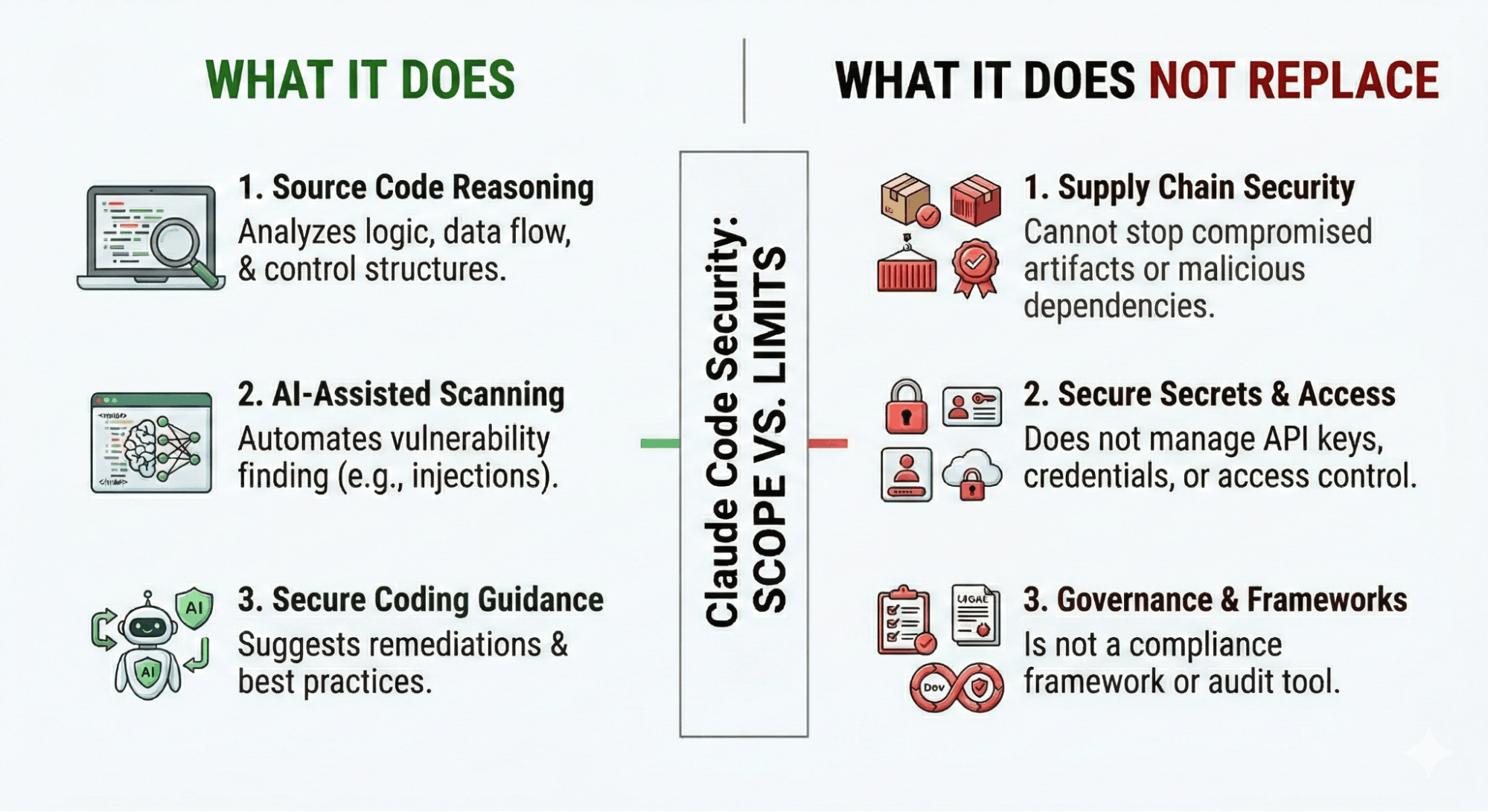
Claude Code Security, Scope vs. Limits
What Claude Code Security Means for Security Teams?
The shift happening here is broader than tooling. Security is moving from detection engines to reasoning assistants, and that changes what good looks like. A finding that comes with context, exploitability reasoning, and a suggested fix is a fundamentally different artifact than a pattern-match alert. It changes how developers engage with security feedback, and over time, that changes security culture inside engineering teams.
The organizations that will see the most value are those that embed AI-assisted analysis tightly into developer workflows, inside CI/CD pipelines and IDEs, so findings reach developers in context.
Ensar Seker: “The real transformation will not be in vulnerability count, it will be in time-to-understand and time-to-remediate. Organizations that integrate AI reasoning tightly into CI/CD pipelines and developer IDEs will see the most value. AI reasoning in code analysis is a step forward, but AppSec maturity, layered defense, and supply chain visibility remain non-negotiable.”
Those who treat it as another scanning layer dropped into an already-cluttered toolchain will likely see marginal gains.
In Conclusion
AI-assisted vulnerability analysis is a real step forward, but it is one layer in a much deeper stack. The broader shift matters more than any single tool release. Attackers are already using AI to find exploitable weaknesses faster, and defenders who integrate reasoning-based analysis while maintaining depth across the supply chain, secrets management, and governance will be better positioned than those chasing the headline capability alone.
Security is not getting simpler. The attack surface is getting wider, the tooling is getting smarter on both sides, and the organizations that build maturity into their programs now will have a compounding advantage over time.
Stay ahead of emerging threats with SOCRadar’s Extended Threat Intelligence platform. Monitor your attack surface, track threat actors, and get actionable intelligence before it becomes an incident. Try SOCRadar for Free.

Table Of Content
Related Articles

CVE-2026-97229: Critical GitLab RCE
Oct 13, 2026
CVE-2026-102255: Critical SonicWall SMA1000 SSRF
Oct 12, 2026
Critical Cisco NX-OS Flaws Threaten Nexus Switches
Oct 09, 2026