

Oct 07, 2026
Feb 03, 2026
5 Mins Read

Summarize with:
CVE-2026-21509: APT28 Actively Exploits Microsoft Office Vulnerability in Ukraine
On January 26, 2026, Microsoft released an update to address CVE-2026-21509, a high-severity vulnerability affecting nearly every modern version of Microsoft Office and the flaw is currently being exploited in the wild by state-sponsored threat actors, including the Russian-linked group UAC-0001 (APT28), to target government and diplomatic organizations.
By leveraging a specially crafted document, attackers can bypass Object Linking and Embedding (OLE) security mitigations.
This blog explains what CVE-2026-21509 is, which versions are affected, how the attacks on Ukraine worked, what indicators defenders should look for, and what actions organizations should take next.
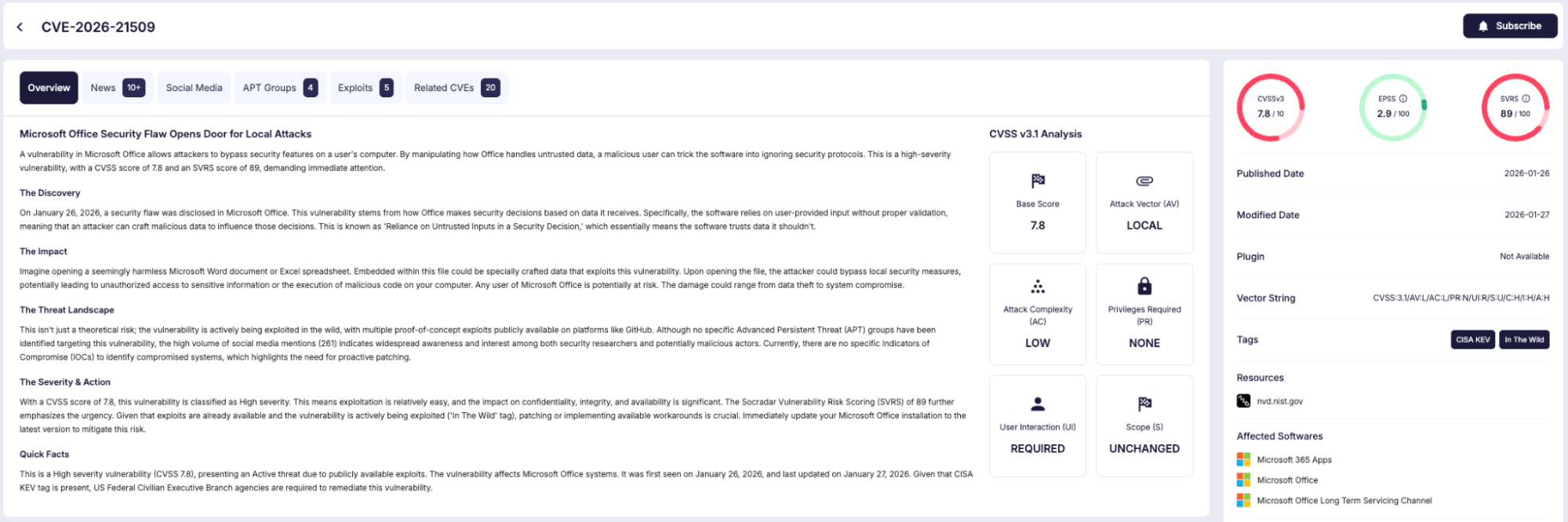
Details of CVE-2026-21509 (SOCRadar Vulnerability Intelligence)
How Is This Vulnerability Exploited in Real Life?
Based on the most recent intelligence, CVE-2026-21509 (CVSS 7.8) is actively exploited in real-world scenarios through social engineering campaigns. Attackers use specially crafted Microsoft Office documents to bypass security features and deploy malware.
The most detailed case study currently available involves the threat actor UAC-0001 (APT28) targeting organizations in Ukraine.

Social Engineering as The Attack Vector
Because this vulnerability requires user interaction, exploitation begins with phishing or lure documents rather than automated remote attacks.
- Delivery Method: Attackers send phishing emails disguised as legitimate correspondence. For example, emails were sent to Ukrainian central executive bodies purporting to be from the Ukrainian Hydrometeorological Center.
- Malicious Files: Victims are tricked into opening Microsoft Word documents (DOC files). Observed filenames include:
- BULLETEN_H.doc
- Consultation_Topics_Ukraine(Final).doc (related to EU/COREPER consultations)
Technical Execution Chain
Once a victim opens the malicious file, the exploit triggers a multi-stage infection process. The following kill chain was observed by CERT-UA in attacks against Ukrainian and EU targets:
- Initial Connection (WebDAV): Opening the document triggers a network connection to an external server using the WebDAV protocol, followed by downloading a file with a shortcut file name containing program code designed to download and run the executable file.
- System Modification: The exploit drops several files locally, including:
- EhStoreShell.dll: A malicious library disguised as a legitimate storage extension.
- SplashScreen.png: An image file containing hidden shellcode.
- COM Hijacking: The attacker modifies the Windows Registry for a specific CLSID ({D9144DCD-E998-4ECA-AB6A-DCD83CCBA16D}). This technique, known as COM hijacking, forces the system to load the malicious DLL instead of the legitimate one.
- Execution Trigger: A scheduled task named “OneDriveHealth” is created. This task terminates and restarts the explorer.exe process. When Explorer restarts, the COM hijacking ensures the malicious EhStoreShell.dll is loaded.
- Final Payload: The DLL executes the shellcode hidden in the PNG file, which launches the COVENANT framework.
In these specific real-world attacks, the attackers utilized legitimate cloud infrastructure to hide their activity. The COVENANT framework was configured to use Filen (filen.io), a legitimate encrypted cloud storage service, for its management infrastructure.
Which Versions Are Affected?
CVE-2026-21509 affects a wide range of Microsoft Office products and both 32-bit (x86) and 64-bit (x64) architectures are vulnerable. According to Microsoft and security researchers, the following versions are affected:
- Microsoft 365 Apps for Enterprise
- Microsoft Office LTSC 2024
- Microsoft Office LTSC 2021
- Microsoft Office 2019
- Microsoft Office 2016
Who Is Actually at Risk From This Issue?
The exposure from CVE-2026-21509 affects two broad groups. One group includes organizations that are already being targeted in active campaigns. The other includes any organization running the affected software without the patch.
- High-Priority Targets
- Ongoing campaigns show targeted delivery of lure documents tied to political and diplomatic themes.
- The activity is linked to a known threat actor with a history of espionage operations.
- The targeting pattern focuses on institutions involved in governance, policy, and international coordination.
- Broader Organizational Risk
- While current attacks are targeted, the vulnerability affects a massive user base. Any organization using Microsoft Office that has not applied the update is at risk.
- Lagging Security: Security researchers predict that the number of attacks will increase in the near future due to the “inertia” of the update process, meaning organizations that are slow to patch will become easy targets for cybercriminals adopting these techniques.
- The Human Element
- You are at risk if you can be convinced to open a malicious Office file.
- The exploit is delivered via phishing emails that mimic legitimate sources. Therefore, employees who frequently handle external email attachments without strict verification can be the entry point.
What Should They Do Now?
The immediate priority for any organization using Microsoft Office is to apply the out-of-band security updates released by Microsoft.
Here is the prioritized checklist of actions organizations should take now:
- Patch Immediately
- Reinforce User Training
- Alert Users: Warn employees about opening files from external sources, even if they appear to come from legitimate bodies.
- Verify Senders: Remind staff to verify the sender’s identity through a secondary channel before opening unexpected attachments.
- Registry Hardening
- If immediate patching is impossible, Microsoft recommends specific Windows registry modifications to reduce the attack surface.
Indicators of Compromise
You can find the IoCs published by the CERT-UA below.
Files:
- 7c396677848776f9824ebe408bbba943
c91183175ce77360006f964841eb4048cf37cb82103f2573e262927be4c7607f
BULLETEN_H.doc
- d8e880975ab01c745386663409a9d3aab2e771cbfa0a74d0774db162d28c1eecd3a7cb384dfe97522e9baabd1c04d304
document.doc.LnK
- 744bbe8d7c3d0421fa0deb582481f5ba
8c1dc9732884c6078b23953b78314a8d0d8b8d9fe42e5f97a7cd09b8ace943a9
s.d
- 4423b8f3456e54eb48dfbde0b4c7984b
52b6fb40e7efb09c2bebe8550178e7e30009600bdedd1acae085d753761b7598
EhStoreShell.dll
- 418dc7365e78f79ef7dfcfbfe1bc8b0ec4389cc34b672c4f885547f413bf38575e6ee2b23a0ddfdd306a69c1775db6fc
SplashScreen.png
- 331e055e6a519d443233bd740dbfe8ee495cf3fd22d4fc2c6c86b689b68141ac7d0130b0bb5cbc834ef59275132ee5c2
SplashScreen_shellcode.bin
- 6f528ad405bffa4a8c2f61b1fa2172fd
40c2e559992a7f595c593b419930a3f216516c3042ad86fb985348d53b6e01b9
covenant.dll (COVENANT)
- ee0b44346db028a621d1dec99f429823
9f4672c1374034ac4556264f0d4bf96ee242c0b5a9edaa4715b5e61fe8d55cc8
office.xml
- 4727582023cd8071a6f388ea3ba2feaa
5a17cfaea0cc3a82242fdd11b53140c0b56256d769b07c33757d61e0a0a6ec02
4727582023cd8071a6f388ea3ba2feaa.doc
- 95e59536455a089ced64f5af2539a449
b2ba51b4491da8604ff9410d6e004971e3cd9a321390d0258e294ac42010b546
Consultation_Topics_Ukraine(Final).doc
- d47261e52335b516a777da368208ee91
fd3f13db41cd5b442fa26ba8bc0e9703ed243b3516374e3ef89be71cbf07436b
1291.doc
- b6a86f44d0a3fa5a5ac979d691189f2d
969d2776df0674a1cca0f74c2fccbc43802b4f2b62ecccecc26ed538e9565eae
1301.doc
Network:
- (smb)://freefoodaid[.]com/documents/template_2_2.doc
- (smb)://wellnesscaremed[.]com/davwwwroot/buch/Downloads/blank.doc
- (smb)://wellnesscaremed[.]com/davwwwroot/venezia/Favorites/blank.doc
- (smb)://wellnessmedcare[.]org@ssl/cz/Downloads/blank.doc
- (smb)://wellnessmedcare[.]org@ssl/pol/Downloads/blank.doc
- hXXp://freefoodaid[.]com/davwwwroot/2_2.lNk?init=
- hXXp://freefoodaid[.]com/documents/2_2.lNk?init=
- hXXps://wellnesscaremed[.]com/buch/Downloads/document.doc.LnK?init=
- hXXp://wellnesscaremed[.]com/buch/Downloads/document.doc.LnK?init=
- hXXp://wellnesscaremed[.]com/venezia/Favorites/document.doc.LnK?init=
- hXXp://wellnesscaremed[.]com/venezia/d/s.d
- hXXps://wellnessmedcare[.]org/davwwwroot/cz/Downloads/document.LnK?init=
- hXXp://wellnessmedcare[.]org/davwwwroot/cz/Downloads/document.LnK?init=
- hXXps://wellnessmedcare[.]org/davwwwroot/pol/Downloads/document.LnK?init=
- hXXp://wellnessmedcare[.]org/davwwwroot/pol/Downloads/document.LnK?init=
- freefoodaid[.]com (2026-01-12)
- wellnesscaremed[.]com (2026-01-12)
- wellnessmedcare[.]org (2026-01-30)
- 159[.]253.120.2
- 193[.]187.148.169
- 23[.]227.202.14
Filen cloud storage infrastructure:
*.filen.net
*.filen-1.net
*.filen-2.net
*.filen-3.net
*.filen-4.net
*.filen-5.net
*.filen-6.net
*.filen.io
*.filen.dev
146.0.41.204
146.0.41.205
146.0.41.206
146.0.41.207
146.0.41.208
146.0.41.231
146.0.41.232
146.0.41.233
146.0.41.234
Host:
- %PROGRAMDATA%Microsoft OneDrivesetupCacheSplashScreen.png
- %PROGRAMDATA%USOPublicDataUserEhStoreShell.dll
- %TMP%Diagnosticsoffice.xml
- HKCUSoftwareClassesCLSID{D9144DCD-E998-4ECA-AB6A-DCD83CCBA16D}InProcServer32′(Default)’
- HKCUSoftwareClassesCLSID{D9144DCD-E998-4ECA-AB6A-DCD83CCBA16D}InProcServer32’ThreadingModel’
- schtasks /delete /f /tn OneDriveHealth
- schtasks.exe /Create /tn “OneDriveHealth” /XML “%TMP%Diagnosticsoffice.xml”
- start explorer >nul 2>&1
- taskkill /f /IM explorer.exe >nul 2>&1
- OneDriveHealth

Table Of Content
Related Articles

CVE-2026-21589: Critical Atlassian File Access

CVE-2026-88779: Citrix NetScaler Zero-Day
Oct 06, 2026

CVE-2026-90970: GitLab AI Gateway RCE
Oct 05, 2026

FortiMail Zero-Day Under Active Exploitation
Oct 02, 2026

TeamViewer Fixes Five Remote Access Flaws
Oct 01, 2026