




Sep 03, 2026

Table Of Content
CVE-2026-8451 Adds a New NetScaler Memory Overread to the CitrixBleed Pattern
What Is CVE-2026-8451?
Why Is It Being Compared to CitrixBleed?
When Is the Appliance Actually Exposed?
Which Citrix Products and Versions Are Affected?
What We Know About Impact and Leak Behavior
Exploitation Status and Timeline for CVE-2026-8451
What Defenders Should Do Now
Related Articles

JFrog Artifactory CVE-2026-82329 Exploited

SonicWall CVE-2026-83548 Leads to CISA Alert
Sep 03, 2026



PaperCut RCE Chain: CVE-2026-82078 Exploited
Aug 31, 2026

Jul 01, 2026
5 Mins Read

Summarize with:
CVE-2026-8451 Adds a New NetScaler Memory Overread to the CitrixBleed Pattern
Citrix has patched CVE-2026-8451, a vulnerability affecting Citrix NetScaler ADC and NetScaler Gateway. The issue is an insufficient input validation bug that can lead to a memory overread, meaning an attacker may be able to read data beyond an intended buffer and potentially disclose sensitive process memory.
This new vulnerability is being discussed alongside prior CitrixBleed incidents because it fits a familiar and high-risk pattern for edge appliances: unauthenticated memory disclosure/overread.
What Is CVE-2026-8451?
CVE-2026-8451 (CVSS 8.8) is a memory overread vulnerability in NetScaler ADC / Gateway caused by insufficient input validation. Memory overreads are often categorized as read-only bugs, but they can still be serious because even small leaks can expose secrets that help attackers move deeper into an environment.
A key constraint matters for triage: the appliance must be configured as a SAML Identity Provider (SAML IdP) for exposure.
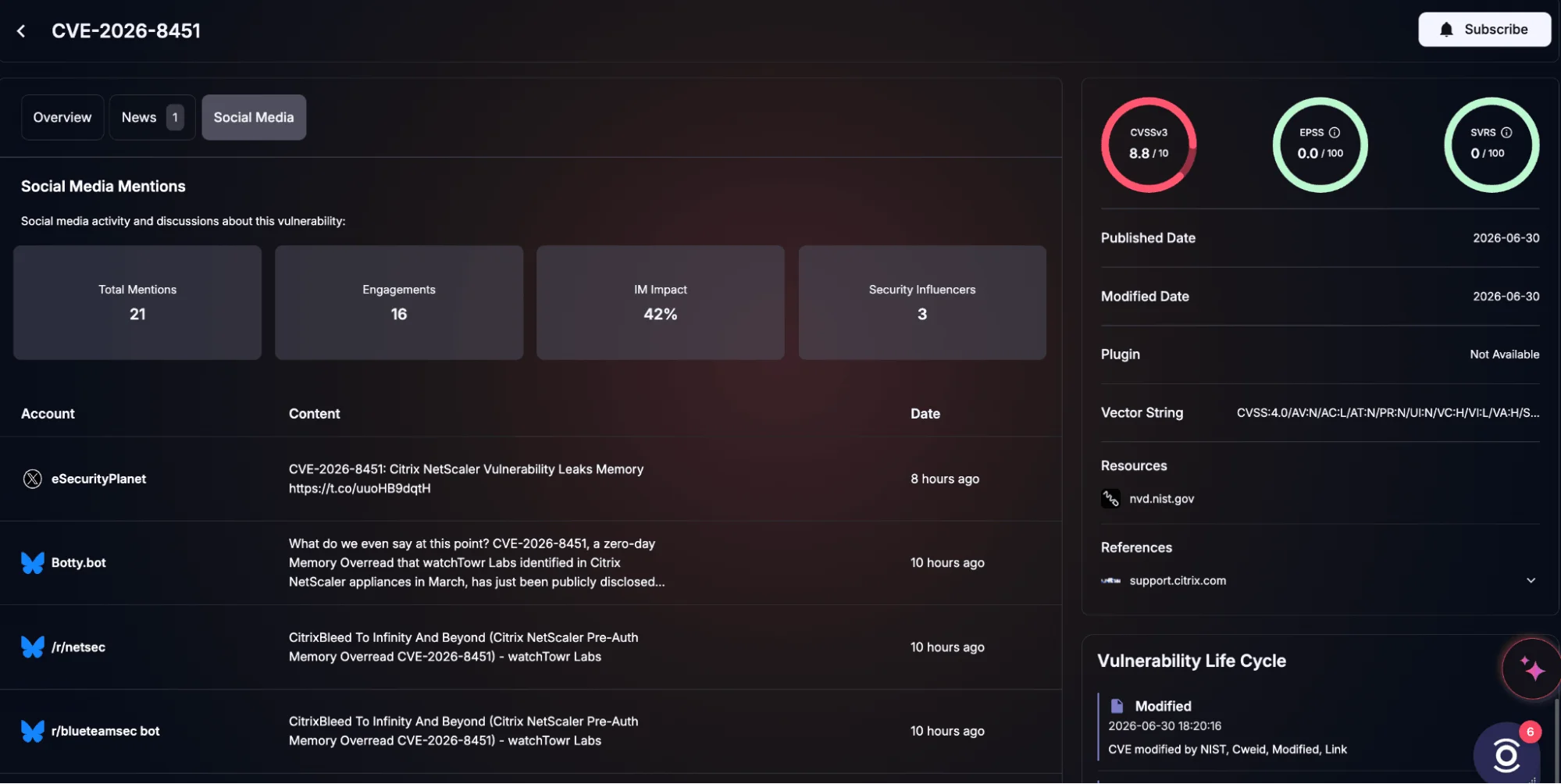
Details of CVE-2026-8451 (SOCRadar Vulnerability Intelligence)
Why Is It Being Compared to CitrixBleed?
The CitrixBleed label describes a recurring class of weakness: unauthenticated memory disclosure on NetScaler edge devices.
Defenders have recent context from earlier NetScaler memory disclosure issues (including Bleed incidents in 2023 and 2025, plus additional overread discussions in early 2026). With that history, another unauthenticated overread, even if constrained, typically gets treated as a high-priority patch item.
When Is the Appliance Actually Exposed?
CVE-2026-8451 is not described as universally reachable in every NetScaler deployment. Reported guidance ties exploitability to a specific posture:
- Exploitable condition: NetScaler ADC / Gateway configured as a SAML IdP
- Trigger surface: NetScaler’s XML parser mishandling malformed attribute termination while processing SAML authentication requests at the /saml/login endpoint
For vulnerability management teams, this means version checks alone are not enough. You also need to confirm whether SAML IdP is enabled on each relevant appliance, especially for internet-facing instances.
Which Citrix Products and Versions Are Affected?
CVE-2026-8451 impacts:
- Citrix NetScaler ADC
- Citrix NetScaler Gateway
Affected version ranges (per public advisory summaries) include:
- NetScaler ADC / Gateway 14.1 before 14.1-72.61
- NetScaler ADC / Gateway 13.1 before 13.1-63.18
- NetScaler ADC FIPS before 14.1-72.61 FIPS
- NetScaler ADC FIPS & NDcPP before 13.1-37.272
Citrix disclosed this vulnerability as part of a broader bulletin set that also includes: CVE-2026-8452, CVE-2026-8655, CVE-2026-10816, CVE-2026-10817, and CVE-2026-13474.
What We Know About Impact and Leak Behavior
- Confirmed impact (generic to the class): a successful memory overread can disclose sensitive process memory contents.
- Reported technical context: watchTowr notes that the CVE-2026-8451 vulnerability was found while attempting to reproduce CVE-2026-3055, an earlier NetScaler flaw that was actively exploited and added to CISA’s catalog. They link the root cause to SAML authentication request parsing when the appliance runs as a SAML IdP.
- Reported leak characteristics: Researchers’ Proof-of-Concept (PoC) reportedly leaked data that appeared to include a process memory pointer, with leaked bytes embedded in an authentication cookie returned to the client. It is noted that the read is more constrained than CVE-2026-3055 – which could leak kilobytes of data – because it terminates once it hits certain control characters (such as NULL or >).
What remains unconfirmed is whether leaked data commonly includes high-value artifacts (for example, session material) in real deployments. That uncertainty does not change the patching priority, but it should inform how you frame the risk internally.
Exploitation Status and Timeline for CVE-2026-8451
As of July 1, 2026, public reporting indicates no evidence of active exploitation.
Key dates that matter for incident response and patch SLAs:
- Late March 2026: watchTowr discovered and reported CVE-2026-8451 during research into prior NetScaler issues.
- June 30, 2026: Citrix published the advisory set covering CVE-2026-8451 and related CVEs. The same day, public-sector guidance reiterated affected version ranges and urged patching.
- July 1, 2026: reporting emphasized that exploitation had not been observed at the time of coverage.
Even without confirmed exploitation, unauthenticated issues in edge appliances often draw attention quickly after patches ship, especially when they resemble previously weaponized bug classes.
What Defenders Should Do Now
Patch and Validate Configuration Exposure
- Upgrade to fixed builds (for example, ensure 14.1 is at or above 14.1-72.61 and 13.1 is at or above 13.1-63.18, including the appropriate FIPS/NDcPP fixed releases).
- Prioritize internet-facing NetScaler appliances.
- Confirm whether each appliance is configured as a SAML IdP, since that condition determines exposure for CVE-2026-8451.
Review Risk in the Context of Memory Disclosure
Even a limited memory disclosure can matter on an authentication gateway. Based on how these bug classes are commonly used, small leaks can sometimes support follow-on activity, including session or authentication-adjacent chaining. Treat this as a planning assumption rather than a CVE-2026-8451-specific guarantee.
Use External Exposure and Vulnerability Tracking to Prioritize
In larger environments, response often slows down for two reasons: teams first need to identify which appliances are externally reachable, and then determine whether a newly disclosed edge vulnerability is drawing real attention from attackers.
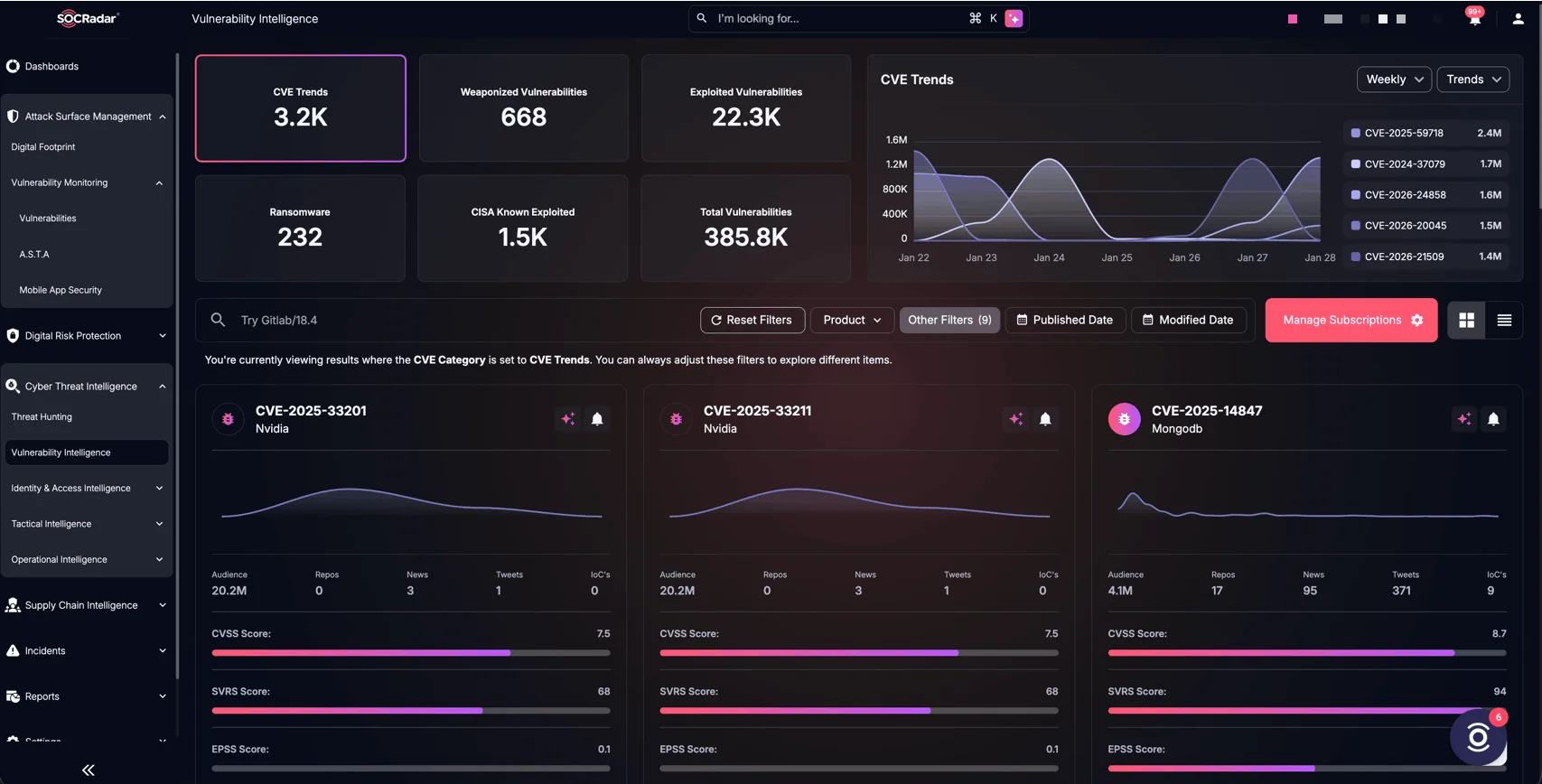
SOCRadar’s Vulnerability Intelligence
SOCRadar supports both sides of that workflow. Attack Surface Management (ASM) helps your team identify internet-facing NetScaler assets and validate external exposure, while Cyber Threat Intelligence helps you monitor how a disclosure is evolving through exploitation signals, attacker interest, related reporting, and other threat indicators. Together, they help your organization prioritize the systems that are both exposed and most likely to be targeted.
Use Available Validation Tooling
Researchers have also published a Detection Artifact Generator for CVE-2026-8451 on GitHub, which accepts a target NetScaler device and attempts to leak memory. Use it only in authorized testing and validation workflows.



