


Oct 07, 2026

Table Of Content
Critical Elasticsearch Exposure: 544M Plain-Text Credentials Found Publicly Accessible
Technical Snapshot of the Exposure
What the Dataset Contained
Why This Exposure Is Critical
A Broader Pattern: Correlation With Forum Activity
Why Misconfigured Elasticsearch Instances Remain Dangerous
How SOCRadar Strengthens External Exposure Visibility
Conclusion
Related Articles

NetScaler C2: CVE-2026-88771 Exploitation Operation





Feb 24, 2026
5 Mins Read

Summarize with:
Critical Elasticsearch Exposure: 544M Plain-Text Credentials Found Publicly Accessible
SOCRadar’s AI-powered Sensitive Data Exposure Monitoring service identified a publicly accessible and misconfigured Elasticsearch instance containing approximately 544,322,698 records. The database was exposed directly to the internet without authentication controls.
Our analysis shows the dataset follows a structured credential aggregation format:
URL : email/username : password
No encryption or hashing was observed in sampled entries. At this scale, the exposure moves beyond a typical leak and into exploitation-ready infrastructure.
Technical Snapshot of the Exposure
The exposed Elasticsearch server was publicly reachable and did not require authentication. It hosted approximately 88.3 GB of indexed data comprising roughly 544 million records, all structured in a URL, email or username, and password format.
- Exposure Type: Publicly accessible Elasticsearch instance
- Authentication: Not enabled
- Total Size: 88.3 GB
- Indexed Records: ~544 million
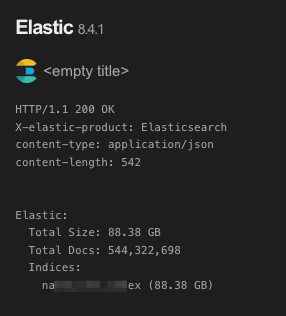
Elasticsearch instance showing 88.3 GB and document count
The instance responded with an HTTP 200 status and exposed index statistics, confirming that the database was fully accessible. The total indexed document count exceeded 544 million entries.
What the Dataset Contained
Sample records included login endpoints tied to major online services, alongside associated usernames or email addresses and corresponding passwords.
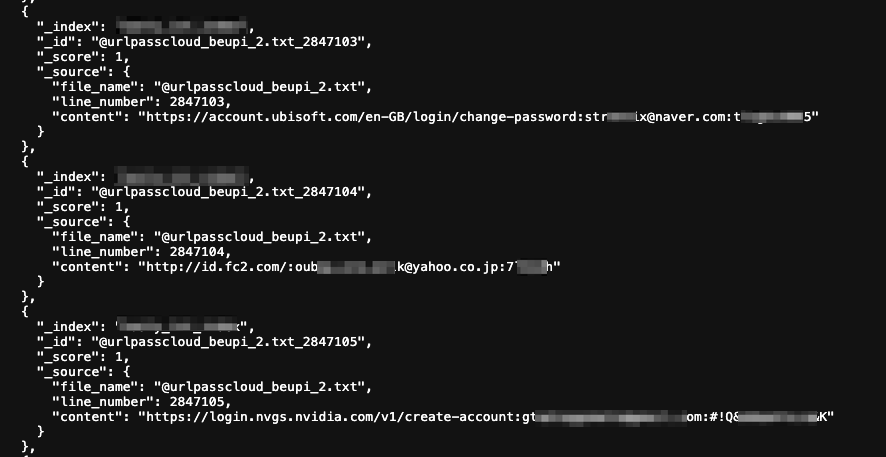
Sample JSON records showing URL:email:password structure
The structure was consistent across sampled records. Each line mapped a service login URL to an account identifier and a plain-text password. No masking, tokenization, or hashing mechanisms were observed in the exposed fields.
Examples included:
- Direct login URLs
- Consumer email accounts
- Account creation endpoints
- Service-specific authentication paths
Because passwords were stored in plain text, the data required no cracking or transformation before potential misuse.
Why This Exposure Is Critical
The presence of 544 million plain-text credential records introduces immediate and systemic risk. Unlike hashed dumps that require processing, these credentials are ready for automated use at scale. Even a modest rate of password reuse across consumer and enterprise environments could translate into widespread account takeover attempts, credential stuffing activity, and lateral access into corporate systems.
The combination of massive scale, readable authentication data, and direct public accessibility elevates this case to Critical severity.
A Broader Pattern: Correlation With Forum Activity
SOCRadar observed that around the same timeframe, hacker forums began advertising large credential datasets. One listing claimed “555M URL:Log:Pass” records.
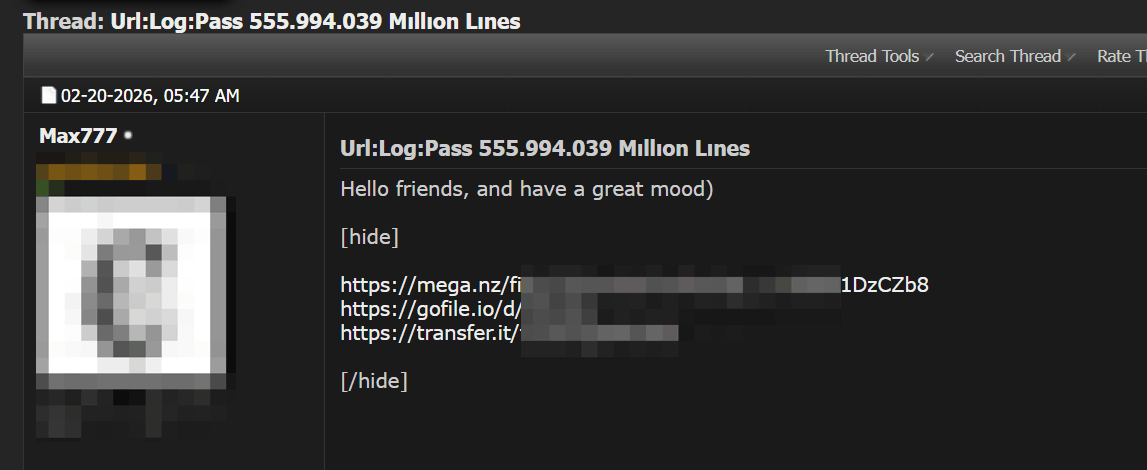
Forum post advertising 555M URL:Log:Pass dataset
The advertised structure closely resembles the format observed in the exposed Elasticsearch index. However, preliminary sample comparisons indicate that the records do not fully match those referenced in the forum listing. This suggests the exposed dataset may be distinct rather than a redistribution of an already circulating dump.
The structure and aggregation style point toward systematic credential collection rather than a single isolated breach event. Datasets of this nature are commonly compiled from:
- Infostealer malware logs
- Previous breach combinations
- Automated credential harvesting operations
- Aggregated combo lists
At this volume, the database effectively functions as a credential warehouse.
Why Misconfigured Elasticsearch Instances Remain Dangerous
Elasticsearch is built for fast indexing and retrieval. When exposed without authentication, it effectively becomes a public data repository.
Common exposure causes include:
- Port 9200 exposed to the internet
- Disabled authentication
- Weak firewall rules
- Misconfigured cloud security groups
- Forgotten development or staging environments
Threat actors continuously scan for open Elasticsearch services. Once identified, data extraction requires minimal technical effort.
In this case, the exposed instance hosted a dataset large enough to serve as a ready-made attack resource.
How SOCRadar Strengthens External Exposure Visibility
Exposures like this often sit outside the reach of traditional internal controls, which are typically designed to monitor activity inside the network rather than what is publicly reachable. Because the risk originates from internet-facing infrastructure, external visibility becomes essential. SOCRadar’s External Attack Surface Management is built for that purpose, continuously identifying misconfigurations, exposed services, and unintended data leaks across publicly accessible assets.
When large credential datasets or other high-risk findings are uncovered, our Digital Risk Protection and Cyber Threat Intelligence capabilities add context by assessing potential abuse scenarios, correlating underground signals, and helping security teams prioritize remediation.
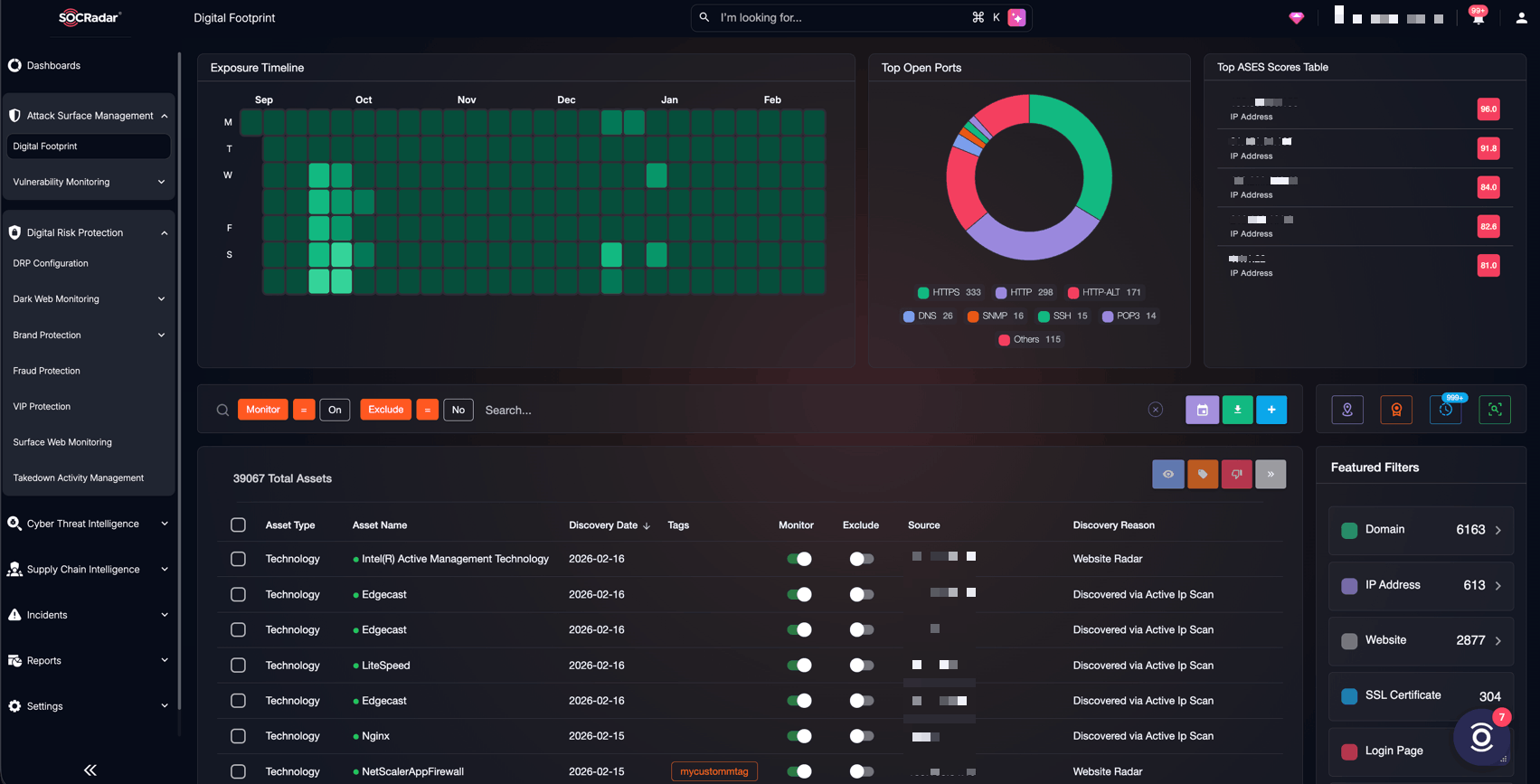
SOCRadar’s Attack Surface Management, Digital Footprint
By extending monitoring beyond the internal perimeter and enriching findings with threat intelligence insight, organizations can detect infrastructure weaknesses earlier and reduce the likelihood that exposed data turns into active credential abuse or account compromise.
Conclusion
An unsecured Elasticsearch server hosting more than half a billion credentials represents more than a configuration mistake; it represents concentrated authentication risk placed directly on the open internet.
With 88.3 GB of readable login data exposed, the dataset provides immediate operational value to anyone capable of automating credential validation at scale. When service URLs are paired directly with usernames and passwords, testing and targeting become faster, more structured, and significantly more efficient.
Incidents like this highlight how quietly exposed infrastructure can transform into a high-impact threat vector. The difference between contained exposure and widespread abuse often comes down to how quickly the issue is identified and addressed.
Elasticsearch, when properly secured, is a powerful indexing engine. When left unprotected, however, it can unintentionally function as a globally accessible credential repository. Proactive visibility into internet-facing assets remains critical to ensuring that misconfigurations do not evolve into active compromise scenarios.