FortiSandbox Vulnerabilities Expose Systems to Auth Bypass and Command Execution
Fortinet FortiSandbox administrators should review their environments after several critical vulnerabilities raised concern around authentication bypass and command execution risks.
The flaws affect FortiSandbox API and Web UI components. In vulnerable deployments, attackers may be able to bypass authentication, escalate privileges, or execute commands without valid credentials. These risks become more serious when management interfaces are exposed to the internet or connected to sensitive security workflows.
The vulnerabilities are tracked as CVE-2026-39813, CVE-2026-39808, and CVE-2026-25089.
What Are the FortiSandbox Vulnerabilities?
Fortinet disclosed two of the issues in April 2026 and another in June 2026. Each vulnerability affects a different FortiSandbox component, but all three involve network-reachable attack paths.
CVE-2026-39813
CVE-2026-39813 (CVSS 9.8) is a path traversal vulnerability in the FortiSandbox JRPC API. Fortinet describes it as an authentication bypass issue that could allow an unauthenticated attacker to send crafted HTTP requests and gain unauthorized access. Fortinet lists the impact as privilege escalation rather than direct remote code execution.
This distinction matters. CVE-2026-39813 may give attackers a way past authentication controls, but defenders should avoid treating it as a standalone RCE unless new technical details confirm that behavior.
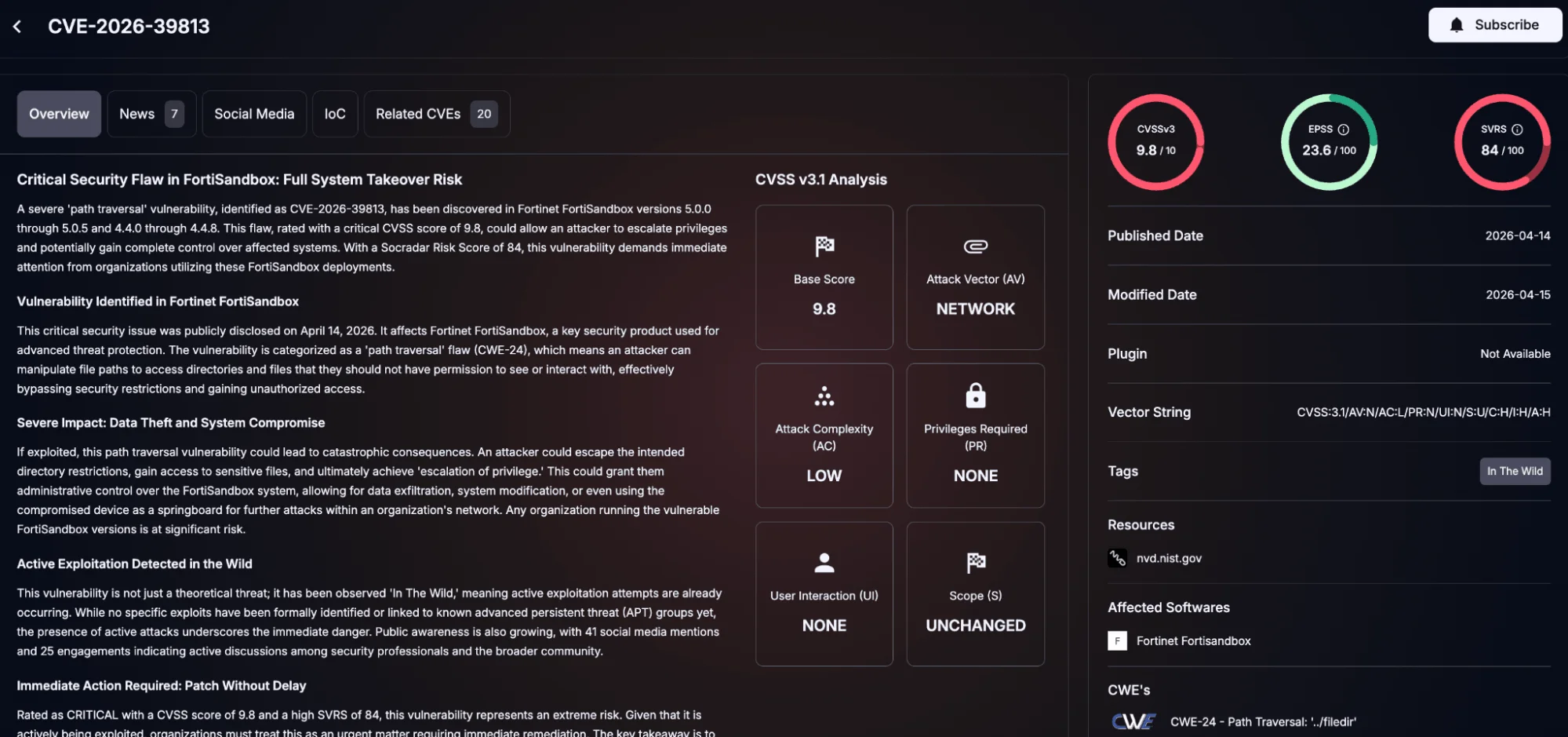
Details of CVE-2026-39813 (SOCRadar Vulnerability Intelligence)
CVE-2026-39808
CVE-2026-39808 (CVSS 9.8) is an OS command injection vulnerability in a FortiSandbox API endpoint. An unauthenticated attacker could exploit the flaw by sending crafted HTTP requests that trigger unauthorized commands.
Because exploitation does not require credentials, this bug creates a direct execution risk for affected FortiSandbox 4.4 deployments. Public proof-of-concept references also increase the likelihood of scanning and weaponization.
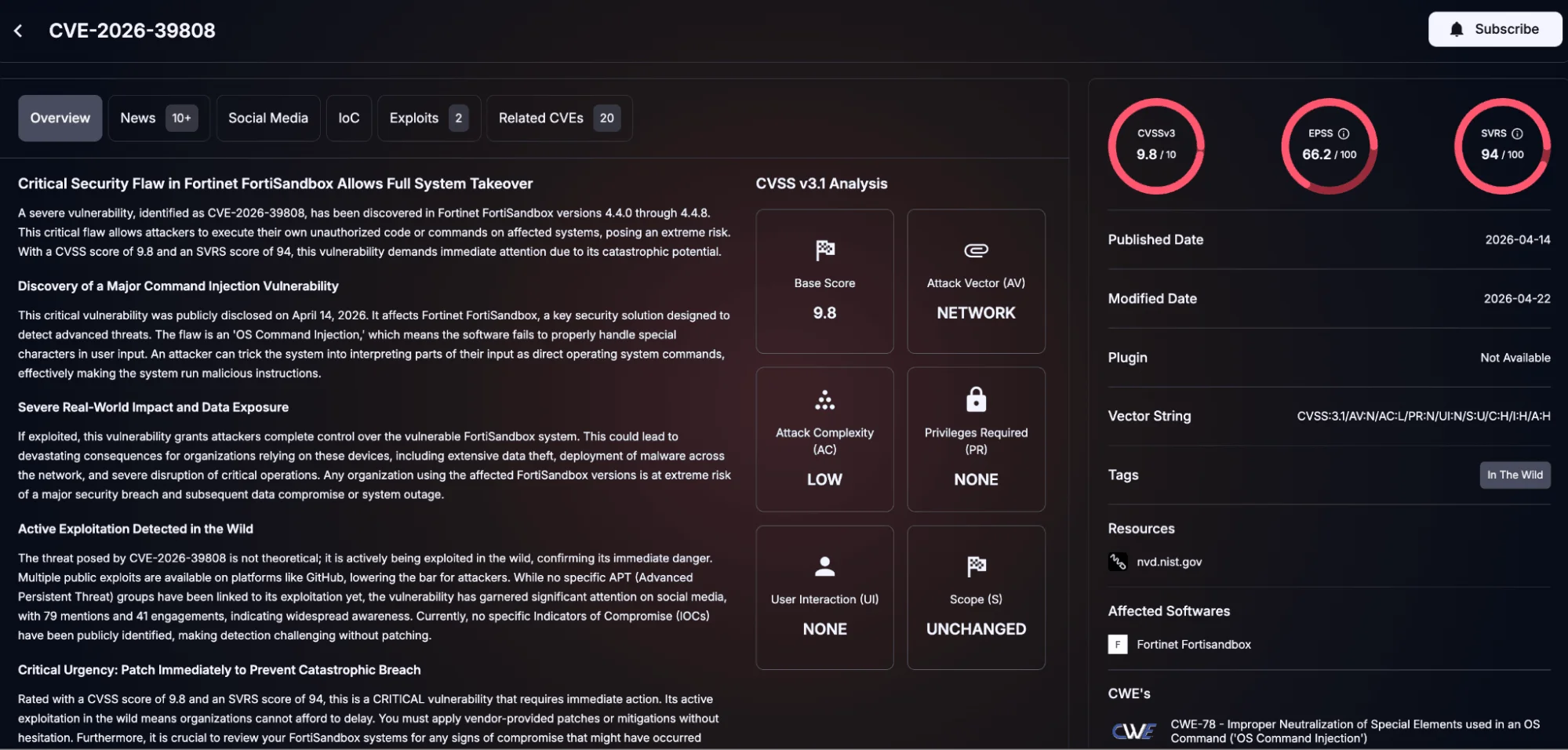
Details of CVE-2026-39808 (SOCRadar Vulnerability Intelligence)
CVE-2026-25089
CVE-2026-25089 (CVSS 9.8) is an OS command injection vulnerability in the FortiSandbox Web UI. The flaw affects FortiSandbox, FortiSandbox Cloud, and FortiSandbox PaaS in specific version ranges.
For defenders, the concern is straightforward: a vulnerable Web UI may give an unauthenticated attacker a path to execute system commands through crafted HTTP requests.
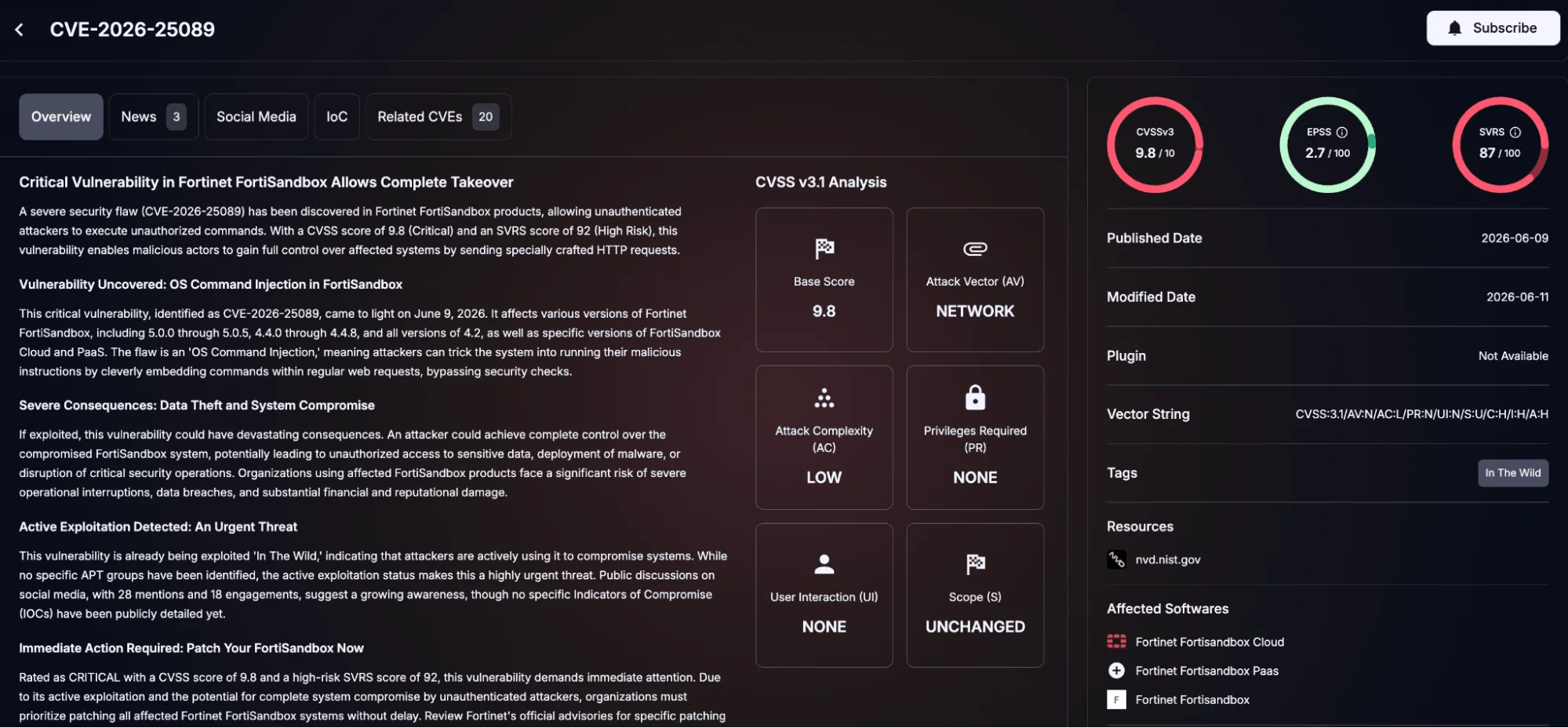
Details of CVE-2026-25089 (SOCRadar Vulnerability Intelligence)
Which FortiSandbox Versions Are Affected?
Affected versions vary by CVE, so teams should check each FortiSandbox branch against Fortinet’s official advisories.
| CVE | Affected products and versions | Fixed versions |
| CVE-2026-39813 | FortiSandbox 5.0.0 through 5.0.5; FortiSandbox 4.4.0 through 4.4.8 | Upgrade to 5.0.6 or later, or 4.4.9 or later |
| CVE-2026-39808 | FortiSandbox 4.4.0 through 4.4.8 | Upgrade to 4.4.9 or later |
| CVE-2026-25089 | FortiSandbox 5.0.0 through 5.0.5; FortiSandbox 4.4.0 through 4.4.8; FortiSandbox Cloud 5.0.4 through 5.0.5; FortiSandbox PaaS 5.0.4 through 5.0.5 | Upgrade affected 5.0 branches to 5.0.6 or later, and FortiSandbox 4.4 to 4.4.9 or later |
NVD also includes FortiSandbox 4.2.x in its affected software configuration for CVE-2026-25089. Organizations running older or unsupported branches should confirm remediation guidance directly with Fortinet.
Why These Vulnerabilities Matter
FortiSandbox often sits close to sensitive security operations. Teams use it to analyze suspicious files, support malware verdicts, and integrate with other security tools.
That role can increase the blast radius of a compromise. If attackers gain control of a vulnerable appliance, they may be able to inspect local configuration, interfere with analysis workflows, or use the system as a foothold inside the network.
A successful attack could allow an intruder to:
- Run unauthorized commands on the affected system
- Access sensitive logs or configuration data
- Establish persistence on the appliance
- Use trusted network placement for internal reconnaissance
- Disrupt sandboxing, malware analysis, or verdict-sharing workflows
Internet-facing deployments carry the highest risk. This is why, in the case of CVE-2026-39813, CVE-2026-39808, and CVE-2026-25089, any FortiSandbox Web UI, API, or JRPC endpoint exposed to the public internet should receive immediate attention.
Because Fortinet products are widely used in enterprise networks, attackers frequently look for exposed or compromised Fortinet assets. In another recent case, SOCRadar threat researchers revealed FortiBleed, which involves compromised Fortinet firewalls and VPN gateways.
Has Exploitation Been Observed?
Threat intelligence firm Defused warned on June 16, 2026, that attackers had been observed exploiting CVE-2026-39813, CVE-2026-39808, and CVE-2026-25089.
Public details remain limited. Fortinet’s advisories noted no known exploitation at the time of publication, and technical indicators of compromise were not broadly available.
Security teams should still treat these flaws as urgent. Unauthenticated, network-reachable vulnerabilities in security appliances often attract fast-moving attacker interest, especially when command execution is possible.
What Defenders Should Do Now
1. Patch affected FortiSandbox systems
Apply Fortinet’s fixed versions as soon as possible.
For on-premises deployments, confirm the FortiSandbox branch and upgrade path. For FortiSandbox Cloud and FortiSandbox PaaS, verify the patching responsibility model with Fortinet or the service owner.
2. Restrict management access
Remove direct internet exposure from FortiSandbox management interfaces wherever possible.
Limit access to trusted networks, VPNs, jump hosts, or dedicated management segments. Use IP allowlisting when available, and review firewall rules for unnecessary access to Web UI, API, and JRPC endpoints.
3. Review HTTP logs for suspicious requests
Even without public IOCs, defenders can look for signs of pre-authentication probing and exploitation attempts.
Prioritize checks for:
- Unusual requests to FortiSandbox API, JRPC, or Web UI paths
- Traversal patterns or malformed URLs
- Unexpected JSON payloads or abnormal parameters
- Repeated unauthenticated requests from unfamiliar IP addresses
- Administrative access attempts outside normal maintenance windows
4. Hunt for post-exploitation activity
Command injection can lead to activity beyond the initial web request. Review system and network telemetry for signs that attackers executed commands or attempted persistence.
Look for:
- Unexpected child processes from web-facing services
- Suspicious file creation or modification
- New administrative users or configuration changes
- Unusual outbound connections from the appliance
- Communication with internal systems that does not match normal behavior
5. Track exploit developments
Public exploit references and attacker interest can change the risk profile quickly. Security teams should monitor vendor updates, vulnerability databases, and threat intelligence feeds for new technical details.
SOCRadar can support prioritization without adding extra manual workload. SOCRadar Cyber Threat Intelligence module helps teams track CVE severity, exploit availability, affected products, and remediation guidance in one place. SOCRadar Attack Surface Management (ASM) can also help identify exposed FortiSandbox assets and other internet-facing systems before attackers turn them into entry points.
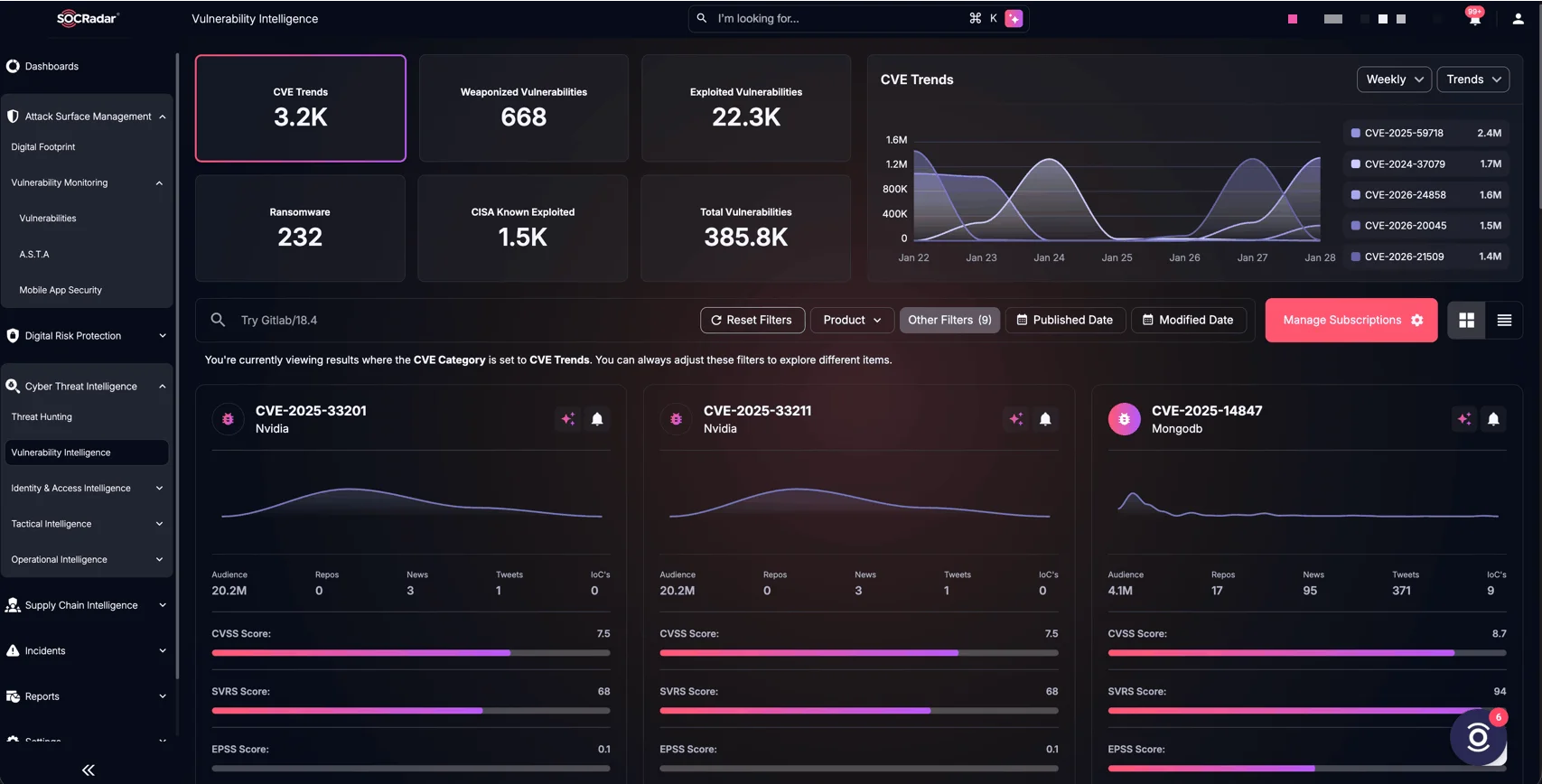
SOCRadar’s Vulnerability Intelligence
The FortiSandbox vulnerabilities create a serious risk for affected deployments, especially where management interfaces are exposed or poorly segmented. CVE-2026-39813 can weaken authentication controls, while CVE-2026-39808 and CVE-2026-25089 may allow unauthenticated command execution.
For security teams, the priority is clear: patch affected systems, reduce exposure, and review logs for suspicious activity. Organizations that use FortiSandbox in sensitive security workflows should also validate integrations and monitor the appliance closely after remediation, since a security appliance should strengthen detection and response rather than become an attacker’s foothold.