Attack Surface Management Is Now Autonomous Exposure Management
Few security teams struggle to find exposures. They struggle with too many findings, too few people to work them, and no clear way to show that risk went down. SOCRadar’s Attack Surface Management (ASM) module has been rebuilt around that problem. It is now Autonomous Exposure Management (AEM), live for all customers inside the SOCRadar Extended Threat Intelligence (XTI) platform.
AEM replaces the ASM module outright, with nearly every screen rebuilt or replaced. ASM answered what an organization has and what is open. AEM answers what matters, who is likely to use it, and whether the fix held: it discovers the external attack surface, shows which threat actors have a way in, ranks what to fix first, and re-checks fixes on demand.
From ASM to AEM
SOCRadar’s Attack Surface Management started where every exposure program starts: continuous, automated discovery of an organization’s internet-facing assets, running inside Extended Threat Intelligence next to cyber threat intelligence and digital risk protection. Discovery answers the first question every security team has: what do we have, and what is open?
As the window between disclosure and exploitation kept shrinking, SOCRadar anticipated that visibility alone would not be enough and that ASM had to evolve from showing exposure to helping close it. A.S.T.A (Attack Surface Threat Assessment) was the first step on that path. It added active vulnerability scanning of discovered assets, custom scan policies, prioritization that weighs CVSS against exploit trends and the CISA KEV catalog, and revalidation scans that confirm a fix after patching.
Autonomous Exposure Management is where that line leads today. It keeps the discovery that ASM built and the assessment and validation that A.S.T.A introduced, now as Scan & Policies under Vulnerability Management, and adds threat actor context, cross-asset insights and graded posture reporting, all connected in one cycle.
Know What’s Yours. Know Who’s Coming. Prove the Fix.
AEM is built on three ideas, each answering a question security teams ask every day:
- Know what’s yours: Every asset, with the path that found it, including third parties nobody listed
- Know who’s coming: Which threat groups have a way in, and through which asset, CVE or leaked credential
- Prove the fix: Re-check a fix with one button, and see a finding reopen with its alarm if it comes back
For a CISO, the three roll up into one view: a single grade for the external attack surface, a peer benchmark behind it, and evidence to bring to the board and auditors.
A scanner tells you what’s open. Intelligence tells you who’s likely to use it. AEM puts SOCRadar threat intelligence, leak data and third-party data on the same map as an organization’s assets, then carries each finding from discovery to a validated fix in one cycle: see what is yours, find what is exposed, decide what to fix first, prove the fix and report it.
The AEM exposure cycle
See what’s yours
Digital FootprintThird PartyFind what’s exposed
Attack Surface MapExposure AnalyticsDecide what to fix first
Security RatingsKey FindingsProve the fix
Vulnerability LifecycleValidate NowReport it
Risk & ComplianceSnapshot Report
Six Problems Autonomous Exposure Management Solves
Exposure management programs tend to stall on the same six problems. Here is how AEM addresses each one.
Too Many Findings, Too Few Decisions
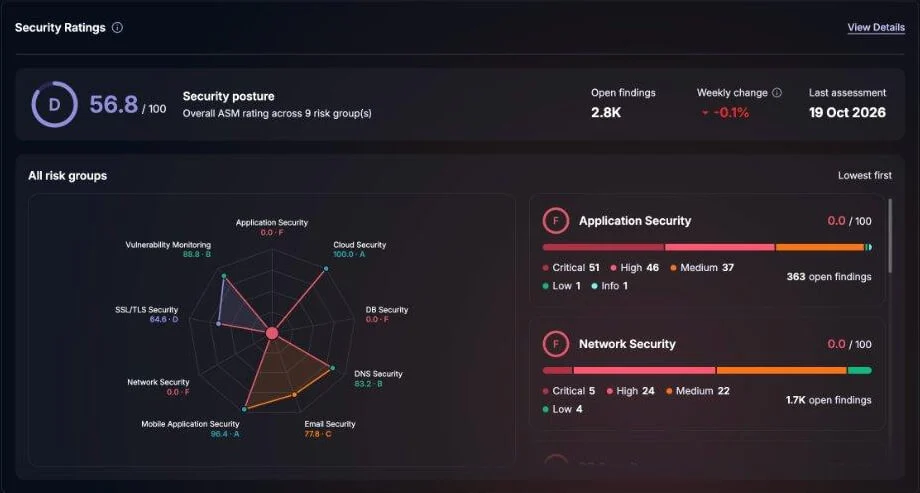
When every finding is ranked by severity alone, the few that matter get lost. AEM rolls the external attack surface into one grade anyone can read, from the analyst to the board, and uses threat intelligence on who is likely to target the organization to rank what to fix first.
The Same Risk, Repeated Across the Surface
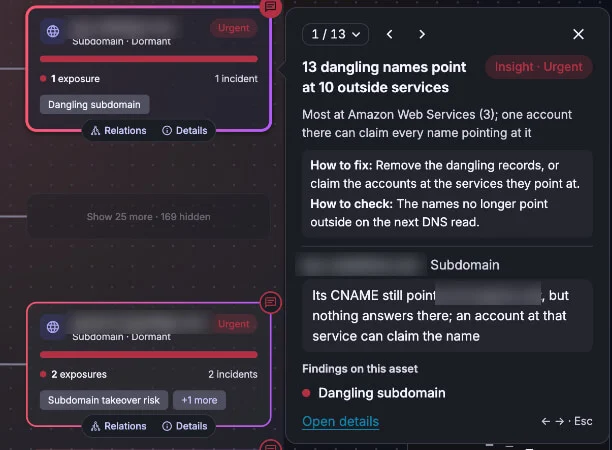
Security teams often fix the same problem again and again, one ticket at a time. AEM reads patterns across the whole surface, such as dangling DNS records pointing to outside services, so the team fixes the pattern once. The same view surfaces the handful of suppliers with exposed logins or a breach.
A Surface Growing Faster Than the Team
Marketing launches a microsite with an agency, a developer adopts a new app, and nobody tells security. AEM keeps finding these assets, including shadow and third-party services, and puts the ones that need attention first.
No Proof the Fix Worked
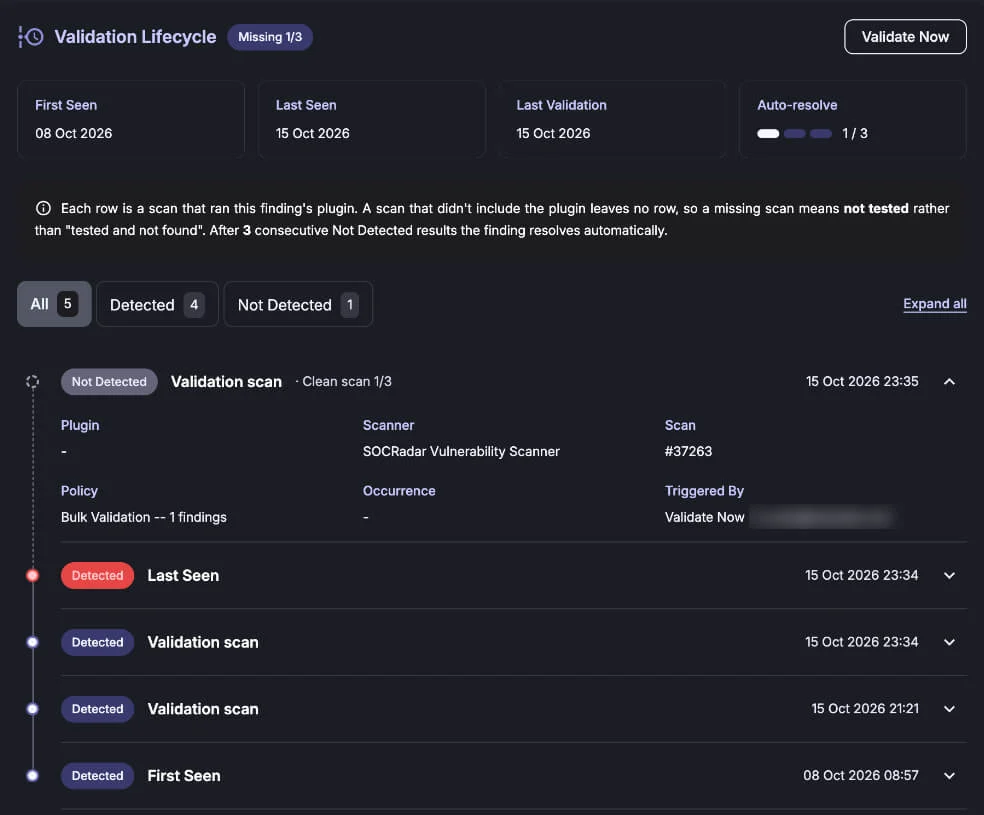
“We fixed it, but can we prove it?” is a question every security leader eventually asks. AEM tracks every finding from first sighting to fix, re-checks a reported fix the same day with Validate Now instead of waiting for the next scan, and reopens the finding if the issue comes back.
Reporting and Audit Evidence Built by Hand
Leadership wants to know whether things are getting better, and GRC teams rebuild the same evidence before every audit. AEM shows how the grade moves over time, what each fix is worth and how the organization compares with its peers, and maps findings to frameworks such as SOC 2 and GDPR to support audit preparation.
Discovery That Doesn’t Know the Business
Discovery that does not know the business creates noise. Teams tune AEM once to how the organization actually looks, such as brand keywords and IP ranges, and every run uses it after that.
What Makes It “Autonomous”
The platform does the legwork, and the team makes the call. On its own, AEM:
- Flags newly found assets that have not been scanned yet
- Resolves fixed findings and reopens them if they return
- Reads patterns across the whole surface
- Turns a plain sentence into a filter
People stay in control of the decisions: starting scans on newly found assets, running validation, changing a severity or hiding a rule, and the remediation itself.
How AEM Aligns With CTEM
AEM covers discovery, prioritization, validation and mobilization in alignment with Gartner’s Continuous Threat Exposure Management (CTEM) framework. Discovery and prioritization draw on SOCRadar’s own internet-wide scanning and threat intelligence, validation runs through the finding lifecycle and Validate Now, and findings route to owning teams through Jira and ServiceNow integrations. Scoping by business impact is the stage still in progress.
Stronger Inside Extended Threat Intelligence
AEM runs inside SOCRadar XTI, so threat actor activity, leaked credentials, Dark Web mentions and supplier risk enrich every exposure it finds. Cyber threat intelligence shows who is coming, Digital Risk Protection shows what is leaked or spoofed, and AEM shows what is exposed, who is likely to use it, and whether the fix held. Each role gets its own view of the same cycle:
- CISOs: A graded posture mapped to controls, ready for the board
- SOC analysts: An open queue limited to what the latest scan still sees, with fixes confirmed by Validate Now
- SOC and CTI teams: Threat actors, leaks and vendors on the same map as the assets they touch
- MSSPs: A graded view of each client’s exposure, with proof of fixes for every quarterly business review
For a deeper look at intelligence-driven prioritization and evidence-based remediation, read the Prove the Fix whitepaper.
Frequently Asked Questions
What Is SOCRadar Autonomous Exposure Management?
Autonomous Exposure Management (AEM) is the module that replaces Attack Surface Management in the SOCRadar Extended Threat Intelligence platform. It discovers an organization’s external assets, shows which threat actors have a way in, ranks what to fix first, and re-checks fixes on demand in one cycle.
Do Existing ASM Customers Need to Change Anything?
No. APIs, alarm types and their conditions, and customer configurations all carry over unchanged, so there is nothing to reconfigure.
What Happened to A.S.T.A?
A.S.T.A, the Attack Surface Threat Assessment feature, is now called Scan & Policies and sits under Vulnerability Management. Scan schedules, scanning policies and validation runs are managed there.
What Does Validation Mean in AEM?
Validation re-runs the check that found a finding, on the same asset, to confirm whether a fix held. It is a re-check of the same finding, not an attack simulation or a penetration test. Validate Now works on a single finding, and Bulk Validation covers up to 100 findings for a single credit.
Can Every Finding Be Validated?
No. Validate Now applies to findings from active scans. Findings from passive scans cannot be re-checked with Validate Now.
Does AEM Replace a Vulnerability Scanner?
No. AEM is built to work alongside internal vulnerability management. Its focus is the external view: assets an organization may not know it has, such as shadow IT and third-party services, correlated with threat intelligence on who is likely to target them.