

Oct 07, 2026

Table Of Content
How Surface Web Monitoring Turns Public Exposure Into Actionable Defense
The Operational Gap in Public Web Oversight
A Recent Surface Web Exposure Example: Home Depot’s Public GitHub Token
Establishing Context Around Public Findings
Translating Exposure Signals into Clear Priorities
Reducing the Time Between Exposure and Remediation
Protecting Brand Presence Across Public Channels
Conclusion
Related Articles

NetScaler C2: CVE-2026-88771 Exploitation Operation





Feb 20, 2026
6 Mins Read

Summarize with:
How Surface Web Monitoring Turns Public Exposure Into Actionable Defense
Exposure does not always originate from hidden forums or underground marketplaces. In many cases, the earliest signals attackers rely on are found on the openly indexed internet. Public repositories, misconfigured cloud storage, exposed API documentation, and forgotten test environments often contain sensitive fragments of information long before any incident becomes visible internally.
Despite this reality, many organizations still approach open web exposure reactively. They perform periodic repository searches, review cloud configurations during audits, or investigate only after an external notification. While these practices support baseline hygiene, they do not establish continuous control over what is publicly accessible.
The issue is not the size of the digital footprint. It is the absence of structured intelligence that connects indexed exposure directly to operational risk.
The Operational Gap in Public Web Oversight
Most organizations do not lack tools. They lack coordination between discovery and action.
Public exposure monitoring often develops organically across teams. Developers check repositories. Cloud teams review infrastructure. Security teams respond to alerts when they surface. Without a unified framework, oversight becomes fragmented and inconsistent.
This gap typically manifests in several ways:
- Manual review processes that cannot scale across thousands of public assets
- Newly indexed artifacts that go undetected for extended periods
- Findings that are identified but not connected to remediation workflows
- Lack of clear prioritization between low-impact artifacts and critical leaks
As a result, exposure awareness exists, but risk clarity does not. Teams recognize that public artifacts are present, yet struggle to determine which ones introduce real and immediate risk.
Surface Web Monitoring closes this operational gap by centralizing indexed discovery and tying it directly to structured response.
A Recent Surface Web Exposure Example: Home Depot’s Public GitHub Token
In December 2025, security researcher Ben Zimmermann identified a publicly exposed GitHub access token belonging to Home Depot that had remained accessible for nearly a year. The token, originally published in early 2024, was still valid when discovered and reportedly provided access to hundreds of private source code repositories tied to internal systems, including cloud infrastructure and development workflows.
The exposure did not result from a complex intrusion. It originated from a development artifact that became publicly accessible and indexed. Once exposed, the token created a prolonged risk window during which unauthorized access to internal resources was technically possible.
This case reflects a broader pattern seen across surface web exposure incidents:
- Credentials committed to public repositories
- API keys or tokens embedded in indexed files
- Development artifacts unintentionally published
- Extended exposure windows before detection
The operational takeaway is clear. Publicly indexed secrets can introduce persistent internal risk when discovery depends on manual review or external notification.
Incidents like this demonstrate why surface web monitoring must be continuous rather than periodic. Organizations should:
- Continuously scan indexed repositories for exposed credentials
- Monitor exposure status across its lifecycle, from discovery to remediation
- Connect detection directly to credential rotation and takedown workflows
Surface Web Monitoring operationalizes this approach by combining indexed discovery, contextual risk evaluation, and structured remediation tracking within a centralized environment.
Establishing Context Around Public Findings
Effective exposure management begins when findings are placed into context rather than treated as isolated alerts.
An optimal Surface Web Monitoring solution continuously scans publicly indexed platforms such as GitHub, GitLab, cloud infrastructure services, API documentation environments, and collaboration tools. Instead of generating keyword-based alerts, it should correlate the findings with your organization’s digital footprint and evaluate them using defined risk indicators.
This structured analysis allows security teams to determine:
- The origin of exposure
- The sensitivity of the exposed data
- The severity and potential impact
- The current remediation status
Below is the centralized operational interface used to manage these findings:
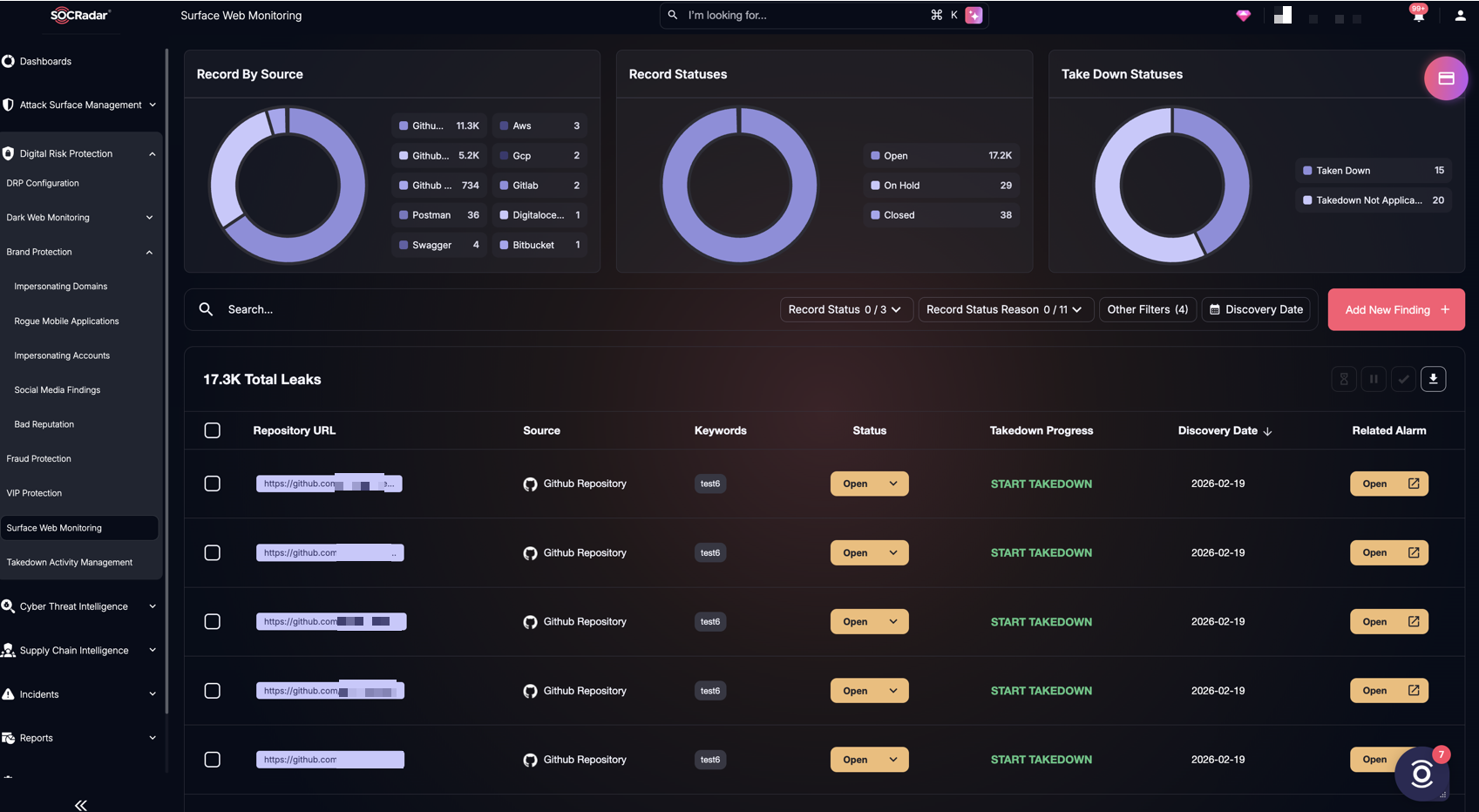
SOCRadar Surface Web Monitoring dashboard displaying exposure source distribution, record status tracking, and integrated takedown workflows.
The dashboard consolidates exposure records by platform, tracks lifecycle progression, and integrates takedown management within the same workflow. Analysts can review discovery timelines, monitor open cases, and initiate remediation without shifting between disconnected systems.
The outcome is more than visibility. It is governed exposure control.
Translating Exposure Signals into Clear Priorities
Modern digital operations generate exposure signals continuously through code commits, cloud updates, and platform integrations. Surface Web Monitoring replaces periodic discovery with continuous evaluation supported by structured risk logic.
Two evaluation dimensions are particularly important:
- Source relevance, which highlights high-impact indexed platforms
- Severity classification, identifying exposed credentials, confidential data, or intellectual property
By combining these signals, organizations can categorize findings into practical response paths:
- Immediate remediation for high-impact exposures
- Structured investigation for moderate-risk findings
- Ongoing monitoring for low-risk artifacts
This model supports proportional response, ensuring that remediation efforts are aligned with actual risk rather than alert volume.
Reducing the Time Between Exposure and Remediation
Timing frequently determines whether public exposure escalates into compromise. Credentials left in repositories or configuration files may remain accessible for days before detection. During that period, they can be indexed, scraped, and reused.
Continuous monitoring shortens this window significantly. Security teams gain early awareness of exposure, enabling rapid credential rotation, takedown requests, and documentation for compliance reporting.
By reducing the interval between publication and remediation, organizations materially lower the probability that public exposure becomes an entry point.
Protecting Brand Presence Across Public Channels
Exposure on the surface web extends beyond technical artifacts. Rogue mobile applications and unauthorized brand impersonation frequently appear on publicly accessible platforms and marketplaces.
These incidents may involve:
- Misuse of corporate branding
- Unauthorized collection of user credentials
- Fraudulent activity conducted under the organization’s identity
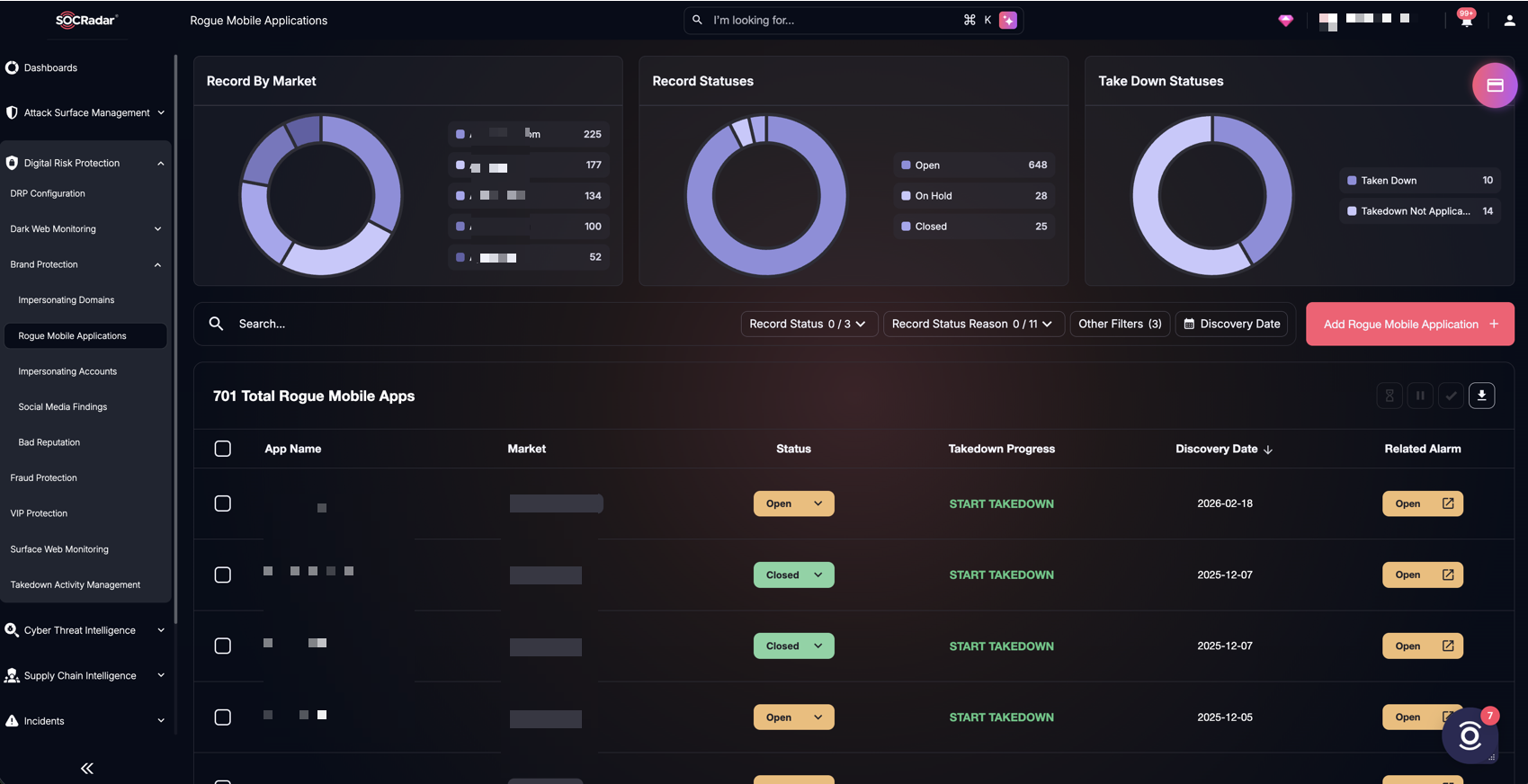
SOCRadar Brand Protection module
Surface Web Monitoring identifies these threats early and supports removal workflows, reinforcing both security posture and brand integrity in publicly visible environments.
Conclusion
Digital footprints expand continuously. Development teams deploy new assets, cloud environments evolve, and documentation is published at speed. Without structured monitoring, public exposure grows faster than oversight.
Surface Web Monitoring introduces continuous intelligence across indexed environments and connects discovery directly to remediation. Through centralized visibility, contextual prioritization, lifecycle tracking, and integrated takedown management, it transforms open web exposure from a blind spot into a controlled surface.
Organizations that implement this approach do not simply detect exposure earlier. They establish measurable control over what is publicly visible and reduce the likelihood that public artifacts become the starting point of compromise.