Top Supply Chain Risks in 2026 and Management Strategies
Supply chains in 2026 are more connected, digital, and exposed than ever. Organizations now depend on software vendors, SaaS platforms, cloud providers, logistics partners, manufacturers, data processors, MSPs, and subcontractors to keep daily operations running. This creates speed and flexibility, but it also expands the number of places where disruption, compliance failure, or cyber compromise can begin.
Traditional supply chain risks such as logistics delays, supplier instability, demand volatility, and regional disruption still matter. However, they now overlap with digital supply chain risks, including third-party cyber risk, SaaS compromise, software supply chain attacks, exposed supplier credentials, and AI-assisted fraud.
The biggest risks often emerge from overlapping dependencies: a vendor with privileged access, a compromised software package, an AI-assisted phishing campaign, a third-party compliance failure, or a logistics disruption in a critical region. These risks can quickly move across business units, customers, and partner ecosystems.
This is why supply chain risk management in 2026 needs to go beyond annual supplier reviews and basic compliance checks. Organizations need continuous visibility, stronger vendor access controls, better software dependency tracking, AI-aware policies, and resilience plans for critical suppliers and regions.
The Role of Supply Chain Intelligence
Supply chain risk management is shifting from periodic supplier reviews to continuous risk visibility. Organizations need to understand not only which suppliers they work with, but also which vendors have critical access, which third-party systems are exposed, and which external threats could affect business operations.
This is where supply chain intelligence becomes important. It connects supplier data with cyber threat intelligence, attack surface signals, leaked credential monitoring, ransomware activity, vulnerability exposure, and third-party risk indicators. Instead of reviewing vendors only during onboarding or annual assessments, teams can track changes that may increase risk in real time.
For digital supply chain risk, this helps organizations prioritize the suppliers that matter most. A vendor with exposed infrastructure, leaked credentials, known vulnerabilities, privileged access, or signs of active targeting should receive more attention than a low-risk supplier with limited access. This approach helps security, procurement, risk, and compliance teams move from broad supplier lists to focused, intelligence-led action.
What Are Supply Chain Risks?
Supply chain risks are events, weaknesses, or dependencies that can disrupt the flow of goods, services, software, data, or business operations across a supplier ecosystem. These risks can come from direct suppliers, subcontractors, logistics providers, software vendors, SaaS platforms, cloud providers, financial instability, regulatory changes, geopolitical events, or cyber threats.
In traditional supply chain management, risk often focused on physical disruption, such as delayed shipments, raw material shortages, supplier failure, warehouse issues, or demand volatility. In 2026, those risks still matter, but they increasingly connect with digital exposure. A supplier may create operational risk because it supports production, compliance risk because it handles regulated data, and cyber risk because it has privileged access to internal systems.
That is why supply chain risk management now needs to cover both business continuity and cybersecurity. Organizations should understand which suppliers are critical, what systems or data they can access, which regions they depend on, and how quickly a disruption or compromise could affect the wider business.
Main Types of Supply Chain Risks
Supply chain risks can affect different parts of the business. Some disrupt production or logistics. Others create legal exposure, financial pressure, data breaches, ransomware impact, or loss of customer trust. The table below summarizes the main types of supply chain risks organizations should track in 2026.
| Type of Supply Chain Risk | What It Means |
| Third-party cyber risk | Risk from vendor breaches, stolen supplier credentials, privileged access abuse, MSP compromise, SaaS exposure, and nth-party dependencies |
| Software supply chain risk | Risk from open-source package abuse, poisoned updates, CI/CD compromise, repository breaches, exposed secrets, and dependency confusion |
| AI-driven supply chain risk | Risk from AI-assisted phishing, supplier impersonation, fake invoices, automated reconnaissance, shadow AI use, and malicious AI use in vendor environments |
| Regulatory and compliance risk | Exposure linked to privacy laws, cyber resilience rules, ESG requirements, forced labor rules, sanctions, or sector-specific regulations |
| Operational and logistics risk | Disruption caused by port delays, transportation issues, labor strikes, warehouse disruption, production delays, or supplier performance gaps |
| Financial and supplier stability risk | Exposure caused by supplier insolvency, inflation, currency fluctuation, rising costs, reduced capacity, or payment instability |
While all of these categories matter, cyber and digital supply chain risks now need closer attention. Many organizations depend on vendors, cloud platforms, SaaS tools, APIs, software packages, and external service providers to operate. This means disruption or compromise can move through digital connections as quickly as through physical supply routes.
The Risk Layers Behind Supply Chain Exposure
Supply chain exposure usually builds across several layers: suppliers, subcontractors, software, data, access, geography, and compliance obligations. A single vendor can sit across more than one layer. For example, a SaaS provider may support a critical business process, store sensitive data, rely on third-party cloud infrastructure, and give administrators remote access.
This layered structure makes modern supply chain risk harder to manage. A supplier may look low-risk in a basic procurement review, but become high-risk when its access level, data exposure, software dependencies, or regional footprint are considered together.
Key Supply Chain Risks and Management Strategies for 2026:
Third-Party Cyber Risk
Third-party cyber risk is one of the most important supply chain risks to manage in 2026 because attackers no longer need to breach an organization directly to reach its systems, data, or customers. Vendors, suppliers, SaaS providers, managed service providers, contractors, and service partners often hold trusted access to business environments. That access can include internal portals, APIs, cloud platforms, customer data, software repositories, identity systems, and remote management tools.
This makes third parties attractive targets. A single vendor breach can create a path into several downstream organizations, especially when the vendor has privileged access or supports critical operations. In some cases, the affected company may not even be the attacker’s first target. It may become exposed because a supplier, subcontractor, SaaS provider, or MSP was compromised first.
Third-party cyber risk also includes nth-party exposure, where risk comes from a vendor’s own subcontractors, cloud providers, data processors, open-source dependencies, or technology partners. This creates a visibility problem. An organization may assess its direct vendor, but still miss hidden dependencies that support that vendor’s services.
WEF’s Global Cybersecurity Outlook 2026 found that 65% of large companies by revenue identify third-party and supply chain vulnerabilities as their greatest cyber resilience challenge, up from 54% in 2025.
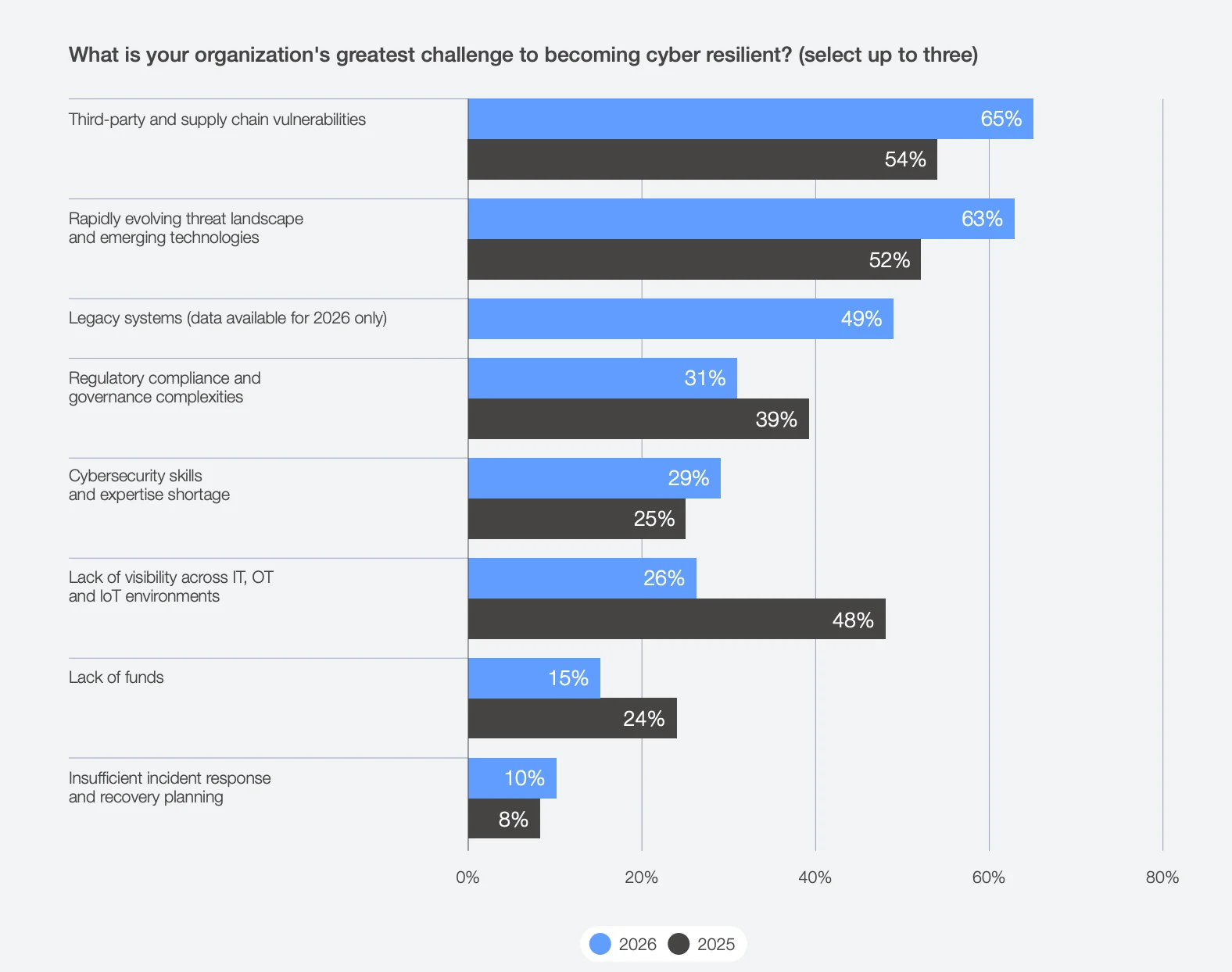
Third-party and supply chain vulnerabilities ranked as the top cyber resilience challenge for large companies in 2026, rising to 65% from 54% in 2025 (Source: WEF’s Global Cybersecurity Outlook 2026)
Why Third-Party Cyber Risk Matters in 2026
Many organizations still rely on periodic vendor questionnaires, annual assessments, and contract-based security requirements. These methods can show whether a vendor had controls in place at one point in time, but they do not show whether the vendor is exposed today.
That gap matters because vendor risk changes constantly. A supplier may introduce a new internet-facing system, suffer credential theft, use an insecure subcontractor, delay patching a critical vulnerability, or expose sensitive data through a misconfigured SaaS platform. Attackers can take advantage of these changes faster than annual reviews can detect them.
Vendor access also increases the impact of compromise. Suppliers often need privileged access to deliver support, integrations, maintenance, software updates, billing, logistics, or customer service. If attackers steal vendor credentials, they may bypass normal perimeter defenses and appear as trusted users. This can lead to account takeover, data theft, ransomware deployment, lateral movement, or abuse of API connections.
Management Strategies
Organizations should move from checklist-based vendor reviews to a more continuous and risk-based third-party security model. The goal is not to treat every supplier the same, but to identify which vendors can create the most damage if compromised.
Start by classifying vendors based on business criticality, data access, system access, and operational dependency. A payroll provider, cloud platform, MSP, software vendor, or logistics partner may require deeper monitoring than a low-risk supplier with no access to sensitive systems.
Security teams should also enforce stronger controls around vendor identity and access. This includes MFA, least privilege, session monitoring, regular access reviews, and just-in-time access for high-risk vendor accounts. Vendor access should expire when it is no longer needed, and privileged sessions should be logged and reviewed.
For nth-party risk (The risk created by a vendor’s own suppliers, subcontractors, hosting providers, data processors, cloud platforms, software vendors, or technology partners), organizations should ask critical vendors to disclose high-risk subcontractors, hosting providers, data processors, and key technology dependencies. This is especially important for vendors that handle sensitive data, provide managed services, support production systems, or deliver software updates.
| Risk Area | Management Approach |
| Vendor breaches | Continuously monitor critical suppliers for exposure, breach signals, and security posture changes |
| Vendor credentials | Require MFA, least privilege, access reviews, and rapid offboarding |
| Privileged vendor access | Use just-in-time access, session logging, and approval workflows |
| MSP and SaaS compromise | Apply stricter controls to providers with broad access or administrative permissions |
| Nth-party exposure | Map subcontractors, cloud providers, data processors, and critical dependencies |
| Annual assessment gaps | Replace one-time reviews with continuous monitoring and risk-based reassessment |
Third-party cyber risk management should also connect with incident response planning. Organizations need to know which vendors support critical operations, who to contact during a supplier incident, what data may be affected, and how quickly access can be revoked. Without this preparation, a vendor breach can turn into a slow, confusing response effort.
Monitoring Third-Party Companies with SOCRadar SCI 2.0
Managing third-party cyber risk requires more than a vendor list. Security teams need to see how suppliers are exposed, which risks are changing, and which vendors need attention first. SOCRadar Supply Chain Intelligence 2.0 supports this through a combined view of Cyber Threat Intelligence, Digital Risk Protection, and Attack Surface Management, helping teams monitor third-party companies, security trust scores, common vulnerabilities, and high-risk suppliers from one dashboard.
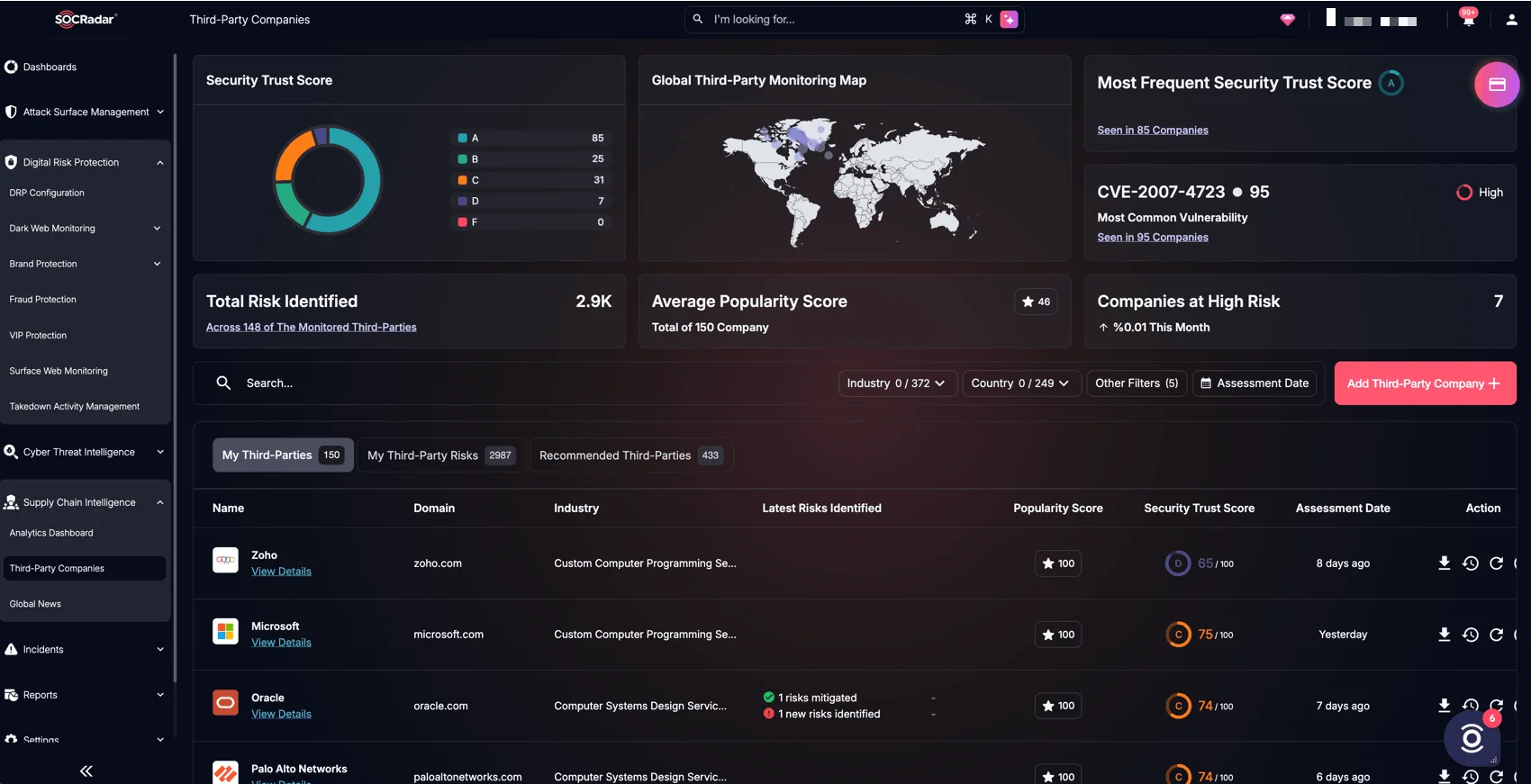
SOCRadar SCI 2.0 centralizes third-party risk visibility and vendor security scores
The module uses 133 technical assessment checkpoints across areas such as network security, email security, DNS health, cloud security, vulnerability monitoring, confidential information exposure, cybercriminal ecosystem activity, and source code repository exposure. With scoring models like Popularity Score and Security Trust Score, teams can move beyond static vendor reviews and prioritize suppliers with exposed assets, known vulnerabilities, leaked credentials, suspicious activity, or lower trust scores.
Software Supply Chain Attacks
Software supply chain attacks target the trusted code, tools, and platforms organizations use to build and deploy software. Attackers may abuse open-source packages, poison software updates, compromise CI/CD pipelines, breach repositories, steal developer tokens, or exploit dependency confusion to introduce malicious code into trusted environments.
Because modern applications depend on many external components, one compromised package or build process can affect several downstream organizations. These attacks are difficult to detect because they often move through systems that developers and security tools already trust.
IBM X-Force reported a 44% year-over-year increase in exploitation of public-facing software or system applications, showing how exposed software and trusted infrastructure remain major entry points for attackers.
Why Software Supply Chain Attacks Matter in 2026
Software development now depends heavily on open-source libraries, SaaS development platforms, container registries, CI/CD tools, cloud services, and third-party repositories. This creates a larger attack surface across the software lifecycle.
Attackers can use this ecosystem to scale their impact. A malicious package can spread through dependency chains, a compromised repository can expose secrets and source code, and a CI/CD breach can let attackers alter builds or deployment workflows before software reaches production.
Management Strategies
Organizations should improve visibility into the software components and tools they rely on. SBOMs can help teams identify what exists inside critical applications, while dependency scanning and package reputation checks can detect vulnerable, abandoned, or suspicious packages.
| Control | Why It Helps |
| SBOMs | Shows which components exist inside critical software |
| Dependency scanning | Detects vulnerable, outdated, or suspicious packages |
| Package reputation checks | Helps identify risky maintainers, typosquatting, or malicious packages |
| Code signing | Confirms that software updates and artifacts come from trusted sources |
| Secure CI/CD controls | Protects build pipelines, deployment workflows, and automation tokens |
| Secrets management | Reduces the risk of exposed credentials being abused |
| Repository monitoring | Detects suspicious commits, access changes, leaked keys, or unusual activity |
| Developer access reviews | Limits unnecessary access to source code, build systems, and production workflows |
Security teams should also harden CI/CD environments by protecting secrets, limiting developer and deployment access, monitoring repository changes, and verifying software artifacts before release. Code signing, least privilege, access reviews, and rapid secret rotation can reduce the chance that trusted software becomes a trusted attack path.
AI-Driven Supply Chain Attacks
AI-driven supply chain attacks use automation and generative AI to make supplier-focused attacks faster, more convincing, and easier to scale. Attackers can use AI to write phishing emails, impersonate vendors, create fake invoices, clone supplier communication styles, translate lures, summarize public information, and automate reconnaissance against suppliers or procurement teams.
This risk matters because supply chain relationships already depend on trust. If attackers can convincingly imitate a vendor, finance contact, MSP technician, or procurement partner, they may trick employees into approving payments, sharing credentials, changing bank details, or opening malicious files.
Why AI-Driven Supply Chain Attacks Matter in 2026
AI lowers the effort needed to run targeted supplier attacks. Threat actors no longer need perfect language skills or long manual research cycles to create believable messages. They can quickly generate tailored emails, fake business documents, vendor impersonation scripts, and reconnaissance summaries based on public company and supplier information.
This creates new risks for procurement, finance, vendor management, and security teams. A fake invoice, payment-change request, or supplier support message may look more natural than older phishing attempts. AI can also help attackers identify exposed vendor systems, generate phishing variations, or speed up social engineering against high-value suppliers.
Verizon’s 2026 DBIR found that employee use of unapproved shadow AI rose from 15% to 45% in one year, increasing the risk of sensitive data exposure. For supply chains, that risk can extend to vendors and partners that use public AI tools without clear data handling controls.
Management Strategies
Organizations should update vendor risk policies to include AI-related risks, especially around data handling, shadow AI tools, invoice workflows, and supplier communications. Vendors should explain how they use AI, what data they enter into AI systems, and whether they allow employees to use public AI tools for sensitive business processes.
| Control | Why It Helps |
| AI clauses in vendor policies | Sets expectations for safe AI use, data handling, and tool approval |
| Shadow AI monitoring | Helps detect unsanctioned AI tools used by employees or vendors |
| Supplier impersonation checks | Reduces fake invoice, payment-change, and vendor email fraud |
| Payment verification workflows | Requires out-of-band confirmation for bank detail or invoice changes |
| Procurement and finance training | Helps teams recognize AI-assisted phishing and impersonation |
| Vendor access reviews | Limits damage if AI-assisted social engineering leads to credential theft |
| Email and domain monitoring | Detects lookalike domains, spoofed suppliers, and fake vendor identities |
Security teams should also work closely with finance and procurement teams, not just IT. Many AI-driven supply chain attacks target business processes rather than technical systems. Strong verification steps, clear vendor contact records, MFA, least privilege, and monitoring for suspicious supplier activity can reduce the risk of AI-assisted fraud turning into a wider compromise.
Business, Compliance, and Operational Supply Chain Risks
Not every supply chain risk starts with cyberattacks. Regulations, regional instability, supplier failure, climate events, and logistics disruption can also affect delivery, production, compliance, and customer trust. These risks should be managed alongside cyber and digital exposure because they often overlap.
Regulatory and Compliance Risk
Regulatory and compliance risk is becoming a bigger supply chain concern as governments introduce stricter rules around data privacy, cyber resilience, ESG, forced labor, sanctions, and critical infrastructure security. Organizations may have strong internal controls, but they can still face penalties, contract disruption, reputational damage, or operational delays if suppliers fail to meet compliance requirements.
This risk is especially important for companies that work with global suppliers. A vendor may process personal data in one region, source materials from another, rely on subcontractors in high-risk jurisdictions, or provide services to regulated industries. If those obligations are not tracked properly, compliance gaps can spread across the supply chain.
Regulatory pressure is now one of the main drivers of third-party risk programs. KPMG’s 2026 Global TPRM Survey found that 45% of respondents said regulatory and compliance risk had grown in importance within TPRM, making it the second-highest overall risk driver after cyber risk and information security at 48%.
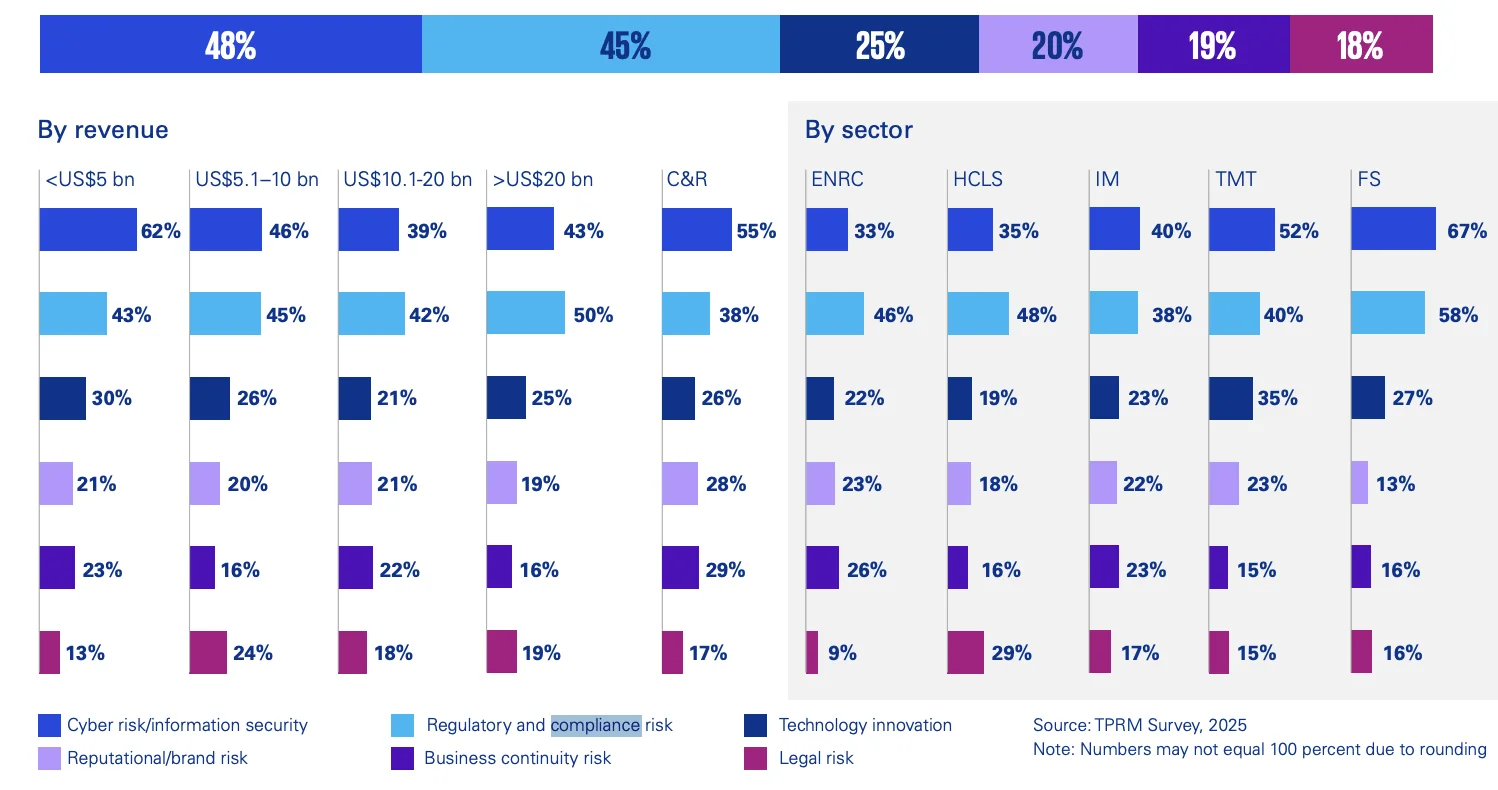
Cyber risk and regulatory compliance are the top risks gaining importance in third-party risk management, cited by 48% and 45% of respondents overall (Source: KPMG’s 2026 Global TPRM Survey)
Why Regulatory and Compliance Risk Matters in 2026
Supply chain compliance is no longer limited to contracts and basic vendor checks. Organizations now need to understand how suppliers manage data, cybersecurity, labor practices, sanctions exposure, environmental obligations, and subcontractor risk.
This creates a major data and coordination challenge. Legal, procurement, security, finance, compliance, and risk teams often track supplier information separately, which makes it harder to see whether a supplier still meets current requirements. A vendor that passed onboarding checks may later become non-compliant because of a new regulation, ownership change, subcontractor issue, cyber incident, or sanctions update.
Management Strategies
Organizations should add compliance checks directly into vendor onboarding, renewal, and offboarding processes. High-risk suppliers should be reviewed more often, especially if they handle sensitive data, support regulated operations, operate in high-risk regions, or rely on subcontractors.
| Control | Why It Helps |
| Compliance checks during onboarding | Identifies privacy, cyber, ESG, sanctions, and labor risks before contracts are signed |
| Centralized third-party risk data | Gives legal, procurement, security, and compliance teams one shared supplier view |
| Regular supplier reviews | Helps detect changes in ownership, operations, subcontractors, or regulatory exposure |
| Contractual compliance clauses | Sets clear obligations for data protection, incident reporting, audits, and subcontractor use |
| Sanctions and watchlist screening | Reduces exposure to restricted entities, regions, or ownership structures |
| Evidence-based assessments | Moves vendor reviews beyond self-attestation and outdated questionnaires |
| Critical supplier mapping | Shows which vendors could create legal, operational, or regulatory disruption if they fail |
Compliance teams should also connect supplier reviews with business continuity planning. If a critical supplier becomes non-compliant or restricted, the organization needs to know which services, data flows, contracts, and customers may be affected. In 2026, regulatory and compliance risk management should be treated as an ongoing supply chain function, not a one-time onboarding task.
Operational and Logistics Disruption
Operational and logistics disruption includes port delays, transportation issues, labor strikes, warehouse disruption, production delays, equipment failures, inventory shortages, and quality problems. These risks can slow delivery, increase costs, affect customer commitments, and create pressure across the wider supply chain.
This type of supply chain risk is not new, but it is more difficult to manage when companies rely on lean inventory models, global suppliers, just-in-time delivery, and limited backup capacity. A single disruption at a port, warehouse, supplier facility, or transportation route can delay production and affect multiple downstream partners.
Why Operational and Logistics Disruption Matters in 2026
Supply chains remain exposed to congestion, labor shortages, regional instability, extreme weather, and transportation bottlenecks. At the same time, digital systems now support many logistics processes, including routing, inventory management, customs documentation, warehouse automation, and shipment tracking.
This means operational disruption can also overlap with cyber risk. A ransomware attack on a logistics provider, a system outage at a warehouse, or a compromised transportation platform can delay shipments just like a physical disruption. Organizations should treat logistics resilience and digital resilience as connected priorities.
Management Strategies
Organizations should identify which suppliers, routes, ports, warehouses, and logistics providers support critical operations. They should also map single points of failure and build realistic backup plans for high-impact disruptions.
| Control | Why It Helps |
| Supplier and route diversification | Reduces reliance on one supplier, region, port, or transportation route |
| Safety stock for critical items | Helps maintain operations during shortages or shipment delays |
| Logistics visibility | Improves tracking across shipments, warehouses, and transportation partners |
| Backup logistics providers | Gives teams alternatives when primary providers are disrupted |
| Scenario planning | Prepares teams for strikes, port congestion, weather events, and production delays |
| Business continuity testing | Shows whether recovery plans work before disruption occurs |
| Cyber checks for logistics providers | Reduces the risk of ransomware or system compromise affecting delivery operations |
Operational and logistics risk management should be based on practical recovery planning. It is not enough to know that a disruption could happen. Organizations need to know how long they can operate without a supplier, which customers may be affected, and which alternatives are ready to use.
Financial and Supplier Stability Risk
Financial and supplier stability risk includes supplier insolvency, rising costs, inflation, currency fluctuations, payment instability, reduced capacity, and sudden changes in supplier ownership. These risks can disrupt production, increase procurement costs, and force organizations to find replacement suppliers under pressure.
A supplier does not need to suffer a cyberattack to become a supply chain risk. Financial weakness can lead to missed deadlines, lower product quality, reduced staffing, delayed shipments, or contract failures. In some cases, a financially distressed supplier may also reduce security investment, creating additional cyber and compliance exposure.
Why Financial and Supplier Stability Risk Matters in 2026
Cost pressure, unstable demand, energy prices, borrowing costs, and regional market shifts can affect supplier reliability. Smaller suppliers may be especially exposed if they depend on a limited customer base, narrow margins, or one production region.
This risk can also create hidden dependencies. A supplier may appear replaceable on paper, but replacing it may require new certifications, legal reviews, technical integrations, product testing, or customer approvals. That can make recovery slower than expected.
Management Strategies
Organizations should monitor the financial health and performance of critical suppliers, especially those that support production, logistics, sensitive services, or customer-facing operations.
| Control | Why It Helps |
| Supplier financial monitoring | Helps detect early signs of insolvency, instability, or reduced capacity |
| Performance tracking | Identifies delivery delays, quality issues, or service degradation |
| Backup supplier planning | Reduces recovery time if a supplier fails |
| Contract review | Clarifies obligations, exit rights, price changes, and service commitments |
| Payment risk controls | Reduces exposure to invoice fraud, payment instability, or vendor impersonation |
| Critical supplier scoring | Prioritizes suppliers based on business impact and replacement difficulty |
| Cross-functional review | Helps procurement, finance, legal, and risk teams evaluate supplier health together |
Financial risk management should focus on early warning signs. Missed delivery dates, frequent price changes, lower service quality, delayed responses, or ownership changes may signal that a supplier needs closer review.
Why Traditional Supply Chain Risk Management Is No Longer Enough
Traditional supply chain risk management often depends on annual supplier reviews, static questionnaires, contract clauses, and manual assessments. These methods can still support governance, but they are too slow for modern supply chain risks.
A supplier’s risk profile can change quickly. A vendor may expose a new cloud asset, suffer a breach, lose financial stability, add a subcontractor, adopt an unapproved AI tool, or become affected by sanctions or regional disruption. If organizations only review suppliers once a year, they may miss the changes that matter most.
Modern supply chain risk management should combine traditional resilience planning with continuous monitoring, threat intelligence, third-party cyber risk visibility, attack surface management, and stronger identity controls. This helps organizations detect early warning signs before a supplier issue becomes a business-wide disruption.
How to Manage Supply Chain Risks in 2026
Effective supply chain risk management should combine traditional business continuity practices with digital supply chain security. Organizations need to prepare for physical disruption, but they also need to detect cyber threats, vendor exposure, credential abuse, SaaS risks, and software supply chain attacks.
Traditional Supply Chain Risk Management Strategies
Traditional controls help organizations reduce disruption across sourcing, logistics, operations, finance, and compliance.
| Strategy | Why It Helps |
| Diversify critical suppliers | Reduces dependence on one vendor, region, or production source |
| Build contingency plans | Helps teams respond to supplier failure, logistics disruption, or regional instability |
| Monitor supplier financial health | Identifies early signs of insolvency, rising costs, or service degradation |
| Maintain backup suppliers | Reduces recovery time during outages, shortages, or contract failures |
| Review compliance obligations | Helps manage privacy, sanctions, ESG, forced labor, and sector-specific requirements |
| Use scenario planning | Prepares teams for operational, geopolitical, climate, and demand-related disruption |
These controls remain important because many supply chain disruptions are still operational, financial, regional, or environmental. However, they should not operate separately from cybersecurity and digital risk management.
Digital Supply Chain Risk Management Strategies
Digital supply chain controls help organizations manage the risks created by vendors, SaaS platforms, software dependencies, cloud services, third-party access, and external threat activity.
| Strategy | Why It Helps |
| Continuously monitor third-party cyber risk | Detects changes in supplier exposure, breach signals, and external risk posture |
| Review vendor access and privileges | Reduces the risk of credential abuse, API misuse, and unauthorized access |
| Track software supply chain risks | Helps identify exposed secrets, vulnerable dependencies, repository issues, and CI/CD weaknesses |
| Use threat intelligence | Supports monitoring of ransomware activity, exploitation trends, actor targeting, and supplier-related threats |
| Strengthen identity controls | Limits access through MFA, least privilege, just-in-time access, and access reviews |
| Monitor attack surface changes | Shows when vendors, subsidiaries, cloud assets, or internet-facing systems become exposed |
| Detect supplier impersonation | Helps stop fake invoices, lookalike domains, spoofed emails, and payment fraud |
The strongest programs combine both sides. Supplier diversification can reduce operational dependency, while continuous cyber monitoring can reveal whether a critical supplier is exposed to ransomware, credential theft, or active exploitation.