

Oct 08, 2026
Table Of Content
How Third-Party Risk Management Turns Vendor Exposure Into Actionable Defense
Why Traditional Third-Party Risk Management Programs Fall Short
From Vendor Lists to Risk-Aware Prioritization in Third-Party Risk Management
Detecting Third-Party Breaches Before They Reach You
From Threat Context to Proportional Response and Compliance
Conclusion
Related Articles

Feb 09, 2026
9 Mins Read

Summarize with:
How Third-Party Risk Management Turns Vendor Exposure Into Actionable Defense
In modern environments, third-party risk management failures are often the entry point attackers rely on. Compromise usually starts quietly in someone else’s environment, long before any impact is visible internally.
Despite this reality, many organizations still rely on static vendor lists, annual questionnaires, and manual reviews. This compliance-first approach creates the appearance of control but fails to answer the questions that matter most: Which suppliers matter right now? Which risks are active? And which exposures can realistically affect us today?
The challenge is not vendor volume. It is the lack of intelligence connecting vendor risk to real-world threat activity, leaving security teams reacting late or prioritizing without confidence.
Why Traditional Third-Party Risk Management Programs Fall Short
Most vendor risk management processes were designed for compliance, not adversaries. As a result, third-party risk management often becomes a documentation exercise rather than an operational security function. They emphasize documentation, point-in-time assessments, and self-reported controls. While these practices support audits, they offer little help when attackers are actively exploiting weaknesses across interconnected ecosystems.
These weaknesses usually show up as:
- Overwhelming scale, where hundreds or thousands of vendors make deep review impractical
- Static assessments that miss changes in vendor security posture and emerging threats
- Disconnected threat signals, with external compromise indicators appearing long before disclosure
- Flat prioritization, where critical and low-impact vendors look identical on paper
The result is a familiar pattern: teams know their supply chain is risky, but they can’t confidently say where the risk is most acute or when to act.
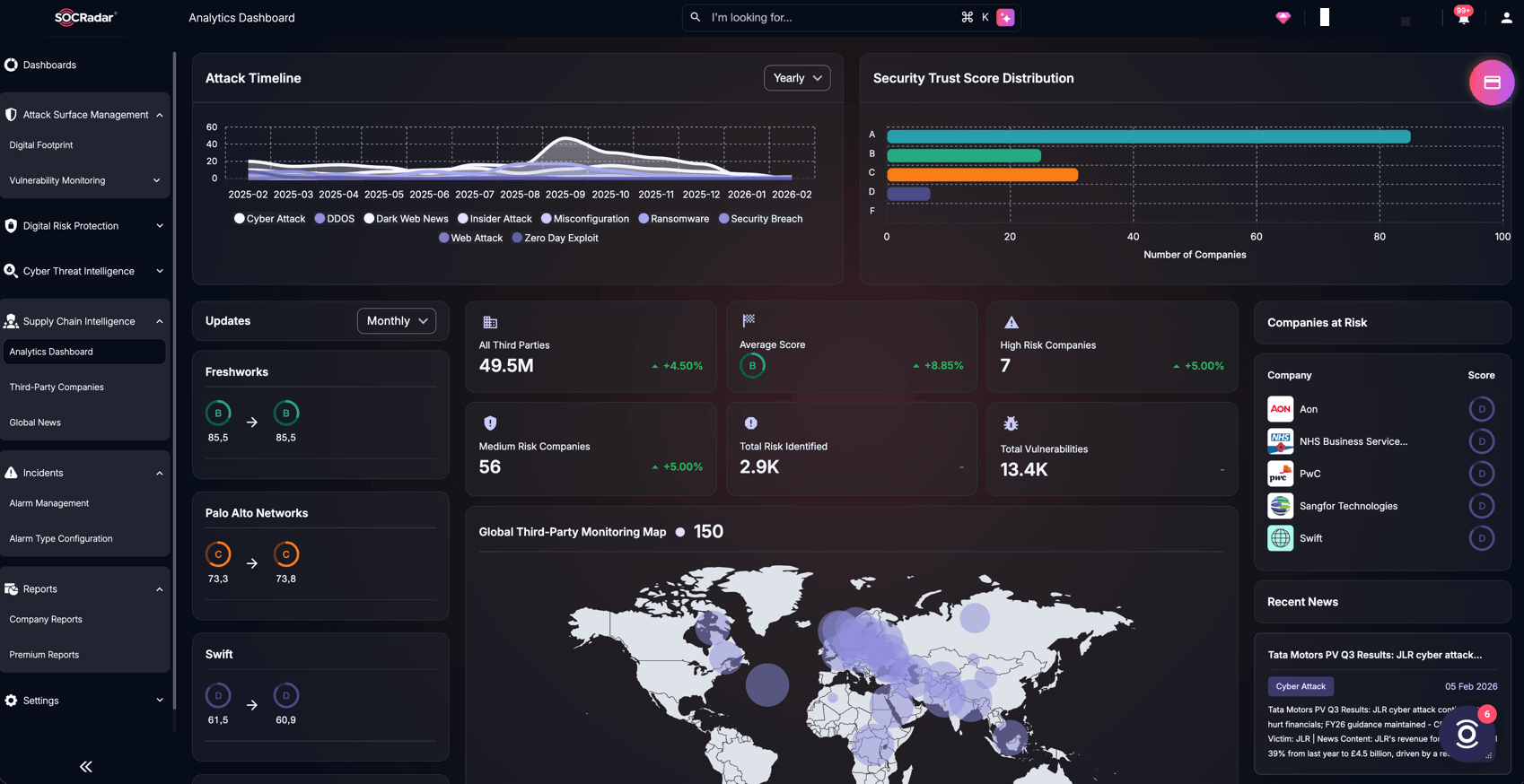
SOCRadar’s Supply Chain Intelligence offers a centralized view of third-party risk across the ecosystem, showing attack trends, risk distribution, and the number of monitored suppliers. This helps teams quickly understand overall exposure and identify where attention is needed.

From Vendor Lists to Risk-Aware Prioritization in Third-Party Risk Management
Effective supply chain defense starts with a shift in perspective. Mature third-party risk management focuses on real exposure and attacker behavior, not just vendor attestations. Instead of asking, “Have we assessed this vendor?” teams need to ask, “How much risk does this vendor introduce today, and how relevant is that risk to our organization?”
This requires two dimensions of intelligence working together. First, teams need to understand how critical or systemic a vendor is within their ecosystem.
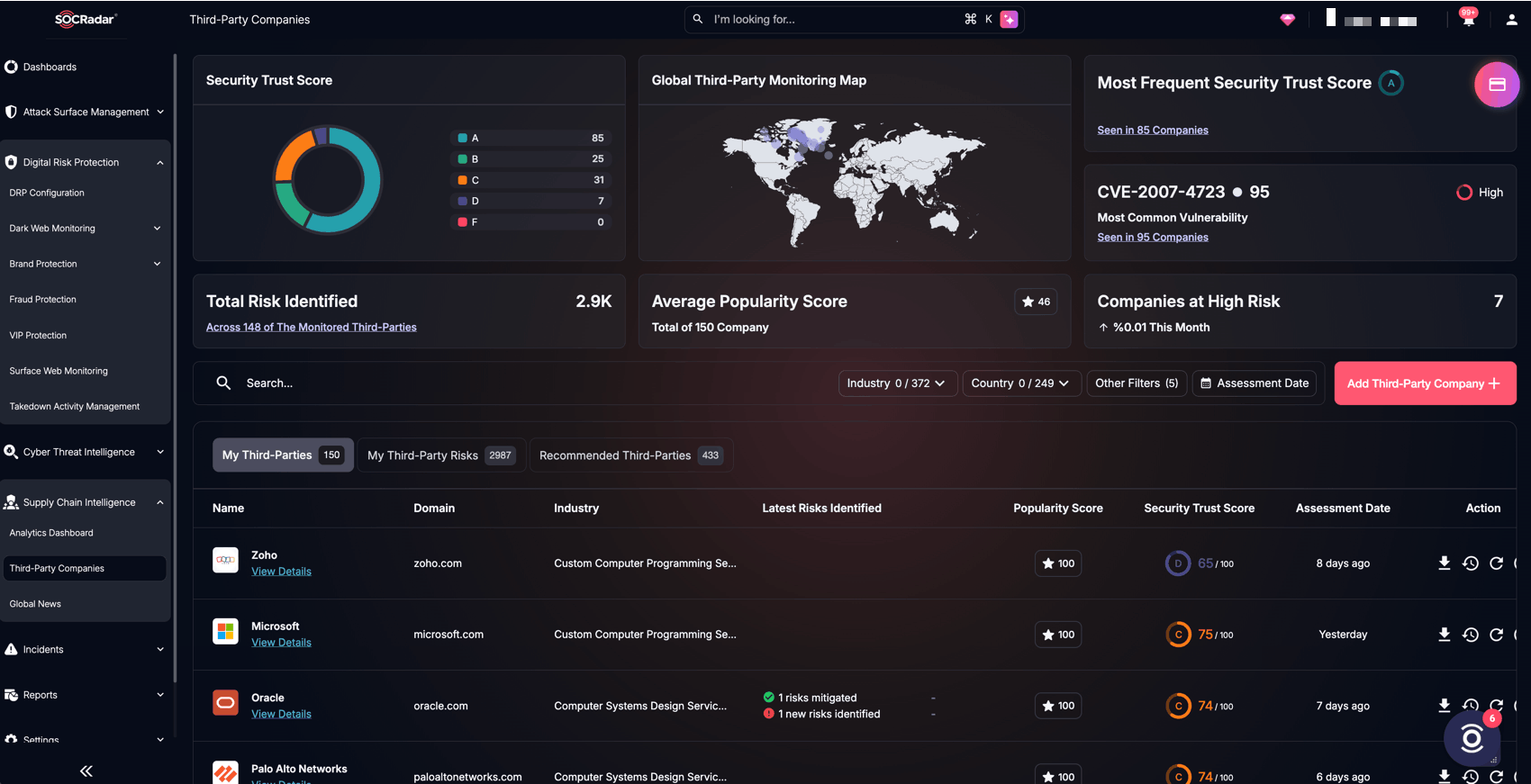
SOCRadar’s Third-Party Companies Overview and Risk Distribution – An aggregated view of monitored third parties, highlighting security trust score distribution, global monitoring coverage, and the most common risks observed across suppliers.
Second, they must assess how exposed or vulnerable that vendor is based on real security signals rather than self-reported controls.
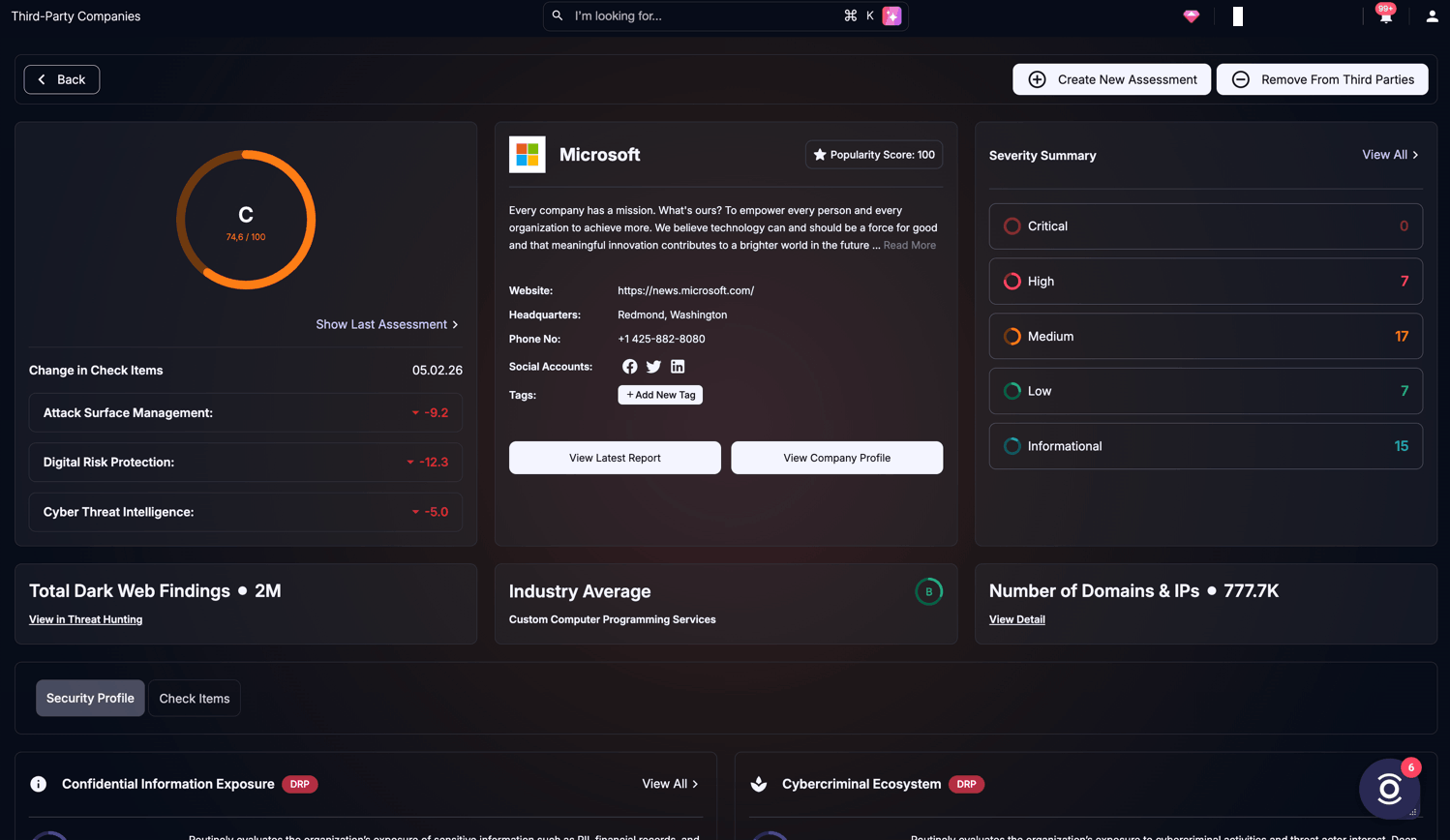
Individual Third-Party Company Profile and Risk Summary – A detailed profile of a single supplier, combining popularity, security trust score, severity breakdown, and recent changes in risk posture. This view supports deeper investigation into why a vendor is classified as higher or lower risk.
When these perspectives are combined, vendor risk becomes something teams can clearly prioritize, investigate, and respond to in real operational terms.
Automated Vendor Risk Scoring in Practice
Modern Supply Chain Intelligence platforms address scale by automating vendor assessment across millions of companies. This evolution strengthens third-party risk management by replacing manual reviews with continuous evaluation. Instead of relying solely on surveys, they continuously evaluate vendors using structured risk criteria and external intelligence.
Two scoring dimensions are especially useful in this context, because they translate abstract vendor risk into clear priorities: Popularity or ecosystem relevance highlights vendors that are widely used or deeply integrated, while data-driven risk scores evaluate suppliers against hundreds of technical and security-related checks.
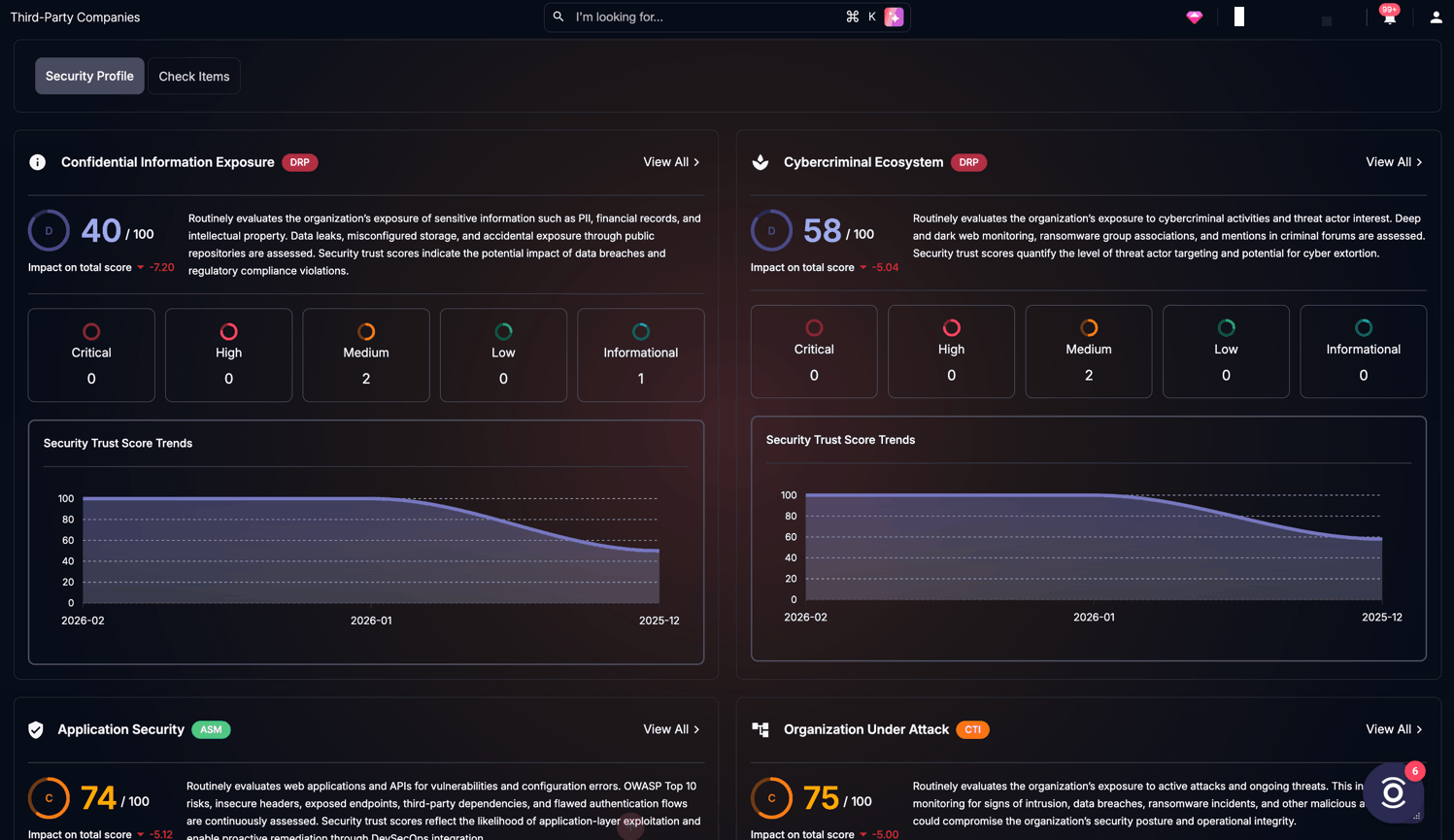
Third-Party Risk Categories and Trend Analysis – A breakdown of risk categories such as confidential data exposure, cybercriminal activity, application security, and active threats, along with historical score trends. This helps teams track how vendor risk evolves over time rather than relying on point-in-time assessments.
Together, these signals help teams quickly surface vendors that are both high-risk and high-impact, allowing low-risk or low-relevance suppliers to be monitored with less intensity.
This makes it easier to separate vendors into practical response tiers:
- High risk / high relevance vendors that require immediate review or remediation
- High relevance / lower risk vendors that need closer monitoring
- Lower relevance suppliers that can be reviewed on a lighter cadence
Rather than spreading resources thin, security teams gain a defensible way to focus where it matters most.
In day-to-day operations, this is typically reflected in a centralized vendor view where teams can see all third parties ranked by risk and relevance. Analysts start investigations directly from this view, drilling into individual vendor profiles to understand why a supplier is classified as high risk, which risk categories are driving the score, and whether the situation is improving or deteriorating over time.
Detecting Third-Party Breaches Before They Reach You
One of the most dangerous aspects of supply chain incidents is timing. Weak third-party risk management often means organizations learn about vendor breaches too late. By the time a vendor publicly discloses a breach, attackers may already be moving laterally into customer environments.
Early detection depends on visibility outside your own perimeter.
Where Early Signals Actually Appear
In many cases, the first indicators of a vendor compromise show up in places most organizations don’t routinely monitor. Dark Web marketplaces may advertise access to supplier systems, while hacker forums discuss initial breaches long before disclosure. Infostealer logs often contain vendor credentials harvested directly from infected devices, and underground chatter tied to active attack campaigns can reveal intent and momentum weeks in advance.
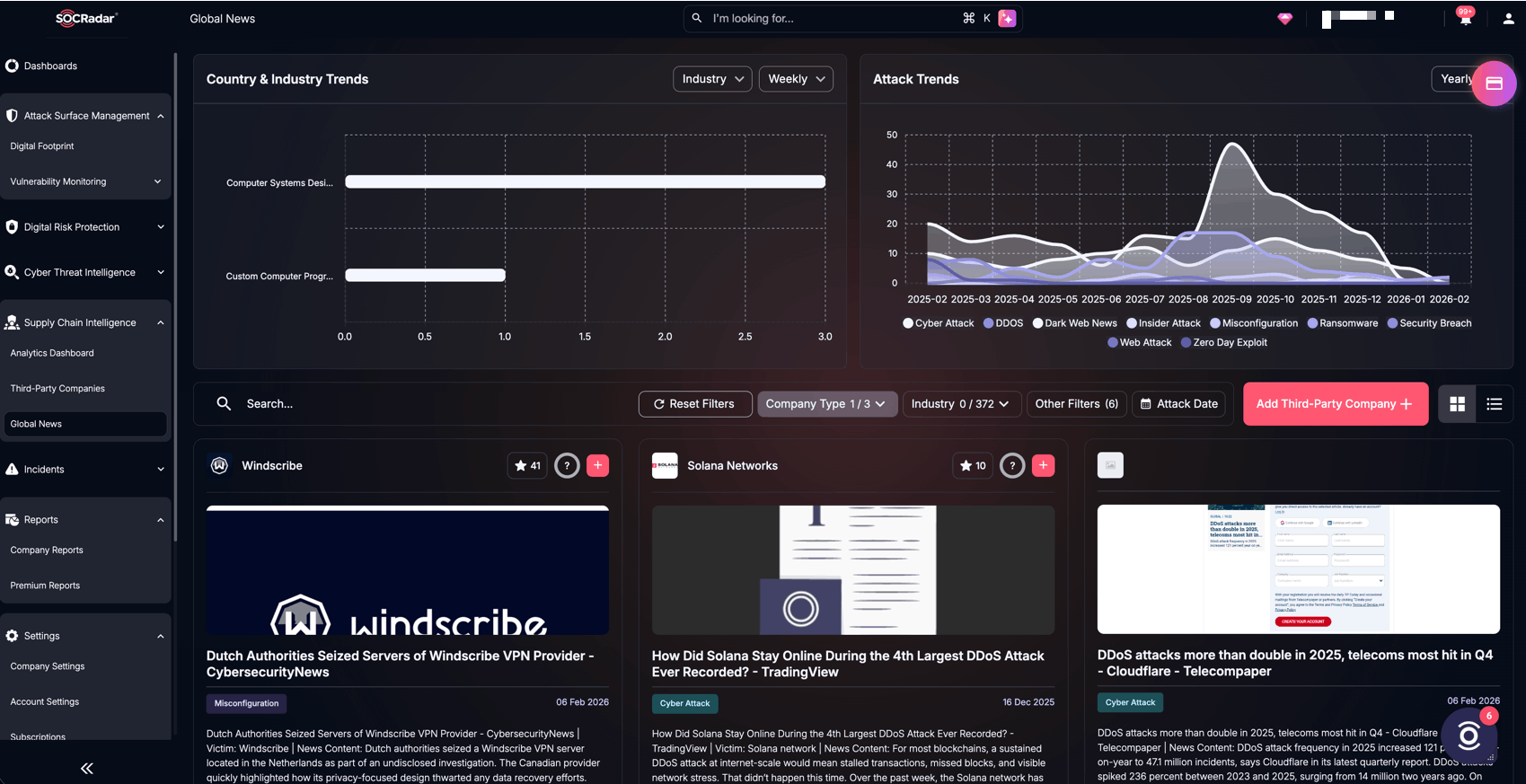
Global News and Threat Activity Relevant to Third Parties – A consolidated feed of industry and country-level news, attack trends, and security incidents related to monitored suppliers.
Without external intelligence, organizations remain blind during this critical window. Without external intelligence, organizations remain blind during this critical window.
Turning External Signals Into Action
Supply Chain Intelligence continuously monitors these sources and correlates findings back to known vendors, giving third-party risk management teams early warning they can act on. When suspicious activity tied to a supplier appears, teams can immediately review the underlying evidence, such as a Dark Web post or stealer log, and determine whether the exposure is isolated or part of a broader campaign.
This context allows security teams to act early by restricting integrations, resetting shared credentials, increasing monitoring, or engaging the supplier directly. Acting on these signals before confirmation of impact enables preventive containment, which is far less costly than responding after a breach has already spread.
From Threat Context to Proportional Response and Compliance
Not every exposure requires the same response. Effective third-party risk management depends on understanding whether a signal represents active compromise or residual risk, and applying that judgment consistently across both security operations and compliance workflows.
In practice, analysts enrich alerts with timing, source, and activity context to determine urgency. This same context then feeds operational response and regulatory oversight, ensuring actions are defensible and aligned.
Teams typically apply this intelligence in three clear ways:
- Active compromise indicators trigger immediate containment, incident response, and supplier engagement
- Recent but inactive exposure leads to credential hygiene, access review, and heightened monitoring
- Historical or low-impact findings are documented to support audits, trend analysis, and framework alignment
Because this response logic is mapped directly to regulatory frameworks such as NIS2, ISO 27001, and ANSI, teams can demonstrate continuous third-party risk management rather than one-time assessments. The same workflows used for daily prioritization and investigation also support audits and reporting, allowing governance and operations to function as a single, coordinated discipline.
Conclusion
Supply chain attacks succeed because they exploit trust, scale, and blind spots. Defending against them requires more than knowing who your vendors are. It requires understanding how risky they are right now and what that risk means for your organization.
By combining large-scale vendor monitoring, early breach detection, forensic context, and regulatory alignment, Supply Chain Intelligence enables security teams to move from reactive awareness to proactive defense. The organizations that make this shift will not only respond faster to incidents, but prevent many of them from happening at all.