Top 10 Cyber Threat Exposure Management Platforms
Cyber Threat Exposure Management (CTEM) has moved from a conceptual framework into a real buying and operating decision. Security teams are trying to reduce what attackers can actually use, across a mix of cloud services, SaaS, endpoints, identities, and internet-facing infrastructure that changes constantly.
This list is for CISOs and security leaders building an exposure-reduction program, vulnerability and risk teams trying to prioritize remediation at scale, and practitioners who need better context than “high CVSS equals top priority.” It’s also for buyers trying to make sense of vendor overlap across ASM/EASM, CAASM, RBVM, cloud exposure analytics, attack path management, and security validation.
The goal is not to pick a universal “best” platform. CTEM is a lifecycle. Different products cover different stages well, and many organizations end up with a small set of complementary tools rather than a single suite.
Disclaimer and sourcing note: The CTEM market changes fast, and vendors frequently relabel adjacent categories under “CTEM.” This article is intentionally conservative and sticks to high-level positioning based on widely known market patterns plus vendor-stated intent. The draft provided no URLs, so specific feature names, licensing requirements, and quantitative claims should be verified against each vendor’s current documentation before you treat them as definitive.
Key Takeaways
- CTEM is a program. Tools support it, but scoping, ownership, and remediation governance decide whether exposure actually goes down.
- Most teams need at least two capability buckets: discovery/prioritization plus some form of validation (attack paths, BAS/ASV/AEV, or both).
- Prioritization quality matters more than raw detection volume. Look for context like asset criticality, external exposure, reachability, and compensating controls.
- Mobilization is where value is won or lost: routing, SLAs, retesting, and proof of closure.
What This List Covers (and Why This Topic Matters)
CTEM is best understood as a way to run security exposure reduction continuously, not a single tool category. Many organizations already have scanners, CSPM tools, SIEM dashboards, and ticketing workflows. The persistent gap is that those systems often produce more issues than teams can handle, with unclear prioritization and limited proof that fixing something reduced real risk.
This list focuses on platforms that can support CTEM outcomes across one or more lifecycle stages:
- Discovery: what assets exist, what is exposed, and what changed
- Prioritization: what to fix first using business and technical context
- Validation: what is actually reachable/exploitable, or whether controls truly work
- Mobilization: assigning work to owners, tracking SLAs, retesting, and showing measurable reduction over time
You will see entries that approach CTEM from different starting points:
- VM-led exposure management platforms
- Cloud-first exposure analytics
- External attack surface and threat intelligence driven approaches
- Attack path management (reachability-based prioritization)
- Security validation platforms (BAS/ASV/AEV)
How We Selected These Entries
This is a curated list, not a strict ranking. The intent is to represent the main ways teams operationalize CTEM today, across suites and specialist tools.
Source Types and Evidence Signals Used
Because no links were provided with the draft, this article avoids deep claims that would require citation (for example, exact scoring formulas, coverage guarantees, proprietary metrics, or specific integration lists). Instead, selection is based on:
- Vendor-stated positioning and commonly understood product category alignment (exposure management, attack path management, BAS/ASV/AEV)
- Market presence and adoption patterns in enterprise security programs
- CTEM lifecycle fit: whether a platform meaningfully supports discovery, prioritization, validation, and/or mobilization
If you provide vendor URLs or analyst references, the entries can be tightened with precise terminology, current module names, and any documented limitations.
What “Good Fit” Means In This List
Platforms were favored when they show strength in at least two CTEM stages, and ideally connect stages in a way that reduces handoffs. We also weighed:
- Discovery breadth and freshness (internal, cloud, identity, external, depending on the platform’s scope)
- Prioritization clarity (what signals drive priority, and whether humans can explain it to stakeholders)
- Validation strength (reachability, exploitability evidence, control effectiveness testing)
- Mobilization (ticketing/ownership/SLAs/retesting and trend reporting)
- Operational realism (how teams actually run remediation, not just dashboards)
Summary Table: Quick Comparison of CTEM Platforms
| CTEM Platform | Vendor | Strongest CTEM Stages | Best When You Need | Watchouts During Evaluation |
|---|---|---|---|---|
| SOCRadar XTI (A.S.T.A module) | SOCRadar | Discovery, Prioritization, Validation, Mobilization | External exposure plus threat-led vulnerability assessment | Confirm scan scope, data noise, and workflow fit |
| Microsoft Security Exposure Management (MSEM) | Microsoft | Discovery, Prioritization, Mobilization | Exposure insights across Microsoft security telemetry | Licensing/packaging details; non-Microsoft coverage depth |
| Tenable One | Tenable | Discovery, Prioritization, Mobilization | VM-led exposure management and risk-based prioritization | Validation often needs a companion tool; scoring transparency |
| Rapid7 Exposure Command | Rapid7 | Discovery, Prioritization, Mobilization | Consolidated exposure view for Rapid7-heavy shops | Dependent on how complete Rapid7 data sources are |
| Cortex Exposure Management | Palo Alto Networks | Discovery, Prioritization, Mobilization | Platform approach to prioritizing exposure with ecosystem integration | Clarify exact “exposure” scope; suite dependency |
| Wiz Exposure Management | Wiz | Discovery, Prioritization | Cloud-first context across resources, identities, and data | Cloud-centric; on-prem and endpoint depth may require other tools |
| XM Cyber | XM Cyber | Prioritization, Validation, Mobilization | Attack path context to find choke points and reduce wasted fixes | Model accuracy depends on integrations and data quality |
| Cymulate | Cymulate | Validation, Prioritization, Mobilization | Control validation and evidence for what works and what fails | Not a discovery replacement; needs safe testing governance |
| Pentera | Pentera | Validation, Prioritization, Mobilization | Automated security validation with repeatable measurement | Requires careful scoping and change control; not full CTEM alone |
| Horizon3.ai NodeZero | Horizon3.ai | Validation, Prioritization, Mobilization | Adversarial validation outputs tuned for remediation | Governance and safety boundaries are essential; complements discovery tools |
The Top 10 Cyber Threat Exposure Management Platforms
CTEM programs usually succeed when they start with one hard question: “Where do we lose time or credibility today?” Some teams lack asset visibility. Others have visibility but cannot prioritize. Others can prioritize but cannot prove exploitability or control effectiveness. Others can prove it but cannot move work through engineering and IT.
Use the entries below to map products to your biggest bottleneck.
1) SOCRadar XTI (with A.S.T.A module)
SOCRadar XTI combines external threat intelligence, digital risk signals, attack surface visibility, and exposure management workflows. Its A.S.T.A module, short for Attack Surface Threat Assessment, adds a direct CTEM layer by helping teams continuously discover, scan, validate, and prioritize vulnerabilities across exposed assets.
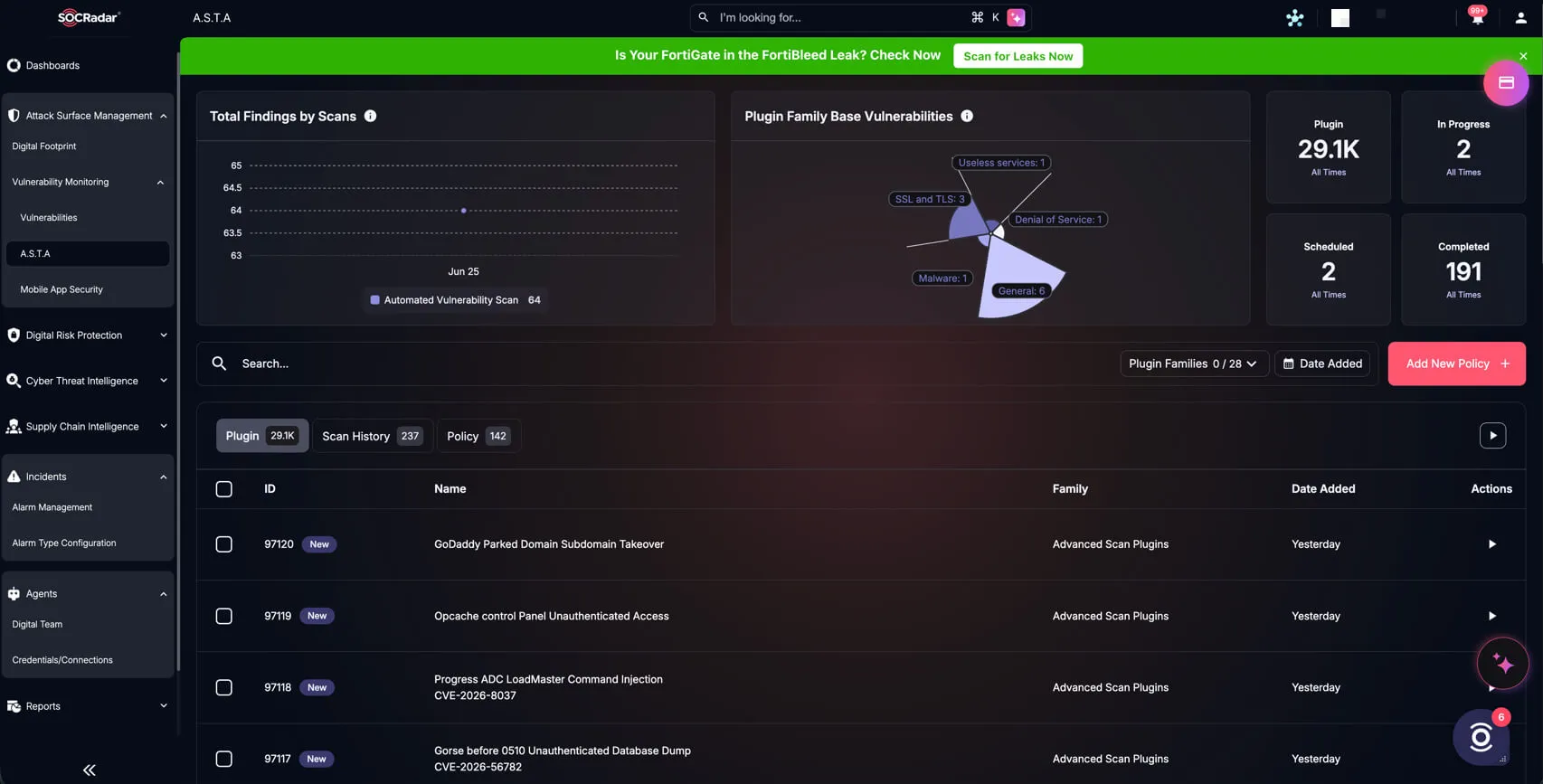
SOCRadar A.S.T.A’s module
Many CTEM programs underweight external reality. Attackers start from what they can see: exposed services, misconfigured DNS, leaked credentials, lookalike domains, vulnerable internet-facing assets, and third-party exposures. SOCRadar is included because A.S.T.A connects external attack surface visibility with vulnerability scanning, threat intelligence, validation, and remediation tracking.
Key strengths and notable points
- Continuous security assessments. A.S.T.A lets teams create custom scan policies for specific domains, IPs, login pages, cloud apps, vulnerabilities, attack vectors, or compliance needs. Scans can run on demand or on scheduled intervals such as weekly or monthly.
- Threat-led prioritization. Findings can be prioritized using CVSS severity, exploitability, external exposure context, CISA KEV tags, active exploitation signals, and threat group interest. This helps teams focus on vulnerabilities that create real business risk.
- Vulnerability validation. After remediation, teams can trigger manual or automated re-scans to confirm whether an issue has been resolved, helping reduce false positives and keep vulnerability status accurate.
- Large vulnerability and plugin library. A.S.T.A uses a plugin-based scanning engine with around 30,000 vulnerability, CVE, exploit scenario, and misconfiguration checks.
- Full scan history and exposure tracking. The platform records scan events, affected assets, triggered plugins, vulnerabilities found, severity groupings, scan duration, and validation status for remediation tracking and audit readiness.
Limitations and context
- External exposure data can still be noisy. Asset ownership, temporary infrastructure, third-party systems, and duplicate findings need clear triage rules.
What to watch for during evaluation
- How scan policies are created, including asset selection, scan frequency, scan location, and compliance-focused options.
- How prioritization explains exploitability, external exposure, KEV status, active exploitation, and threat intelligence context.
- How findings convert into action: assignment, evidence, SLAs, re-scan options, and closure checks.
- Whether scan history, reporting, MTTR tracking, and validation records are strong enough for risk, compliance, and executive reporting.
2) Microsoft Security Exposure Management (MSEM)
Microsoft Security Exposure Management (MSEM) is Microsoft’s exposure-focused capability set designed to help organizations understand and reduce exposure using telemetry and relationships available in Microsoft’s security ecosystem. In practice, that usually means strong coverage where Microsoft already has a control-plane or sensor footprint, such as identity, endpoint, and cloud services within the Microsoft stack.
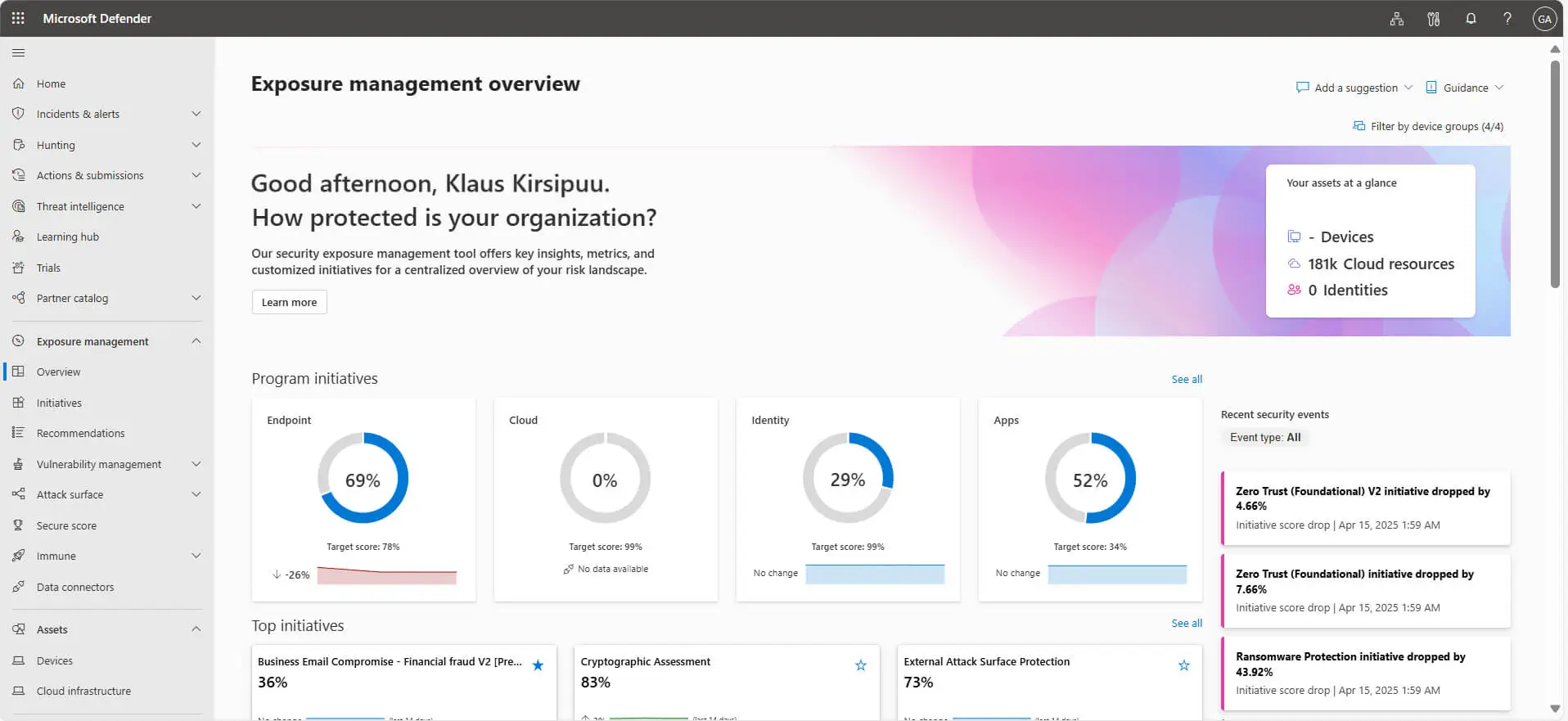
Microsoft Security Exposure Management (MSEM) module
Many CTEM efforts stall because exposure data is split across products and teams. Microsoft is included because Microsoft-centric organizations often want a single exposure view that can connect security signals to remediation workflows without building a large integration project first. If your core identity, endpoint management, and cloud foundation are Microsoft-led, the consolidation benefit can be real.
Key strengths and notable points:
- Correlation across common enterprise control points. CTEM prioritization improves when identity, endpoint, and cloud signals can be viewed together rather than as separate findings queues.
- Operational fit for Microsoft-heavy environments. If teams already run Microsoft Defender, Entra ID, and Azure controls, adoption friction can be lower than introducing a net-new platform.
- Leadership reporting potential. Exposure reduction needs trend metrics and repeatable views that executives can understand, not just a list of vulnerabilities.
Limitations and context
- Coverage is strongest inside the Microsoft universe. If major parts of your estate sit outside Microsoft (multi-EDR environments, heavy AWS/GCP footprint with limited Azure usage, niche SaaS), expect gaps or additional tooling requirements.
- Exposure management is not a substitute for ownership mapping. Even when telemetry is rich, someone still needs to decide who owns an asset, what the SLA is, and how “fixed” is verified.
What to watch for during evaluation
- Exactly which exposure features require which Microsoft products, licenses, or SKUs.
- How well MSEM pulls in non-Microsoft context (CMDB, ticketing, cloud accounts, third-party scanners) and how clean those integrations are in real operations.
- Whether the platform helps you produce a stable backlog that engineering teams respect, rather than a rolling set of alerts that constantly reprioritize without explanation.
3) Tenable One
Tenable One is Tenable’s exposure management platform that builds on Tenable’s vulnerability management heritage to deliver an exposure-centric view. The core promise is familiar to anyone who has run a VM program: you can find a lot of issues, but you need a defensible way to focus on what matters.
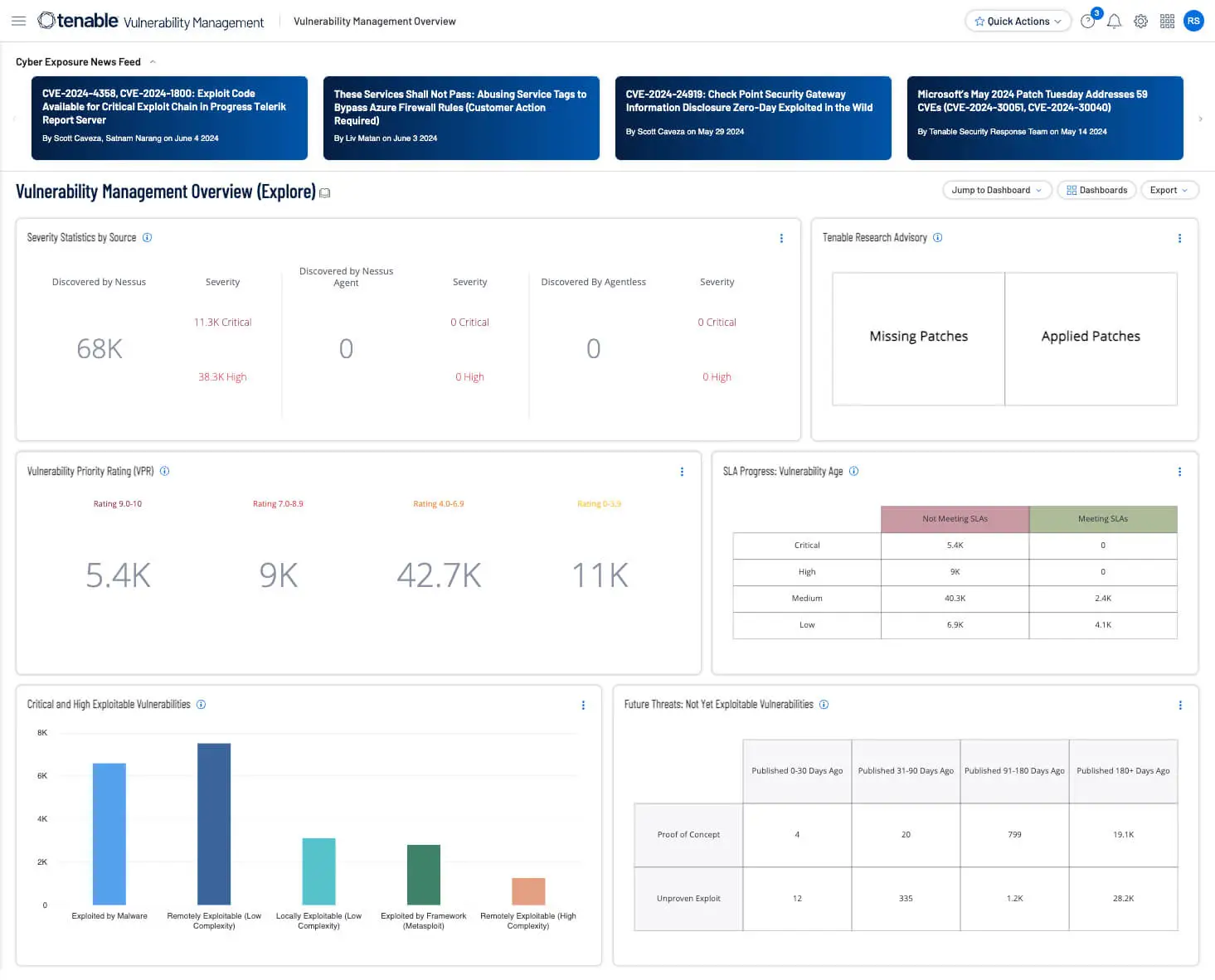
Tenable Vulnerability Management
A large portion of CTEM programs start as “VM plus better prioritization.” Tenable is included because it represents that VM-led path to CTEM. For many organizations, improving exposure outcomes begins by reducing the vulnerability backlog into a smaller set of actions tied to critical assets and real threat context.
Key strengths and notable points
- Broad vulnerability discovery roots. Tenable is commonly used for enterprise vulnerability identification, which gives it a natural role in CTEM discovery for many customers.
- Prioritization emphasis. Exposure management lives or dies on reducing noise. Platforms like Tenable One are often evaluated on how they score, group, and explain priorities rather than how many CVEs they can list.
- Fits existing remediation muscle. If you already have a patch and remediation workflow that runs off Tenable findings, an exposure management layer can be an evolution instead of a reset.
Limitations and context
- Discovery and scoring do not equal validation. Even strong RBVM does not automatically prove exploitability in your environment. Many CTEM teams pair VM-led platforms with attack path analysis or a validation platform.
- Asset criticality is the missing ingredient for many buyers. If your organization cannot reliably tag crown jewels, critical apps, and business ownership, any risk score will be challenged by stakeholders.
What to watch for during evaluation
- How the platform explains prioritization. Engineers will ask why one issue is above another, especially when it conflicts with CVSS instincts.
- How cloud, containers, and external exposure (if included in your Tenable deployment) are handled relative to classic on-prem scanning.
- Whether the tool helps you manage remediation throughput (SLA tracking, suppression rules with governance, retest confirmation) rather than just generating better charts.
4) Rapid7 Exposure Command
Rapid7 Exposure Command is Rapid7’s exposure management offering intended to unify exposure signals across Rapid7’s ecosystem and help teams translate findings into a prioritized remediation plan.
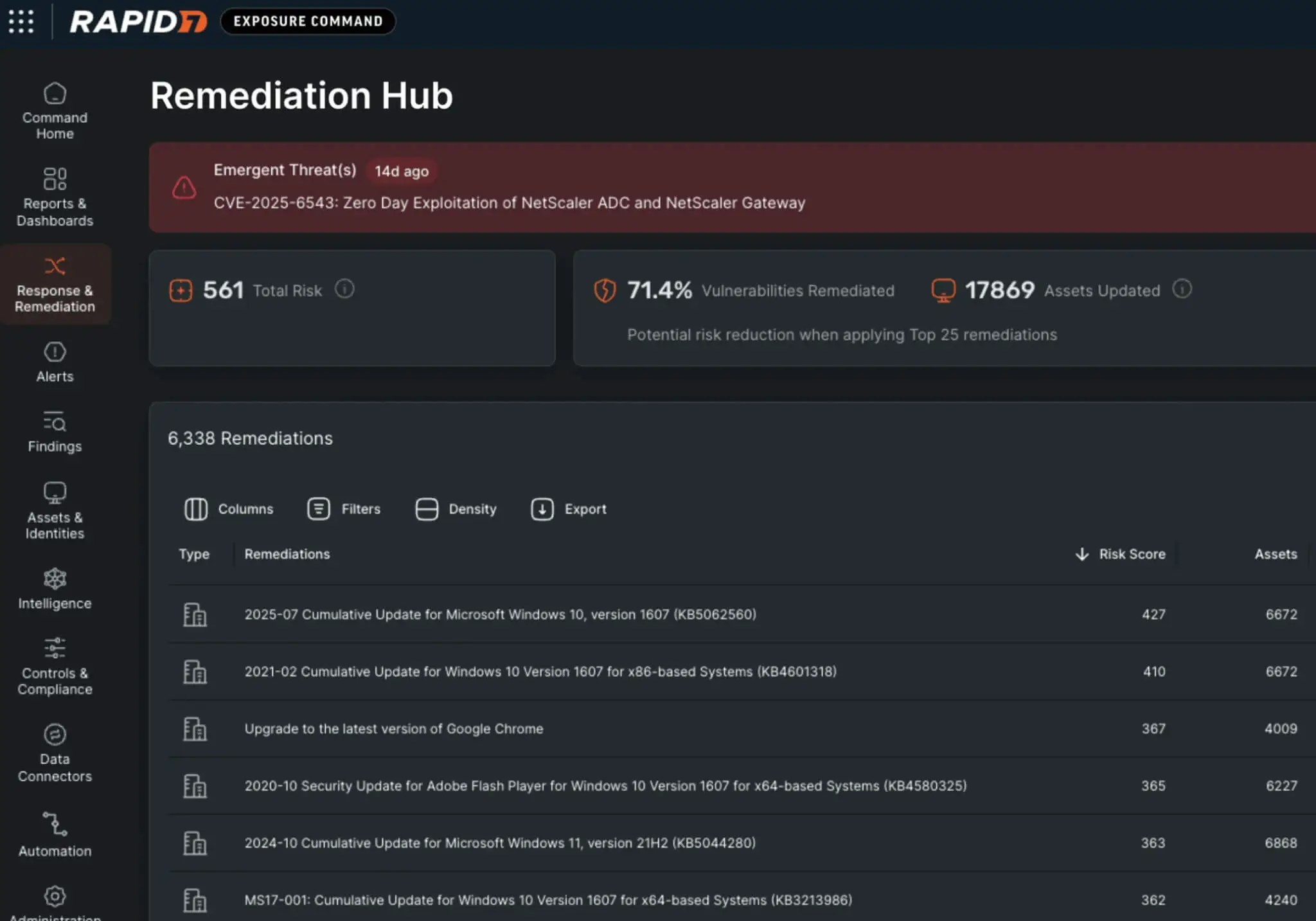
Rapid7 Hybrid Exposure Management
CTEM requires consolidation and action. Rapid7 is included because many organizations already use Rapid7 components across vulnerability management and security operations, and Exposure Command is positioned to bring those signals into an exposure view that supports prioritization and mobilization.
Key strengths and notable points
- Consolidation for Rapid7 customers. When exposure inputs come from tools you already run, you can spend more time fixing and less time normalizing data.
- Action orientation. A strong exposure platform should support “what do we do next” workflows, not just “what exists.”
- Practical for mixed estates. Many Rapid7 environments include on-prem plus cloud workloads. CTEM often fails when tooling only covers one side.
Limitations and context
- Value follows coverage. If your Rapid7 deployment only sees part of the environment, the exposure picture can be skewed, and prioritization may be misleading.
- Validation is a separate question. Exposure Command may help you decide what to fix, but teams that need proof of exploitability or control effectiveness often add a validation layer.
What to watch for during evaluation
- Which data sources actually feed your Exposure Command view and how frequently they update.
- How the platform models ownership and routes remediation to the right teams.
- Whether it can show measurable reduction over time that aligns with your governance model, not just “current state.”
5) Palo Alto Networks Cortex Exposure Management
Cortex Exposure Management is Palo Alto Networks’ exposure management positioning within the broader Cortex ecosystem. It is typically discussed as part of a platform approach to prioritizing exposures by correlating security signals and reducing alert and finding noise.
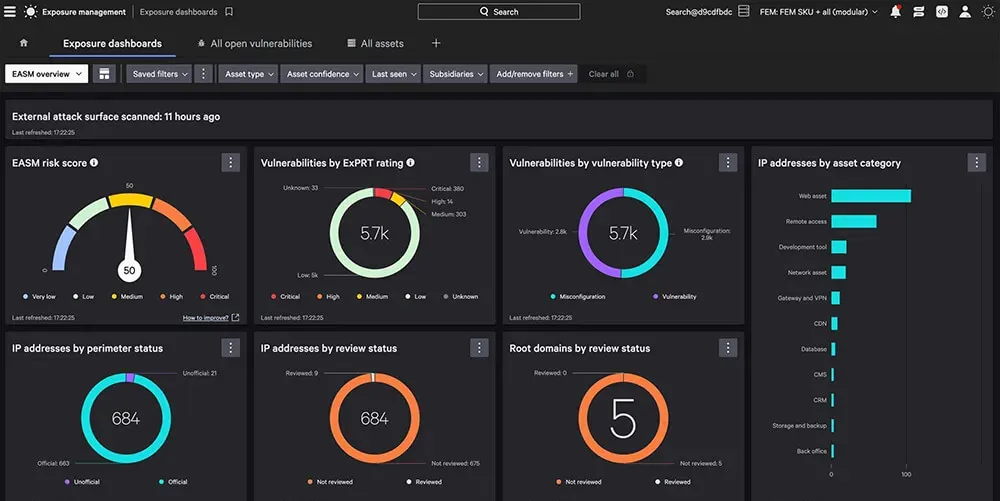
Palo Alto Networks Cortex Exposure Management
A recurring CTEM need is to bring disparate security signals into one place, then drive a smaller set of high-confidence remediation actions. Palo Alto Networks is included because its platform story often resonates with organizations that want to standardize workflows and reduce tool sprawl.
Key strengths and notable points
- Ecosystem alignment. Platform approaches can reduce integration overhead, especially if you already use Cortex products and want exposure insights to flow into existing security operations processes.
- Prioritization narrative. Exposure management buyers typically want fewer, better actions. Cortex Exposure Management is commonly evaluated on how well it helps teams cut through volume.
- Potential external exposure tie-ins. Many organizations want exposure management that accounts for what is visible from the outside, not just internal scanner data. Buyers often explore how Palo Alto Networks addresses that across its portfolio.
Limitations and context
- Clarify what “exposure” means in your deployment. Some products focus on vulnerabilities, others on misconfigurations, identities, internet exposure, or combinations. Do not assume “exposure management” equals full-scope CTEM.
- Suite dependency can be real. Exposure consolidation tends to work best when the platform has broad telemetry and control hooks. If you are multi-vendor by design, integration quality becomes the deciding factor.
What to watch for during evaluation
- The exact signals the platform ingests in your environment and what it does not ingest.
- How prioritized items map to specific owners and fixes, especially for externally discovered assets where ownership can be unclear.
- Whether dashboards and reports support your CTEM operating cadence (weekly triage, monthly leadership review, quarterly goals).
6) Wiz Exposure Management
Wiz is commonly positioned as a cloud security platform that uses contextual relationships between cloud resources, identities, configurations, and data to identify and prioritize risk. In a CTEM framing, it is often used to strengthen discovery and prioritization for cloud environments where change volume is high.
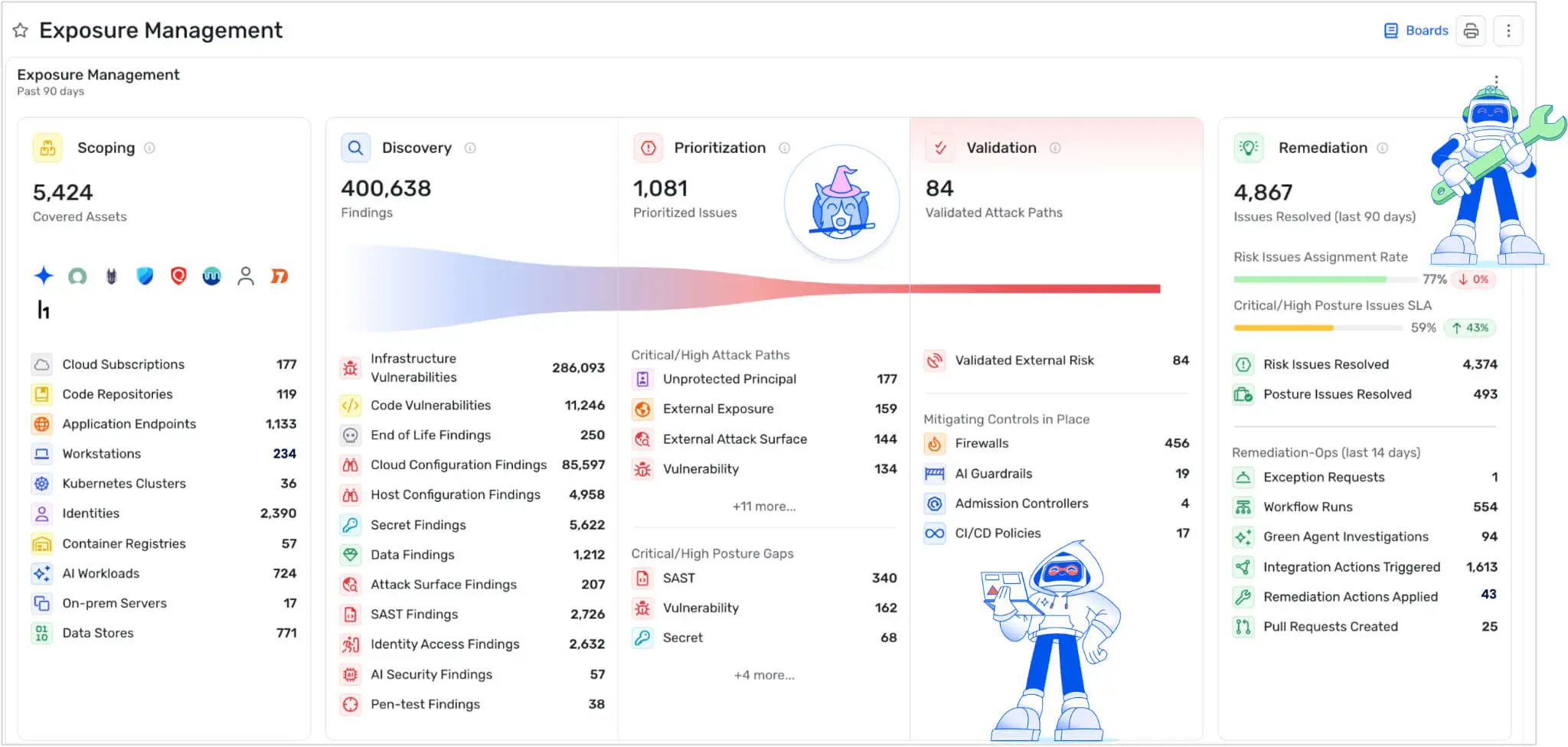
Wiz Exposure Management
For many teams, CTEM becomes urgent in the cloud first. Misconfigurations, exposed services, and overly permissive identity paths can appear quickly and have immediate impact. Wiz is included because it represents a cloud-first approach to exposure: connect findings to context, then prioritize what is most likely to matter.
Key strengths and notable points
- Context-rich prioritization for cloud. Prioritization tends to improve when you can relate vulnerabilities and misconfigurations to identity privileges, reachable paths, and sensitive data locations.
- Good fit for high-velocity environments. Cloud estates create more changes than manual review can keep up with; exposure programs need continuous visibility and a way to suppress noise without hiding true risk.
- DevOps-adjacent workflow potential. Cloud exposure reduction often requires fixes in IaC, CI/CD, and platform engineering practices, not just ticketing the VM team.
Limitations and context
- Cloud-centric by design. If your CTEM scope includes deep on-prem dependencies, legacy networks, or endpoint-centric exposures, expect to pair Wiz with other platforms.
- Validation still matters. Cloud context helps prioritization, but many organizations still want evidence that a pathway is reachable or that compensating controls (WAF, segmentation, IAM conditions) truly block it.
What to watch for during evaluation
- Coverage for your specific cloud services and how findings differ across AWS/Azure/GCP in your footprint.
- How business ownership is derived (tags, accounts, subscriptions) and how fragile that mapping is over time.
- Whether outputs integrate into how cloud work is done (engineering backlogs, IaC policies) instead of creating a parallel security-only queue.
7) XM Cyber
XM Cyber is known for attack path management: modeling how an attacker could move through an environment based on relationships between identities, permissions, assets, and configurations. The practical CTEM benefit is reachability-based prioritization and identification of “choke points” where a small fix can break multiple paths.
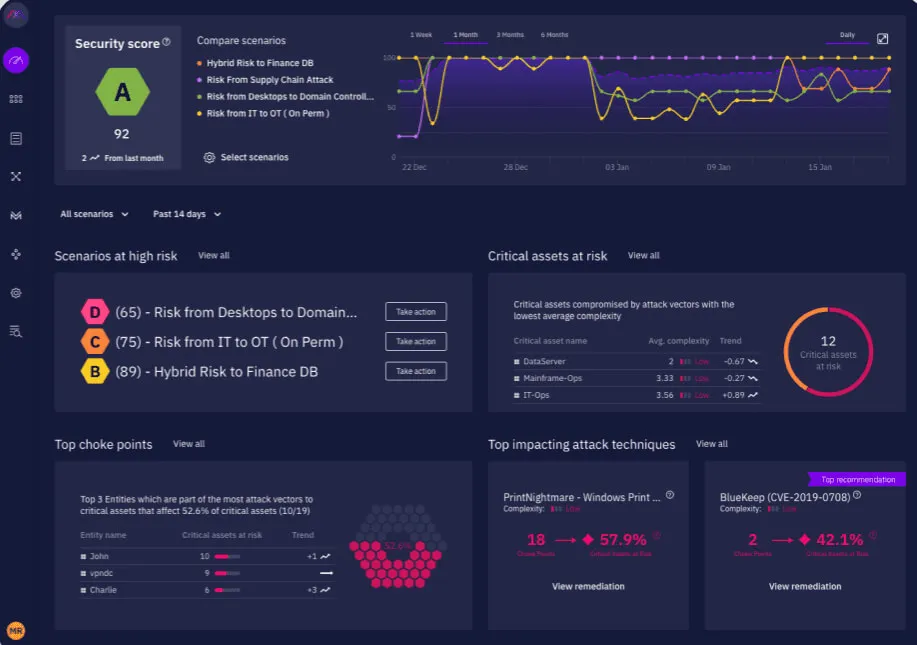
XM Cyber Attack Path Management
Attack path context is one of the most useful ways to turn “we found 10,000 things” into “fix these 20 to reduce real exposure.” XM Cyber is included because it aligns strongly with CTEM prioritization and validation needs, especially in hybrid environments where identity and lateral movement risk drive outcomes.
Key strengths and notable points
- Reachability-focused prioritization. Attack path tools can reduce wasted remediation effort on issues that are technically real but not practically usable in your environment.
- Choke point remediation. CTEM mobilization improves when you can propose fixes that have broad impact, rather than hundreds of scattered patches.
- Good fit for identity-driven risk. Modern breaches often involve credential access, privilege escalation, and lateral movement. Attack path modeling is designed to surface those routes.
Limitations and context
- Depends on input quality. If integrations are incomplete (identity sources, endpoint inventories, cloud configs), the model may miss paths or overstate them.
- May not solve unknown external asset discovery by itself. If your biggest gap is “we do not know what is internet-facing,” you may need dedicated EASM alongside attack path management.
What to watch for during evaluation
- Connector support and data refresh cadence for your identity providers, clouds, and asset sources.
- Whether the platform’s outputs are remediation-ready (clear steps, clear owners) or mostly analytical.
- How it handles retesting and proof of closure once you apply recommended fixes.
8) Cymulate
Cymulate is a security validation platform commonly associated with breach and attack simulation (BAS) and control validation. In a CTEM program, Cymulate fits primarily in the validation stage: testing whether controls and detections behave as expected, within authorized and controlled boundaries.
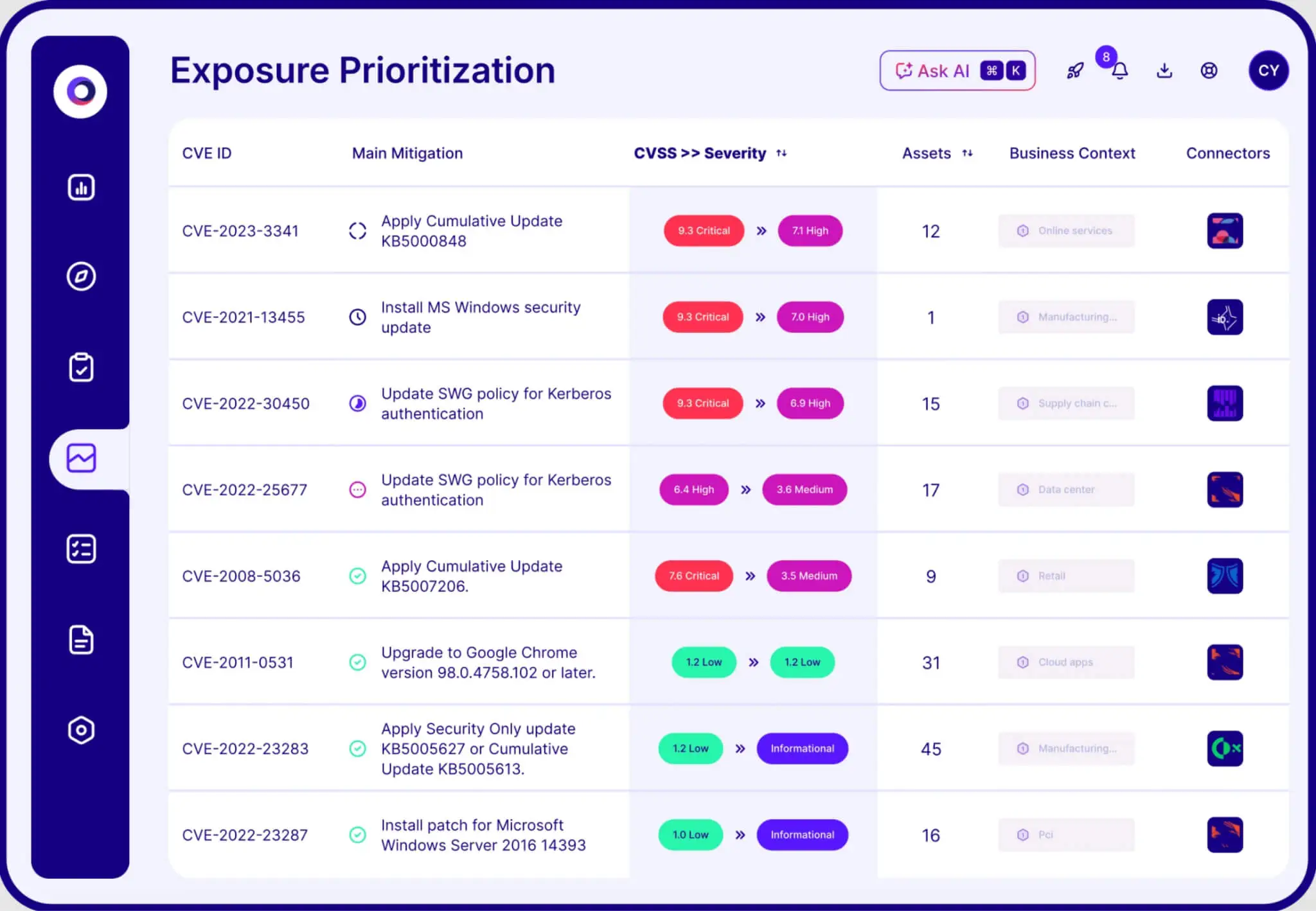
Cymulate Comprehensive Exposure Management Software
CTEM fails when it becomes a renamed backlog. Validation tools introduce evidence. They can show that a “low severity” misconfiguration is actually dangerous because controls fail, or that a seemingly scary issue is mitigated by a real control that works. Cymulate is included as a representative validation-driven route to CTEM maturity.
Key strengths and notable points
- Control effectiveness testing. Instead of assuming email security, endpoint protections, segmentation, or detections are working, validation produces measurable pass/fail style outcomes.
- Evidence to settle prioritization debates. Validation results can reduce friction between security and operations by focusing on what demonstrably fails.
- Supports continuous improvement. CTEM is iterative. Running validation over time helps show whether fixes and tuning actually improved outcomes.
Limitations and context
- Not a discovery tool. Validation complements discovery platforms; it does not replace them. You still need asset and exposure visibility.
- Requires governance and safety discipline. Testing must be authorized, scoped, and scheduled to avoid operational impact and to meet policy requirements.
What to watch for during evaluation
- Safety features and guardrails: how tests are bounded and how disruption risk is managed.
- Integration into SOC tooling and ticketing so results turn into owned work, not slide decks.
- Reporting maturity: whether you can track “control performance improved” and connect that to exposure reduction objectives.
9) Pentera
Pentera is positioned as an Automated Security Validation (ASV) platform. In CTEM terms, it is typically used to validate exploitable gaps and quantify security improvement over time, under controlled and authorized conditions.
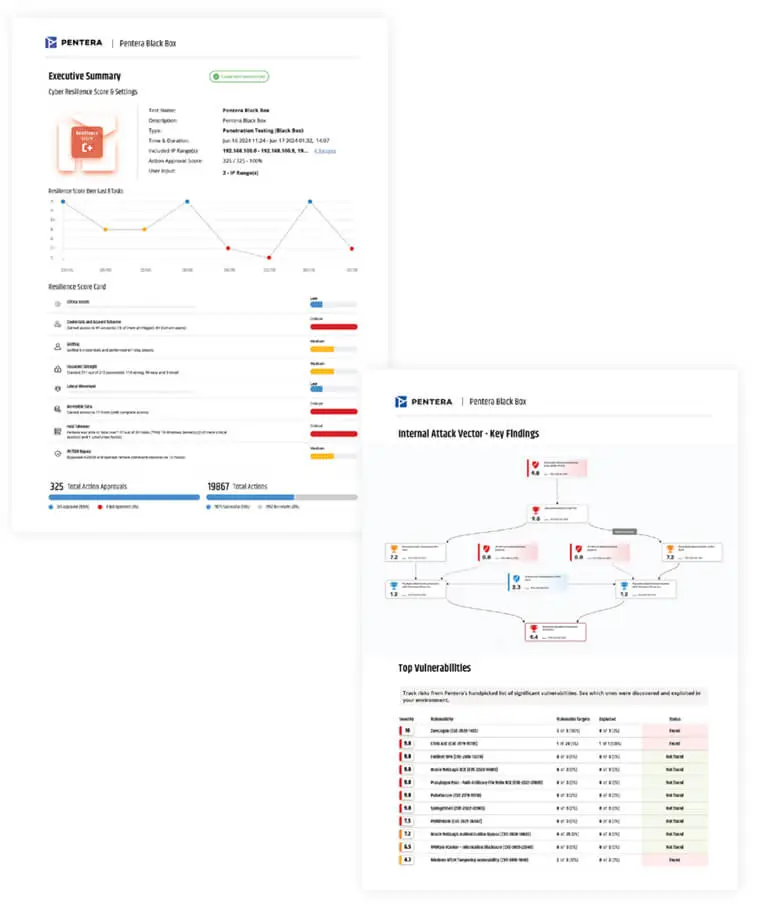
Pentera’s Adversarial Exposure Validation
Prioritization often feels theoretical until you can demonstrate which weaknesses lead to real compromise paths. Pentera is included because validation can turn arguments into evidence, and evidence tends to accelerate remediation. It also supports a repeatable measurement loop, which CTEM programs need to show progress quarter over quarter.
Key strengths and notable points
- Evidence-based exposure confirmation. Demonstrating practical exploitability can reshape priorities faster than any scoring model.
- Repeatable validation cycles. CTEM is continuous; validation is more useful when it is not a one-time “annual exercise.”
- Remediation focus. Validation outputs are most valuable when they help teams break paths efficiently and then confirm the fix.
Limitations and context
- Not a full CTEM stack. You still need scoping, discovery, and mobilization governance. Validation tools do not magically assign ownership or maintain asset inventories.
- Operational controls matter. Authorization, safety boundaries, and change management are non-negotiable, especially in production-like environments.
What to watch for during evaluation
- How findings translate into remediation tickets with clear owners and retest steps.
- Coverage alignment to your environment (hybrid identity, cloud assets, segmentation, etc.), as defined in current vendor documentation.
- Whether reporting supports leadership decisions (exposure reduced, time to fix, improvement trends) rather than only technical output.
10) Horizon3.ai NodeZero
Horizon3.ai NodeZero is commonly positioned around Adversarial Exposure Validation (AEV), focused on identifying and validating exploitable weaknesses and attack paths from an attacker’s perspective, with outputs intended to be actionable for remediation.
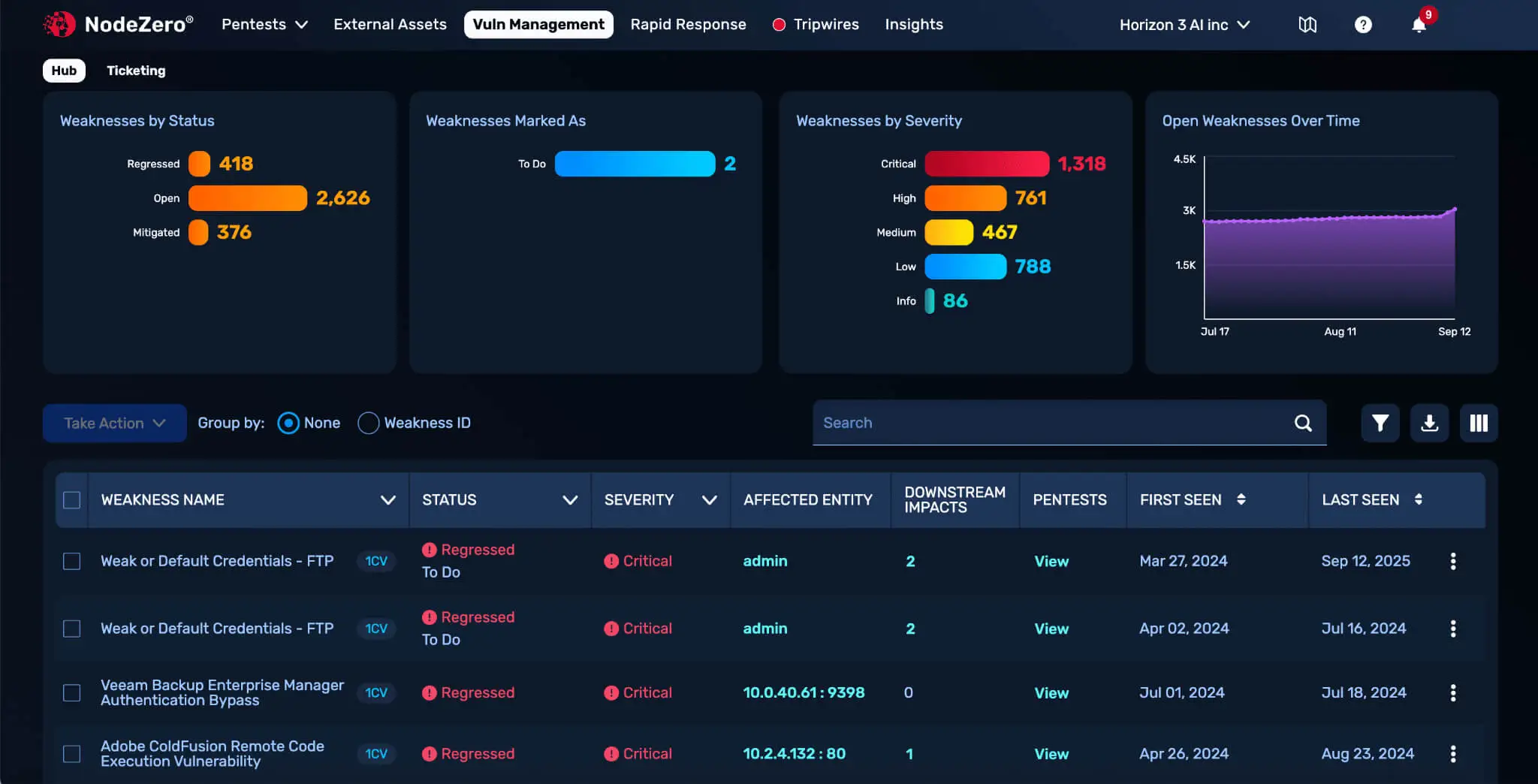
Horizon3.ai NodeZero CTEM Vulnerability Management
CTEM needs a reality check. NodeZero is included because adversarial validation helps confirm what is truly exploitable and what provides a credible path to impact. That can make prioritization more defensible and reduce time spent on issues that do not change real exposure.
Key strengths and notable points
- Attacker-oriented validation lens. CTEM prioritization improves when teams can see which paths are feasible, not just which issues exist.
- Actionable remediation framing. The best validation platforms help teams fix root causes and then verify that the path is broken.
- Scales for lean teams. Some organizations need adversarial-style feedback without staffing a large internal offensive function.
Limitations and context
- Complements discovery, not replaces it. AEV does not substitute for asset inventory, cloud posture management, or vulnerability discovery.
- Governance is essential. Testing must be authorized and bounded, with clear scheduling and safety controls.
What to watch for during evaluation
- How the product enforces safety boundaries and how you control scope, timing, and approvals.
- Retesting workflow and whether “fixed” is confirmed in a way engineers trust.
- How well the outputs integrate into your existing remediation and reporting processes.
How to Choose, Prioritize, or Evaluate These Platforms
Most teams make better CTEM decisions by starting with their failure mode, not with vendor category labels.
1) Identify Your CTEM Bottleneck
Pick the statement that best matches your reality:
- “We do not know what we own.” Start with discovery: asset inventory plus external visibility, then ownership mapping.
- “We know what we own, but we cannot prioritize.” Focus on contextual prioritization: criticality, internet exposure, reachability, identity permissions, and compensating controls.
- “We prioritize, but we cannot prove what matters.” Add validation: attack path analysis, BAS/ASV/AEV, or a combination.
- “We know what to fix, but it never gets fixed.” Fix mobilization: ticketing, SLAs, routing, retesting, and measurement.
Your first CTEM purchase should remove the bottleneck that blocks progress, even if it does not cover every CTEM stage on day one.
2) Define “Exposure” In Business Terms
CTEM programs break when “exposure” becomes a dumping ground for every possible finding. Define scope and stick to it. Examples of exposure definitions that tend to work:
- “Internet-facing paths to customer data systems”
- “Identity and privilege paths to production cloud accounts”
- “External assets and services tied to revenue-generating applications”
- “Control failures that increase likelihood of initial access or lateral movement”
Tie exposure to systems and outcomes leadership cares about. That keeps the program focused and makes metrics meaningful.
3) Demand Explainable Prioritization
If a platform produces a risk score, you need to know what drives it:
- Does it incorporate asset criticality and business impact?
- Does it account for reachability (attack paths) rather than assuming everything is equally exploitable?
- Does it consider control coverage (segmentation, WAF, EDR, identity conditions)?
- Can you explain the prioritization to engineering, auditors, and leadership without hand-waving?
If you cannot explain it, you will not be able to operationalize it.
4) Treat Validation as a Separate Capability decision
Many organizations end up with a two-layer CTEM architecture:
- Layer 1: discovery + prioritization (VM, cloud exposure, ASM/EASM, asset mapping)
- Layer 2: validation (attack path management and/or BAS/ASV/AEV)
That division is useful because it prevents your CTEM program from becoming “we found more things” instead of “we reduced real exposure.”
5) Evaluate Mobilization Like a Workflow Product
Exposure reduction is a throughput problem. During evaluation, get specific:
- Can findings be routed to the right owner automatically?
- Can you set SLAs and enforce them without constant manual follow-up?
- Is retesting built-in, and does it provide closure evidence?
- Can leadership see exposure reduction over time, not just the size of the backlog?
If the platform cannot fit your operational reality (ServiceNow, Jira, CMDB, engineering backlogs), adoption will stall.
FAQ
Is CTEM a Product Category or a Framework?
CTEM is primarily a framework and operating model for continuously reducing exposure. Vendors may sell “CTEM platforms,” but most organizations implement CTEM by combining capabilities across discovery, prioritization, validation, and mobilization.
How Is CTEM Different From Vulnerability Management?
Vulnerability management focuses on finding and fixing vulnerabilities, often prioritized by severity. CTEM is broader: it includes vulnerabilities plus misconfigurations, identity risk, external attack surface exposure, validation of reachability/exploitability, and the remediation workflows needed to reduce exposure measurably.
Do I Need One CTEM Platform or Multiple Tools?
Many teams use multiple tools because CTEM spans multiple disciplines. A common pattern is one platform for discovery/prioritization (VM, cloud exposure, ASM/EASM) and another for validation (attack paths, BAS/ASV/AEV). Suites can reduce integration work, but you still need to verify coverage.
What CTEM Metrics Are Practical to Track?
Useful metrics focus on reduction and throughput, such as:
- Time to discover and inventory new internet-facing assets
- Count and age of high-priority exposures tied to critical assets
- Mean time to remediate prioritized items (not the entire backlog)
- Validation pass rate trends for key controls
- Percent of prioritized exposures with assigned owner and SLA
Avoid relying only on “total vulnerabilities found.” That number can go up even as real exposure goes down.
Where Does Threat Intelligence Fit Into CTEM?
Threat intelligence is most helpful when it changes priorities and actions. It can help you focus on exposures that align with active exploitation trends, targeting patterns, or observed malicious activity. If it stays in a report, it usually does not affect exposure outcomes.
What’s the Difference Between Attack Path Management and Security Validation?
They overlap but solve different problems:
- Attack path management models reachability and relationships (“can an attacker get from here to there given permissions and connectivity?”).
- Security validation (BAS/ASV/AEV) tests controls and defenses to generate evidence of what fails or succeeds, under controlled conditions.
Mature CTEM programs often use one or both depending on goals and scope.
Conclusion
CTEM exists because most organizations can identify more exposures than they can remediate, while attackers only need one workable path. The platforms in this list represent the main implementation styles: suite-based exposure consolidation, VM-led exposure management, cloud-first exposure analytics, external threat and attack surface driven discovery, attack path prioritization, and validation platforms that provide proof.
The best “CTEM platform” is the one that removes your current bottleneck and fits how your teams actually remediate. If you can scope tightly, prioritize transparently, validate what matters, and move work reliably through owners with retesting, you will see exposure go down in a way you can defend.