

Oct 13, 2026
Table Of Content
Oracle EBS Flaw CVE-2026-46817 Exposes Oracle Payments to Takeover
What Is CVE-2026-46817?
Which Oracle EBS Versions Are Affected?
How Can An Attacker Exploit It Over HTTP Without Credentials?
Is CVE-2026-46817 Being Exploited?
What Is The Timeline Defenders Should Know?
What Should Defenders Do Now To Reduce Risk?
Related Articles

NetScaler C2: CVE-2026-88771 Exploitation Operation
Oct 07, 2026

Jun 30, 2026
5 Mins Read

Summarize with:
Oracle EBS Flaw CVE-2026-46817 Exposes Oracle Payments to Takeover
CVE-2026-46817 is a critical vulnerability in Oracle E-Business Suite (EBS) Oracle Payments, specifically in the File Transmission component. Oracle rates it as easily exploitable over HTTP with no authentication required, and the stated impact is severe: successful exploitation can lead to takeover/compromise of Oracle Payments.
The issue was addressed in the May 2026 Oracle Critical Patch Update (CPU), and there are reports of exploitation attempts observed in late June 2026. This post breaks down what’s affected, what we know about exploitation, and what defenders should do immediately.
What Is CVE-2026-46817?
CVE-2026-46817 (CVSS 9.8) is a network-reachable, unauthenticated vulnerability affecting Oracle Payments in Oracle EBS. Oracle’s advisory indicates the flaw is easily exploitable over HTTP and can result in compromise/takeover of Oracle Payments.
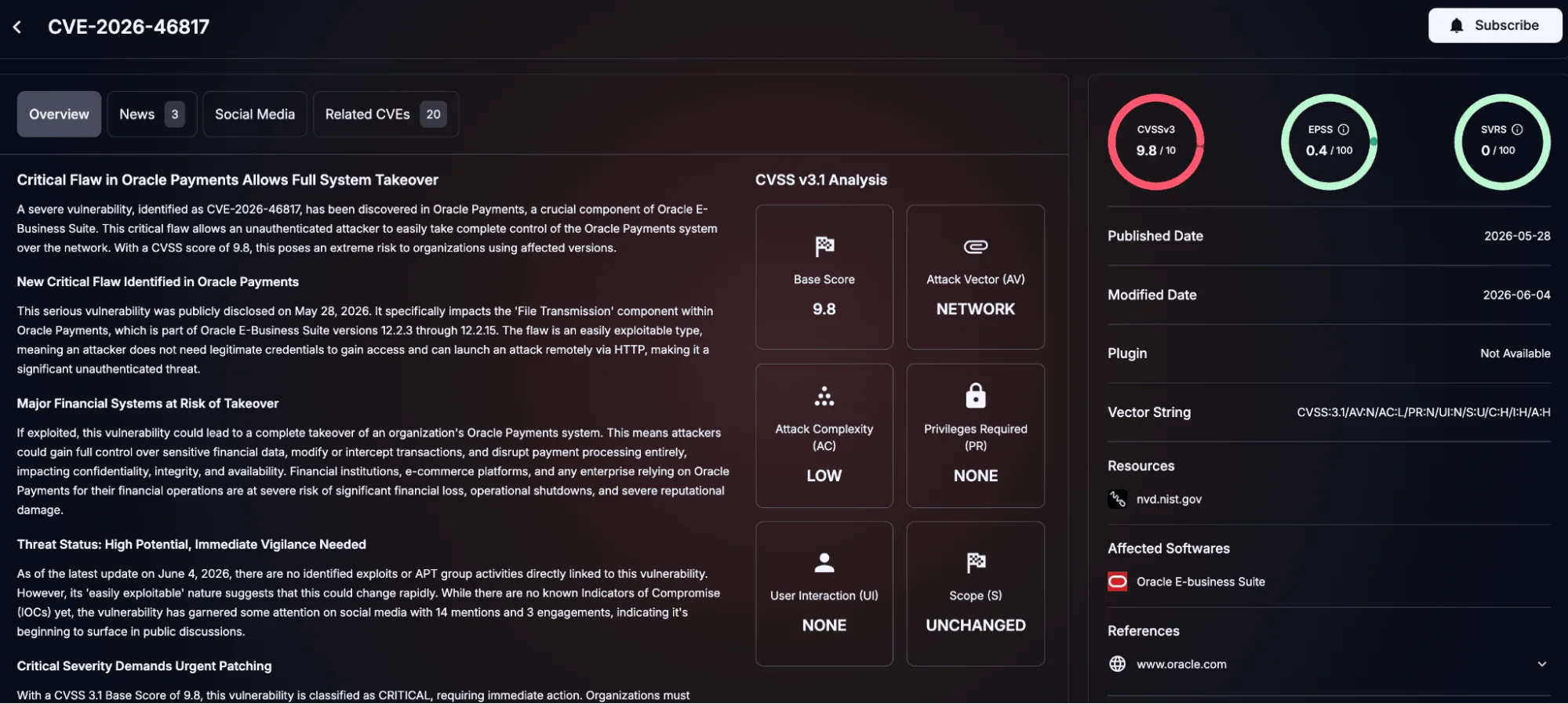
Details of CVE-2026-46817 (SOCRadar Vulnerability Intelligence)
NVD enrichment tags the weakness as related to missing or improper authentication, including CWE-306 (Missing Authentication for Critical Function) and CWE-287 (Improper Authentication). These CWE labels point to an authentication boundary that may be bypassed or never enforced.
Which Oracle EBS Versions Are Affected?
Oracle lists supported affected versions of Oracle Payments as:
- 12.2.3 through 12.2.15 (inclusive)
The vulnerable area is within:
- Oracle EBS → Oracle Payments → File Transmission
If you manage Oracle E-Business Suite, prioritize identifying any instances running 12.2.3 through 12.2.15, confirm whether Oracle Payments File Transmission is reachable over HTTP, and expedite the May 2026 CPU deployment.
How Can An Attacker Exploit It Over HTTP Without Credentials?
From Oracle and NVD, the key exploitation characteristics are as follows:
- Attack vector: Network
- Protocol exposure: HTTP
- Authentication: Not required
- Privileges required: None
- User interaction: None
Exposure drives risk. If an attacker can reach the relevant Oracle EBS HTTP endpoints from the internet or from a broad internal network segment, they may be able to attempt exploitation immediately.
Oracle does not provide detailed public root-cause notes in the sources reviewed, so avoid assuming a specific exploit mechanism unless you can validate it. That said, third-party reporting has suggested exploitation traffic patterns that include crafted HTTP requests to Oracle EBS application paths associated with Payments File Transmission. Treat these as investigative leads, not confirmed technical details.
Some external reporting has referenced crafted POST requests to an /OA_HTML/ibytransmit endpoint with XML payloads and behavior consistent with attempts to access local files (for example, targeting /etc/passwd).
Is CVE-2026-46817 Being Exploited?
Reports of exploitation currently trace back to Defused, which says its Oracle EBS honeypots observed several unauthenticated file-read attempts against CVE-2026-46817 on June 27, 2026. Based on that telemetry, the activity appears to be early, targeted exploitation testing rather than large-scale opportunistic scanning so far.
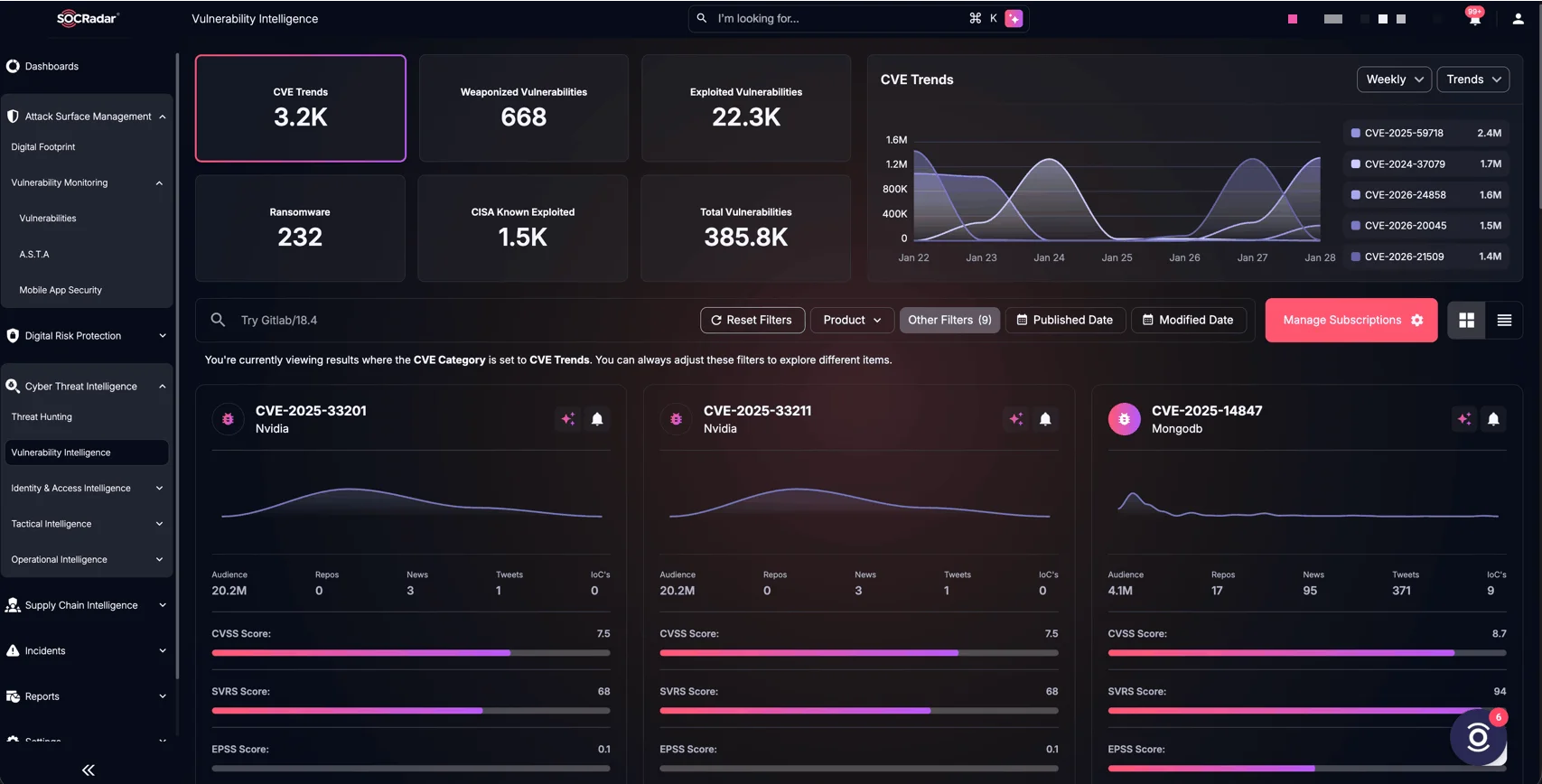
SOCRadar’s Vulnerability Intelligence
SOCRadar Cyber Threat Intelligence gives your security team one place to track vulnerability developments, exploitation signals, threat actor activity, and related indicators. When serious issues affect Oracle environments and other business-critical platforms, your organization gets the context needed to assess risk quickly, prioritize remediation, and respond before exposure turns into operational impact.
What Is The Timeline Defenders Should Know?
- 2026-05-28: NVD published the CVE entry (sourced from Oracle)
- 2026-05-29: NVD shows CISA-ADP updates, including SSVC fields
- 2026-06-16: Oracle’s May 2026 CPU advisory page shows an update date
- 2026-06-17: NVD record last modified, including affected versions updates
- 2026-06-29: third-party reporting indicates exploitation attempts observed over the weekend and disclosed Monday
Operationally, this suggests defenders had a patch window starting with the May 2026 CPU, followed by reported exploitation attempts about a month later.
What Should Defenders Do Now To Reduce Risk?
Apply the Oracle May 2026 Critical Patch Update
The primary remediation is to apply Oracle’s May 2026 CPU that includes the fix for CVE-2026-46817 in Oracle Payments File Transmission. For organizations running Oracle EBS, this should be treated as an emergency change if Oracle Payments is reachable from untrusted networks.
Reduce HTTP exposure while you patch
Because the vulnerability is unauthenticated and reachable over HTTP, compensating controls can reduce risk if patching will take time:
- Remove direct internet exposure of Oracle EBS application endpoints where possible
- Place EBS behind a VPN or an allowlisted reverse proxy
- Restrict access to trusted network ranges and administrative jump hosts
- Review segmentation to limit which internal subnets can reach the EBS HTTP front end
Add targeted monitoring and triage
Even without a vendor-published IOC set, you can still do practical detection work:
- Baseline normal access patterns to Oracle EBS HTTP endpoints and alert on anomalies
- Hunt for unusual unauthenticated access attempts to Payments-related paths
- If you hunt for paths like /OA_HTML/ibytransmit or unusual XML-heavy POST patterns, document them internally as third-party reported indicators and tune to your environment to manage false positives
Prepare incident response actions for high-impact compromise
Oracle’s stated impact is a takeover/compromise of Oracle Payments, so response planning should include:
- Credential rotation plans for accounts and integrations tied to payment workflows
- Review of outbound connections, scheduled jobs, and file transfer configurations associated with Payments
- Validation of Oracle EBS application server integrity if exploitation is suspected