

Mar 10, 2026
Mar 05, 2026
8 Mins Read
Sep 13, 2026
Table Of Content
Related Articles
SMS Bombing
Threat Actors
Jan 08, 2026
Dark Web Monitoring
Feb 19, 2026
Ransomware
Jan 31, 2026
OSINT Framework
Apr 17, 2026

AI Prompt Security
AI prompt security is the protection of model instructions, user input, retrieved content, tool calls, and generated output from manipulation or unintended disclosure. It is an application security discipline: prompts are one control layer, while identity, authorization, data handling, isolation, validation, and monitoring enforce the actual security boundary.
The central threat is prompt injection. An attacker places instructions in direct input or in content the system later retrieves, attempting to override intended behavior, reveal protected information, or misuse connected tools. No system prompt can reliably defend a high-impact application on its own.
Key Takeaways
- Prompt injection can be direct from a user or indirect through retrieved documents, websites, emails, and tool output.
- System prompts and hidden instructions should be treated as configuration, not as secrets or authorization controls.
- Models need least-privilege tools, permission-aware retrieval, validated output, and approval gates.
- Testing must cover the entire AI application and its data flows, not only the base model.
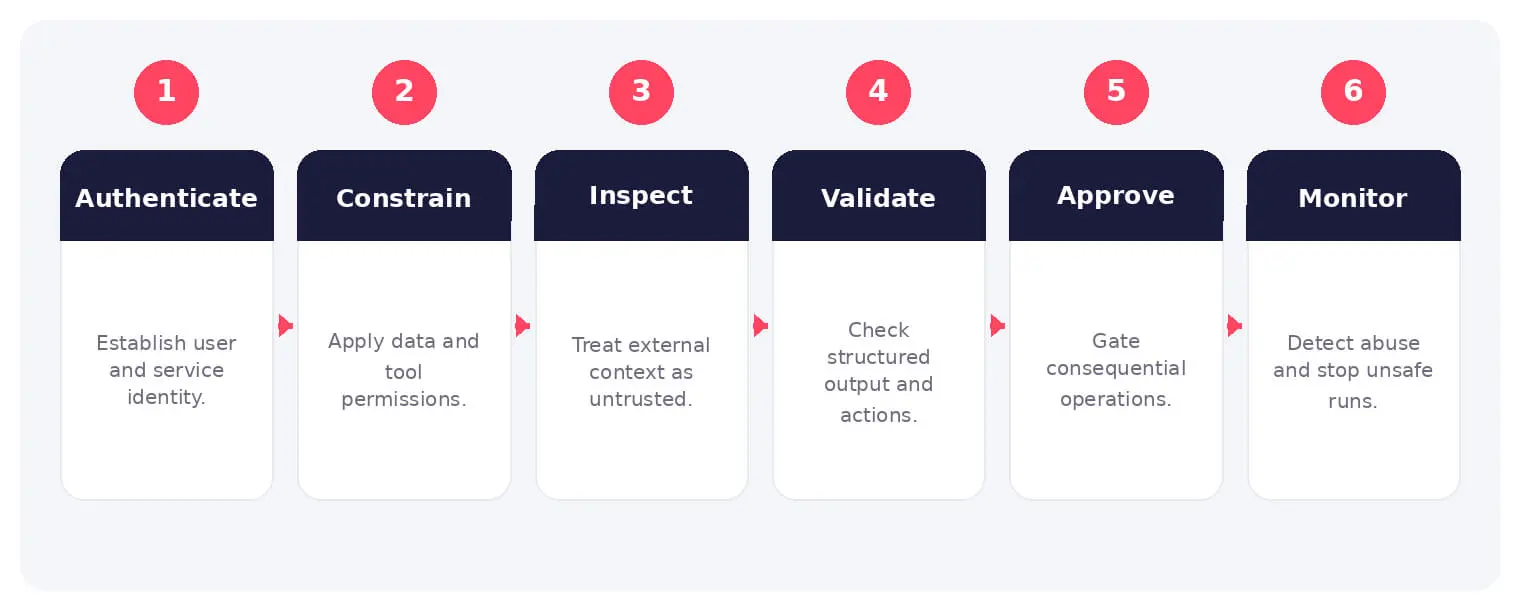
How AI Prompt Security Works
A secure AI application separates instructions by trust level and assumes that user input and external content may be hostile. The application authenticates the user, enforces authorization outside the model, restricts retrieved data, limits tool permissions, validates generated actions, and records decisions for investigation.
Prompt design still matters. Clear role, scope, refusal, and output requirements reduce accidental failure and improve consistency. They cannot replace deterministic controls because the model processes instructions and data through the same language channel and may follow malicious text embedded in otherwise legitimate content.
Direct and Indirect Prompt Injection
Direct prompt injection occurs when a user tells the model to ignore prior instructions, reveal internal context, or perform a prohibited task. Indirect prompt injection hides instructions in a source the application processes, such as a webpage, document, email, ticket, code repository, image metadata, or tool response.
Indirect injection is especially dangerous for retrieval systems and agents because the attacker may never interact with the model directly. Content should be treated as data, stripped of unnecessary active elements, labeled by provenance, and prevented from changing permissions or authorizing tool use.
Other Prompt-Related Security Risks
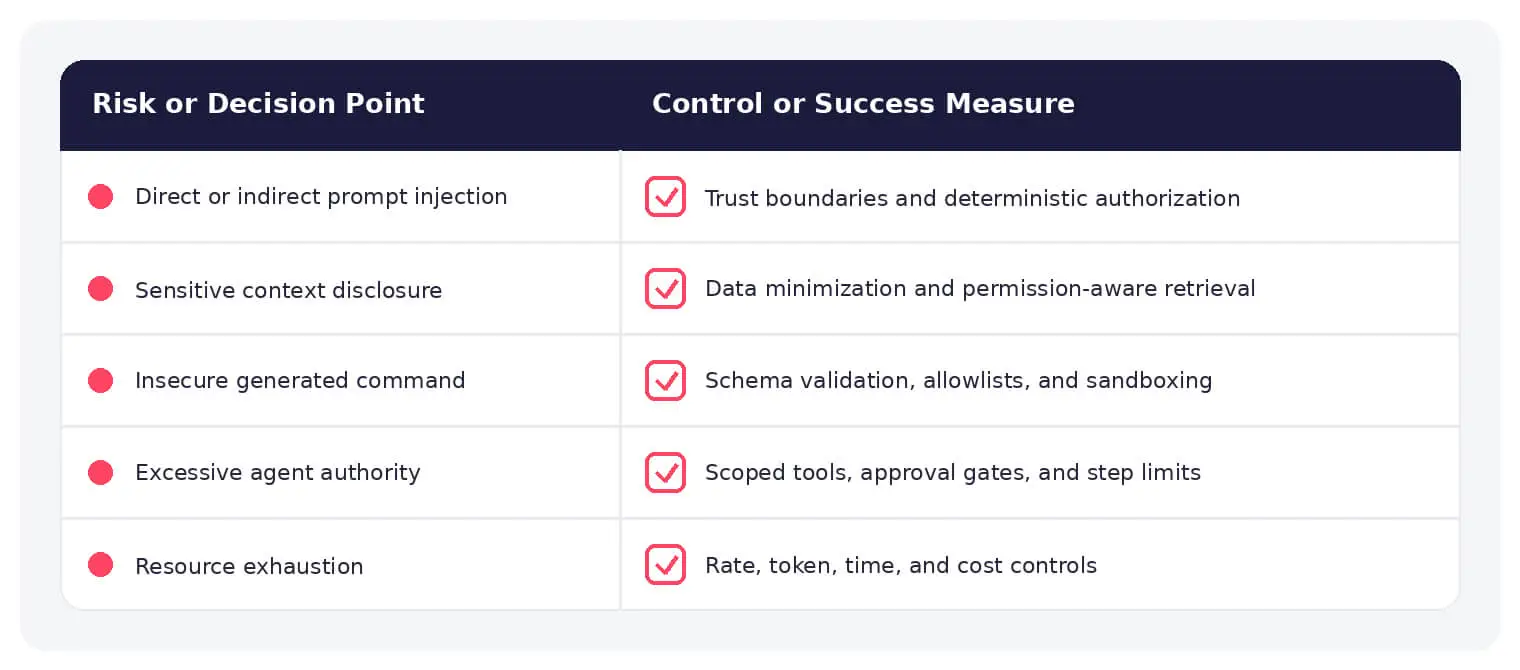
Sensitive information disclosure can expose system instructions, conversation history, retrieval content, secrets, or data belonging to another user. Jailbreaks attempt to bypass safety behavior through role-play, encoding, fragmentation, or iterative manipulation. Prompt leakage can also reveal defensive logic that helps an attacker adapt.
Insecure output handling occurs when an application trusts generated HTML, SQL, shell commands, URLs, or API parameters. Excessive agency gives a model tools or permissions broader than its task requires. Denial-of-wallet attacks exploit long contexts, repeated calls, or agent loops to consume resources.
Security Controls for Prompts and Context
Classify every input source and preserve provenance. Retrieval should apply the requesting user’s permissions and return only the minimum relevant content. Secrets should remain in protected execution environments and be injected only into the specific tool call that needs them, never placed in the model context.
Use structured output schemas, allowlists, parameter validation, and policy engines before executing a generated action. Apply least privilege to each tool and service identity. High-impact operations need user confirmation or approval by an authorized role, plus limits on frequency, scope, and data movement.
Secure Design for AI Agents
An agent should receive a narrow objective and a limited set of tools. Read and write capabilities should be separated, and write operations should be reversible where possible. The application should cap steps, tokens, time, and spending, and detect repeated or circular behavior.
Memory and long-term context need explicit retention, access, and deletion rules. Output from one agent should not automatically become trusted instruction for another. Agent-to-agent messages, MCP servers, plugins, and external tools belong in the threat model and supply chain review.
Testing and Monitoring Prompt Security
Testing should include known injection patterns, multilingual and encoded variants, malicious retrieved documents, data-exfiltration attempts, cross-user access, unsafe tool arguments, and requests that combine individually harmless steps into a harmful outcome. Test cases should reflect the application’s real tools and permissions.
Monitor policy violations, unusual prompt length, repeated refusals, anomalous tool sequences, unexpected data access, and changes in cost or latency. Logs should support reconstruction without storing sensitive prompts indefinitely. A kill switch and incident process are necessary when an agent can affect production systems.
How SOCRadar Supports AI Prompt Security
SOCRadar helps teams enrich AI security testing and monitoring with current external intelligence. Extended Threat Intelligence can provide context on malicious infrastructure, phishing domains, leaked credentials, exposed assets, threat actors, vulnerabilities, and Dark Web discussions that may affect AI applications and their connected services.
Explore SOCRadar Extended Threat Intelligence or request a demo to bring verified threat context into AI application security and monitoring.
Frequently Asked Questions
What Does AI Prompt Security Protect?
AI prompt security covers every element of an AI application that language can influence: system instructions, user input, retrieved content, tool calls, and generated output. Its goal is to prevent behavior manipulation and unintended disclosure of data. Because models process instructions and content through the same channel, protection depends on application-level controls rather than prompt wording alone.
What Is the Difference Between Direct and Indirect Prompt Injection?
Direct injection comes from the user, for example by asking the model to ignore previous instructions, reveal internal context, or perform a prohibited task. Indirect injection hides instructions in content the application processes, such as webpages, documents, emails, or tool responses. Indirect injection is often harder to detect because the attacker may never interact with the model directly.
How Is a Jailbreak Different From Prompt Injection?
A jailbreak tries to bypass the model’s safety behavior through role-play, encoding, fragmentation, or iterative manipulation, while prompt injection targets the application to alter behavior, expose data, or misuse tools. The techniques overlap, and a single attack can combine both. The distinction matters because defenses must cover application controls, not only model safety tuning.
Why Can’t a System Prompt Serve as the Primary Security Control?
A system prompt shapes behavior but cannot reliably resist adversarial instructions on its own. Authentication, authorization, permission-aware retrieval, least-privilege tools, output validation, and approval gates should enforce the actual boundary. Treating the prompt as the main defense leaves the application exposed whenever user input or retrieved content contains hidden instructions.
Should System Prompts Be Treated as Secrets?
Secrecy is not a dependable boundary, because attackers can often infer or extract portions of a prompt through probing. It is safer to treat prompts as configuration and keep credentials, authorization decisions, and enforcement logic outside the model context. This limits the impact if the prompt leaks or is reconstructed.
Why Should Secrets Stay Out of the Model Context?
Anything inside the model context can potentially surface in generated output or be extracted through injection. Secrets belong in protected execution environments and should be injected only into the specific tool call that needs them. This way, even a successful manipulation of the conversation does not expose credentials or authorization material.
How Should Retrieved Content Be Handled to Reduce Injection Risk?
Retrieved documents, webpages, emails, and tool responses should be treated as untrusted data. Label content by provenance, strip unnecessary active elements, apply the requesting user’s permissions during retrieval, and prevent external content from changing permissions or authorizing tool use. These steps limit what hidden instructions in that content can achieve.
What Is Excessive Agency in AI Applications?
Excessive agency means giving a model tools, permissions, or data access broader than its task requires. If an agent can send emails, modify records, or move data without limits, one successful injection can escalate into a serious incident. Least-privilege tool identities, reversible write operations, and approval gates for high-impact actions help contain the damage.
What Is a Denial-of-Wallet Attack?
A denial-of-wallet attack inflates consumption through long contexts, repeated calls, or looping agents, driving up cost rather than causing a classic outage. Caps on steps, tokens, time, and spending, along with detection of repeated or circular behavior, limit the financial impact. Monitoring sudden changes in cost or latency helps surface these attacks early.
How Should Trust Be Handled Between AI Agents and Connected Tools?
Output from one agent should not automatically become trusted instruction for another, and agent-to-agent messages, MCP servers, plugins, and external tools belong in the threat model. Each connection should carry defined permissions, validation, and rate limits. Supply chain review matters because a compromised tool can inject instructions into many workflows at once.
What Warning Signs Suggest Prompt Abuse in Production?
Useful signals include policy violations, unusually long or repeated prompts, spikes in refusals, anomalous tool sequences, unexpected data access, and shifts in cost or latency. These indicators rarely prove an attack on their own, so they should feed a documented investigation workflow. Logs should support reconstruction without storing sensitive prompts indefinitely.
How Should Teams Respond to a Suspected Prompt Injection Incident?
Focus on what the application could do, not only on what the model said. Disable or restrict the affected agent’s tools, rotate any exposed credentials, review tool-call logs and data access, and identify which retrieved content carried the malicious instructions. A kill switch and a rehearsed incident process are important whenever agents can affect production systems.
How Should Organizations Test AI Applications for Prompt Security?
Testing should cover the entire application and its data flows, not only the base model. Useful cases include known injection patterns, encoded and multilingual variants, malicious retrieved documents, data-exfiltration attempts, cross-user access, and unsafe tool arguments. Tests should verify that deterministic controls contain failures even when the model follows malicious text.