

Mar 10, 2026

Jun 25, 2026
5 Mins Read
Sep 13, 2026
Table Of Content
Related Articles
SMS Bombing
Threat Actors
Jan 08, 2026
Dark Web Monitoring
Feb 19, 2026
Ransomware
Jan 31, 2026

Dark Web
Jan 31, 2026
What Is Business Email Compromise (BEC)?
Business email compromise (BEC) is fraud that uses trusted business identities and communication to manipulate employees, customers, or partners into sending money, changing payment details, disclosing data, or granting access. The attacker may impersonate an executive or vendor, or take over a real mailbox.
BEC often contains no malware attachment and may use correct names, invoices, writing style, and active email threads. Technical email controls help, but payment verification, identity protection, mailbox monitoring, and business-process controls are equally important.
Key Takeaways
- Executive and employee impersonation is one important form or technique.
- Detection depends on correlated technical and operational context.
- Prevention should reduce both initial access and post-compromise impact.
- Response must preserve evidence and remove every reusable access path.
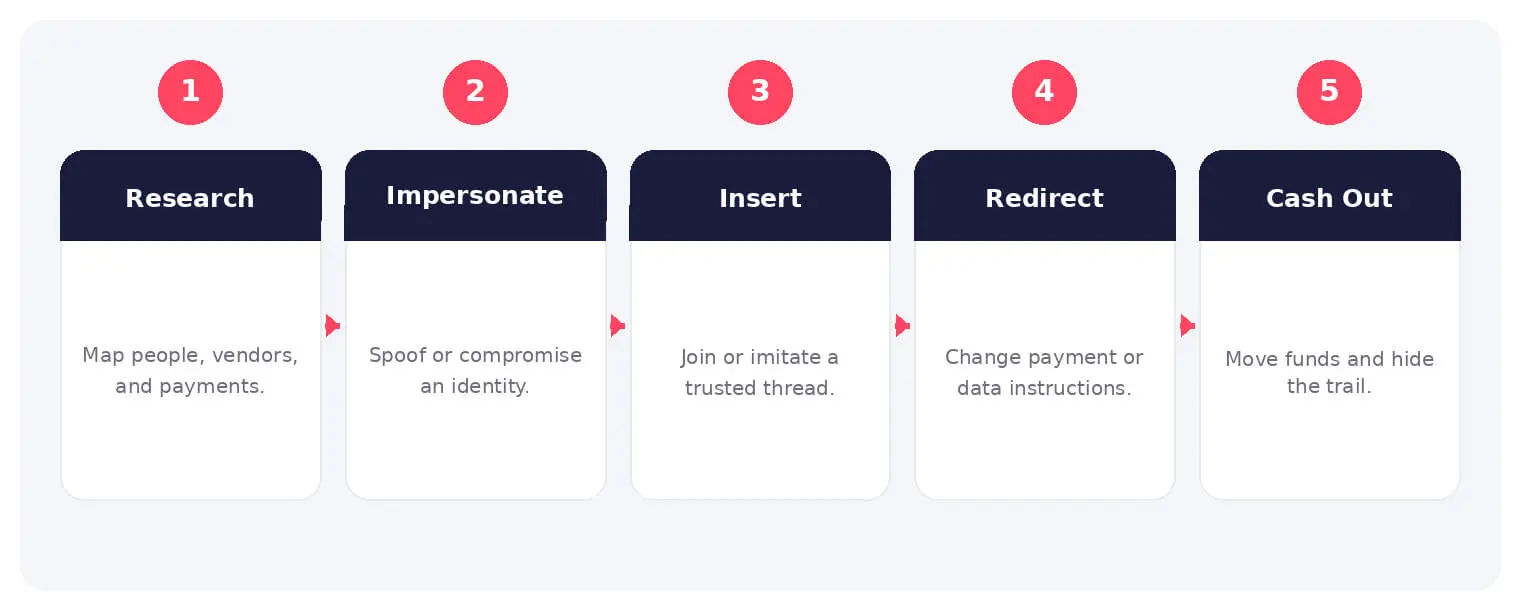
How Business Email Compromise (BEC) Works
The sequence shown above is not mandatory in every case, but it provides a practical way to connect initial opportunity with the actor’s objective. Individual steps may occur in parallel, repeat, or be completed by different participants.
BEC often contains no malware attachment and may use correct names, invoices, writing style, and active email threads. Technical email controls help, but payment verification, identity protection, mailbox monitoring, and business-process controls are equally important.
Common Types and Techniques
- Executive and employee impersonation
- Vendor invoice and payment diversion
- Mailbox takeover and thread hijacking
- Payroll, gift-card, data, and real-estate fraud
Security and Business Risks
- Direct financial loss and recovery difficulty
- Exposure of employee or customer information
- Compromise of partners through trusted messages
- Legal, insurance, and reputational consequences
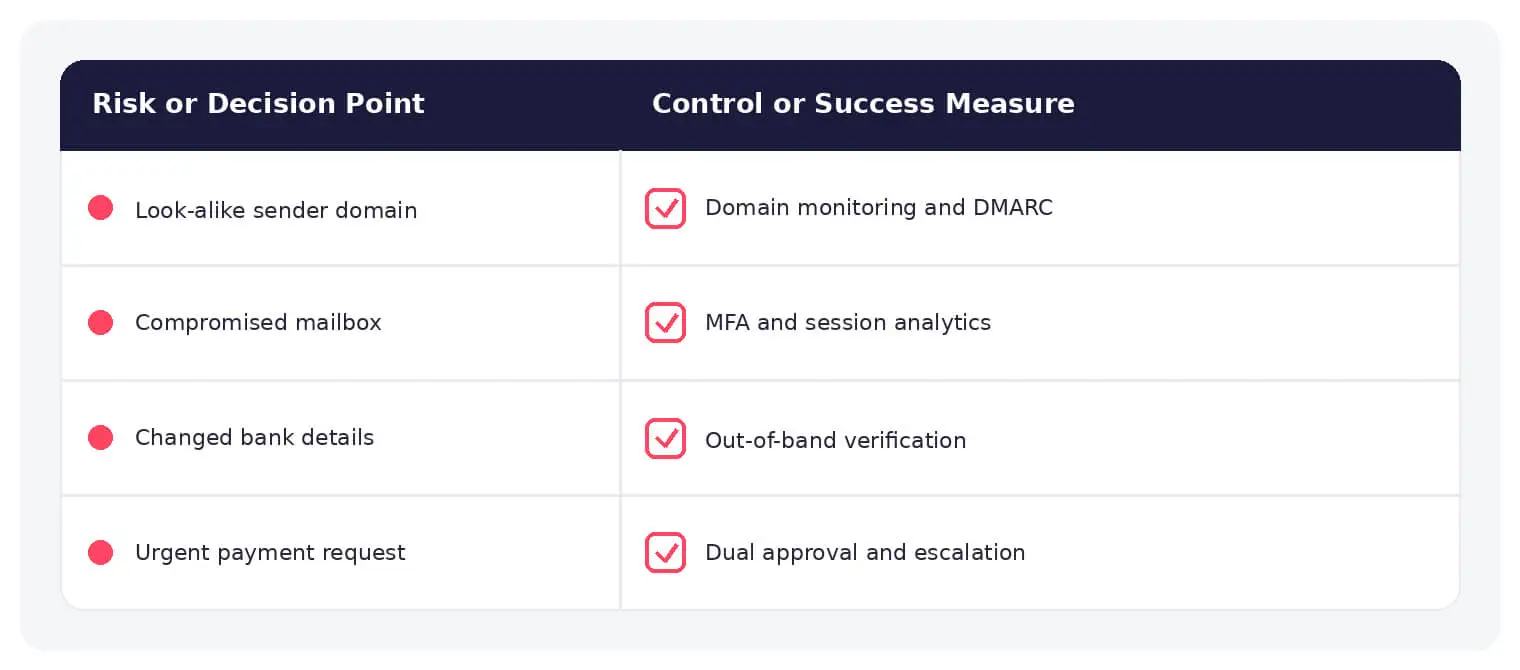
Warning Signs and Detection
Look for new forwarding rules, unusual OAuth grants, impossible travel, changed reply-to addresses, look-alike domains, urgent payment changes, unusual secrecy, and bank-detail updates inside otherwise legitimate threads.
Prevention and Response
Use phishing-resistant MFA, DMARC with SPF and DKIM, mailbox and OAuth monitoring, domain protection, independent verification of payment changes, dual approval, staff training, and rapid bank and law-enforcement contact after fraud.
How SOCRadar Can Help
SOCRadar combines external asset visibility, threat intelligence, Dark Web monitoring, vulnerability context, and indicator enrichment to help teams identify exposure and investigate activity connected to business email compromise.
Explore SOCRadar Brand Protection or request a demo to strengthen threat-informed prevention and investigation.
Frequently Asked Questions
What Is Business Email Compromise (BEC)?
Business email compromise is a form of fraud that uses trusted business identities, such as an executive, employee, or vendor, to convince victims to send money, change payment details, or disclose data. Attacks rely on credible context and social pressure rather than malicious code, and many contain no malware or suspicious link at all.
How Is BEC Different from Standard Phishing?
Standard phishing often casts a wide net using malicious links or attachments. BEC is targeted: it may reuse correct names, real invoices, familiar writing style, and active email threads, so the message reads like ordinary business correspondence and is harder to flag.
Can a BEC Attack Succeed Without a Compromised Mailbox?
Yes. Attackers can spoof a display name, register a look-alike domain, or open a free account that resembles a real one, and impersonation alone is often enough to deceive a busy employee. A taken-over mailbox adds credibility because the fraud arrives inside a genuine thread, but it is not a requirement.
What Are the Most Common BEC Techniques?
Frequent variants include executive impersonation (also called CEO fraud), vendor invoice and payment diversion, payroll redirection, gift-card fraud, real-estate closing fraud, and thread hijacking after a mailbox takeover. Requests for sensitive data, such as employee tax records or customer lists, are also common.
Why Do Secure Email Gateways Often Miss BEC Messages?
Most BEC messages carry no malicious payload, so content-based filters have little to detect. Mail from a legitimately compromised account or a correctly configured look-alike domain can pass SPF, DKIM, and DMARC checks, leaving identity, context, and process anomalies as the remaining signals.
What Warning Signs Point to a Possible BEC Attempt?
Common red flags include sudden payment-detail changes, look-alike domains, and unusual urgency or secrecy:
- Reply-to addresses that differ from the visible sender
- Bank-detail updates inserted into otherwise legitimate threads
- Requests to keep the transaction confidential or bypass normal approvals
At the account level, new forwarding rules, unfamiliar OAuth grants, and impossible-travel sign-ins can indicate that a mailbox has been taken over.
What Should You Do Immediately After a Fraudulent Transfer?
Contact your bank right away to attempt a recall and ask it to alert the receiving bank, then report the fraud to law enforcement, such as the FBI’s Internet Crime Complaint Center (IC3). Preserve the messages and headers, reset credentials, revoke active sessions and app passwords, and remove attacker-created forwarding rules or OAuth grants, because a password change alone may not end an attacker’s access. Inform your insurer once initial containment is underway.
How Should New or Changed Payment Instructions Be Verified?
Confirm payment details through a channel you already trust, such as a phone number on file, and never rely on contact information supplied within the request itself. For high-value changes, require dual approval and separation of duties so that no single person can authorize a new beneficiary.
Do SPF, DKIM, and DMARC Stop BEC?
These controls mainly protect against direct spoofing of your own domain. They do not stop look-alike domains, free-mail impersonation, or fraud sent from a genuinely compromised mailbox, so they should be paired with payment verification and mailbox monitoring rather than relied on alone.
Does Multi-Factor Authentication Prevent BEC?
Phishing-resistant MFA makes it far harder for attackers to phish mailbox credentials, which reduces account takeover. It does not address pure impersonation that involves no login, and it will not automatically revoke a session an attacker has already established.
Why Are BEC Funds Difficult to Recover?
Stolen money is typically moved to mule accounts or converted within hours, often across borders, so recovery odds fall quickly. This speed is why immediate bank contact and law-enforcement reporting are the highest-value steps in the first hours after a transfer.