

Mar 10, 2026
May 15, 2026
6 Mins Read
Sep 13, 2026
Table Of Content
Related Articles
SMS Bombing
Threat Actors
Jan 08, 2026
Dark Web Monitoring
Feb 19, 2026
Ransomware
Jan 31, 2026
OSINT Framework
Apr 17, 2026
What Is Cyber Espionage?
Cyber espionage is the covert use of digital access to collect confidential information for strategic, political, military, or economic advantage. Campaigns are commonly associated with state-sponsored groups or their proxies, although commercial competitors and well-resourced criminal actors may pursue similar objectives.
Unlike a short, opportunistic intrusion, an espionage operation is designed to preserve access and avoid attention while the actor identifies, collects, and removes valuable information. The target may be a government agency, research institution, technology company, defense supplier, critical infrastructure operator, or an individual with access to sensitive decisions.
Key Takeaways
- Cyber espionage prioritizes intelligence collection and long-term access over immediate disruption.
- Operators combine social engineering, vulnerabilities, stolen identities, trusted relationships, and legitimate tools.
- Weak signals become meaningful when identity, endpoint, cloud, network, and external intelligence are correlated.
- Containment must remove every foothold while protecting evidence needed for scoping and attribution.
How Cyber Espionage Works
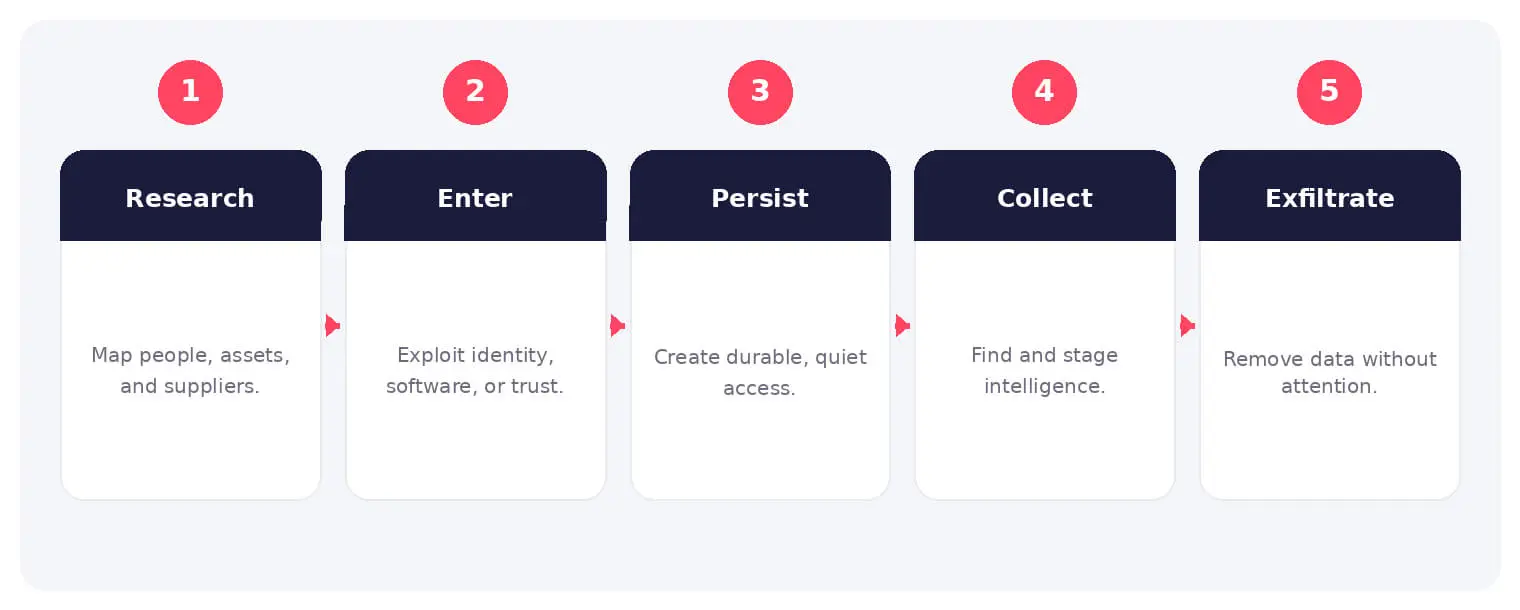
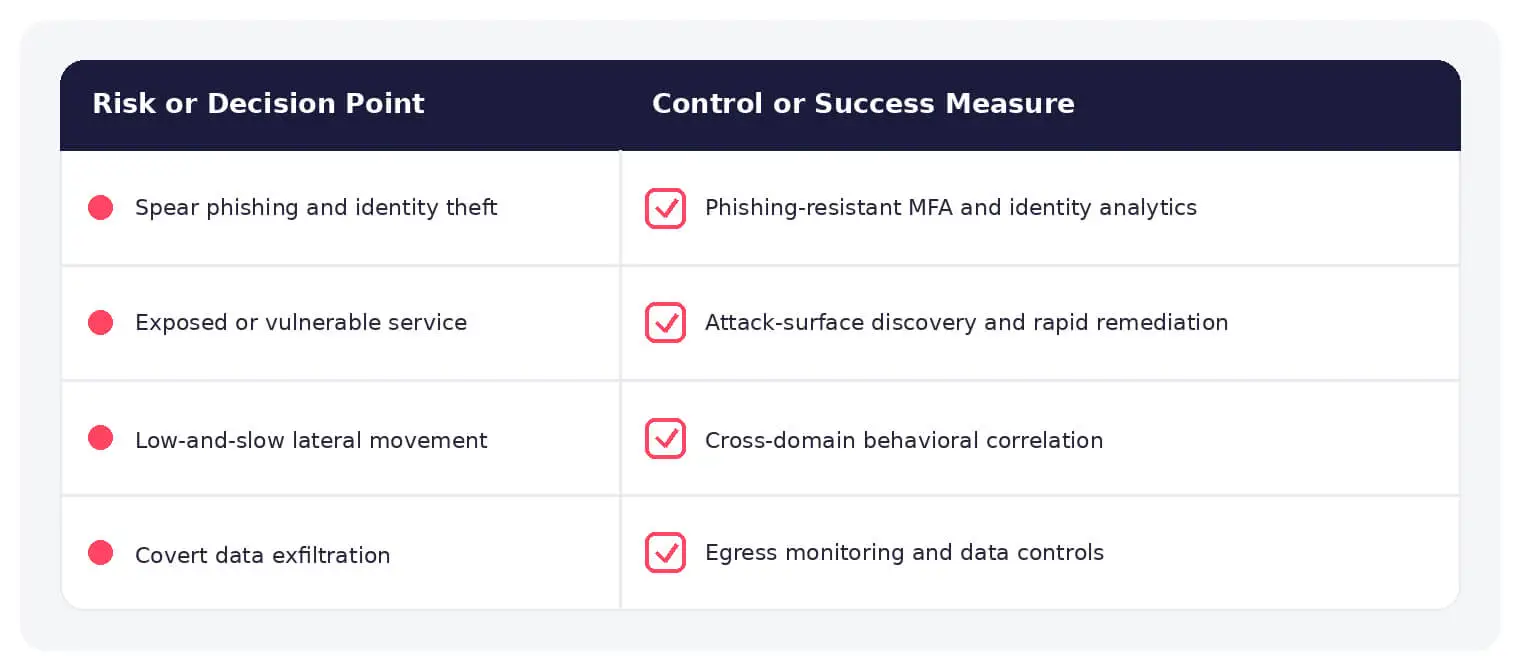
Attackers research people, technologies, suppliers, and exposed systems before selecting an entry point. Spear phishing, stolen credentials, vulnerable internet-facing services, cloud applications, and supply-chain access are common options.
After entry, the operator establishes persistence, escalates privileges, maps the environment, and moves toward intelligence repositories. Collection and exfiltration may be deliberately slow, encrypted, or routed through legitimate services to blend with normal activity.
Common Types and Techniques
- Government and diplomatic intelligence collection
- Defense, technology, and intellectual property theft
- Strategic surveillance of critical infrastructure
- Supply-chain compromise to reach a protected target
Security and Business Risks
- Loss of trade secrets, research, and negotiating positions
- Exposure of officials, employees, partners, or sources
- Long-term compromise of trusted identities and systems
- Strategic, economic, regulatory, and national-security consequences
Warning Signs and Detection
Hunt for unusual privileged access, rare cloud applications, unexpected mailbox rules, lateral movement, data staging, long-lived outbound sessions, and repeated low-volume anomalies. Threat intelligence can connect infrastructure, malware, targeting, and behavior to a broader campaign.
Prevention and Response
Use phishing-resistant MFA, least privilege, segmentation, hardened administration, rapid remediation of exposed weaknesses, centralized logging, endpoint detection, and tested incident response. Treat suppliers and cloud identities as part of the same trust boundary.
How SOCRadar Can Help
SOCRadar combines external asset visibility, threat intelligence, Dark Web monitoring, vulnerability context, and indicator enrichment to help teams identify exposure and investigate activity connected to cyber espionage.
Explore SOCRadar Cyber Threat Intelligence or request a demo to strengthen threat-informed prevention and investigation.
Frequently Asked Questions
What Counts as Cyber Espionage?
Cyber espionage is the covert use of digital access to collect confidential information for strategic, political, military, or economic advantage. The defining trait is intelligence collection over time rather than immediate disruption or direct financial theft. Most campaigns are linked to state-sponsored groups or their proxies, though well-resourced criminal and commercial actors may pursue similar objectives.
Who Are the Typical Targets of Cyber Espionage Campaigns?
Government agencies, defense suppliers, technology and research organizations, critical infrastructure operators, and holders of valuable intellectual property are frequent targets. Individuals with access to sensitive decisions, such as executives, officials, and lead engineers, can also be targeted directly. Weaker suppliers and partners are sometimes compromised as a route into a better-protected organization.
What Entry Points Do Cyber Espionage Actors Commonly Use?
Common paths include spear phishing, stolen or purchased credentials, vulnerable internet-facing services, misconfigured cloud applications, and compromised suppliers. Operators research people, technologies, and exposed systems before choosing the access route least likely to draw attention. Trusted vendor and partner access is treated as part of the same attack surface.
Why Do Cyber Espionage Operations Stay Hidden for Months?
These operations are built to preserve access rather than create impact. Actors establish persistence, rely on legitimate administrative tools, keep collection volumes low, and route traffic through trusted services so activity blends with normal operations. With no destructive payload to raise alarms, an intrusion can persist until defenders correlate weak signals across identity, endpoint, network, and cloud data.
What Warning Signs Can Indicate a Cyber Espionage Intrusion?
Defenders should watch for patterns such as:
- Unusual privileged account activity and unexpected mailbox rules
- Rare cloud applications and sudden changes in administrative behavior
- Lateral movement toward file shares, mail stores, and repositories
- Data staging in uncommon locations and long-lived outbound sessions
Any single signal can be benign, but repeated low-volume anomalies across systems become meaningful when correlated. External threat intelligence can connect observed infrastructure and behavior to a broader campaign.
What Should an Organization Do After a Suspected Espionage Incident?
Scope the intrusion, then remove every foothold, including compromised credentials, persistence mechanisms, and active sessions, while preserving logs and evidence for investigation. Password resets alone may not end an intrusion, because stolen sessions and tokens can remain valid depending on the platform’s session controls. Involving legal, communications, and leadership early is also prudent, since espionage incidents often carry regulatory, contractual, and disclosure considerations.
Which Security Controls Help Reduce the Risk of Cyber Espionage?
No single control stops a determined espionage actor, but layered defenses raise the cost of access considerably:
- Phishing-resistant MFA and least-privilege access
- Network segmentation and hardened administrative paths
- Centralized logging and endpoint detection
- Rapid remediation of exposed services and exploitable vulnerabilities
- Monitoring of supplier access and cloud identities
Because espionage actors frequently reach targets through third parties, supplier and cloud access should be scoped and monitored with the same rigor as internal access.
What Are the Business Consequences of Cyber Espionage?
Direct losses include trade secrets, research, and negotiating positions that lose competitive value once exposed. Compromised information about employees, partners, or sources creates safety and reputational risks, and long-lived compromise of trusted identities can force broad credential rotation and access reviews. Organizations in defense, technology, and critical infrastructure may also face regulatory and national-security repercussions.
How Is Cyber Espionage Different from Financially Motivated Cybercrime?
Cybercrime is generally driven by direct financial gain, such as ransom, fraud, or the sale of stolen data, while espionage is driven by intelligence value and strategic advantage. This shapes behavior: espionage operators tend to avoid noise, protect their access, and leave systems functional. The same techniques can appear in both, so motivation and campaign context matter more than any single tool or exploit.
Is Cyber Espionage Illegal?
The legal picture is layered. Espionage between states sits in a gray area of international law, but the methods involved, such as unauthorized access, fraud, and theft of trade secrets, violate domestic criminal laws in most jurisdictions. Economic espionage is a prosecutable offense in many countries, and affected companies may also pursue civil remedies.
Why Is Attribution in Cyber Espionage Difficult?
Attribution is an assessed judgment built from multiple evidence types, not a conclusion drawn from a single indicator. Analysts weigh infrastructure, malware, tradecraft, targeting, timing, operational mistakes, and external reporting, then state findings with confidence levels and alternatives. Sponsors can also operate through contractors and proxies, adding distance between the activity and its origin.