

Mar 10, 2026

Jan 08, 2026
7 Mins Read
Sep 13, 2026
Table Of Content
Related Articles

SMS Bombing

Threat Actors
Jan 08, 2026
Dark Web Monitoring
Feb 19, 2026

Ransomware
Jan 31, 2026
OSINT Framework
Apr 17, 2026

What Is an Advanced Persistent Threat (APT)?
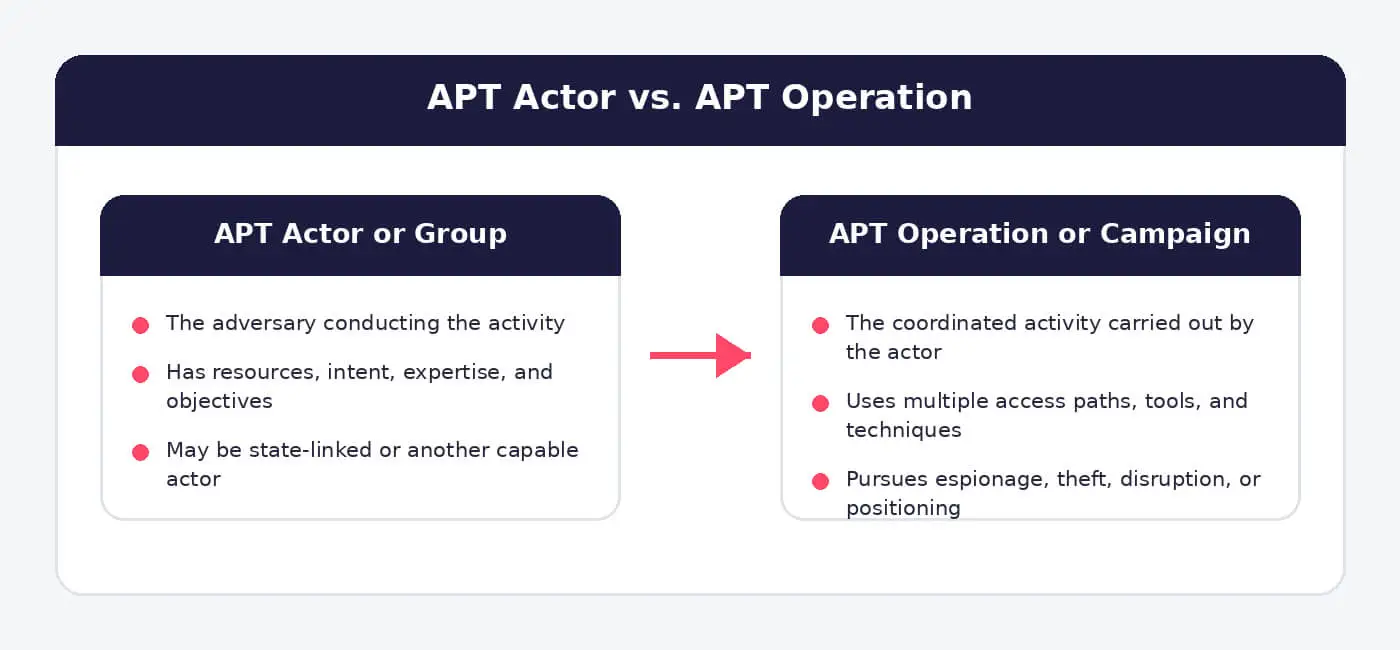
An advanced persistent threat (APT) is a capable threat actor or group that conducts targeted, sustained cyber operations to achieve a strategic objective. Many APT groups are associated with nation-states, although the label may also be applied to other well-resourced actors with comparable expertise, patience, and operational discipline.
An APT attack, operation, or campaign is the activity carried out by that actor. It may involve espionage, intellectual property theft, financial activity, surveillance, disruption, or preparation for a later operation. The distinction matters: the APT is the actor, while the intrusion and its connected actions form the operation.
APT groups combine stolen identities, vulnerabilities, social engineering, cloud services, legitimate administration tools, malware, and custom capabilities. Persistent does not mean that one malware implant remains active forever. It means the actor continues pursuing the objective, maintains or rebuilds access, and adapts when defenders interrupt part of the operation.
Key Takeaways
- An APT is the threat actor or group; an APT operation or campaign is the activity it conducts.
- APT operations are targeted, mission-driven, adaptive, and often designed to support long-term access.
- Valid accounts and legitimate tools can make individual events appear harmless when viewed alone.
- Containment must remove every foothold, identity, token, and trust path the actor could reuse.
How an APT Operation Works
APT operations often begin with research into employees, suppliers, exposed services, identity systems, and technologies. Initial access may come from spear phishing, stolen credentials, public-facing vulnerabilities, trusted third parties, cloud applications, or supply-chain compromise.
After entry, the group may establish additional access, raise privileges, discover the environment, and move toward valuable systems. Collection and exfiltration can occur slowly to blend with normal activity. When defenders expose one part of the intrusion, the actor may rotate infrastructure, change tooling, use another compromised identity, or return through a separate access path.
Common Stages and Techniques
- Reconnaissance and preparation of infrastructure, accounts, domains, or operational resources
- Initial access through phishing, stolen credentials, exposed applications, or trusted relationships
- Privilege escalation, persistence, discovery, credential access, and lateral movement
- Collection, command and control, exfiltration, disruption, or another mission objective
Security and Business Risks
- Long-term loss of sensitive intelligence and intellectual property
- Compromise of privileged identities, cloud tokens, and trust relationships
- Supply-chain exposure that provides access to customers or downstream organizations
- Sabotage, operational disruption, surveillance, or strategic positioning for a future event
Warning Signs and Detection
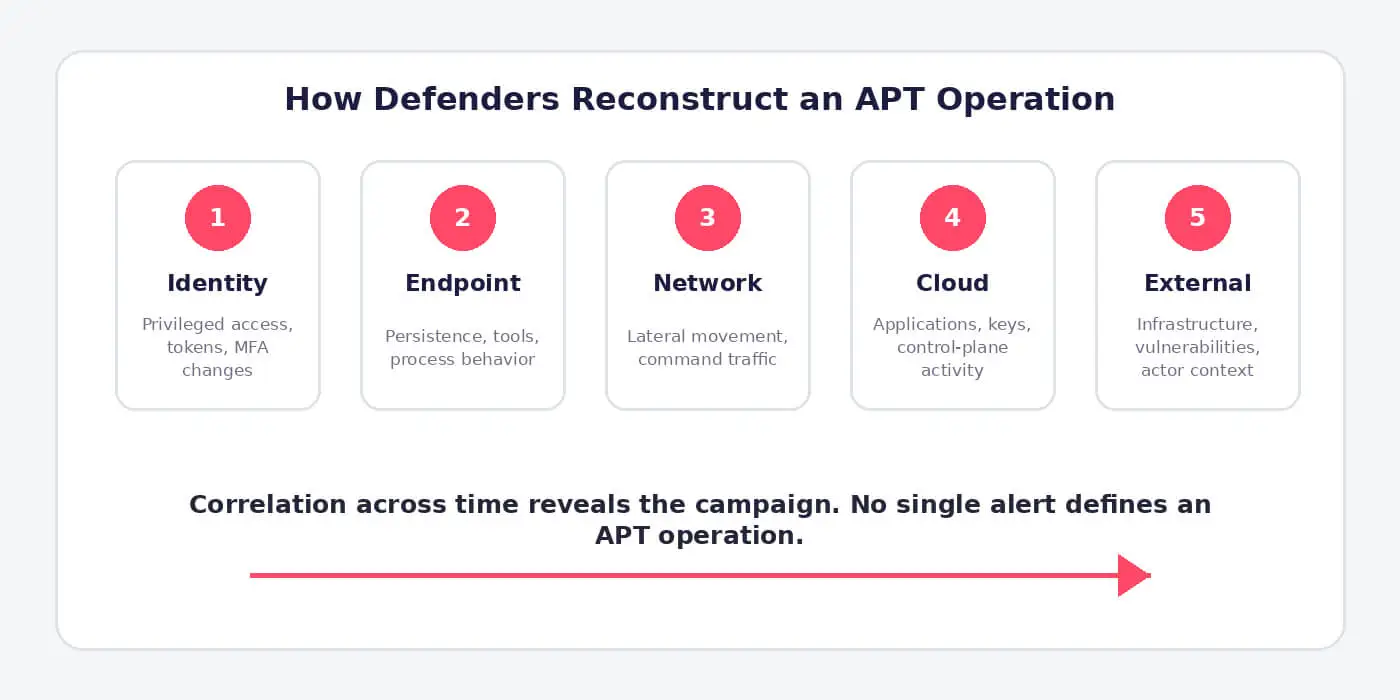
No single alert proves that an APT group is present. Analysts should correlate unusual privileged access, new cloud applications or tokens, rare administration tools, persistence changes, lateral movement, data staging, low-volume outbound traffic, and security-control tampering. Weak signals become meaningful when they form a consistent sequence across systems, identities, and time.
External context can strengthen the assessment. Newly registered attacker infrastructure, exploitation of a vulnerability present on an exposed asset, leaked access offered by an initial-access broker, or techniques associated with an active campaign can help analysts test a hypothesis. Attribution should remain separate from containment and should state confidence and competing explanations.
Prevention and Response
Use phishing-resistant MFA, least privilege, segmentation, rapid risk-based patching, endpoint detection and response, protected cloud and identity logs, resilient backups, and tested incident-response playbooks. Monitor privileged and machine identities as closely as endpoints, and reduce direct administrative exposure to the internet.
During response, preserve evidence and scope the operation before taking actions that may alert the actor. Revoke sessions and tokens, rotate secrets, remove persistence, close exploited paths, rebuild compromised systems from trusted sources, and examine suppliers or connected environments. Recovery is incomplete until defenders confirm that the group cannot reuse another identity, application, key, device, or trust relationship.
How SOCRadar Can Help
SOCRadar Cyber Threat Intelligence helps teams follow threat groups, campaigns, infrastructure, tools, and changing tactics. Attack Surface Management identifies exposed assets that could provide initial access, Vulnerability Intelligence adds exploitation context, and Dark Web Monitoring can surface leaked credentials or access discussions connected to the organization.
Explore SOCRadar Cyber Threat Intelligence or request a demo to strengthen threat-informed prevention, investigation, and response.
Frequently Asked Questions
Is an APT a Type of Malware or a Threat Actor?
No. An APT is the threat actor or group that conducts targeted, sustained operations, while the intrusion it carries out is an APT attack, operation, or campaign. The term is often used loosely for both, but separating the actor from the activity makes tracking, reporting, and response clearer.
What Does “Persistent” Mean in an APT Operation?
Persistent describes the actor’s commitment to the objective, not a single implant that never stops running. If one access path is cut off, the group may return through a different account, token, device, or vulnerability. That is why containment aims to address every foothold and trust path, not just the malware that was detected.
How Do APT Groups Typically Gain Initial Access?
Common routes include spear phishing, valid accounts acquired through theft or purchase, exploitation of internet-facing vulnerabilities, trusted third-party relationships, and supply-chain compromise. Initial access brokers sometimes sell ready-made footholds to groups that prefer not to develop their own. The chosen route usually reflects the target’s weakest realistic boundary.
Why Are APT Operations Difficult to Detect?
These operations are deliberately low-noise. Actors often work with legitimate credentials, built-in administration tools, and low-volume activity, so any single event can look routine. Correlation across identity, endpoint, network, and cloud data over days or weeks is usually what exposes the pattern.
What Warning Signs May Indicate an APT Operation?
No single alert proves an APT is present. Sequences such as unusual privileged logons, new cloud tokens or OAuth grants, rare remote-administration tools, persistence changes, data staging, and security-control tampering become meaningful when correlated across identities, systems, and time. External context—newly registered attacker infrastructure, leaked access offered underground, or techniques tied to an active campaign—helps analysts test the hypothesis. Threat intelligence platforms such as SOCRadar Cyber Threat Intelligence track these groups, campaigns, and infrastructure so teams can compare internal signals against observed actor behavior.
How Long Can an APT Operation Remain Undetected?
There is no fixed duration. Operations have stayed hidden for months and, in some documented cases, years when they imitate normal administration and logging coverage is limited. Detection speed depends heavily on log retention, monitoring of privileged and machine identities, and the ability to connect weak signals into a coherent sequence.
What Business Damage Can an APT Operation Cause?
Typical impacts include long-term loss of intellectual property and sensitive intelligence, compromised privileged identities and cloud tokens, supply-chain exposure that reaches customers and partners, and regulatory or reputational harm. Because an actor may retain quiet access in reserve, costs can continue accruing after the initial incident appears resolved.
What Should an Organization Do After Discovering Suspected APT Activity?
Preserve evidence and scope the operation before taking disruptive actions that could tip off the actor. Containment should revoke active sessions and tokens, rotate secrets, remove persistence, close the exploited entry path, and rebuild compromised systems from trusted sources where warranted. Password resets alone may not end an intrusion if stolen sessions remain valid. Recovery should include confirming that the group cannot re-enter through another identity, application, key, device, or trust relationship.
Which Security Controls Help Reduce Exposure to APT Groups?
No single control stops these groups, but strong baselines make quiet, long-term access harder to establish and maintain:
- Phishing-resistant MFA and least-privilege access
- Network segmentation and limited internet-facing administrative exposure
- Risk-based patching guided by exploitability rather than severity scores alone
- Endpoint detection paired with protected identity, endpoint, and cloud logs
- Resilient backups and tested incident-response playbooks
How Is an APT Different From a Ransomware Attack?
Commodity malware and most ransomware campaigns spread opportunistically and aim for quick results, such as mass infection or encryption for extortion. APT operations are targeted and patient, prioritizing stealth and durable access in pursuit of a specific objective. The categories can overlap, because some state-linked groups deploy ransomware for revenue or disruption.