Unpatched Danfoss AK-SM800A Flaws Allow Takeover
Six unpatched vulnerabilities in the Danfoss AK-SM800A, a system manager that runs refrigeration in supermarkets and cold storage sites, could let a remote attacker take over the controller without logging in. The flaws became public on November 11, 2026, and there is still no fixed firmware version and no CVE ID for any of them.
The timing raises the stakes. Since October 11, 2026, attackers have tampered with internet-exposed refrigeration controllers across Europe. Germany’s Federal Office for Information Security (BSI), the Centre for Cybersecurity Belgium (CCB) and Ireland’s NCSC now tell operators to take AK-SM800A management interfaces off the internet, with a VPN as the minimum for any remote connection. BSI rates the issue criticality 3 (Orange), its level for immediate action, and the CCB confirmed the findings on November 12.
What Did Researchers Find Inside the AK-SM800A Firmware?
Carlo Meijer of Dutch security firm Midnight Blue spotted the bugs within about an hour, using firmware from the Danfoss website. The team’s technical write-up classifies all six as stack-based buffer overflows reachable before any login.
Five of them live in the web request handlers of sm_app, the controller’s main application, which runs as root. Using one of these, a CGI handler that needs no login and copies request data with strcpy, the team achieved Remote Code Execution (RCE) as root on firmware 3.3.0. The same bugs are present in 5.3.2, the most recent build they analyzed.
The sixth flaw is in sm_fcgi_app, a separate gateway process that lets only login requests through until a session is established. When the team emulated the latest firmware with Strict mode switched on, a single overlong request brought the gateway down. They believe the crash could be developed into code execution, noting that the binary was built without hardening such as stack canaries. So far, only the crash has been shown.
The researchers are keeping the affected endpoints and their exploitation technique private while they work through coordinated disclosure with Danfoss, and no public proof of concept (PoC) is available.
Why Strict Mode Does Not Close the Gap
Strict mode, the default session-control setting since firmware 4.0, forces HTTPS and makes API clients present a session token. With it on, an unauthenticated visitor can reach very little of the web interface, and the CGI bug from the root demo is out of reach.
The gateway bug is different: it lives in the component that enforces Strict mode, so turning the setting on leaves it exposed. For that reason, the Belgian advisory, echoed by Ireland’s NCSC, warns that patching, replacing default passwords and switching on Strict mode will not protect a controller by themselves.
Which Firmware Versions Are Exposed?
| Firmware | Status |
|---|---|
| 3.3.0 | Affected, root RCE demonstrated |
| Up to and including 5.3.2 | Affected |
| 5.4.0 (November 2026) | Not confirmed as fixed |
Firmware 5.4.0 has caused some confusion. A BSI press release on November 13, 2026, first listed it as unaffected, but an update the same day said BSI cannot rule that out. The researchers have since stated that 5.4.0 leaves the flaws in place, and Danfoss’ November release documentation describes no security fix, only tighter password requirements.
As of November 16, 2026, the Danfoss security advisories page lists no entry for the six flaws, and no fix date has been published. Earlier AK-SM800A issues, such as the authentication bypass CVE-2025-41450 and the OS command injection CVE-2025-41451, were addressed in updates released in 2023 and 2025. Because 5.3.2 already contains those patches, keeping a controller current does not protect it from the new bugs.
What Could Root Access Mean for a Store or Warehouse?
The direct effect of the flaws is pre-authentication memory corruption, with root code execution demonstrated for one of them. From that position, the researchers outline several potential outcomes:
- Process Manipulation: altering temperature setpoints or forcing defrost cycles, then covering those changes in the controller’s logs
- Persistence: because the secure boot capability of the i.MX6 chip is not enabled, malicious code planted on the device could outlast both a factory reset and a firmware upgrade
- Permanent Denial of Service: erasing flash memory or loading corrupted firmware could brick a controller, leaving hardware replacement as the only fix
The persistence and permanent outage scenarios are the researchers’ assessments and were not demonstrated on a device. BSI’s security notice warns that the researchers’ write-up may already give attackers enough pointers toward exploitation, and that an outage could last a long time if many devices were compromised at once. The team also believes further bugs of this type remain in the code.
Are These Danfoss Flaws Behind the Supermarket Freezer Attacks?
The AK-SM800A has already featured in the recent wave of attacks on supermarket freezers and other OT systems, which raises an obvious question: were the attackers already exploiting these new bugs? So far, no evidence ties the two together. BSI is not aware of any active exploitation of the six flaws, and none of the agencies or researchers has connected them to the incidents. Attackers in the campaign have instead abused exposed web panels, default credentials and older vulnerabilities that already have fixes; public PoCs for CVE-2025-41450 appeared within 48 hours of the first French attacks.
The concern is reach. The researchers report that, as of November 10, 2026, internet scan data still showed hundreds of exposed Danfoss controllers, though they expect many to be honeypots by now. In the US, CISA, the FBI and three other federal agencies issued a joint warning on refrigeration controller attacks on November 5, 2026.
How Should Operators Respond Before a Patch Arrives?
Danfoss itself advises against exposing the AK-SM800A directly to the internet and says this holds for every software version, Strict mode or not. The government advisories add the following steps:
- Map Exposure: list all controllers with an internet-facing management interface, including cellular modems installed by refrigeration integrators
- Lock Down Remote Access: route remote maintenance through a VPN, a private APN or an internal network; limiting access to a contractor’s IP addresses only buys time
- Look for Tampering: compare temperature setpoints, defrost timing, alarm thresholds, accounts and remote access configuration against known-good values
- Handle Suspected Compromise: BSI recommends rotating every credential and testing the equipment attached to the controller; because of the persistence risk, a reset alone may not make a device trustworthy again
- Coordinate With Service Providers: before disconnecting a refrigeration contractor, the CCB suggests reviewing contract and insurance obligations and providing a secured alternative so temperature monitoring keeps running
- Watch for a Fix: follow the Danfoss advisories page for CVE assignments and corrected firmware, and do not treat Strict mode or 5.4.0 as a substitute
Spotting Exposed Refrigeration Controllers With SOCRadar
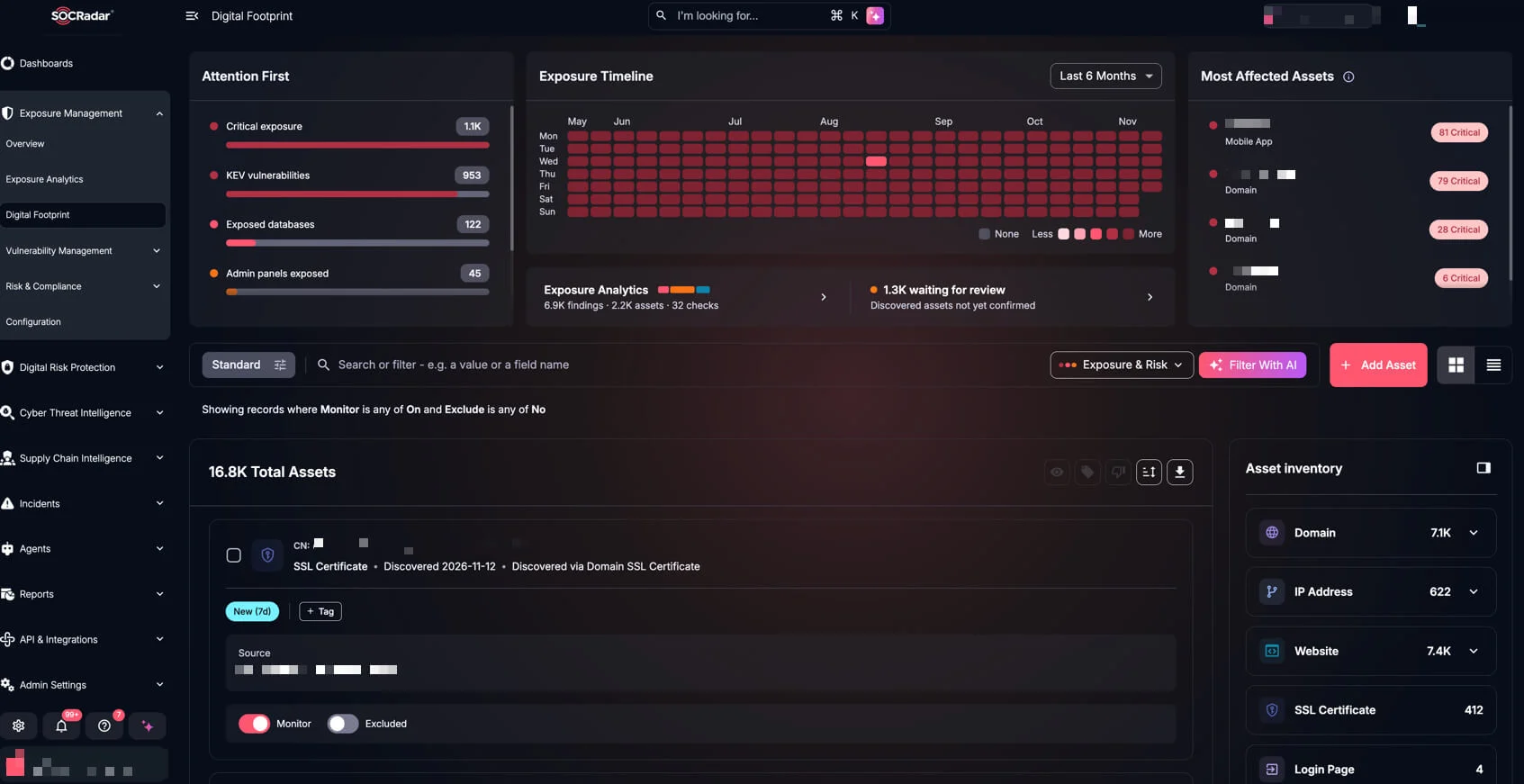
With no patch available, internet exposure decides whether an AK-SM800A is at risk, and refrigeration controllers are often connected by contractors through cellular modems that never appear in IT inventories. Here’s how SOCRadar can help:
- Autonomous Exposure Management: continuously discovers internet-facing assets tied to an organization, including OT management interfaces, so security teams can see which sites expose controller web panels
- Cyber Threat Intelligence: tracks when the six flaws receive CVE IDs, when Danfoss ships a fix and whether exploitation is reported
- Dark Web Monitoring: adds visibility into exploit claims or access sales targeting refrigeration systems
Teams can use these findings to prioritize sites for VPN migration, then confirm device configuration and signs of tampering with on-site logs and their service providers.
Frequently Asked Questions
Do the Danfoss AK-SM800A Flaws Have CVE IDs?
Not yet. CVE assignments are still pending while coordinated disclosure with Danfoss continues.
Does Enabling Strict Mode Protect the AK-SM800A?
Only partly. Strict mode blocks most of the unauthenticated web surface, but the sixth flaw sits in the gateway that enforces it.
Is Danfoss Firmware 5.4.0 Safe to Rely On?
No. The researchers say 5.4.0 does not fix the flaws, and BSI cannot rule out that it is affected. Removing internet exposure remains the priority.