

| Tactic | Technique ID | Technique Name |
| Initial Access | T1190 | Exploit Public-Facing Application |
| T1566.001 | Phishing: Spearphishing Attachment | |
| T1133 | External Remote Services | |
| T1195.002 | Supply Chain Compromise: Compromise Software Supply Chain | |
| Execution | T1059.001 | Command and Scripting Interpreter: PowerShell |
| T1059.003 | Command and Scripting Interpreter: Windows Command Shell | |
| T1059.004 | Command and Scripting Interpreter: Unix Shell | |
| T1059.007 | Command and Scripting Interpreter: JavaScript | |
| T1197 | BITS Jobs | |
| T1203 | Exploitation for Client Execution | |
| T1218.001 | System Binary Proxy Execution: Compiled HTML File | |
| T1218.011 | System Binary Proxy Execution: Rundll32 | |
| T1569.002 | System Services: Service Execution | |
| T1047 | Windows Management Instrumentation | |
| Persistence | T1547.001 | Boot or Logon Autostart Execution: Registry Run Keys / Startup Folder |
| T1037 | Boot or Logon Initialization Scripts | |
| T1136.001 | Create Account: Local Account | |
| T1543.003 | Create or Modify System Process: Windows Service | |
| T1546.008 | Event Triggered Execution: Accessibility Features | |
| T1505.003 | Server Software Component: Web Shell | |
| T1053.005 | Scheduled Task/Job: Scheduled Task | |
| T1542.003 | Pre-OS Boot: Bootkit | |
| T1014 | Rootkit | |
| T1098.007 | Account Manipulation: Additional Local or Domain Groups | |
| Privilege Escalation | T1134 | Access Token Manipulation |
| T1480.001 | Execution Guardrails: Environmental Keying | |
| Defense Evasion | T1562.006 | Impair Defenses: Indicator Blocking |
| T1070.001 | Indicator Removal: Clear Windows Event Logs | |
| T1070.003 | Indicator Removal: Clear Command History | |
| T1070.004 | Indicator Removal: File Deletion | |
| T1574.001 | Hijack Execution Flow: DLL | |
| T1574.006 | Hijack Execution Flow: Dynamic Linker Hijacking | |
| T1036.004 | Masquerading: Masquerade Task or Service | |
| T1036.005 | Masquerading: Match Legitimate Resource Name or Location | |
| T1027 | Obfuscated Files or Information | |
| T1027.002 | Obfuscated Files or Information: Software Packing | |
| T1027.013 | Obfuscated Files or Information: Encrypted/Encoded File | |
| T1140 | Deobfuscate/Decode Files or Information | |
| T1001.003 | Data Obfuscation: Protocol or Service Impersonation | |
| T1553.002 | Subvert Trust Controls: Code Signing | |
| Credential Access | T1110 | Brute Force |
| T1555 | Credentials from Password Stores | |
| T1555.003 | Credentials from Web Browsers | |
| T1003.001 | OS Credential Dumping: LSASS Memory | |
| T1003.002 | OS Credential Dumping: Security Account Manager | |
| T1003.003 | OS Credential Dumping: NTDS | |
| T1056.001 | Input Capture: Keylogging | |
| T1055 | Process Injection | |
| T1112 | Modify Registry | |
| T1087.001 | Account Discovery: Local Account | |
| T1087.002 | Account Discovery: Domain Account | |
| Discovery | T1069 | Permission Groups Discovery |
| T1083 | File and Directory Discovery | |
| T1680 | Local Storage Discovery | |
| T1046 | Network Service Discovery | |
| T1135 | Network Share Discovery | |
| T1012 | Query Registry | |
| T1018 | Remote System Discovery | |
| T1595.002 | Active Scanning: Vulnerability Scanning | |
| T1595.003 | Active Scanning: Wordlist Scanning | |
| T1593.002 | Search Open Websites/Domains: Search Engines | |
| T1594 | Search Victim-Owned Websites | |
| T1596.005 | Search Open Technical Databases: Scan Databases | |
| T1082 | System Information Discovery | |
| T1016 | System Network Configuration Discovery | |
| T1049 | System Network Connections Discovery | |
| T1033 | System Owner/User Discovery | |
| Lateral Movement | T1021.001 | Remote Services: Remote Desktop Protocol |
| T1021.002 | Remote Services: SMB/Windows Admin Shares | |
| T1570 | Lateral Tool Transfer | |
| T1550.002 | Use Alternate Authentication Material: Pass the Hash | |
| Collection | T1119 | Automated Collection |
| T1005 | Data from Local System | |
| T1213.003 | Data from Information Repositories: Code Repositories | |
| T1213.006 | Data from Information Repositories: Databases | |
| T1074.001 | Data Staged: Local Data Staging | |
| T1560.001 | Archive Collected Data: Archive via Utility | |
| T1560.003 | Archive Collected Data: Archive via Custom Method | |
| Command and Control | T1071.001 | Application Layer Protocol: Web Protocols |
| T1071.002 | Application Layer Protocol: File Transfer Protocols | |
| T1071.004 | Application Layer Protocol: DNS | |
| T1090 | Proxy | |
| T1008 | Fallback Channels | |
| T1104 | Multi-Stage Channels | |
| T1568.002 | Dynamic Resolution: Domain Generation Algorithms | |
| T1573.002 | Encrypted Channel: Asymmetric Cryptography | |
| T1102.001 | Web Service: Dead Drop Resolver | |
| T1583.007 | Acquire Infrastructure: Serverless | |
| T1586.003 | Compromise Accounts: Cloud Accounts | |
| Exfiltration | T1030 | Data Transfer Size Limits |
| T1048.003 | Exfiltration Over Alternative Protocol | |
| T1041 | Exfiltration Over C2 Channel | |
| T1567.002 | Exfiltration Over Web Service: Exfiltration to Cloud Storage | |
| Impact | T1486 | Data Encrypted for Impact |
| T1496.001 | Resource Hijacking: Compute Hijacking |
Mar 06, 2026
11 Mins Read

Summarize with:
Dark Web Profile: APT41
APT41 stands out in the threat landscape because it doesn’t stick to a single playbook. It has been repeatedly linked to both cyber espionage and financially motivated cybercrime, sometimes running those missions side by side.
That dual-track model, paired with exploit-driven access and long-dwell intrusions, makes APT41 a high-signal profile for defenders looking to understand how modern operations blend strategy, stealth, and scale.
Who Is APT41?
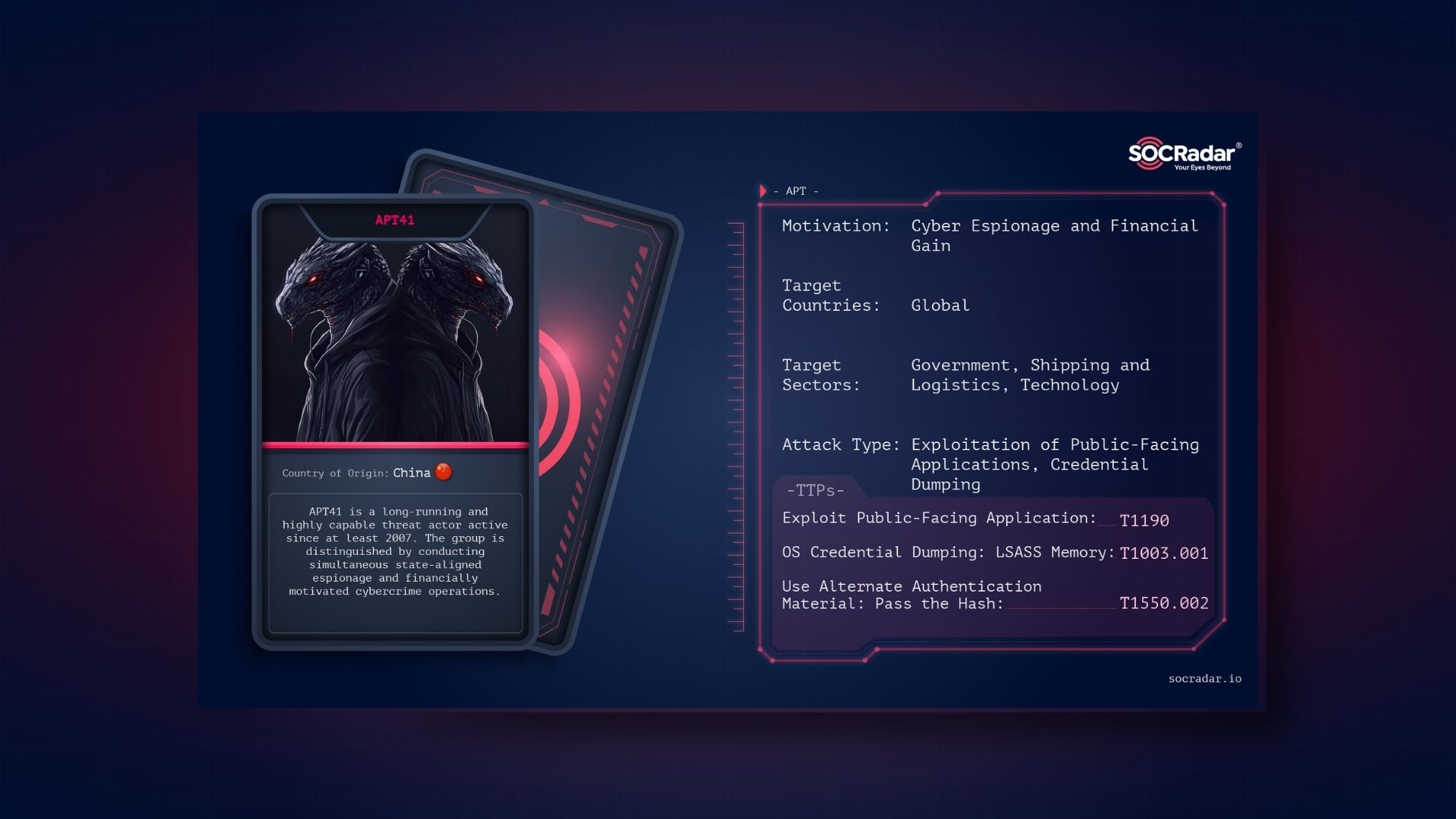
APT41 is a China-linked intrusion set widely assessed to operate in alignment with state-sponsored espionage objectives, while also running profit-driven cybercrime operations. This dual mission is one of the group’s defining traits and has been repeatedly described as evident by at least 2014, when reporting began emphasizing parallel espionage and financially motivated activity.
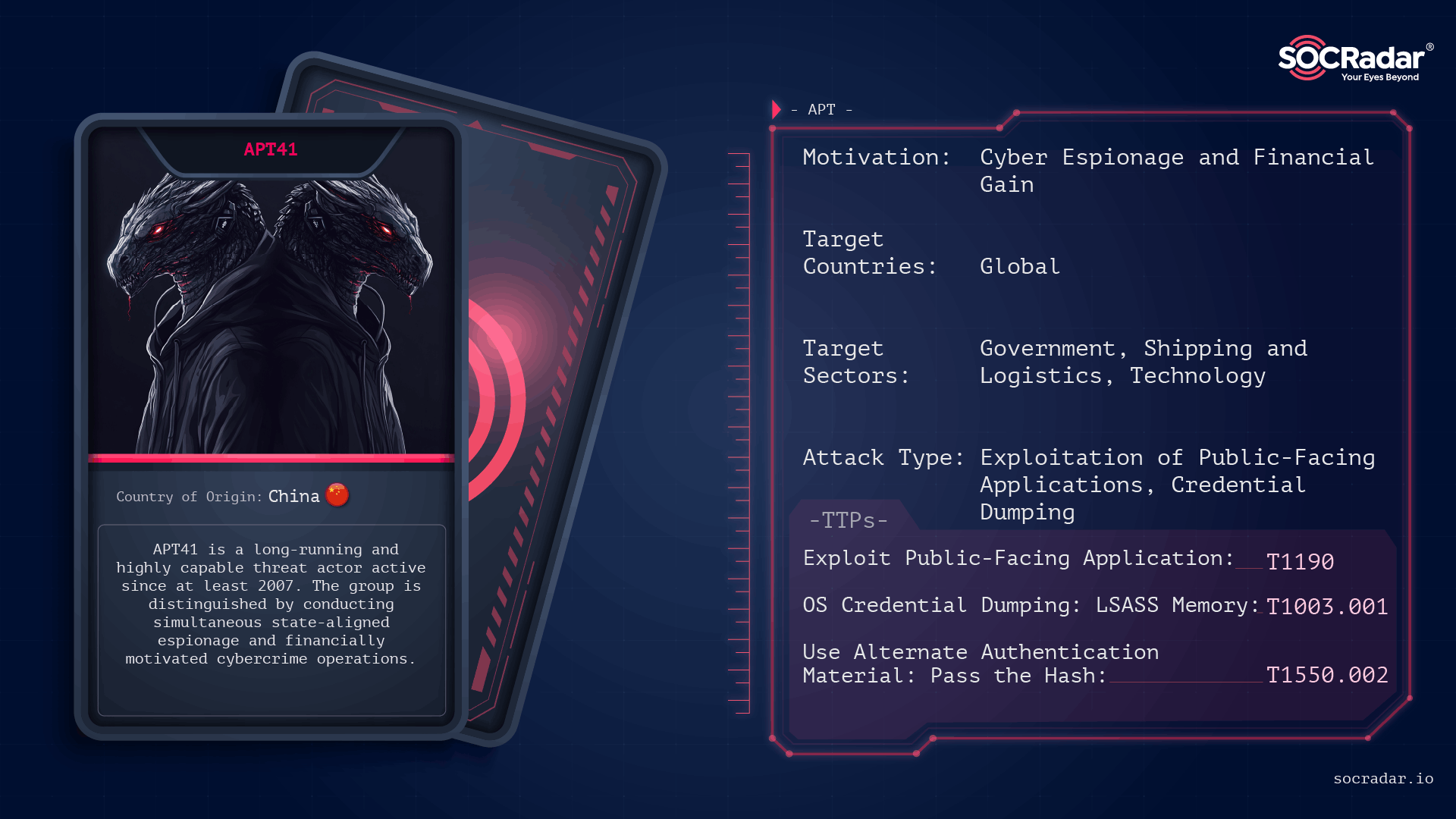
Threat actor card for APT41
Activity associated with APT41 has been observed since at least 2007 (with many public profiles also tracking the group as active since at least 2012), reflecting a long-running operation that has evolved alongside the modern threat landscape. Across that span, APT41 has built a reputation for persistence and for rapid weaponization of newly disclosed vulnerabilities in public-facing systems.
The group is tracked under multiple aliases depending on the vendor or intelligence source, including Double Dragon, Wicked Panda, BARIUM, Winnti, Bronze Atlas, and Brass Typhoon. While naming varies, reporting consistently describes a capable, well-resourced operator with a broad toolset and the operational flexibility to pursue both strategic intelligence collection and monetization.

Public legal actions have also increased visibility. In 2020, U.S. indictments described intrusion activity tied to individuals alleged to be connected to APT41-linked operations, reinforcing broader assessments of a large, coordinated actor supporting strategic objectives while also enabling cybercrime outcomes.
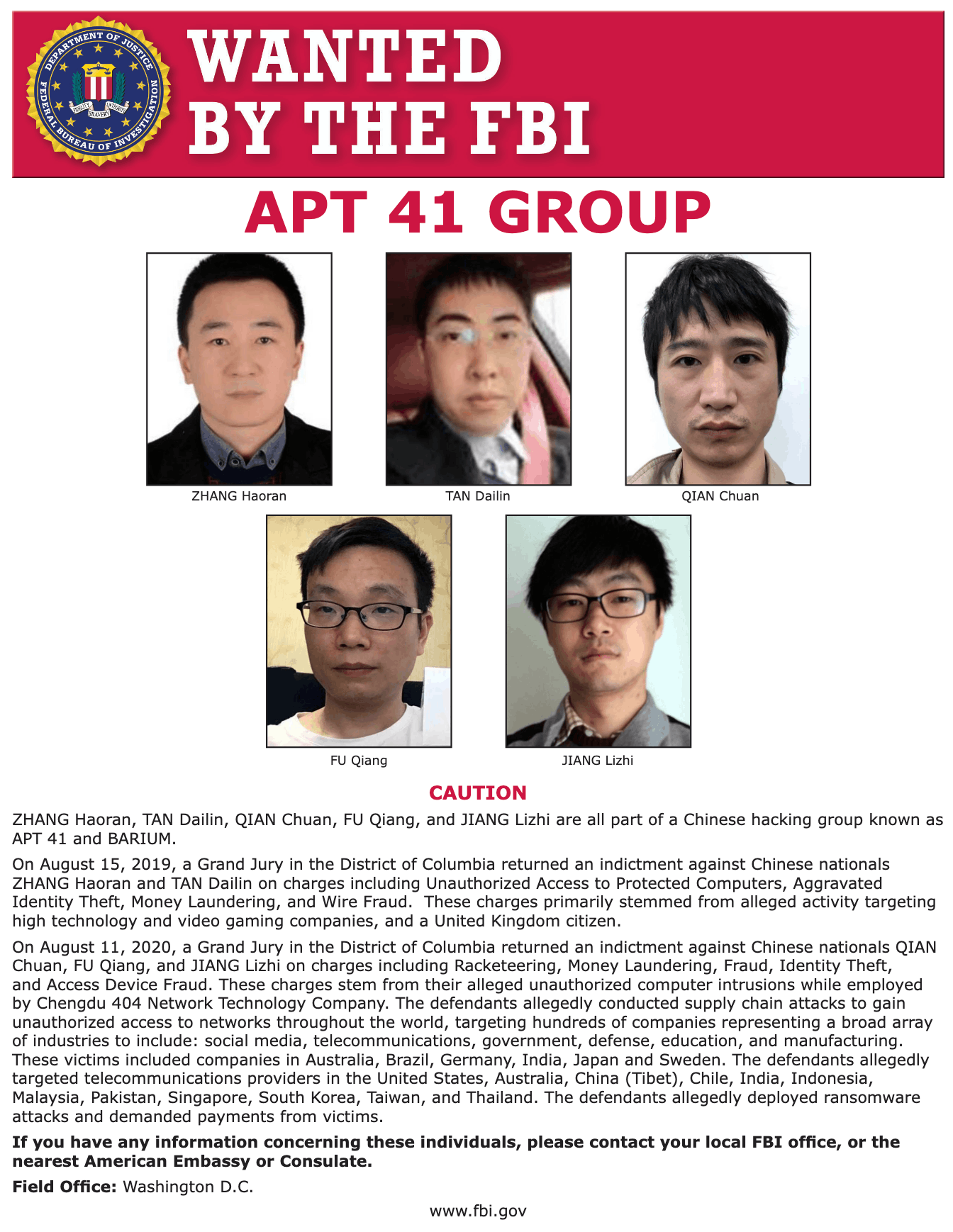
Wanted by the FBI – APT41 Group (fbi.gov)
Overall, APT41 is best understood as a dual-purpose operator: exploit-driven, stealth-focused, and comfortable blending into victim environments with “living off the land” tradecraft, while pursuing both geopolitical and financial impact.
What Are APT41’s Targets?
Reporting links APT41 to intrusions against U.S. state government networks, including multi-state activity observed across 2021-2022 and follow-on compromises in 2022 involving exploitation paths tied to third-party applications. More recently, highly targeted phishing activity aimed at organizations involved in U.S.-China trade policy and diplomacy has also been publicly linked to APT41, with victims reportedly including U.S. government entities, policy-adjacent organizations, and related institutions.
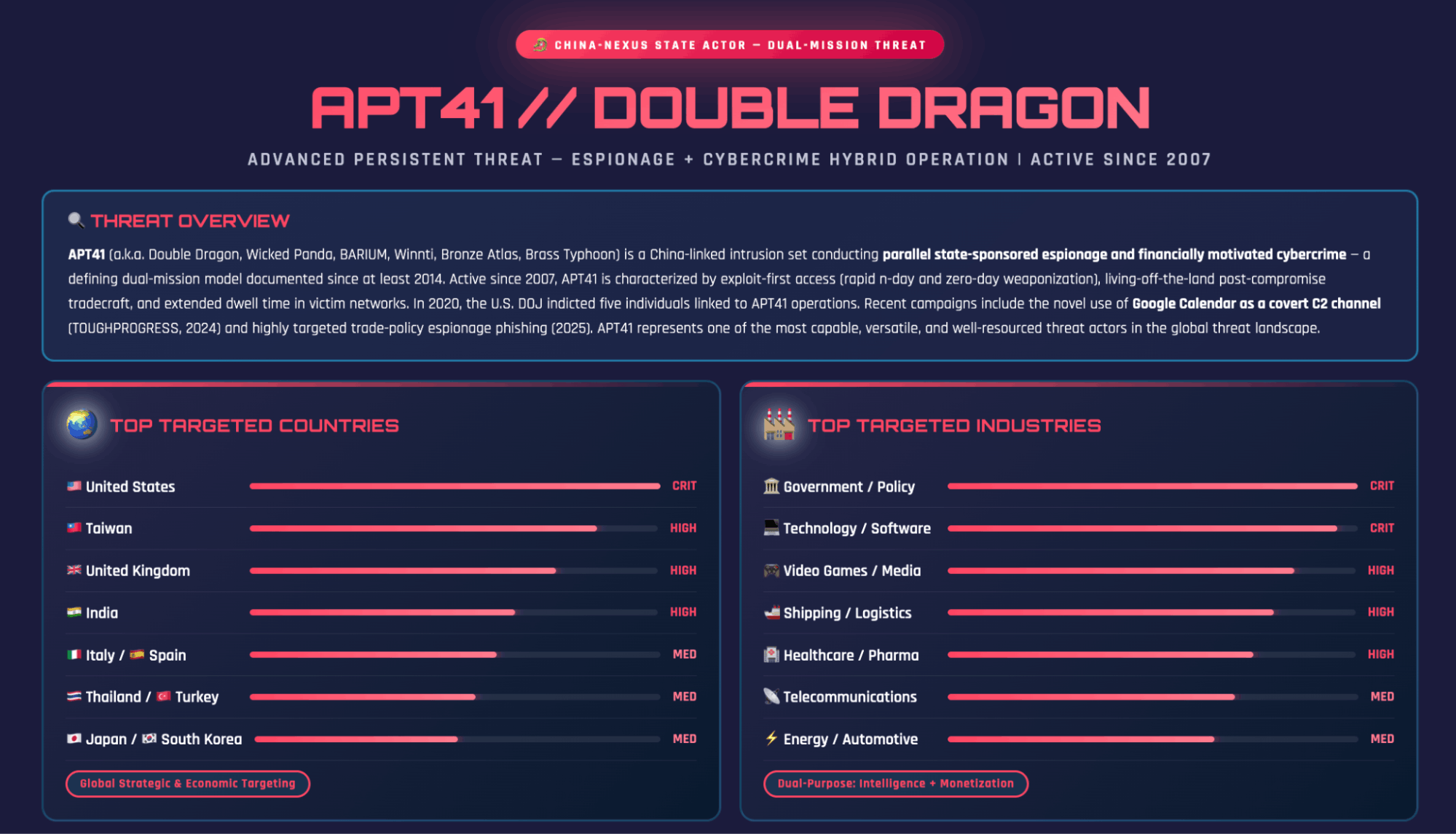
APT41 Threat Intelligence Report (Source: SOCRadar MCP)
On the commercial side, APT41 has repeatedly focused on industries where access yields strategic intelligence, supply-chain leverage, or monetizable data. This includes global shipping and logistics, technology, media and entertainment, and automotive organizations, with victimology spanning countries such as Italy, Spain, Taiwan, Thailand, Turkey, and the United Kingdom. Additional reporting has linked APT41 activity to telecommunications, energy, healthcare, education, and even the video game industry, underscoring the group’s willingness to pursue targets that support both intelligence collection and financial gain.
What Are APT41’s Techniques?
APT41 is best known for an exploit-first intrusion style combined with stealthy post-compromise tradecraft. Across public reporting, the group repeatedly shows three consistent themes: rapid vulnerability weaponization, heavy use of living-off-the-land (LotL) execution, and long-term persistence supported by credential theft and covert command-and-control.
Initial Access
APT41 most commonly gains entry by exploiting public-facing applications, moving quickly on both n-day and, in some cases, zero-day vulnerabilities. Reporting highlights exploitation of widely used enterprise and edge technologies, including Citrix NetScaler/ADC (CVE-2019-19781), Zoho ManageEngine Desktop Central (CVE-2020-10189), and rapid exploitation of Log4Shell (CVE-2021-44228) shortly after disclosure. In addition to exploit-driven access, the group also uses targeted spearphishing, including malicious attachments and link-based delivery chains hosted on compromised infrastructure.
Execution
Once inside, APT41 often relies on built-in Windows utilities to blend into normal administration activity. PowerShell and the Windows command shell are frequently used, alongside trusted binaries such as rundll32. In observed intrusions, APT41 has used staged payload delivery approaches (encoding and chunking payloads, writing them to disk in small pieces, then decoding with native tools like certutil) to reduce detection and preserve payload integrity.
Persistence
APT41 uses multiple persistence options depending on the environment and objective. Common approaches include:
- Web shells on exposed servers (including long-lived shells used for command execution and follow-on payload delivery)
- Scheduled Tasks for recurring execution
- Disguised Windows Services, sometimes named to resemble legitimate components
This persistence focus supports the group’s reputation for extended dwell time, remaining in victim networks for months or longer.
Credential Access and Privilege Expansion
Credential theft is central to APT41 operations. Reporting describes the use of tools like Mimikatz to dump credentials from LSASS, and use of native tooling (e.g., ntdsutil) to extract Active Directory data. The group also searches for credentials in configuration files and can harvest stored browser credentials, enabling lateral movement and access to higher-value systems.
Discovery and Lateral Movement
After gaining a foothold, APT41 performs methodical discovery (enumerating hosts, users, services, and network shares) then pivots using stolen credentials and remote execution techniques. Observed activity includes scanning for exposed services and vulnerable internal systems, transferring tools across the network, and using Windows administration mechanisms to execute payloads remotely.
Command and Control
APT41 has repeatedly demonstrated comfort using legitimate web services and common protocols to hide in plain sight. Communications often leverage HTTP/HTTPS, and in some operations DNS-based channels have also been observed. More notably, recent reporting describes malware that used Google Calendar as a command-and-control channel, embedding encrypted commands and exfiltrated data inside calendar event content to camouflage traffic as routine cloud activity.
Collection and Exfiltration
Collection commonly targets high-value internal data such as credentials, internal documents, source code, communications, and configuration repositories. For exfiltration, APT41 has been reported using compression/archiving tools and exfiltrating to legitimate cloud storage services (for example, OneDrive) to blend outbound data movement into normal enterprise patterns.
Defense Evasion
APT41 invests heavily in evasion through:
- Obfuscation and packing of payloads
- Encrypted/encoded payload stages
- Masquerading malware as legitimate filenames and processes
- Artifact cleanup, including deletion of tools and stolen-data staging files
Recent malware chains described in reporting also emphasize in-memory execution and techniques like process hollowing, reducing the footprint defenders can detect on disk.
Taken together, these techniques form a playbook optimized for speed on initial access, stealth post-compromise, and persistence for long-term value extraction, whether the end goal is espionage, monetization, or both.
What Are the Campaigns Related to APT41?
Below are several real-world campaigns that exemplify how this APT group operates.
Trade Policy and Diplomacy Phishing Campaign (September 2025)
In early September 2025, U.S. reporting described a highly targeted espionage operation in which recipients received phishing emails impersonating U.S. Congressman John Moolenaar, with an attachment positioned as draft legislation related to U.S.-China policy. The operation was framed as an attempt to collect sensitive information from organizations involved in trade policy and diplomacy, with victims reported to include government entities and policy-adjacent organizations.
TOUGHPROGRESS: Google Calendar as Command-and-Control (Late October 2024, disclosed May 2025)
Google’s Threat Intelligence Group disclosed a campaign discovered in late October 2024 targeting multiple government entities using malware dubbed TOUGHPROGRESS. The intrusion chain began with spearphishing that delivered a ZIP from a compromised government website, then progressed through staged components before TOUGHPROGRESS used Google Calendar events as a covert C2 channel, embedding encrypted commands and exfiltrated data inside calendar event content to blend into legitimate cloud traffic.
“DUST” Intrusions and Dual-Use Operations (July 2024)
In mid-2024, Google and partners described APT41 as a dual-purpose actor whose state-aligned espionage activity coexisted with financially motivated intrusions, including operations historically associated with the video game industry (source code and certificate theft, manipulation of virtual currencies, and attempted ransomware deployment). This reporting reinforced the idea that APT41’s mission can vary by victim type and access opportunity.
U.S. State Government Intrusions: USAHerds and Log4Shell Exploitation (2021-2022)
Mandiant reported on APT41 activity targeting U.S. state government environments, including compromises spanning multiple states. Reporting highlighted exploitation of vulnerabilities in public-facing systems and third-party applications (including a livestock management system associated with CVE-2021-44207 (USAHerds)), as well as rapid exploitation behavior around Log4Shell during the same period.
What Are the Mitigation Tactics Against APT41?
APT41 is commonly associated with exploit-driven initial access, credential theft, and stealthy persistence, often using legitimate tools and cloud services to blend in. Defenses should focus on closing exposed entry points and catching low-noise post-compromise behavior early.
- Reduce exploit exposure: Inventory and harden internet-facing apps/edge devices, patch fast (especially widely exploited CVEs), and restrict admin interfaces.
- Harden identity: Enforce phishing-resistant MFA, remove stale accounts, rotate secrets, and monitor abnormal logins/token activity in cloud and email.
- Detect “living off the land”: Alert on unusual use of native tools often abused for staging/execution (PowerShell, rundll32, certutil, wmic, scheduled tasks).
- Block persistence: Hunt for new/odd Windows Services and Scheduled Tasks, and monitor servers for web shells and unexpected web app changes.
- Protect AD and credentials: Watch for credential dumping behavior and suspicious access to directory data; tier admin privileges and limit lateral movement paths.
- Monitor cloud abuse/exfiltration: Alert on unusual bulk uploads/downloads, new OAuth apps, and suspicious cloud storage usage that could hide C2 or data theft.
- Strengthen phishing defenses: Improve email filtering, enforce DMARC/SPF/DKIM, and train for targeted lures (policy/legal/logistics themes).
How Can SOCRadar Help?
SOCRadar helps security teams gain visibility by connecting threat actor intelligence with real-world exposure and leak signals from open, deep, and dark web sources:
- Free Dark Web Report (SOCRadar Labs): Quickly checks whether corporate domains, emails, or credentials appear in leak ecosystems that can enable account takeover and follow-on access.
- Dark Web Monitoring: Alerts on leaked credentials, internal documents, and mentions that could be weaponized for spearphishing, impersonation, or lateral movement.
- Threat Intelligence: Provides actor-focused context (TTPs, infrastructure patterns, IoCs) to enrich detections and prioritize alerts tied to APT41-style behavior.
- Attack Surface Management: Identifies exposed services and misconfigurations that increase risk from APT41’s exploit-first approach.
- Digital Risk Protection: Detects phishing domains, brand impersonation, and spoofed infrastructure that can support targeted delivery and credential harvesting.
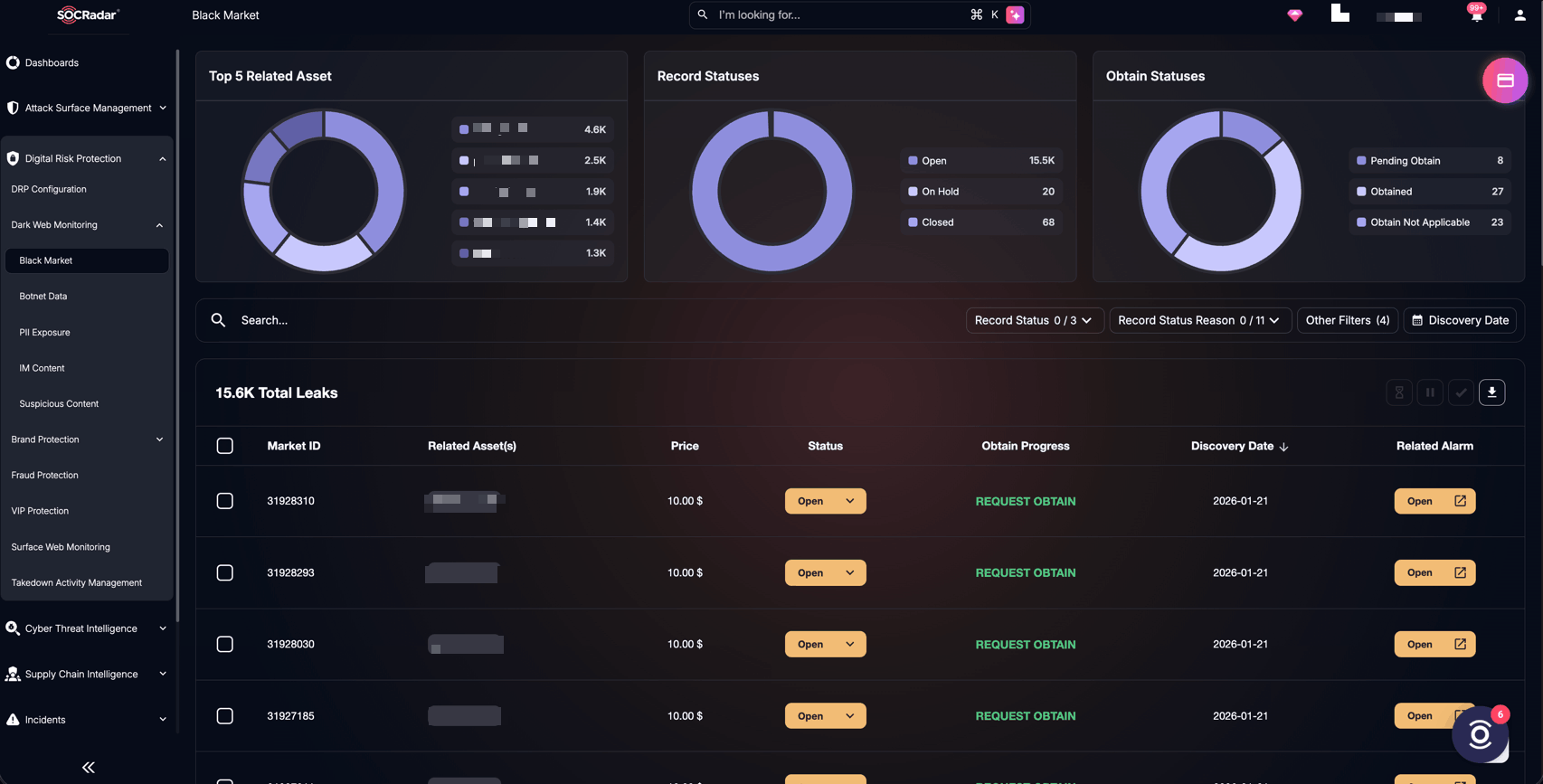
SOCRadar’s DRP Black Market module
What Are the MITRE ATT&CK TTPs of APT41?

Table Of Content
Related Articles


Dark Web Profile: Blue Locker Ransomware
Sep 25, 2026
ShinyHunters Claims Access to FBI Systems
Sep 24, 2026

Clop Hack: ShinyHunters Hijacks Data Leak Site
Sep 21, 2026