Optimizely Attack Hits Zoom, BBC, CNN With Skimmer, iOS Kits
An Optimizely supply chain attack on November 16, 2026, turned a trusted experimentation script into a malware delivery channel for some of the world’s best-known websites. For nearly 19 hours, visitors to sites such as Zoom, BBC, CNN, IKEA, HSBC and Equifax loaded code that swapped cryptocurrency addresses, skimmed payment cards and pushed iOS exploit kits to iPhone and iPad users.
Scott Helme of Report URI reported finding 188 infected snippets belonging to 178 organizations. Optimizely confirmed in a status notice that an unauthorized party exploited a vulnerability in its Experimentation product to add malicious JavaScript to some customer projects.
How Did a Legitimate Optimizely Snippet Start Serving Malware?
Sites that use Optimizely Web load a per-customer JavaScript snippet from cdn.optimizely.com to run A/B tests and personalization. Inside each snippet sits an optional Project JavaScript setting, where customers can add their own code to execute site-wide.
The attacker planted a small loader in that setting across many unrelated customer projects. Nothing else in the snippets changed, so browsers kept receiving what looked like a normal Optimizely file from the usual CDN host, under Optimizely’s own TLS certificate. The researchers rule out CDN cache poisoning; the CDN simply delivered tampered project data.
Self-hosting offered no protection. Some customers, including Scheels and Vodafone Australia, serve the snippet from their own domains, and those copies were infected too because they are built from the same project data.
Three loader variants turned up:
- Plain script tag: a standard script element that fetches hxxps://1688360[.]cc/track.js, found in most infected snippets
- Base64-encoded URL: the C2 address encoded in Base64 and decoded at runtime with atob(), which defeats simple keyword searches; this variant showed up in Smartsheet’s snippet after an earlier cleanup, a sign the attacker still had write access at that point
- Inline fallback: the complete payload embedded directly in the snippet and executed with eval, so the attack still works when the C2 domain is blocked
Inside track.js: Address Swapping, Card Theft and Screenshots
All visitors got one shared payload, track.js, and the operator rebuilt it 26 times over the day to add features and new wallets. Its components ran side by side:
- Cryptocurrency clipper: detects wallet addresses for Bitcoin, Ethereum and other EVM chains, TRON, Solana, TON, Litecoin, Bitcoin Cash and Dogecoin, confirms each one is valid, and substitutes an attacker-controlled address wherever it appears, including copied text and outbound requests
- Card skimmer: added at 13:43 UTC, it inspects submitted forms and outgoing POST requests; once it collects a card number that passes the Luhn check along with an expiry date and CVV, it beacons the set to the attacker’s card.php endpoint
- Context theft: address swaps that happen near payment or wallet wording trigger an upload of the page URL, readable (non-HttpOnly) cookies, the original addresses and an html2canvas screenshot to hit.php on the same server
- iOS redirection: on iPhones and iPads, a router script checks the iOS version and loads a matching exploit chain in a hidden iframe
Checkouts that rely on a payment provider’s hosted iframe kept card numbers out of the skimmer’s view. Card fields built directly into a site’s own pages had no such shield.
On-chain records show the attacker’s wallets received about $7,150 in total: roughly $5,489 in Bitcoin, $760 in Litecoin, $719 on TRON, $101 in Ether and $82 in USDT on BNB Smart Chain. Part of the money was swept to exchange deposit addresses between 13:03 and 13:05 UTC on November 16, and the attacker emptied the wallets between 04:11 and 05:39 UTC on November 17. One of those transfers went to a TRON address the actor also used to cash out operations in March 2026 and on November 3, 2026, which the researchers say ties this campaign to other attacks in their threat intelligence data.
These figures cover cryptocurrency only. How many card numbers, cookies and screenshots reached the command-and-control (C2) server, and how many iOS devices were compromised before the attack stopped, cannot be seen from the outside, so the full impact is unknown.
Exploit Kits Aimed at Older iPhones
The iOS stage pulled a router script, boot.js, from two attacker domains. Devices on iOS 13 through 17 were routed to the Coruna kit, iOS 18 devices to DarkSword, and iOS 26 devices to a separate chain that, for now, only fingerprints the device. Both Coruna and DarkSword had been documented in earlier campaigns, and this Coruna loader is a byte-for-byte match for a sample the same researchers analyzed in October from an unrelated operation.
Code comments in the kit treat iOS 18.7.3 and later, and iOS 26.3 and later, as patched. Devices on iOS 18.6 or earlier gave a visible sign: infected pages refreshed once a minute while the kit retried the exploit.
The evidence so far confirms delivery of these exploit pages, not successful iPhone compromise. No public report has yet confirmed a device infected through this campaign.
From First Injection to Takedown
The published timeline, assembled from scan captures, certificate records and HTTP headers, shows how fast the operation moved (all times UTC):
November 17, 2026, 04:11 to 05:39 UTC
Attacker Empties the Wallets
LTC, USDT and BTC were moved out to new addresses; the USDT went to a TRON address the actor also used to cash out operations in March 2026 and on November 3, 2026.
November 17, 2026, 03:37 UTC
webshell[.]lol Suspended
The earlier-wave injector domain was placed on clientHold.
November 17, 2026, 00:37 UTC
Main C2 Domain Suspended
1688360[.]cc, the payload and data collection server, was placed on clientHold and stopped resolving.
November 16, 2026, 23:11 UTC
All Infected Files Cleaned
Every infected Optimizely file was clean, and the files have stayed clean since.
November 16, 2026, 21:52 UTC
One Snippet Still Infected
Only TalkTalk’s Optimizely snippet still carried the malicious code.
November 16, 2026, 20:40 to 21:10 UTC
Mass Cleanup Across Affected Projects
Injected code was removed from most projects, including Ledger at 20:41, Smartsheet at 20:56 and the BBC at 21:07.
November 16, 2026, 19:24 to 19:59 UTC
Researcher Sweep Finds 186 Infected Snippets
A scan of 1,611 Optimizely snippets found the malicious code in 186 of them.
November 16, 2026, 17:13 to 17:57 UTC
Second iOS Routing Host Added to the Chain
A second iOS router joined the chain, and visits from iOS 18.6 or earlier began receiving the Coruna exploit iframe.
November 16, 2026, 13:43 UTC
Card Skimmer Added to track.js
The payload started capturing card numbers, expiry dates and CVVs from form submissions and POST requests.
November 16, 2026, 13:03 UTC
Stolen Cryptocurrency Swept to Exchanges
Funds collected through address swapping were moved to exchange deposit addresses between 13:03 and 13:05 UTC.
November 16, 2026, 08:28 UTC
track.js First Observed on bbc.com
The cryptocurrency clipper payload, first built at 08:10 UTC, appeared on the BBC’s website.
November 16, 2026, 05:23 UTC
1688360[.]cc Registered
The C2 domain was registered after TLS certificates were issued for it starting at 04:28 UTC.
November 16, 2026, 04:21 UTC
First Optimizely Injection Seen
The BBC’s Optimizely snippet began loading the actor’s earlier injector from webshell[.]lol.
The same operator was active before the Optimizely wave. Between November 13 and 16, the webshell[.]lol injector appeared in scripts from other third-party providers, including Kissmetrics, StorifyMe and Minute Media. Its first known appearance dates to September 17, when it surfaced on Turkish websites through an SEO backlink panel script.
Which Organizations Loaded the Malicious Code?
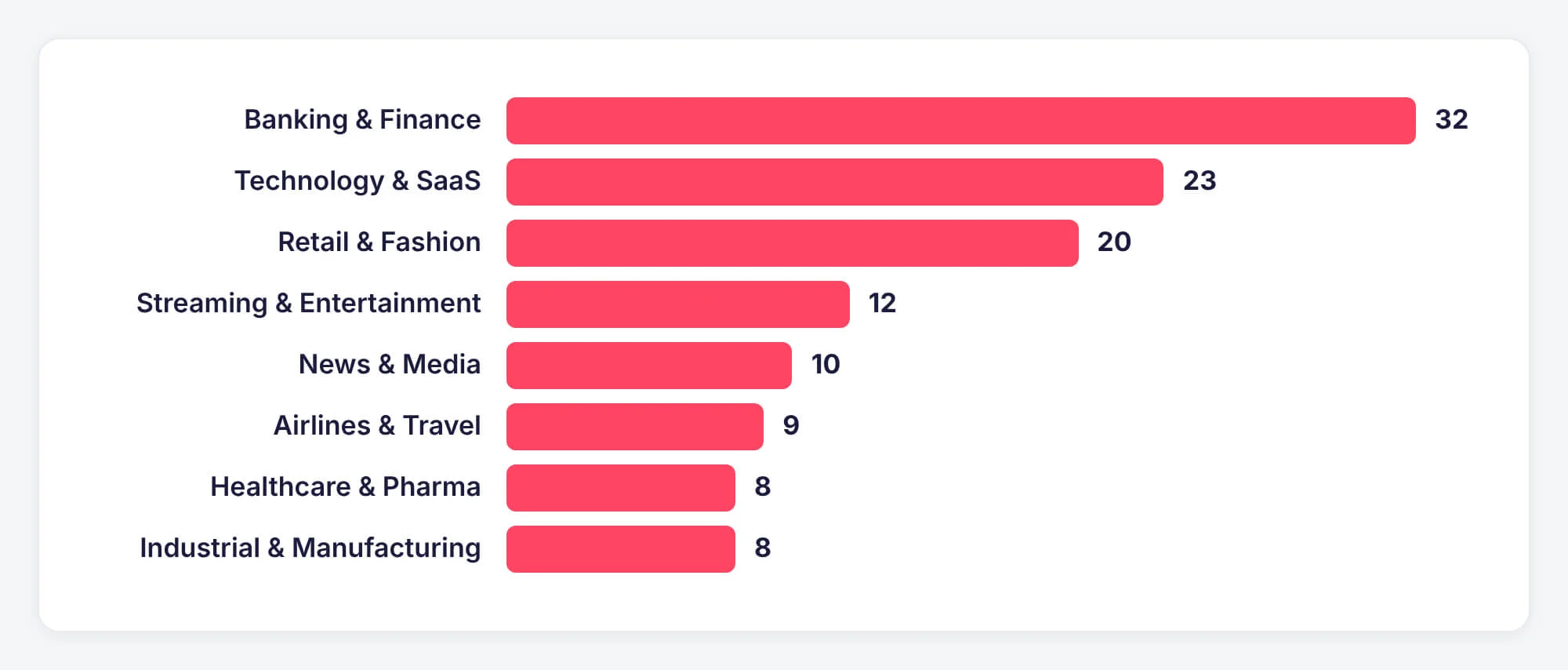
Using crawl data, the researchers located 1,611 distinct Optimizely snippets and scanned each one for the injected code. They found 188 infected snippets belonging to 178 organizations and expect the true total to be higher, since the review covered only the snippets they could find in time.
Named organizations include Zoom, BBC, CNN, Salesforce, GitLab, IKEA, HSBC, Equifax, Air France-KLM, Ledger, Peacock and Smartsheet, and Optimizely’s own main website and login portal also served the code. Banking and finance accounts for the largest share with 32 organizations, followed by technology and SaaS (23) and retail and fashion (20). A full list of affected organizations and domains, grouped by sector, is available in Report URI’s write-up.
Inclusion on this list means a site’s snippet carried the malicious code during the window. It does not confirm that any specific organization’s customers lost data or funds, and none of the named companies had published a statement as of November 17, 2026.
What Optimizely Has Confirmed So Far
Optimizely’s notice, posted at 01:02 UTC on November 17, says the company has fixed the vulnerability, removed the injected code from affected projects, secured affected user accounts and added protections against unauthorized code delivery. The incident is listed under Web Experimentation (Snippet Delivery) with a “Monitoring” status.
Several questions remain open. The notice does not describe the vulnerability, say how many projects were modified or when the flaw was introduced, or give customers any guidance. The write-up raised possible routes to write access, such as a compromised Optimizely system or a credential with cross-customer reach; Optimizely’s description of an exploited vulnerability is now the only confirmed account.
The notice arrived about two hours after the research went public; at that point, the researchers said their outreach to Optimizely through several channels had not drawn a response.
Why Content Security Policy Settings Decided the Outcome
Every infected site trusted Optimizely’s domain, so the outcome depended on what each site let that trusted script do next. The researchers tested the Content Security Policy (CSP) on 256 hosts belonging to affected organizations against what the payload needed: loading track.js, running the inline fallback, sending data to the C2 and loading the iOS kit. Only 24 organizations, about 15%, blocked the payload, while 68 had no CSP at all.
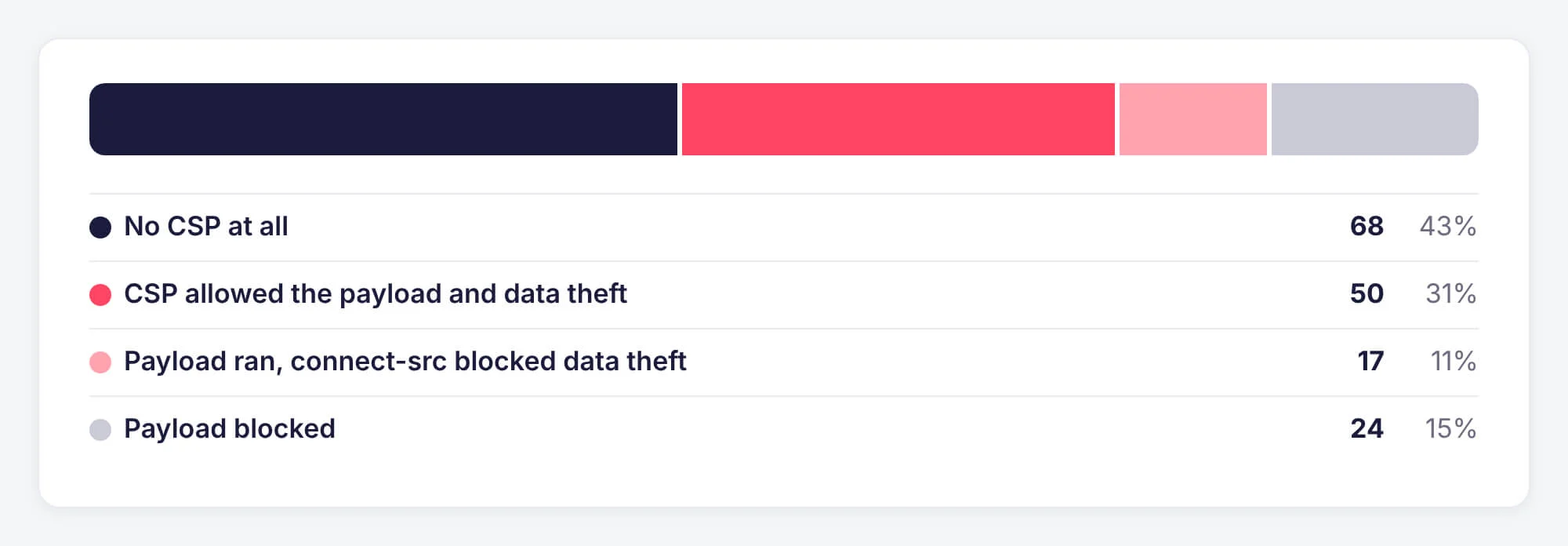
Allowlisting cdn.optimizely.com did nothing here, because the loader arrived from that host. The sites that held were the ones with a tight script-src listing only the hosts they need. Two common settings undid that protection: ‘strict-dynamic’, which extends trust to any script the Optimizely snippet injects, and ‘unsafe-eval’, which let the inline fallback run even where track.js was blocked. The analysis also notes that Optimizely’s documentation tells customers to allow ‘unsafe-eval’, and that HSBC’s policy stopped track.js and the data theft while the embedded copy still executed.
On 17 sites, a restrictive connect-src stopped card, cookie and screenshot exfiltration, yet address swapping continued because it happens inside the page.
Indicators to Block and Hunt For
Researchers list the indicators below. All listed domains are attacker-controlled and should be blocked along with their subdomains. As of November 17, 2026, 1688360[.]cc and webshell[.]lol are on clientHold, eil786npto9u5bq[.]icu no longer resolves to an IP address, and 5vobauua3ojpklx[.]icu still resolves but no longer responds; the indicators remain useful for searching logs from November 13 to 17.
Attacker Domains
- 1688360[.]cc (C2 serving track.js, card.php, hit.php and html2canvas.min.js)
- 5vobauua3ojpklx[.]icu (iOS router serving boot.js)
- eil786npto9u5bq[.]icu (iOS router hosting the Coruna and iOS 26 pages)
- l7bcsnwc7nzr3uo[.]icu (Coruna telemetry, POST /api/iptj)
- webshell[.]lol (injector get.js, used in the earlier wave)
- linkforge[.]cc (SEO panel script that carried the injector)
Fallback C2 Domains Hard-Coded in boot.js
- je4ft3gn8vxudum[.]icu
- q1ls1ho9x7wsxlu[.]icu
- ios-hack[.]icu
Domains Sharing Certificates and IP Addresses With the Exploit Kit
- p55abnw2pnsz0bo[.]icu
- 1y69gy2mdzaltz1[.]icu
- gm38duxoihbmy5o[.]icu
IP Addresses
- 136.113.106[.]136 (hosts 1688360[.]cc)
- 34.96.213[.]201 (hosts 5vobauua3ojpklx[.]icu)
- 34.87.36[.]58 (hosts eil786npto9u5bq[.]icu)
SHA-256 Hashes of track.js
- 814a963c0da480e2449d9b6664480156e1cd6d731014117401bf635badec3a0f (17:13 UTC build)
- f7b84b9a94f749f8ced3f0112d0a66894e8bbc3b4aa5592021d1b8976a9bad40 (17:57 UTC build, latest)
Script and Telemetry Markers
- window._k7 (global variable set by the payload)
- window.__k7b (global variable set by the payload)
- data-channel-code=”02111110″ (attribute on the iOS loader script tag)
- BIGNIAO (Coruna telemetry channel code)
Attacker Wallets Used for Address Swapping
- 19g9rZcPeiz8rUvyWpTRyXXhPnjsWrc3kW (BTC)
- 0xC4026b06D82b0F0B363eda0642D61CfbDc17884e (ETH/EVM)
- THvs6p56XkUiMkJeSc51cAP64u2RsTYqxa (TRON)
- FVtL8NMYS9PA1v3HE67XUGCtGA9JaZUvqav2fU2LrV5n (SOL)
- UQAgM1VqSZQiJLSG5w-ovurq5CZdxLEK3_7CMmwALTA5e09p (TON)
- ltc1q3wp7g6ds0ggg6fl6kncpa4sepn0q3qfacgred5 (LTC)
- qzkaaf8n6grmpr0d9lx8xutn3r9lk722f566hhpe58 (BCH)
- DBEGrxRF7KMSuhTS4c1MFviStU6efdMnu5 (DOGE)
Cash-Out Addresses Used on November 17
- ltc1qpxvjs8u8awg8pvpwmssqlj3gzugd9vtwjtc5fc (LTC)
- TMLQvDvpgSyx94maptc3TxvmCVtT5qHVup (TRON, USDT; also used in March 2026 and November 3, 2026 cash-outs)
- bc1q5fljq9c4g7gsjgg4etpn6k3lyusahcvjfv0u99 (BTC)
A clean result today does not prove a site was never affected, because Optimizely has already removed the injected code.
Response Steps for Optimizely Customers and Site Visitors
Organizations running Optimizely Web should work through these steps:
- Review Project JavaScript and experiment code: inspect the Project JavaScript of every project and the custom code of every experiment for the indicators above, atob() calls or any script your team did not add; Optimizely’s change history shows whether edits came through the API or the web interface
- Ask Optimizely directly: request confirmation of whether your project IDs were modified and when
- Rotate access: review Optimizely users, API tokens and integrations, and rotate credentials
- Treat exposed data as compromised: card data entered into first-party forms on November 16 and any secrets in non-HttpOnly cookies should be handled as exposed, with customer notification considered
- Tighten CSP: start in report-only mode, restrict script-src and connect-src, enable reporting, and drop ‘strict-dynamic’ and ‘unsafe-eval’ wherever the application allows
- Keep third-party tags off payment pages: limit which external scripts can run where card data is entered
Anyone who visited an affected site on November 16 should move iPhones and iPads to iOS 18.7.3 or later, or iOS 26.3 or later, double-check that any cryptocurrency payment made that day went to the intended address, and review card statements for purchases on those sites.
How Can SOCRadar Help?
This attack reached 178 organizations without touching their own infrastructure. The weak point sat with a vendor whose script every site had approved, which is exactly where internal monitoring tends to have no view.
SOCRadar’s Supply Chain Intelligence tracks security incidents, breach reports and exposure signals tied to the vendors in your technology stack, so a compromise at a provider such as Optimizely reaches your team as an alert rather than a headline. Autonomous Exposure Management helps map which of your web properties load third-party tags, giving responders a starting list when a provider is hit.
Frequently Asked Questions
Was This a Breach of the Affected Websites?
The affected organizations’ own servers and code were not breached, based on current evidence. Their Optimizely projects were altered through a vulnerability on Optimizely’s side, and the injected code then ran in visitors’ browsers.
Is the Malicious Code Still Being Served?
Researchers observed that every infected Optimizely file was clean by 23:11 UTC on November 16, and the files have stayed clean since. The main payload server, 1688360[.]cc, was suspended at 00:37 UTC on November 17 and no longer resolves. As of November 17, 2026, Optimizely lists the incident in “Monitoring” status.
Were iPhones Actually Compromised?
Researchers confirmed that exploit pages were delivered to older iOS versions. No successful device compromise from this campaign has been publicly confirmed.