

Sep 18, 2026
Table Of Content
F5 Breach and Urgent BIG-IP Fixes: What You Need to Know
When was the F5 breach detected and disclosed?
What was stolen in the F5 breach – and what was not?
Are other F5 products or ecosystems affected?
What did F5 release on patch day?
What is CISA requiring U.S. federal agencies to do about the F5 breach?
What immediate actions should enterprises take (beyond federal mandates)?
What if my management interface is exposed to the internet?
Is there evidence of active exploitation using the stolen data?
How is F5 hardening its own environment?
What about certificate or supply‑chain changes?
What are other governments and industry watchers saying?
What’s the bottom line for risk owners?
Here’s a Quick Action Checklist
Related Articles

CVE-2026-91843: Check Point Root RCE
CVE-2026-76460: Cisco ISE Flaw Actively Exploited
Sep 17, 2026

CVE-2026-76461: Cisco Email Gateway Flaw Exploited
Sep 16, 2026

CVE-2026-27540 WooCommerce Flaw Exploited
Sep 16, 2026

GitLab CVE-2026-85706 Added to CISA KEV
Sep 14, 2026

Oct 16, 2025
7 Mins Read

Summarize with:
F5 Breach and Urgent BIG-IP Fixes: What You Need to Know
On October 15, 2025, F5 disclosed details of a security incident that it first detected in August. According to the company, an intruder accessed the BIG‑IP development environment and internal engineering knowledge platforms and exfiltrated files, including some source code and vulnerability information. In parallel, F5 released a sweeping set of patches and hardening guidance, while government agencies issued urgent directives.
This blog breaks down the recent F5 breach and answers the most important questions teams are asking right now.

What happened?
F5 states that a “highly sophisticated nation-state threat actor” maintained persistent access to specific internal systems and exfiltrated files. Impacted environments include the BIG‑IP product development environment and engineering knowledge platforms. F5 says its containment actions have been successful and it has not observed new unauthorized activity since response began.
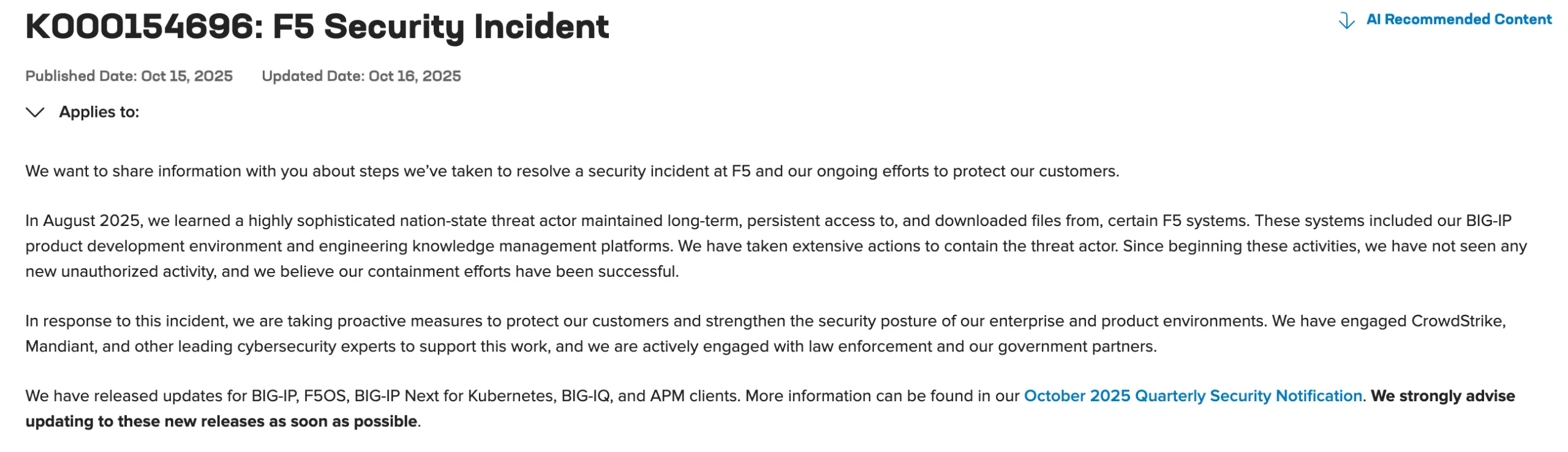
Part of the F5 breach notice
When was the F5 breach detected and disclosed?
F5 detected the intrusion on August 9, 2025, and publicly disclosed the incident on October 15, 2025, with additional detail published on October 16, 2025. The disclosure coincided with the October quarterly security notification and the release of product updates.
What was stolen in the F5 breach – and what was not?
According to F5, the attacker exfiltrated some BIG‑IP source code and internal documentation about undisclosed vulnerabilities. For a small subset of customers, certain configuration or implementation details were included in the stolen files. F5 reports no evidence of access to CRM, finance, support case, or iHealth systems. It also reports no evidence of modification to the software supply chain, including source code integrity and build/release pipelines.
Are other F5 products or ecosystems affected?
F5 says there is no evidence that NGINX source code or its development environment were accessed or modified, and no evidence of access to F5 Distributed Cloud Services or Silverline systems. Independent reviews by NCC Group and IOActive validated that the software supply chain was not altered.
What did F5 release on patch day?
F5’s October 2025 updates aggregate fixes across multiple product lines, addressing 44 vulnerabilities, including those linked to the stolen vulnerability information (see F5 Advisory K000156572).
Notable examples include:
- CVE‑2025‑53868 (CVSS 8.7) – A BIG‑IP SCP/SFTP vulnerability affecting versions 15.x to 17.x that could allow unauthorized access; fixed in 17.5.1 and corresponding patches for earlier branches.
- CVE‑2025‑61955 (CVSS 8.8) and CVE‑2025‑57780 (CVSS 8.8) – F5OS privilege escalation flaws in both appliance and standard modes, remediated in versions 1.8.3 (A) and 1.8.2 (C).
- CVE‑2025‑60016 (CVSS 8.7) – A BIG‑IP SSL/TLS vulnerability allowing potential exposure of encrypted traffic metadata, fixed in 17.1.2 and later.
- CVE‑2025‑48008 (CVSS 8.7) – A BIG‑IP MPTCP flaw leading to possible denial of service, patched in 17.1.2.2, 16.1.6, and 15.1.10.8.
- CVE‑2025‑61974 (CVSS 8.7) – A BIG‑IP SSL/TLS issue across multiple product families, resolved in 17.5.1.3 and equivalent updates.
The company strongly advises customers to update immediately, even though it says it is not aware of undisclosed critical or Remote Code Execution (RCE) bugs being actively exploited.
Updates are available for BIG‑IP, F5OS, BIG‑IP Next for Kubernetes, BIG‑IQ, and APM clients.
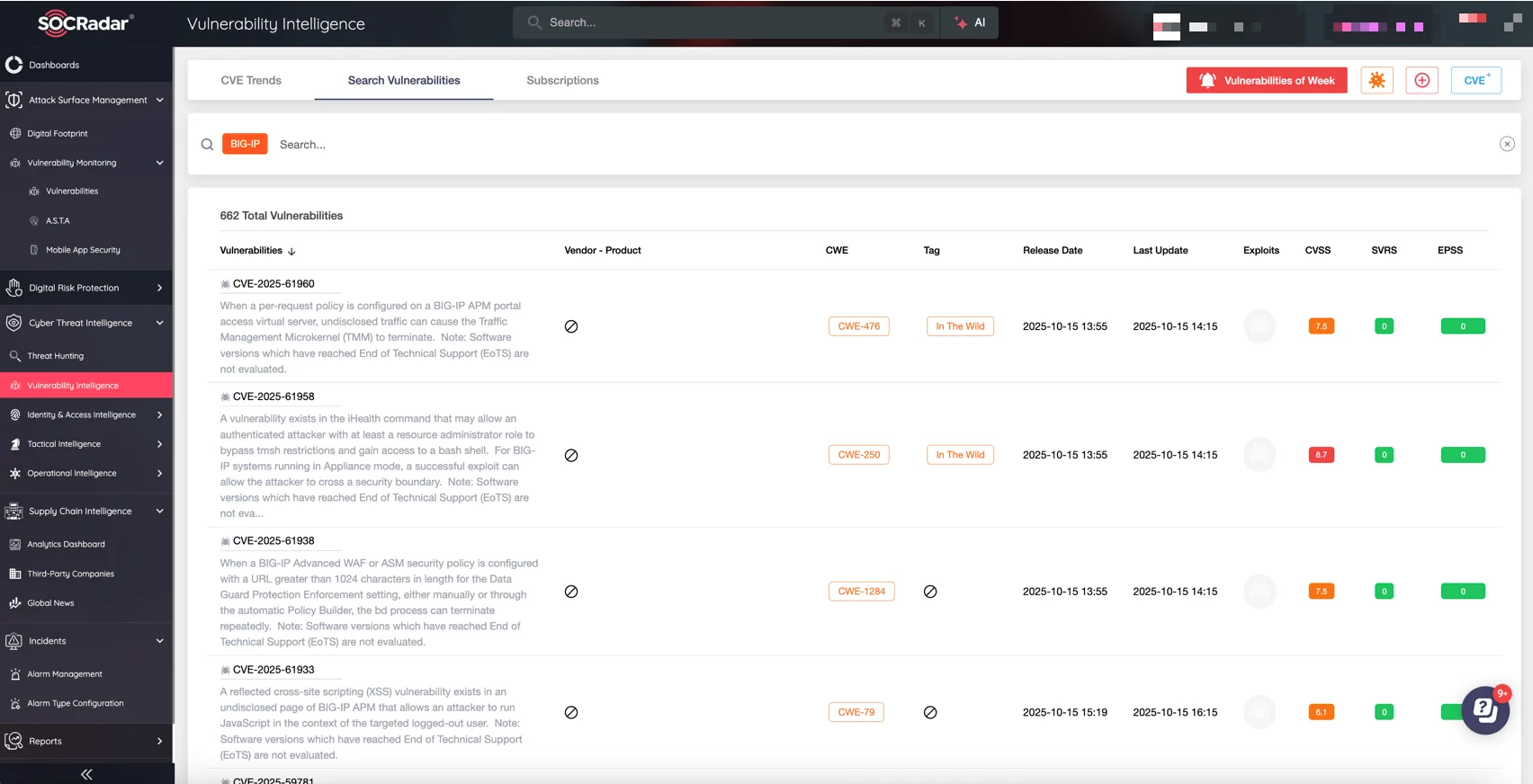
Track CVE & hacker trends, access timely vulnerability updates (SOCRadar’s Vulnerability Intelligence)
With SOCRadar’s Cyber Threat Intelligence (CTI) module, you can easily track the latest vulnerabilities tied to your vendors, products, and technologies – all in one dashboard. Stay informed about new exploits, emerging threats, and patch advisories as soon as they surface, helping your team respond faster and defend smarter.
What is CISA requiring U.S. federal agencies to do about the F5 breach?
CISA’s ED 26‑01 mandates that agencies:
- Inventory all F5 BIG‑IP hardware and software instances.
- Harden public‑facing devices by removing or strictly controlling management interface exposure per Binding Operational Directive 23‑02.
- Patch core products by October 22, 2025 and other appliances by October 31, 2025, and apply all subsequent vendor updates within one week of release.
- Disconnect and decommission any public‑facing F5 devices that have reached end of support, or report mission‑critical exceptions with decommissioning plans.
- Report inventories and status to CISA on mandated timelines (initial summary by October 29, 2025; detailed inventory by December 3, 2025).
What immediate actions should enterprises take (beyond federal mandates)?
- Patch promptly: Apply the October updates for BIG‑IP, F5OS, BIG‑IQ, BIG‑IP Next for Kubernetes, and APM clients.
- Harden: Follow F5’s published hardening guidance and use automated hardening checks in the iHealth Diagnostic Tool to surface gaps and remediation steps.
- Increase visibility: Stream BIG‑IP events to your SIEM, configure remote syslog, and monitor for admin logins, failed authentication, privilege changes, and configuration updates.
- Threat hunt: Use F5’s threat‑hunting guide and proactively review for anomalous access to development or configuration artifacts tied to your deployments.
What if my management interface is exposed to the internet?
CISA’s directive calls out public‑facing management interfaces as high‑risk. Follow the BOD 23‑02 requirements to scope exposure, place interfaces on management networks only, enforce jump‑box access, and report as required. Even outside the federal sector, treat management plane exposure as a must‑fix item.
Is there evidence of active exploitation using the stolen data?
As of publication, F5, CISA, and the UK NCSC report no active exploitation of the vulnerabilities linked to the breach. However, all warn of increased risk given that vulnerability details and source code were stolen, making rapid mitigation and monitoring essential.
How is F5 hardening its own environment?
F5 describes a broad, ongoing response: rotating credentials; strengthening access controls; enhancing network security; improving inventory and patch automation; and hardening software development platforms.
The company engaged CrowdStrike and Mandiant for forensics, continues independent reviews with NCC Group and IOActive, and plans to extend Falcon EDR sensors and managed threat hunting to BIG‑IP customers.
What about certificate or supply‑chain changes?
F5 has indicated it rotated certain signing certificates and keys for product images. Organizations enforcing image signature verification should review vendor notes for any installation impacts (e.g., TMOS ISO signature verification and F5OS tenant image signatures) and validate checksums from the download portal.
What are other governments and industry watchers saying?
In addition to the U.S. CISA, the UK NCSC, CERT‑EU, Canada’s CCCS, and Australia’s ACSC have issued alerts urging rapid patching, asset discovery, and management‑interface hardening. These advisories mirror CISA’s warning that access to proprietary code elevates exploitation risk and call for coordinated, immediate defense actions across sectors.
What’s the bottom line for risk owners?
Independent reviews reduce the likelihood of a classic supply‑chain compromise, but the theft of vulnerability intel and source code materially raises near‑term exploitation risk for BIG‑IP fleets. Treat the October updates as critical, remove any public management exposure, and increase telemetry on authentication and configuration events. If you are among the small subset of customers whose configuration details may be in the exfiltrated files, expect direct outreach from F5.
Here’s a Quick Action Checklist
- Inventory every F5 asset (physical, virtual, and cloud‑native), including where they are hosted.
- Patch now using the October 2025 releases as your master reference.
- Harden the management plane; require jump‑box or VPN‑only access and strong MFA.
- Stream logs to SIEM and enable targeted alerts for authentication, privilege, and configuration events.
- Run iHealth checks and remediate findings.
- Schedule continuous updates within one week of vendor releases.
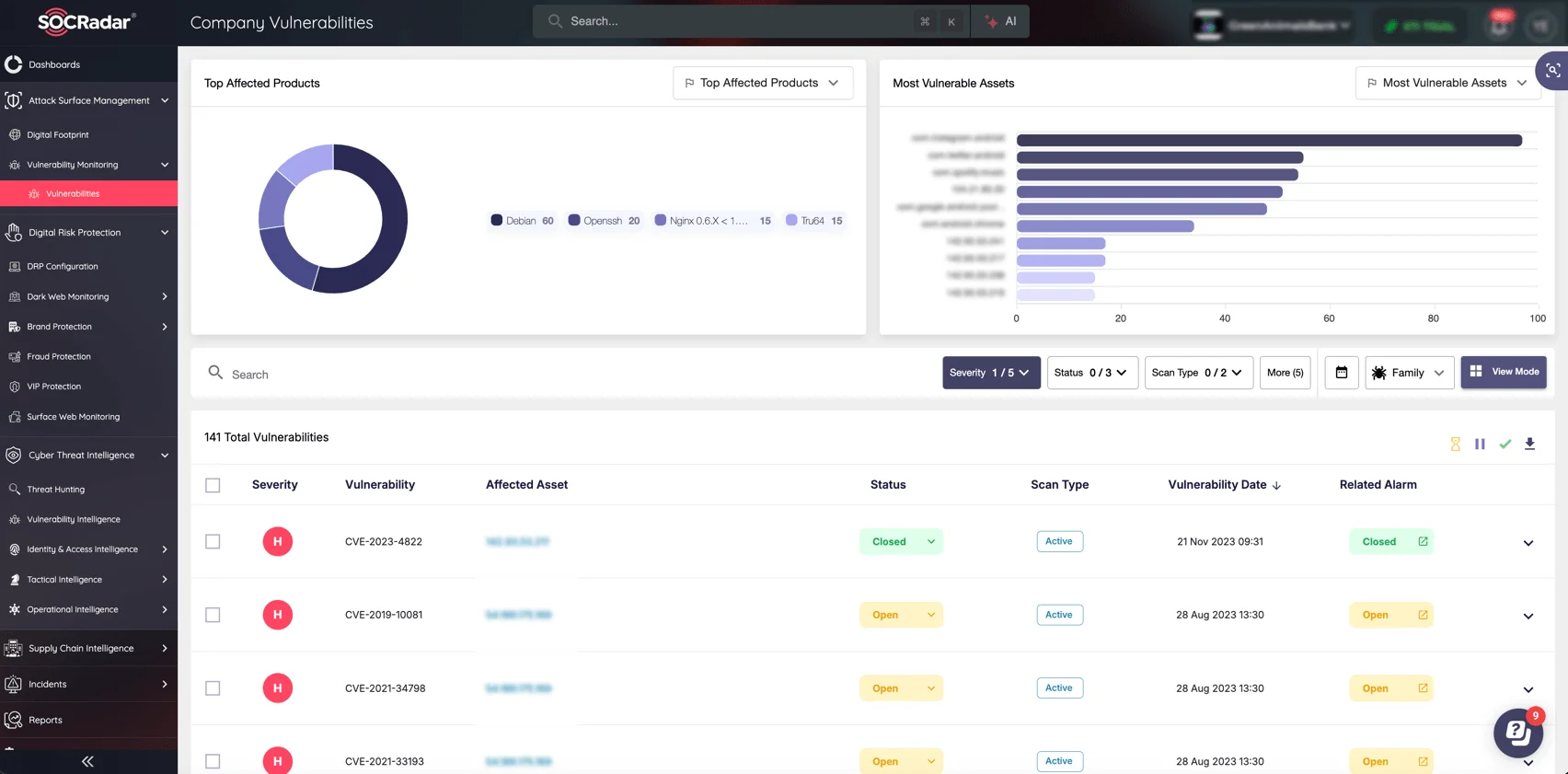
SOCRadar’s Attack Surface Management (ASM) module, Company Vulnerabilities
Complement these actions with SOCRadar’s Attack Surface Management (ASM) module to continuously monitor exposed assets, detect new vulnerabilities, and receive early alerts when your organization or vendors appear in threat actor chatter or exploit discussions.