
What Is Black Box AI?
Black box AI describes an artificial-intelligence system whose internal reasoning cannot be fully inspected or reliably explained, even when its inputs and outputs are visible.
Large neural networks distribute learned behavior across many parameters, making a decision difficult to reconstruct like conventional code. The practical goal is not perfect transparency, but defensible governance through provenance, testing, monitoring, output validation, and controlled deployment.
Key Takeaways
- Black box AI describes an artificial-intelligence system whose internal reasoning cannot be fully inspected or reliably explained, even when its inputs and outputs are visible.
- Large neural networks distribute learned behavior across many parameters, making a decision difficult to reconstruct like conventional code. The practical goal is not perfect transparency, but defensible governance through provenance, testing, monitoring, output validation, and controlled deployment.
- Hidden failure modes and bias is a primary concern.
- Effective programs combine prevention, continuous visibility, accountable ownership, and tested response.
How It Works
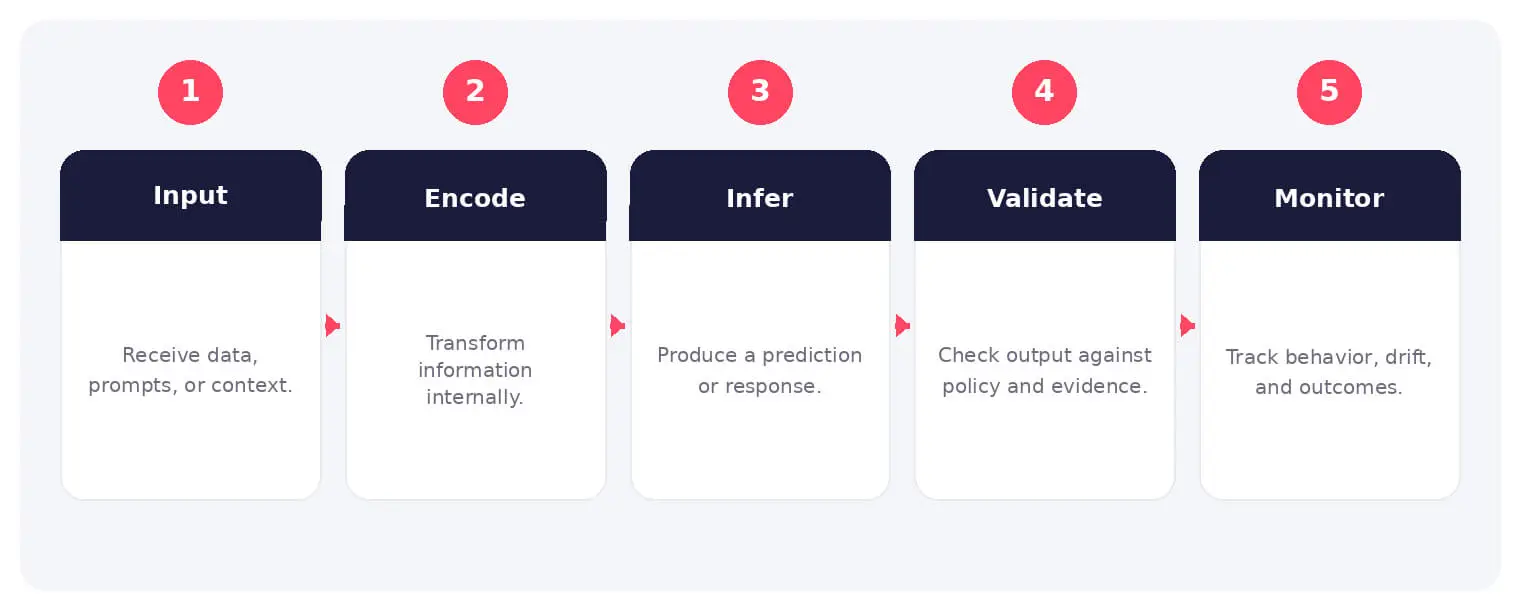
The operating flow above turns the concept into observable steps. Exact implementations vary, but each stage needs accountable ownership, trusted inputs, documented policy, and evidence that analysts can use during investigation and review.
Large neural networks distribute learned behavior across many parameters, making a decision difficult to reconstruct like conventional code. The practical goal is not perfect transparency, but defensible governance through provenance, testing, monitoring, output validation, and controlled deployment.
Common Types and Capabilities
- Deep neural networks
- Large language and multimodal models
- Autonomous and agentic systems
- Opaque third-party AI services
Security and Business Risks
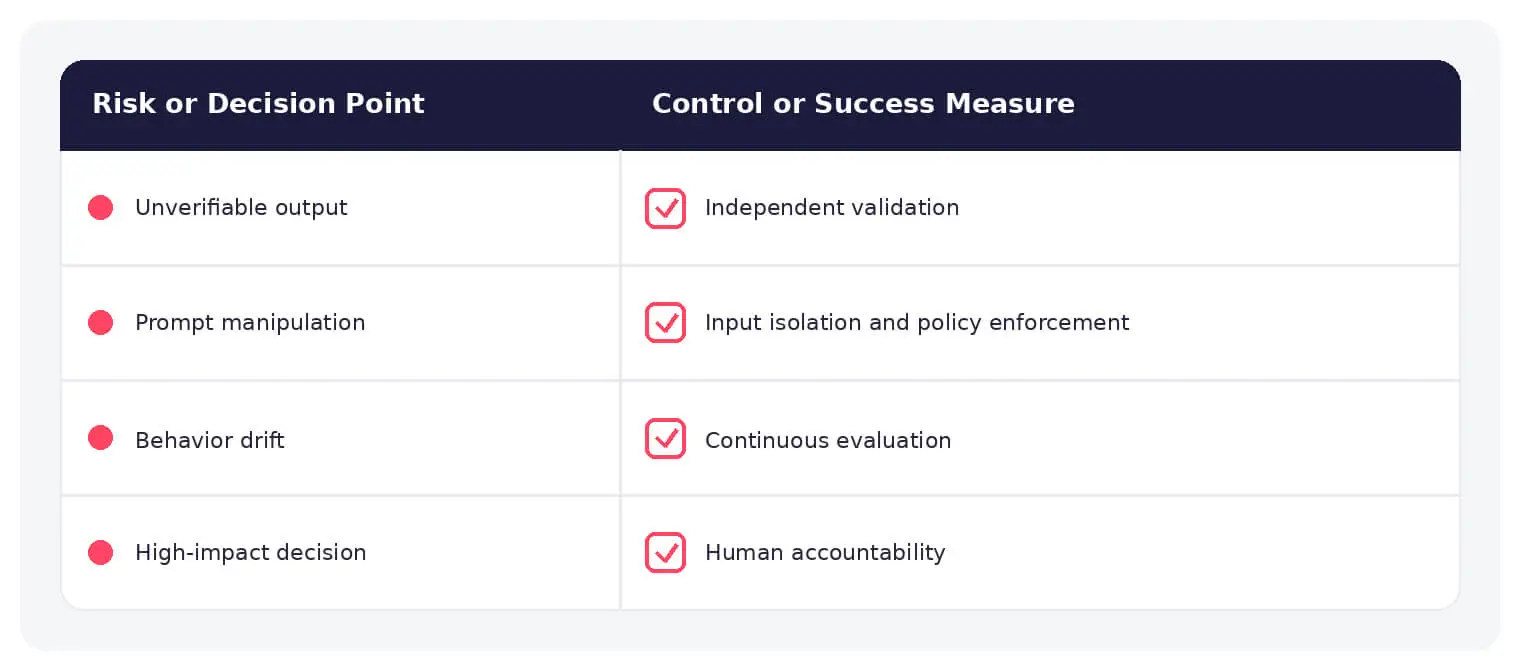
- Hidden failure modes and bias
- Prompt injection and adversarial inputs
- Data poisoning and model drift
- Weak accountability for consequential decisions
Warning Signs and Detection
Watch for unstable responses to small input changes, unexplained confidence, performance drift, policy violations, inconsistent citations, suspicious tool use, unusual data access, repeated reviewer overrides, and outputs that cannot be reproduced.
Best Practices
Document provenance and intended use, restrict data and tools, red-team behavior, maintain evaluation sets, validate outputs, monitor runtime activity, log model and prompt versions, require human review for consequential decisions, and plan rollback.
How SOCRadar Can Help
SOCRadar adds external visibility, threat intelligence, exposure context, and continuous monitoring to help teams validate and prioritize risks related to black box AI. This context complements internal AI, cloud, security operations, and governance controls.
Explore SOCRadar Extended Threat Intelligence or request a demo to strengthen threat-informed prevention and response.
Frequently Asked Questions
What Makes an AI System a Black Box?
An AI system is a black box when its internal reasoning cannot be fully inspected or reliably explained, even though its inputs and outputs are visible. Large neural networks spread learned behavior across millions of parameters, leaving no simple rule set for a reviewer to read. The opacity comes from model complexity, not necessarily from secrecy.
Why Can’t Black Box AI Decisions Be Easily Explained?
Conventional software follows explicit code paths that reviewers can trace line by line, while a neural network encodes patterns as weighted parameters shaped during training. A single output emerges from many interacting weights and activations. Explanation techniques can approximate the factors behind a decision, but they rarely reconstruct the exact internal reasoning.
What Are the Main Security Risks of Black Box AI?
The primary concerns include:
- Hidden failure modes and bias that surface only after deployment
- Prompt injection and adversarial inputs that manipulate behavior in unanticipated ways
- Data poisoning and model drift that silently degrade accuracy over time
- Weak accountability for consequential decisions
Each risk is harder to detect when the model’s logic cannot be directly inspected, which makes layered controls essential.
How Do Adversarial Inputs Exploit Black Box Models?
Because internal decision boundaries are not directly observable, attackers can probe the system with crafted inputs to find small changes that flip its outputs. Prompt injection works similarly for language models, embedding instructions the model will follow even though developers never intended them. Regular red-teaming and maintained evaluation sets help uncover these behaviors before adversaries do.
What Warning Signs Indicate a Black Box Model Is Failing?
Watch for unstable responses to small input changes, unexplained confidence in incorrect answers, performance drift over time, and outputs that cannot be reproduced. Policy violations, inconsistent citations, unusual data access, and repeated reviewer overrides are also operational red flags. Any of these patterns should trigger a deeper investigation.
How Should Teams Respond to an Unexplained AI Output?
Preserve evidence first by logging the model version, prompt, inputs, and configuration that were in effect. Attempt to reproduce the output in a controlled setting and compare it against evaluation sets to determine whether behavior has drifted. Escalate consequential cases to human review, and roll back to a known-good model version if the problem persists.
How Can Organizations Reduce Black Box AI Risks?
Document provenance and intended use, restrict the data and tools the model can reach, and red-team its behavior on a regular schedule. Maintain evaluation sets, validate outputs before they inform decisions, and monitor runtime activity for anomalies. Logging model and prompt versions supports investigation and rollback, while human review protects consequential decisions.
Who Is Accountable for a Black Box AI Decision?
The deploying organization remains accountable even when it cannot fully inspect the model, particularly for decisions that affect customers, employees, or compliance obligations. Vendor contracts should clearly define responsibility for failures, data handling, and incident support. Documented human review of high-impact outputs creates an audit trail that regulators and investigators can follow.
Is Black Box AI Too Opaque to Use Responsibly?
No, opacity raises governance challenges but does not by itself make a system unusable. Many organizations deploy black box models with layered controls such as output validation, runtime monitoring, controlled deployment, and human review for high-impact cases. The realistic goal is defensible governance rather than perfect transparency.
How Does Explainable AI Relate to Black Box AI?
Explainable AI (XAI) refers to techniques that produce human-understandable rationales for model outputs, such as feature attribution or saliency maps. These methods can reduce opacity but rarely eliminate it, especially for very large models. Treat explanations as approximations to verify rather than proof that a decision is correct.

Oct 16, 2026
CVE-2026-102764: BeyondTrust Zero-Day Exploited
BeyondTrust has disclosed CVE-2026-102764, a critical Remote Support vulnerability exploited as a zero-day weeks before customers received a patch. The attack began…

Oct 15, 2026
Cisco Secure Email & PAN-OS Zero-Days Exploited
Cisco Secure Email & PAN-OS Zero-Days Exploited Cisco and Palo Alto Networks have patched two actively exploited zero-day vulnerabilities that can lead…
Oct 15, 2026
SOCRadar Splunk Integration: New MSSP and Vulnerability Apps
SOCRadar Splunk Integration: New MSSP and Vulnerability Apps Your analysts live in Splunk. Your external risk does not: SOCRadar alarms for dozens…
Intelligence in your inbox every Thursday.
Join 30,000+ security professionals reading SOCRadar research.
Subscribe