
What Is Carding Fraud?
Carding fraud is the unauthorized testing and use of stolen payment-card information. Criminals validate cards through low-value transactions, automated checkout attempts, or account additions, then use working records for purchases, resale, gift cards, digital goods, or other cash-out methods.
Card data may come from breaches, e-skimming, phishing, infostealers, insiders, or criminal marketplaces. Fraud prevention must protect both customer accounts and guest checkout because valid card details can be abused without taking over an existing account.
Key Takeaways
- Automated card testing and validation is one important form or technique.
- Detection depends on correlated technical and operational context.
- Prevention should reduce both initial access and post-compromise impact.
- Response must preserve evidence and remove every reusable access path.
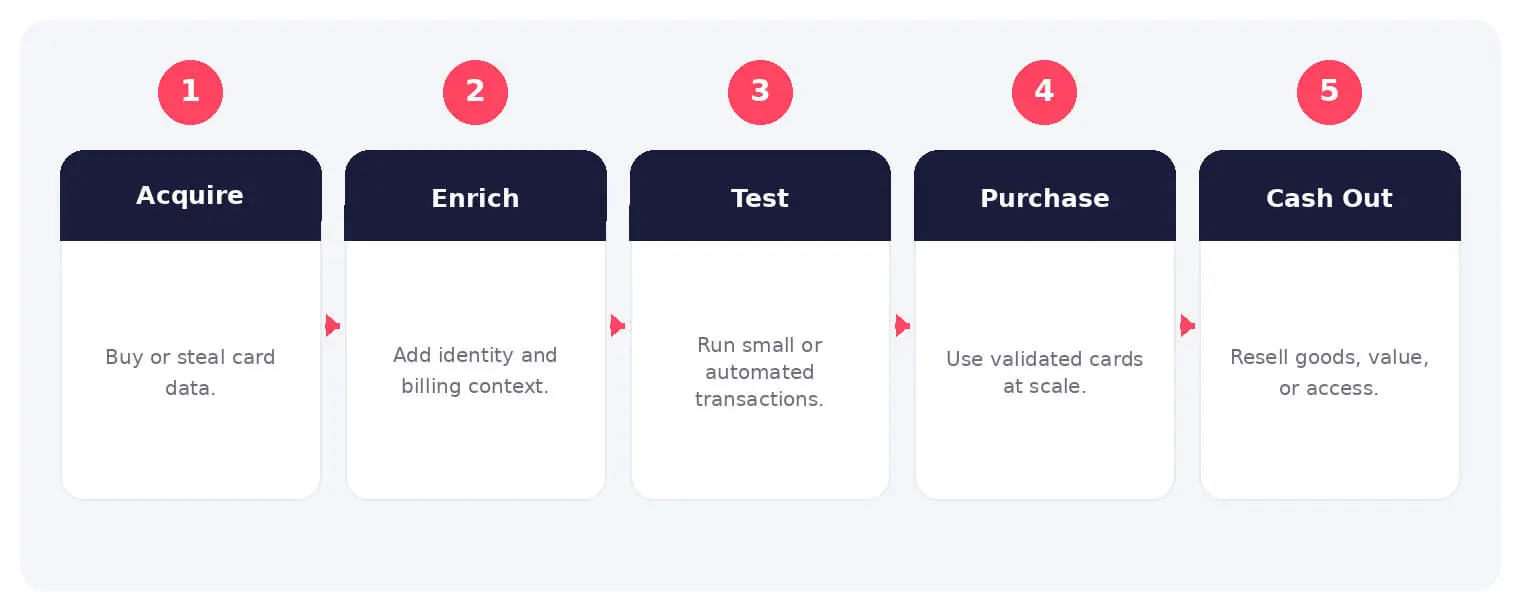
How Carding Fraud Works
The sequence shown above is not mandatory in every case, but it provides a practical way to connect initial opportunity with the actor’s objective. Individual steps may occur in parallel, repeat, or be completed by different participants.
Card data may come from breaches, e-skimming, phishing, infostealers, insiders, or criminal marketplaces. Fraud prevention must protect both customer accounts and guest checkout because valid card details can be abused without taking over an existing account.
Common Types and Techniques
- Automated card testing and validation
- Card-not-present purchase fraud
- Account takeover with stored payment methods
- Gift-card, digital-goods, and reshipping schemes
Security and Business Risks
- Chargebacks, fees, and lost inventory
- Customer harm and support cost
- Payment-provider restrictions and higher friction
- Links to broader identity and account fraud
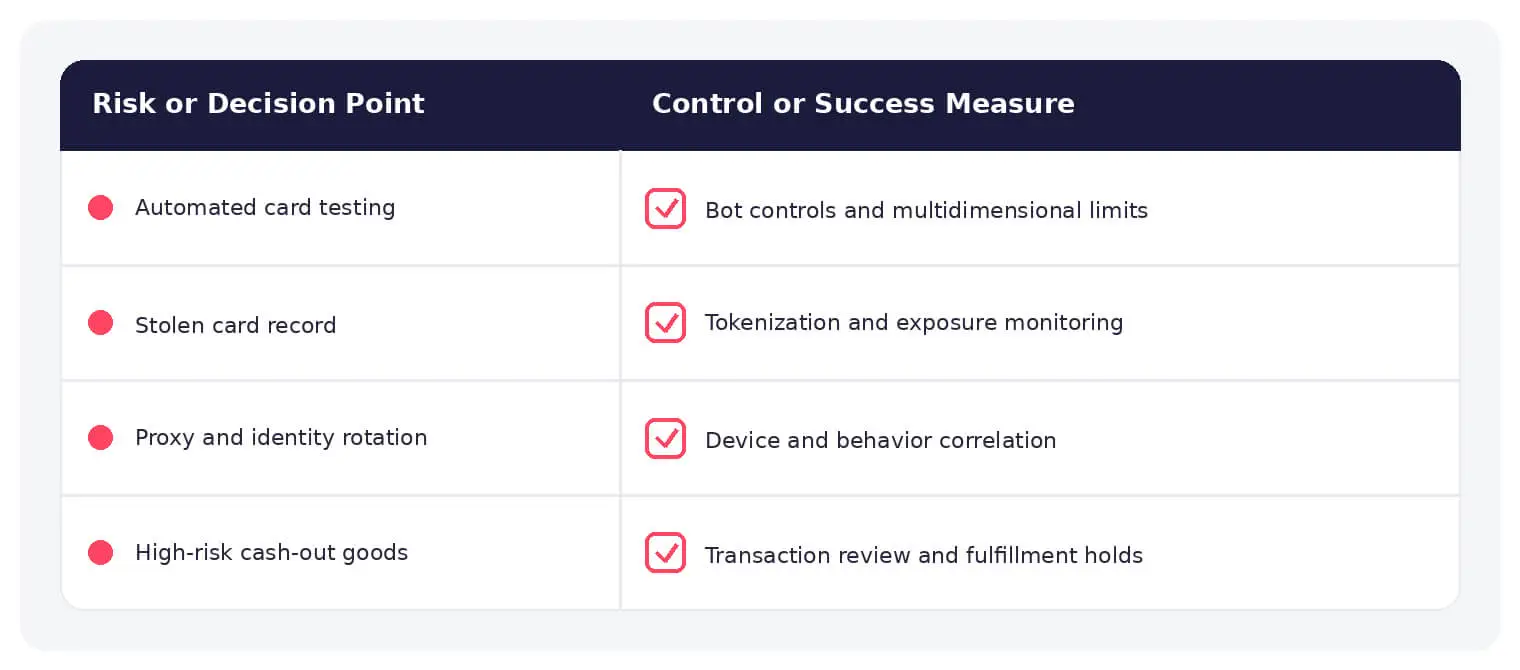
Warning Signs and Detection
Detect rapid low-value attempts, many cards from one device, one card across many identities, repeated authorization failures, mismatched geography, proxy rotation, unusual cart composition, and rapid gift-card or digital-goods purchases.
Prevention and Response
Use payment tokenization, velocity controls across multiple dimensions, device and behavioral analytics, 3-D Secure where appropriate, bot management, account protection, order review, and monitoring for exposed card data and criminal-market activity.
How SOCRadar Can Help
SOCRadar combines external asset visibility, threat intelligence, Dark Web monitoring, vulnerability context, and indicator enrichment to help teams identify exposure and investigate activity connected to carding fraud.
Explore SOCRadar Dark Web Monitoring or request a demo to strengthen threat-informed prevention and investigation.
Frequently Asked Questions
What Is Carding Fraud?
Carding fraud is the unauthorized testing and use of stolen payment-card data, usually in online, card-not-present transactions. Criminals confirm which cards still work through small charges or automated attempts, then use the valid records for purchases, resale, gift cards, or other cash-out methods.
Where Do Criminals Obtain the Card Data Used in Carding?
Card data typically comes from data breaches, e-skimming scripts injected into checkout pages, phishing, infostealer malware, or criminal marketplaces that sell individual records and bulk dumps. Because some records are expired or already maxed out by the time they are sold, fraudsters test them before committing to larger transactions.
What Is a Card Testing Attack?
A card testing attack uses automation to submit large volumes of authorization attempts and identify which stolen cards are still active. Traffic is often spread across many devices, IP addresses, and identities so that no single pattern stands out. The goal is to separate working cards from dead ones at minimal cost before resale or higher-value abuse.
Can Carding Happen Without Taking Over a Customer Account?
Yes. Valid card details can be abused directly through guest checkout or by adding the card to a newly created account. Fraud prevention therefore needs to cover guest checkout and new-account payment flows, not only existing customer accounts.
Why Do Carding Schemes Rely on Gift Cards and Digital Goods?
Gift cards and digital goods convert stolen card value quickly, require no physical shipping, and are difficult to reverse once redeemed. A sudden spike in gift-card or digital-goods orders is therefore a common indicator that card testing is underway.
What Are the Warning Signs of a Carding Attack?
- Rapid low-value transactions or repeated authorization failures
- Many different cards from one device, IP address, or session
- One card used across multiple identities or accounts
- Mismatched geography combined with proxy or VPN rotation
- Unusual cart composition, such as multiple gift cards in a single order
No single signal is conclusive on its own, so detection works best when these patterns are correlated across transactions and time.
How Should a Merchant Respond to an Active Carding Attack?
Block or challenge the traffic driving the attack, such as specific devices, IP ranges, or BIN ranges, and add review steps to the affected checkout paths. Preserve authorization logs and related evidence for your payment provider and any investigation. Review recent orders for fraudulent transactions that may have slipped through before the pattern was spotted.
Which Controls Help Prevent Carding Fraud Without Blocking Legitimate Orders?
Layered controls are more reliable than broad blocking. Payment tokenization, velocity limits across device, card, IP, and identity dimensions, bot management, device and behavioral analytics, and 3-D Secure step-up authentication on risky orders reduce abuse while keeping friction low for genuine customers. Order review queues add a further check on suspicious patterns.
Do CVV Checks and 3-D Secure Stop Carding?
They raise the bar but do not eliminate the risk. CVV values can be captured together with the rest of the card data through phishing or e-skimming, and 3-D Secure coverage varies by issuer, region, and transaction type. Both work best as part of a layered setup that also includes velocity and behavioral controls.
What Does Carding Fraud Cost a Business Beyond Lost Goods?
Direct losses are only part of the impact. Chargebacks and dispute fees, lost inventory, support workload, and fraud-team costs accumulate quickly. Payment providers may respond to elevated chargeback ratios with reserves, penalties, or processing restrictions, and added friction can reduce conversion for legitimate customers.
What Is the Difference Between Carding and Card Skimming?
Skimming is a collection method that captures card data from physical readers or compromised online payment pages. Carding is what happens afterward: the stolen data is tested and used for fraudulent purchases, resale, or cash-out. The two frequently overlap, since skimmed records are often monetized through carding.

Oct 16, 2026
CVE-2026-102764: BeyondTrust Zero-Day Exploited
BeyondTrust has disclosed CVE-2026-102764, a critical Remote Support vulnerability exploited as a zero-day weeks before customers received a patch. The attack began…

Oct 15, 2026
Cisco Secure Email & PAN-OS Zero-Days Exploited
Cisco Secure Email & PAN-OS Zero-Days Exploited Cisco and Palo Alto Networks have patched two actively exploited zero-day vulnerabilities that can lead…
Oct 15, 2026
SOCRadar Splunk Integration: New MSSP and Vulnerability Apps
SOCRadar Splunk Integration: New MSSP and Vulnerability Apps Your analysts live in Splunk. Your external risk does not: SOCRadar alarms for dozens…
Intelligence in your inbox every Thursday.
Join 30,000+ security professionals reading SOCRadar research.
Subscribe