
What Is Network Access Control (NAC)?
Network Access Control (NAC) determines which users and devices may join a network and what resources they can reach after admission.
NAC combines identity, device profiling, posture assessment, policy enforcement, and segmentation. Pre-admission checks evaluate access before connection, while post-admission controls can restrict or quarantine a device when its posture or behavior changes.
Key Takeaways
- Network Access Control (NAC) determines which users and devices may join a network and what resources they can reach after admission.
- NAC combines identity, device profiling, posture assessment, policy enforcement, and segmentation. Pre-admission checks evaluate access before connection, while post-admission controls can restrict or quarantine a device when its posture or behavior changes.
- Rogue or unmanaged devices is a primary concern.
- Effective security combines prevention, continuous visibility, ownership, and tested response.
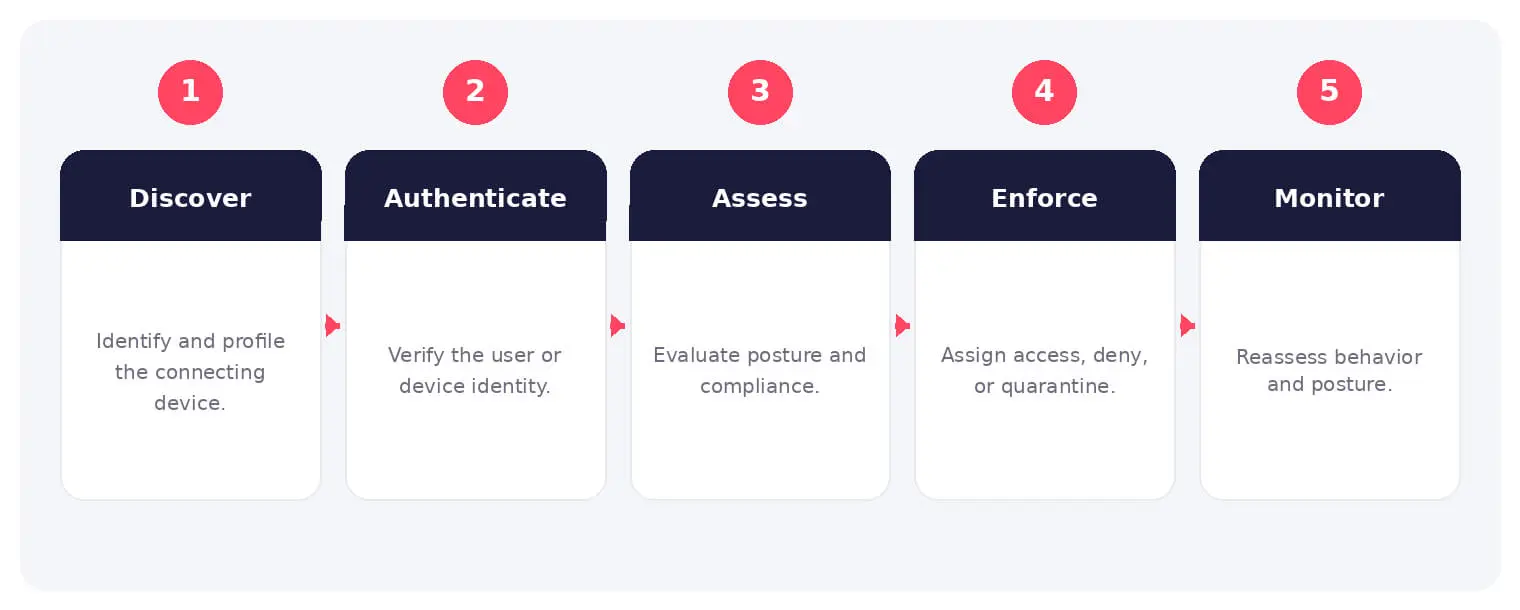
How It Works
The operating flow above turns the concept into observable steps. Exact implementations vary, but each stage needs accountable ownership, trusted inputs, documented policy, and evidence that analysts can use during investigation and review.
NAC combines identity, device profiling, posture assessment, policy enforcement, and segmentation. Pre-admission checks evaluate access before connection, while post-admission controls can restrict or quarantine a device when its posture or behavior changes.
Common Types and Capabilities
- Agent-based and agentless NAC
- Pre-admission and post-admission control
- 802.1X and certificate-based access
- Guest, BYOD, IoT, and OT access
Security and Business Risks
- Rogue or unmanaged devices
- Noncompliant endpoints joining trusted segments
- Overly broad network access
- Operational disruption from incorrect policy
Warning Signs and Detection
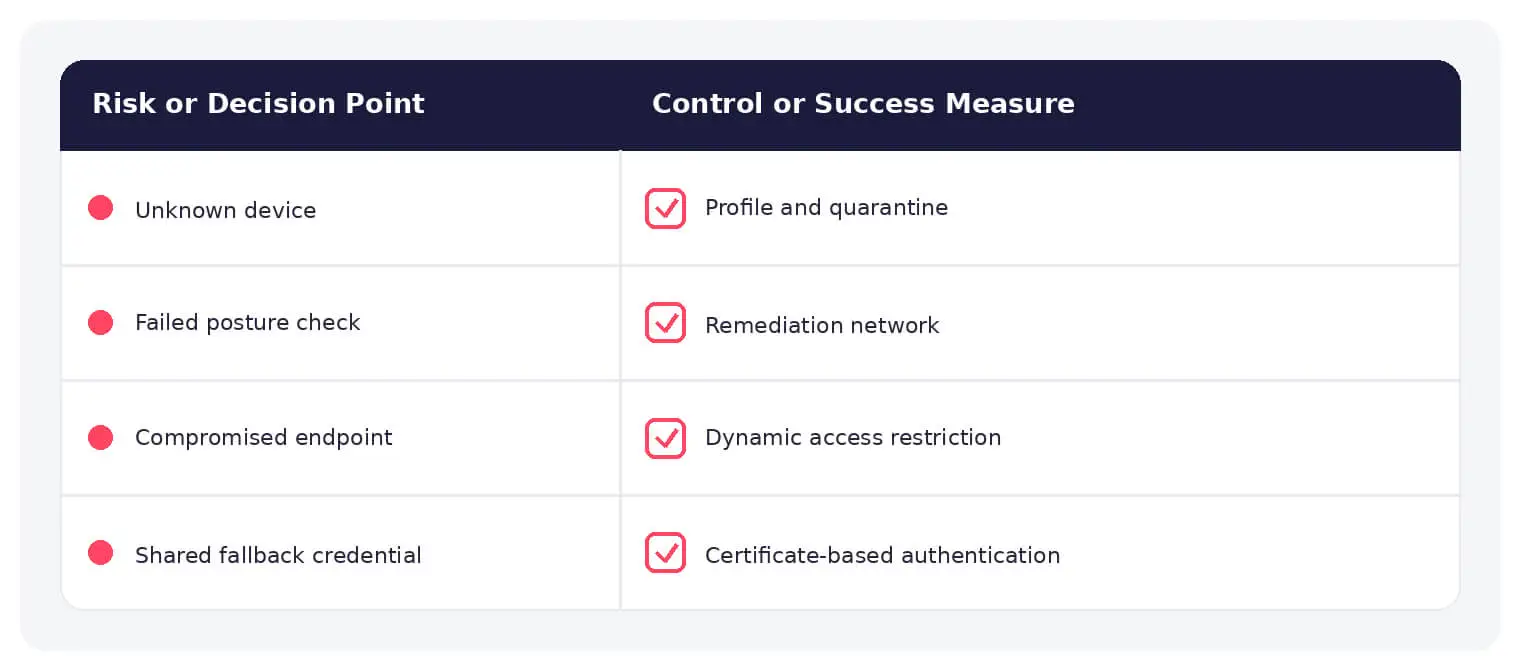
Monitor unknown devices, failed 802.1X sessions, rogue DHCP activity, posture failures, repeated quarantine, unexpected VLAN assignments, identity changes, endpoint-agent gaps, and devices that move between locations or segments.
Best Practices
Begin with discovery and monitor mode, classify device types, integrate identity and endpoint data, phase enforcement, provide remediation paths, segment guests and IoT, protect fallback methods, and review exceptions.
How SOCRadar Can Help
SOCRadar adds external visibility, threat intelligence, exposure context, and continuous monitoring to help teams validate and prioritize risks related to network access control. This context complements internal network, endpoint, identity, and vulnerability controls.
Explore SOCRadar Attack Surface Management or request a demo to strengthen threat-informed prevention and response.
Frequently Asked Questions
What Is Network Access Control (NAC)?
Network Access Control (NAC) determines which users and devices may join a network and what resources they can reach after admission. It combines identity verification, device profiling, posture assessment, policy enforcement, and segmentation to govern both wired and wireless connections.
What Risks Do Rogue or Unmanaged Devices Introduce?
Rogue or unmanaged devices join without identity checks, posture evaluation, or endpoint agents, which makes them a primary concern for NAC programs. They can remain unnoticed in trusted segments and expand the attack surface, so effective security pairs prevention with continuous visibility, clear device ownership, and tested response.
How Does 802.1X Support NAC?
802.1X is a port-based authentication standard that validates a device through a RADIUS server before granting network access. When paired with certificates instead of shared credentials, it ties admission to strong device identity and produces session logs that analysts can review during investigations.
What Happens During a Posture Assessment?
The endpoint is checked against policy criteria such as patch level, encryption status, and endpoint-agent presence before or after it receives access. Devices that fail these checks can be routed to a remediation VLAN or quarantine segment until they are brought back into compliance.
What Is the Difference Between Pre-Admission and Post-Admission Control?
Pre-admission checks evaluate access before a device connects, which keeps noncompliant endpoints out of trusted segments. Post-admission control continues to monitor behavior and posture after connection, so a device can be restricted or quarantined if its state changes.
Which Warning Signs Point to NAC Gaps?
Watch for unknown devices, failed 802.1X sessions, rogue DHCP activity, posture failures, repeated quarantine events, unexpected VLAN assignments, identity changes, and endpoint-agent gaps. Devices that move between locations or segments also deserve scrutiny, since this can signal evasion attempts or policy drift.
How Can Teams Deploy NAC Without Disrupting Operations?
Start with discovery and monitor mode, then classify device types and integrate identity and endpoint data before phasing in enforcement. Provide remediation paths for noncompliant endpoints, protect fallback authentication methods, and review exceptions regularly so policies do not silently broaden over time.
How Should Guests, BYOD, and IoT Devices Be Handled?
Segment guests, BYOD, and IoT devices into isolated network zones with least-privilege access to internal resources. Profile these devices carefully, since many cannot run agents or support strong authentication, and monitor their traffic patterns for anomalies that suggest compromise.
Why Is Incorrect Policy a Business Risk?
Overly broad access undermines segmentation, while overly strict rules can block legitimate users, printers, cameras, or operational technology and interrupt business processes. Phased enforcement, tested fallbacks, and documented exceptions reduce the chance that a policy change causes downtime.
Is NAC Enough to Secure a Network on Its Own?
No. NAC controls admission and segmentation, but it does not replace endpoint protection, vulnerability management, identity controls, or continuous monitoring. Treating it as one layer in a broader defense strategy provides more realistic coverage than expecting a single gate to stop every threat.

Oct 27, 2026
Australia’s Annual Cyber Threat Report 2025-26 Shows Cyber Incidents Up 20%
Australia’s cyber security authority responded to 1,524 cyber security incidents in the 2025-26 financial year, a 20% increase from the previous year…

Oct 27, 2026
PHP2Shell Weaponized After Japanese Real Estate Extortion
An exposed server ties an extortion wave on about 20 Japanese property sites to an operator who later weaponized PHP2Shell (CVE-2026-109618, CVE-2026-109619)…

Oct 27, 2026
Wasmtime Sandbox Escape Flaws Patched in Cranelift
Two critical Wasmtime sandbox escape flaws, CVE-2026-115889 and CVE-2026-115893, let a crafted WebAssembly (Wasm) module push the Cranelift compiler into generating unsafe…
Intelligence in your inbox every Thursday.
Join 30,000+ security professionals reading SOCRadar research.
Subscribe