
What Is Third-Party Cyber Risk Management?
Third-Party Cyber Risk Management (TPCRM) identifies, evaluates, treats, and monitors cybersecurity risks introduced by vendors, suppliers, partners, service providers, and other external relationships.
Risk depends on more than a questionnaire score. Teams must understand what data and systems a third party can access, how services support critical operations, which subcontractors are involved, and how exposure changes throughout the relationship.
Key Takeaways
- Third-Party Cyber Risk Management (TPCRM) identifies, evaluates, treats, and monitors cybersecurity risks introduced by vendors, suppliers, partners, service providers, and other external relationships.
- Risk depends on more than a questionnaire score. Teams must understand what data and systems a third party can access, how services support critical operations, which subcontractors are involved, and how exposure changes throughout the relationship.
- Supplier breach exposing shared data is a primary concern.
- Effective programs combine clear scope, evidence, accountable ownership, and continuous review.
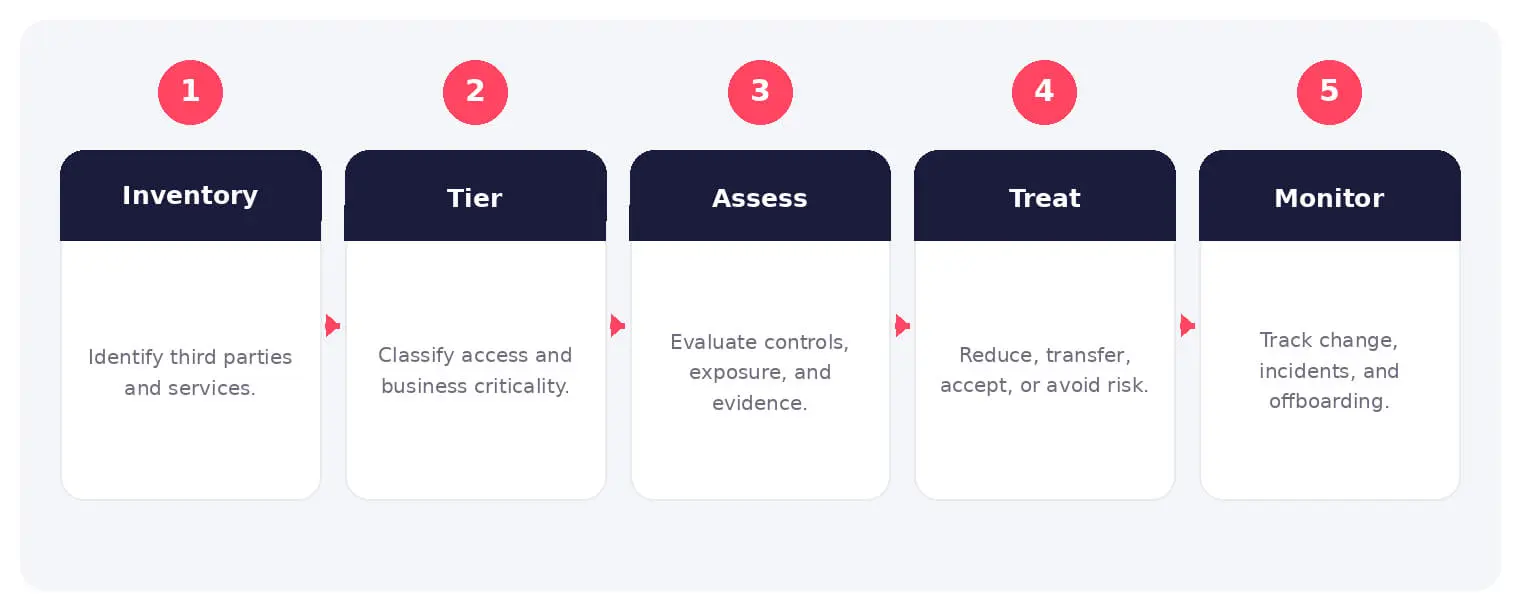
How It Works
The operating flow above turns the concept into observable steps. Exact implementations vary, but each stage needs accountable ownership, trusted inputs, documented policy, and evidence that practitioners can use during review and decision-making.
Risk depends on more than a questionnaire score. Teams must understand what data and systems a third party can access, how services support critical operations, which subcontractors are involved, and how exposure changes throughout the relationship.
Common Types and Capabilities
- Vendor security assessment
- Supply-chain exposure monitoring
- Contract and access governance
- Continuous monitoring and incident coordination
Security and Business Risks
- Supplier breach exposing shared data
- Compromised vendor credentials
- Fourth-party concentration and outages
- Unrevoked access after termination
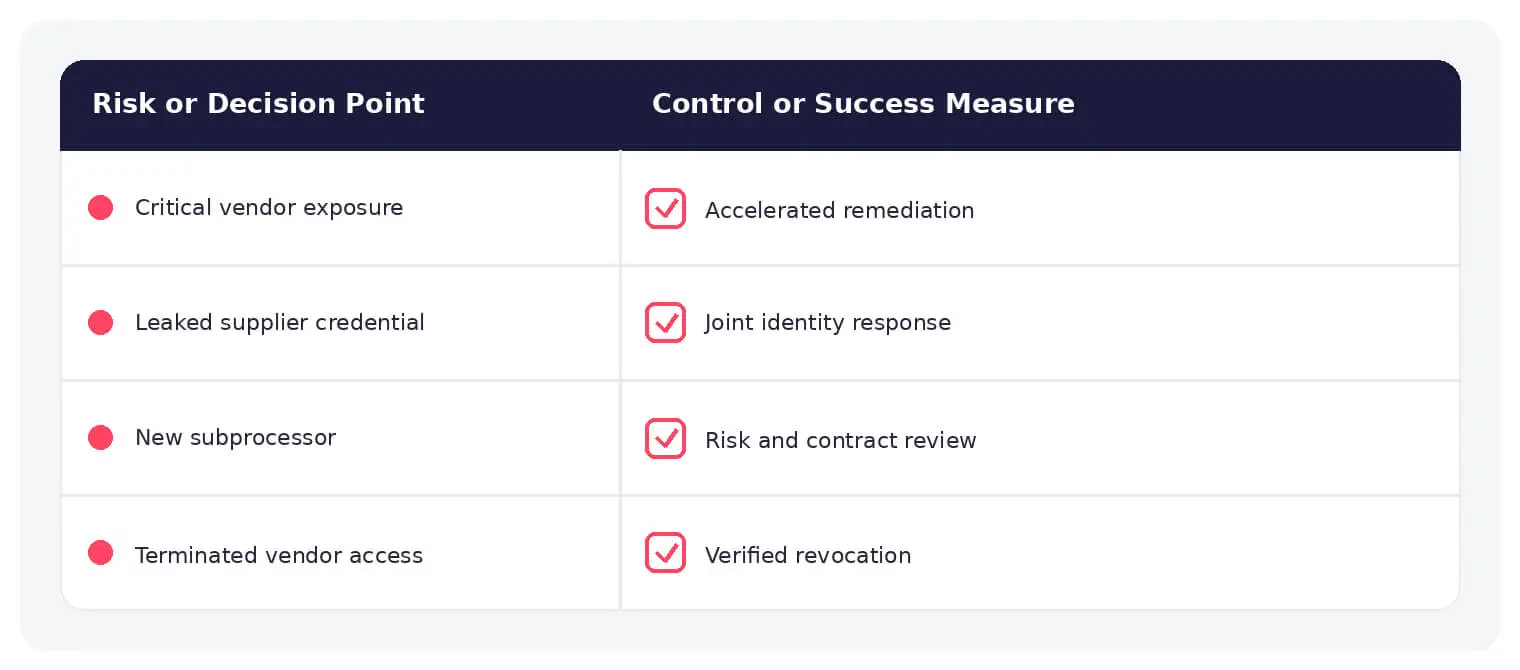
Warning Signs and Detection
Monitor exposed vendor assets, breached credentials, ransomware and data-leak claims, critical vulnerabilities, ownership changes, certificate and domain changes, security-rating shifts, new subprocessors, unusual partner access, contract exceptions, and overdue remediation.
Best Practices
Maintain an authoritative inventory, tier by access and criticality, require evidence proportionate to risk, use contractual security and notification terms, apply least privilege, monitor continuously, exercise joint response, track remediation, and verify offboarding.
How SOCRadar Can Help
SOCRadar adds external visibility, threat intelligence, exposure context, and continuous monitoring to help teams validate and prioritize risks related to third-party cyber risk management. This context complements internal engineering, governance, vulnerability, and security operations controls.
Explore SOCRadar Supply Chain Intelligence or request a demo to strengthen threat-informed prevention and response.
Frequently Asked Questions
What Is Third-Party Cyber Risk Management (TPCRM)?
Third-Party Cyber Risk Management (TPCRM) is the practice of identifying, evaluating, treating, and monitoring cybersecurity risks that originate from vendors, suppliers, partners, and service providers. Because these organizations often connect to internal systems or handle sensitive data, their security weaknesses can directly become your security incidents.
How Does TPCRM Differ From Vendor Risk Management and Supply Chain Risk Management?
These terms overlap but differ in scope. Vendor risk management usually focuses on evaluating individual suppliers, while supply chain risk management covers broader operational dependencies such as logistics and hardware. TPCRM concentrates on the cybersecurity side of external relationships, including software providers, managed service providers, cloud vendors, and contractors.
Why Is a Questionnaire Score Not Enough to Assess Vendor Risk?
A questionnaire captures a point-in-time self-assessment that may be outdated, incomplete, or overly optimistic. Real risk depends on what data and systems the vendor can access, which subcontractors it relies on, and how its exposure changes over the relationship. Pairing questionnaires with evidence requests and continuous monitoring produces a more reliable picture.
What Are the Main Cybersecurity Risks Introduced by Third Parties?
- Supplier breaches that expose data shared with the vendor
- Compromised vendor credentials used to reach your environment
- Fourth-party concentration, where multiple providers depend on the same upstream service
- Unrevoked access after a contract ends
How Does Fourth-Party Concentration Increase Exposure?
Your vendors depend on their own suppliers, sometimes called fourth parties. If several of your providers rely on the same cloud host, data center, or software component, a single breach or outage can affect multiple services at once. Mapping these dependencies helps surface concentration risk before an incident reveals it.
How Should Organizations Tier Their Third Parties?
Classify vendors by the sensitivity of the data they handle, the systems they can reach, and how critical their services are to operations. High-tier relationships justify deeper due diligence, contractual security terms, and more frequent review, while lower-tier vendors can follow lighter evidence requirements proportionate to their risk.
What Warning Signs Suggest a Vendor Is a Growing Risk?
Useful indicators include exposed vendor assets, breached credentials tied to the vendor’s domain, ransomware or data-leak claims naming the supplier, critical unpatched vulnerabilities, security-rating drops, ownership changes, and unusual access patterns. New subprocessors, contract exceptions, and overdue remediation items also deserve attention.
What Security Terms Should Third-Party Contracts Include?
Contracts should define security obligations, breach notification timelines, audit and evidence rights, data handling requirements, and conditions for using subcontractors. Clear terms should also cover access revocation and data return or deletion at termination, giving you grounds to act when a vendor’s posture slips.
How Should Offboarding Be Handled When a Vendor Relationship Ends?
Offboarding should verify that accounts are disabled, API keys and certificates are revoked, network access is removed, and shared data is returned or deleted. Unrevoked access after termination is a common and frequently overlooked exposure, so offboarding should be treated as a verification step with documented evidence rather than an administrative formality.
How Often Should Third-Party Risks Be Reassessed?
Point-in-time reviews at onboarding and annual renewal are rarely sufficient on their own for critical vendors. Continuous monitoring of exposure, leaked credentials, and threat intelligence signals helps teams detect changes between formal reviews. High-tier vendors warrant closer scrutiny and shorter reassessment cycles than lower-tier relationships.

Oct 27, 2026
Australia’s Annual Cyber Threat Report 2025-26 Shows Cyber Incidents Up 20%
Australia’s cyber security authority responded to 1,524 cyber security incidents in the 2025-26 financial year, a 20% increase from the previous year…

Oct 27, 2026
PHP2Shell Weaponized After Japanese Real Estate Extortion
An exposed server ties an extortion wave on about 20 Japanese property sites to an operator who later weaponized PHP2Shell (CVE-2026-109618, CVE-2026-109619)…

Oct 27, 2026
Wasmtime Sandbox Escape Flaws Patched in Cranelift
Two critical Wasmtime sandbox escape flaws, CVE-2026-115889 and CVE-2026-115893, let a crafted WebAssembly (Wasm) module push the Cranelift compiler into generating unsafe…
Intelligence in your inbox every Thursday.
Join 30,000+ security professionals reading SOCRadar research.
Subscribe