
What Is the Traffic Light Protocol (TLP)?
The Traffic Light Protocol (TLP) is a labeling system that tells recipients how widely cybersecurity information may be shared.
TLP 2.0 uses TLP:RED, TLP:AMBER, TLP:GREEN, and TLP:CLEAR, with TLP:AMBER+STRICT available when sharing must remain within the recipient organization. TLP does not classify national-security information or replace legal, contractual, privacy, or handling requirements.
Key Takeaways
- The Traffic Light Protocol (TLP) is a labeling system that tells recipients how widely cybersecurity information may be shared.
- TLP 2.0 uses TLP:RED, TLP:AMBER, TLP:GREEN, and TLP:CLEAR, with TLP:AMBER+STRICT available when sharing must remain within the recipient organization. TLP does not classify national-security information or replace legal, contractual, privacy, or handling requirements.
- Oversharing sensitive incident details is a primary concern.
- Effective programs combine clear scope, evidence, accountable ownership, and continuous review.
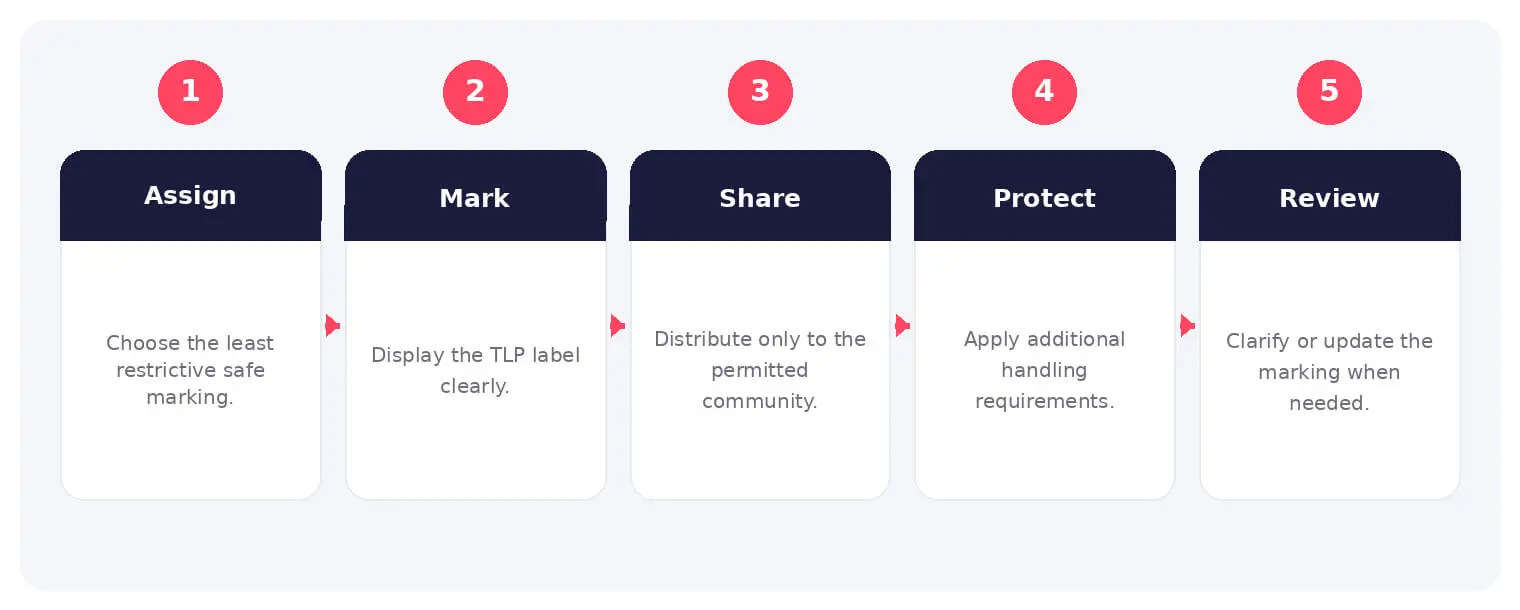
How It Works
The operating flow above turns the concept into observable steps. Exact implementations vary, but each stage needs accountable ownership, trusted inputs, documented policy, and evidence that practitioners can use during review and decision-making.
TLP 2.0 uses TLP:RED, TLP:AMBER, TLP:GREEN, and TLP:CLEAR, with TLP:AMBER+STRICT available when sharing must remain within the recipient organization. TLP does not classify national-security information or replace legal, contractual, privacy, or handling requirements.
Common Types and Capabilities
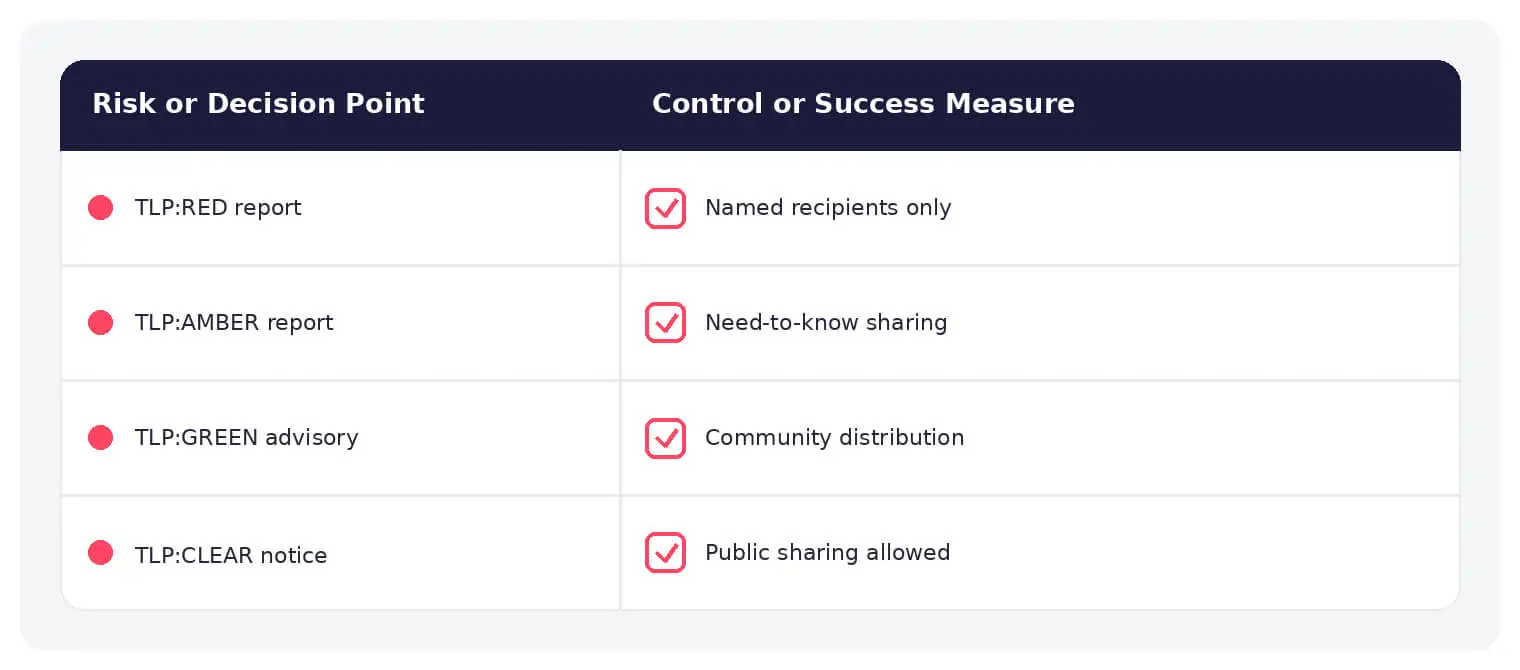
- TLP:RED for named recipients only
- TLP:AMBER for limited need-to-know sharing
- TLP:GREEN for a defined community
- TLP:CLEAR for unrestricted disclosure
Security and Business Risks
- Oversharing sensitive incident details
- Overrestricting intelligence that defenders need
- Conflicting contractual or legal obligations
- Labels lost during forwarding or automation
Warning Signs and Detection
Monitor messages without markings, labels removed by integrations, recipients outside the permitted group, public posting of restricted content, unclear originator instructions, inconsistent TLP versions, and sensitive attachments separated from their handling notice.
Best Practices
Use TLP 2.0 terminology, assign markings at creation, keep labels with content, train users, configure sharing tools, honor stricter legal requirements, ask the originator when uncertain, and lower restrictions only with authorization.
How SOCRadar Can Help
SOCRadar adds external visibility, threat intelligence, exposure context, and continuous monitoring to help teams validate and prioritize risks related to Traffic Light Protocol. This context complements internal engineering, governance, vulnerability, and security operations controls.
Explore SOCRadar Cyber Threat Intelligence or request a demo to strengthen threat-informed prevention and response.
Frequently Asked Questions
What Is the Main Purpose of the Traffic Light Protocol (TLP)?
The Traffic Light Protocol is a set of standardized labels that tell recipients how far cybersecurity information may travel beyond the person who receives it. Maintained by FIRST, it uses color-based designations so that incident details, indicators, and advisories can move quickly between trusted communities without reaching unintended audiences.
What Do the TLP 2.0 Labels Mean?
TLP 2.0 defines five designations, each chosen by the originator:
- TLP:RED – for named recipients only; no further disclosure.
- TLP:AMBER – need-to-know sharing within the recipient organization and its clients.
- TLP:AMBER+STRICT – sharing limited to the recipient organization only.
- TLP:GREEN – sharing within a defined community, such as a sector or an ISAC.
- TLP:CLEAR – unrestricted disclosure, subject to normal attribution rules.
Recipients are expected to honor the label when forwarding, quoting, excerpting, or storing the material.
What Does TLP:AMBER+STRICT Mean and When Should It Be Used?
TLP:AMBER+STRICT narrows the standard AMBER rules so information stays inside the receiving organization, with no sharing to clients, partners, or community members. It suits details that would cause real harm if they left the organization, such as specifics of an active incident, unpatched vulnerability information, or partner names.
What Changed Between TLP 1.0 and TLP 2.0?
TLP 2.0, published by FIRST in 2022, renamed TLP:WHITE to TLP:CLEAR and added TLP:AMBER+STRICT for organization-internal sharing. It also standardized the visual format, with labels written as TLP:RED in capital letters, so markings stay recognizable across documents, emails, and portals.
Who Assigns a TLP Label and When Should It Be Applied?
The originator assigns the label when the information is created or released, based on content sensitivity and the intended audience. Applying the marking at creation rather than after distribution reduces the chance that unmarked copies, extracts, or attachments circulate without handling instructions.
Can a Recipient Change or Downgrade a TLP Label?
No. Only the originator can raise or lower a TLP designation, and recipients who think a label is too strict should request a change rather than deciding on their own. Content extracted or summarized from a marked source generally keeps the original label unless the originator approves otherwise.
What Are the Main Risks of Applying TLP Incorrectly?
The two opposing failure modes are oversharing and overrestriction. Publishing incident details or indicators when they warranted TLP:AMBER can expose remediation gaps to attackers, while marking routine advisories TLP:RED withholds context defenders need. Labels stripped by mail gateways, ticketing systems, or integrations create a third problem: content travels with no handling instruction at all.
What Warning Signs Suggest TLP Labels Are Being Lost or Ignored?
Watch for messages that arrive with no marking, formatting or integration steps that remove the header, recipients in a thread who fall outside the permitted group, and restricted material posted to public channels or pasted into shared tickets. Mixed use of TLP 1.0 and 2.0 terminology, or attachments separated from their handling notice, also signal that the labeling process needs review.
How Should Teams Handle Information That Arrives Without a TLP Label?
Treat unlabeled security information cautiously and check with the originator before forwarding, quoting, or storing it in widely accessible tools. A missing marking does not mean the content is public; vendor reports, peer emails, and internal notes often carry restrictions that TLP is meant to make explicit.
Is TLP a Substitute for Encryption, Access Controls, or Legal Agreements?
No. TLP communicates handling expectations between organizations, but it does not encrypt data, restrict file access, or create contractual obligations, and it is not a national-security classification scheme. Pair the markings with need-to-know permissions, encryption, data loss prevention rules, and any NDAs or regulatory requirements that cover the material.
Can TLP-Labeled Information Be Shared With Vendors and Third Parties?
It depends on the designation the originator applied. TLP:GREEN content may move through a defined community, TLP:AMBER permits need-to-know sharing with the recipient organization and its clients, and TLP:RED stays with named recipients only. When a vendor, MSP, or contractor falls outside those boundaries, ask the originator for explicit permission first.

Oct 16, 2026
CVE-2026-102764: BeyondTrust Zero-Day Exploited
BeyondTrust has disclosed CVE-2026-102764, a critical Remote Support vulnerability exploited as a zero-day weeks before customers received a patch. The attack began…
Oct 15, 2026
Cisco Secure Email & PAN-OS Zero-Days Exploited
Cisco Secure Email & PAN-OS Zero-Days Exploited Cisco and Palo Alto Networks have patched two actively exploited zero-day vulnerabilities that can lead…
Oct 15, 2026
SOCRadar Splunk Integration: New MSSP and Vulnerability Apps
SOCRadar Splunk Integration: New MSSP and Vulnerability Apps Your analysts live in Splunk. Your external risk does not: SOCRadar alarms for dozens…
Intelligence in your inbox every Thursday.
Join 30,000+ security professionals reading SOCRadar research.
Subscribe