
What Is a Transit Gateway?
A transit gateway is a cloud networking service that acts as a central routing hub for multiple virtual networks, data centers, and remote connections.
The hub-and-spoke model replaces a complex mesh of individual peerings. Attachments connect networks to the hub, while route tables determine which attachments can communicate. Centralization simplifies growth but makes routing policy and administration high-impact security controls.
Key Takeaways
- A transit gateway is a cloud networking service that acts as a central routing hub for multiple virtual networks, data centers, and remote connections.
- The hub-and-spoke model replaces a complex mesh of individual peerings. Attachments connect networks to the hub, while route tables determine which attachments can communicate. Centralization simplifies growth but makes routing policy and administration high-impact security controls.
- Routes that bridge isolated environments is a primary concern.
- Effective security combines prevention, continuous visibility, accountable ownership, and tested response.
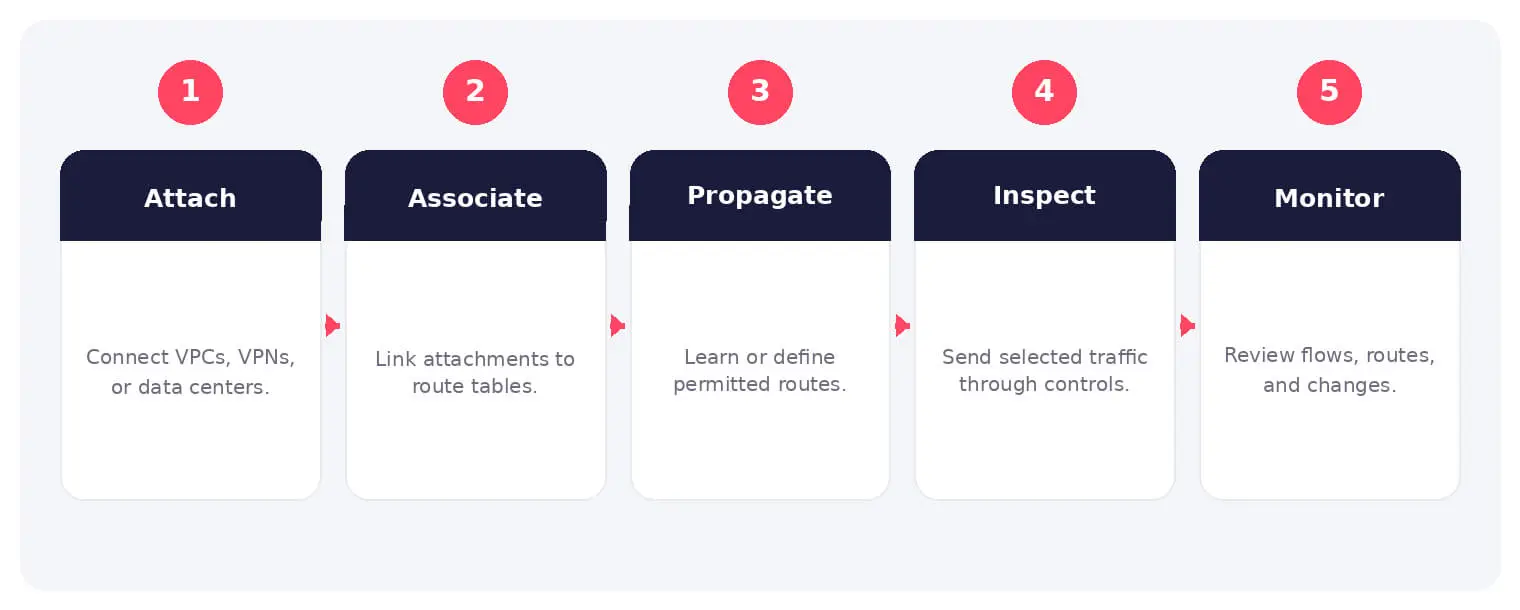
How It Works
The operating flow above turns the concept into observable steps. Exact implementations vary, but each stage needs accountable ownership, trusted inputs, documented policy, and evidence that analysts can use during investigation and review.
The hub-and-spoke model replaces a complex mesh of individual peerings. Attachments connect networks to the hub, while route tables determine which attachments can communicate. Centralization simplifies growth but makes routing policy and administration high-impact security controls.
Common Types and Capabilities
- VPC and virtual-network attachments
- VPN and dedicated-link attachments
- Inter-region gateway peering
- Inspection and shared-services architectures
Security and Business Risks
- Routes that bridge isolated environments
- Compromised gateway administration
- Uninspected lateral traffic
- Cost and outage concentration
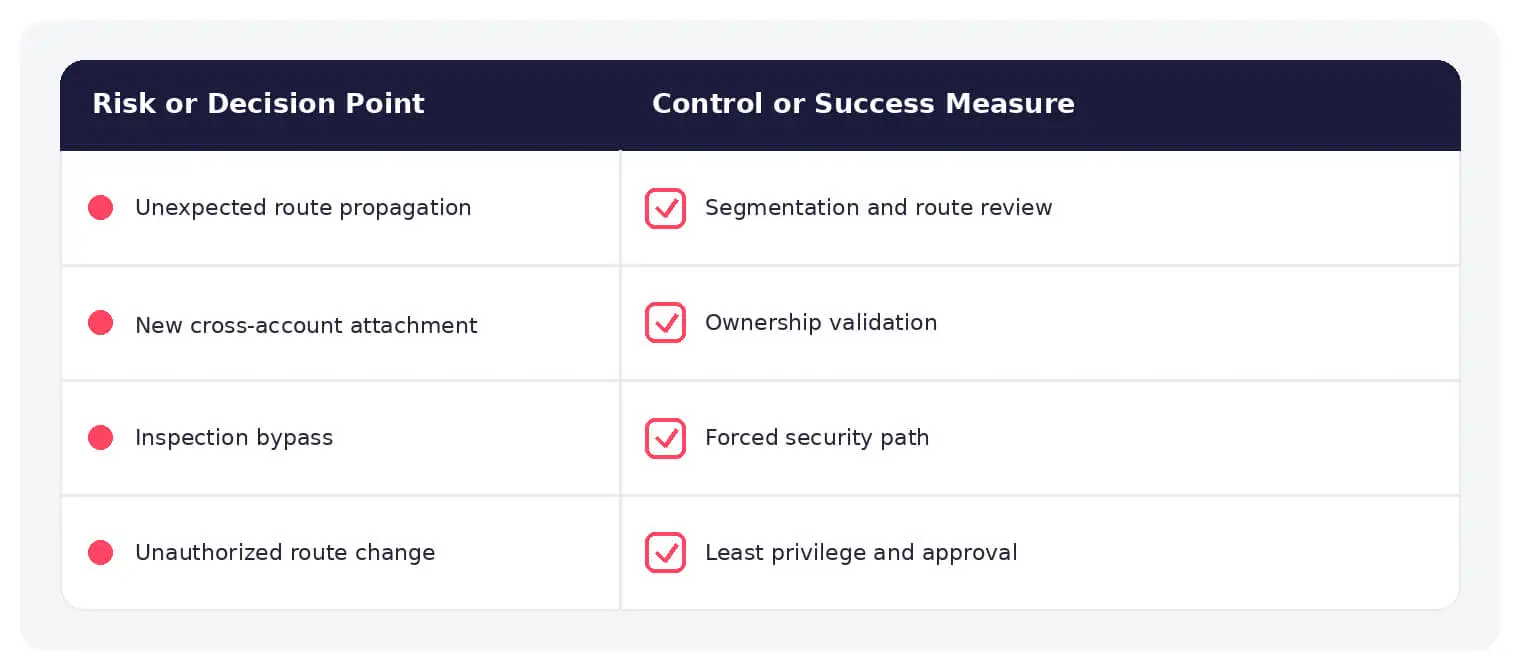
Warning Signs and Detection
Monitor new attachments, route-table changes, broad propagation, unexpected inter-VPC flows, bypass of inspection paths, rejected traffic, cross-account sharing, unusual administrator activity, and unused connections.
Best Practices
Separate route tables by trust domain, deny unintended propagation, restrict administration, require change approval, enable flow logs, inspect sensitive paths, encrypt data end to end, review attachments, and test rollback.
How SOCRadar Can Help
SOCRadar adds external visibility, threat intelligence, exposure context, and continuous monitoring to help teams validate and prioritize risks related to transit gateway. This context complements internal cloud, network, identity, and application controls.
Explore SOCRadar Attack Surface Management or request a demo to strengthen threat-informed prevention and response.
Frequently Asked Questions
What Is a Transit Gateway Used For?
A transit gateway is a cloud networking service that acts as a central routing hub for multiple virtual networks, data centers, and remote connections. It replaces a complex mesh of individual peerings with a hub-and-spoke model, where attachments connect networks to the hub and route tables decide which attachments can communicate. This simplifies growth at scale, but it also makes routing policy a high-impact security control.
How Is a Transit Gateway Different from VPC Peering?
VPC peering creates a direct, non-transitive connection between two networks, so each new pairing adds another link to manage. A transit gateway is transitive by design: a single attachment lets a network reach any destination its route tables allow. That reduces the number of connections dramatically, but it also means one routing mistake can expose paths that peering would have kept separate.
How Do Attachments and Route Tables Control Traffic Flow?
Attachments connect a VPC, VPN, or dedicated link to the gateway, while route tables determine which attachments can send traffic to each other. By assigning separate route tables to different trust domains, teams can isolate production from development or limit which networks reach shared services. Route propagation settings then decide which routes spread automatically across those tables.
What Are the Main Security Risks of a Transit Gateway?
- Bridging isolated environments: routes that connect network segments meant to stay apart.
- Compromised gateway administration: an attacker with routing privileges can redirect traffic or open unintended paths.
- Uninspected lateral traffic: spoke-to-spoke flows that bypass inspection controls.
- Cost and outage concentration: the hub becomes a single operational and billing dependency for many networks.
What Warning Signs Should Teams Monitor?
Watch for new attachments, route-table changes, and route propagation that spreads more broadly than intended. Unexpected inter-VPC flows, traffic bypassing inspection paths, spikes in rejected traffic, cross-account sharing, and unusual administrator activity all warrant investigation. Unused or stale connections should also be flagged for review and removal.
How Should Teams Respond to a Suspicious Route or Attachment Change?
First, compare the change against approved requests and identify who made it using audit logs. If it is unauthorized, remove the offending attachment or route, revert the route table, and check flow logs for traffic that may have used the exposed path. Then tighten administrative permissions and require change approval before further modifications.
How Can Teams Prevent Unauthorized Connectivity Through the Gateway?
Separate route tables by trust domain and deny unintended route propagation so networks only reach approved destinations. Restrict who can create attachments or edit routes, require change approval, and enable flow logs for continuous visibility. Review attachments periodically and test rollback procedures so misconfigurations can be corrected quickly.
How Does a Transit Gateway Affect Cost and Availability?
Because traffic is centralized, every attachment and gigabyte processed contributes to gateway charges, and design choices such as cross-region peering can increase data transfer costs. The hub also concentrates operational risk: a misconfiguration or outage can affect many connected networks at once. Redundancy planning and regular traffic reviews help manage both concerns.
Does a Transit Gateway Encrypt Traffic Between Networks?
A transit gateway routes traffic; it does not encrypt it on its own. Encryption must be applied separately, for example through IPsec VPN attachments, supported dedicated connections, or end-to-end application-layer encryption between workloads. Teams should verify which paths are encrypted rather than assuming the gateway provides that protection.
Can a Transit Gateway Support Multi-Account and Multi-Region Architectures?
Yes. Transit gateways are commonly used in multi-account designs, where resource sharing lets a central networking team provide connectivity while account owners manage their own workloads. Inter-region peering extends the hub model across regions, which supports global architectures but also widens the blast radius of routing errors, so cross-region routes warrant the same review discipline as local ones.

Oct 27, 2026
September 2026: FBI Breach, Clop Hijack & IDScan Leak
The major cyber attacks of September 2026 hit federal law enforcement, a rival cybercrime gang, and the companies that verify identities. ShinyHunters…
Oct 27, 2026
Australia’s Annual Cyber Threat Report 2025-26 Shows Cyber Incidents Up 20%
Australia’s cyber security authority responded to 1,524 cyber security incidents in the 2025-26 financial year, a 20% increase from the previous year…

Oct 27, 2026
PHP2Shell Weaponized After Japanese Real Estate Extortion
An exposed server ties an extortion wave on about 20 Japanese property sites to an operator who later weaponized PHP2Shell (CVE-2026-109618, CVE-2026-109619)…
Intelligence in your inbox every Thursday.
Join 30,000+ security professionals reading SOCRadar research.
Subscribe