

Oct 07, 2026
Jun 05, 2026
16 Mins Read
Jul 17, 2026

Summarize with:
2026 FIFA World Cup Threat Landscape: The Kickoff for Cybercriminals
The fraud and threat ecosystem targeting the 2026 FIFA World Cup is already live, with thousands of phishing domains, active credential theft campaigns, and nation-state actors in position months before the first match.
Starting June 11, the FIFA World Cup 2026 will unite fans, teams, sponsors, broadcasters, hospitality providers, and businesses across the United States, Canada, and Mexico in one of the world’s largest sporting events. It also presents a significant opportunity for cybercriminals. SOCRadar’s follow-up analysis of FIFA World Cup 2026 fraud campaigns examines the counterfeit stores, FIFA portal impersonation, and fraudulent ticketing and betting infrastructure observed around the tournament.
Forty-eight teams, 104 matches, 16 host cities, three countries, 39 days, an estimated 6.5 million in-venue spectators, and a broadcast audience approaching half the planet.
The U.S. Department of Homeland Security has designated all 78 U.S.-hosted matches at Special Event Assessment Rating (SEAR) Level 1 and 2. FEMA has allocated $625 million to host cities for security preparations.
The FBI has already issued warnings about active FIFA website spoofing, tens of thousands of infostealer logs containing FIFA-related credentials, and CISA advisories document Iranian-affiliated actors actively targeting the same U.S. critical infrastructure that host cities depend on. The attack surface is unprecedented, and the threats are already live.
FIFA World Cup 2026 Cyber Threat Landscape: Who’s Targeting the Tournament and Why
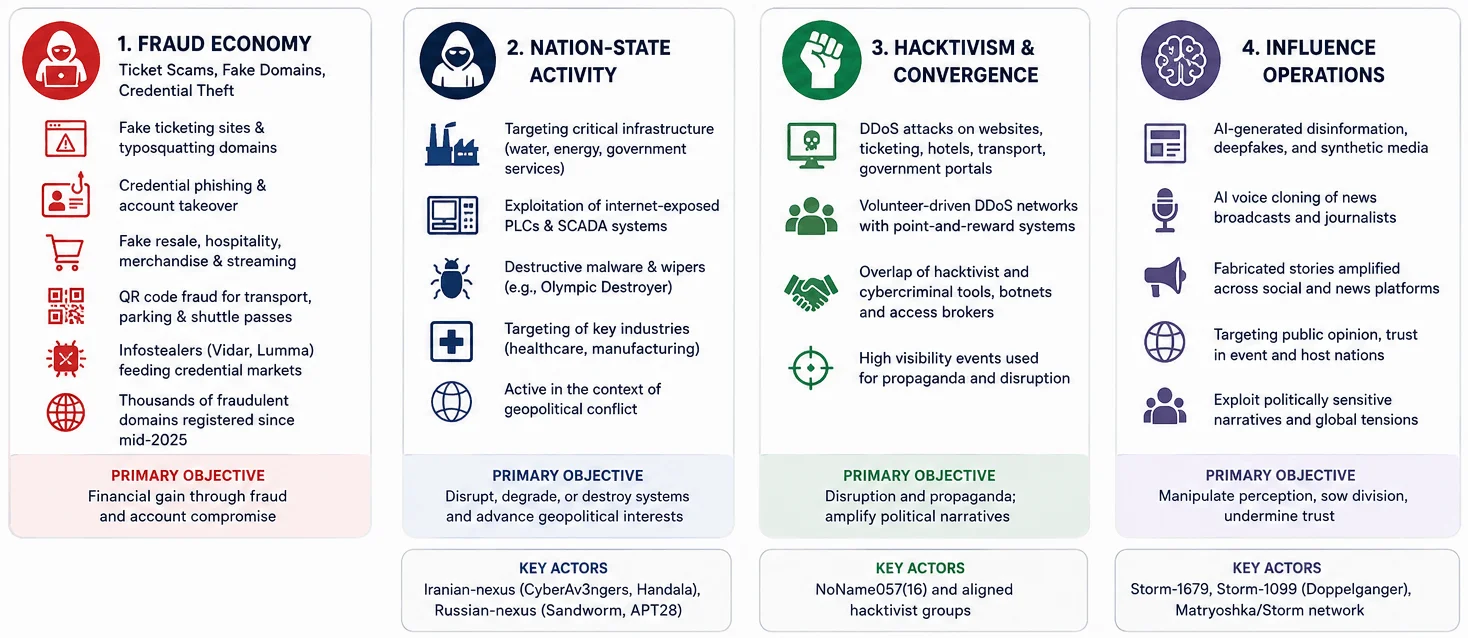
Threat actor clusters targeting the World Cup 2026
Ticket Scams, Fake Domains, and Credential Theft: The Fraud Economy Around FIFA 2026
This is the highest-volume, highest-certainty threat category. Financially motivated cybercrime around mega-events follows a predictable pattern, and the 2026 World Cup has all the ingredients that make it worse: global demand, limited ticket supply, high-value hospitality packages, cross-border transactions, and millions of fans unfamiliar with the official purchasing process.
The fraud ecosystem operates across several parallel tracks. Credential phishing is the most sophisticated. Attackers build pixel-perfect clones of FIFA’s ticketing portal, replicating the single sign-on flow closely enough to fool most users. Once a victim enters credentials on a fake site, the attacker can execute a password reset on the real FIFA account, lock the victim out, and transfer or resell any tickets tied to the compromised account. The premium hospitality segment is especially attractive because individual transactions run from $1,500 to over $10,000, making each successful phish highly profitable.
Beyond credential phishing, the ecosystem includes fake ticket resale sites that accept payment for tickets that do not exist, counterfeit merchandise shops, fraudulent streaming portals, fake betting and casino platforms, and infostealer-driven credential harvesting. Infostealers like Vidar and Lumma feed this pipeline by scraping saved credentials from infected devices, and tens of thousands of logs containing FIFA-related data are already circulating on Dark Web markets.
The FBI’s Internet Crime Complaint Center (IC3) issued a public service announcement on May 27, 2026, warning of FIFA website spoofing and listing 36 known fraudulent domains. Common tactics include typosquatting (fiffa[.]com), alternative TLDs (.org, .xyz, .live, .sale), and fake employment portals (jobs-fifa[.]com, fifa-hiring[.]com). The FBI’s list is a fraction of the total; thousands of fraudulent FIFA-related domains have been registered since mid-2025, with a large share currently parked and likely staged for activation around key match days.
QR code fraud is an emerging variant worth tracking. The multi-city format creates demand for shuttle passes, parking permits, and fan transport codes, all of which are being spoofed. Fans should verify any QR code through official tournament or host-city channels before scanning.
Receive a Free Dark Web Report for Your Organization:
Nation-State Activity
The geopolitical backdrop of this tournament is unlike any prior World Cup. The U.S.-Israel-Iran conflict that began on February 28, 2026 has produced a documented surge in Iranian-nexus cyber operations against U.S. critical infrastructure, and the tournament’s U.S. footprint puts host-city utilities directly in the crosshairs.
On April 7, 2026, CISA, the FBI, the NSA, the EPA, the DOE, and U.S. Cyber Command published joint advisory AA26-097A, warning that Iranian-affiliated actors are actively exploiting internet-exposed programmable logic controllers (PLCs) across Government Services, Water and Wastewater, and Energy sectors.
The advisory states that targeted organizations “experienced disruptions through malicious interactions with the project files and the manipulation of data displayed on human machine interface (HMI) and supervisory control and data acquisition (SCADA) displays.” These are the same municipal systems that World Cup host cities depend on.
This capability is well-established. The IRGC-linked group CyberAv3ngers (also tracked as Bauxite, Hydro Kitten, and Storm-0784) compromised at least 75 Israeli-made Unitronics PLC devices across U.S. and allied critical infrastructure starting in November 2023. One confirmed target was the Municipal Water Authority of Aliquippa, Pennsylvania, where the attackers left the message “You have been hacked, down with Israel” on the compromised HMI. A separateEPA enforcement alert found that over 70% of inspected U.S. water systems were non-compliant with Safe Drinking Water Act cybersecurity requirements, citing default passwords and shared logins. The exposure is real and well-documented.
On March 11, 2026, the MOIS-affiliated Handala Hack Team (also tracked as Void Manticore) executed a destructive wiper attack against U.S. medical technology company Stryker, abusing the company’s own Microsoft Intune MDM platform to push the payload. This demonstrates Iranian willingness to conduct destructive operations against U.S. targets during the current conflict, though Handala’s public claims of impact (200,000+ systems wiped) follow a known pattern of exaggeration and should be treated with skepticism.
Russia-nexus actors hold the most extensive track record against major sporting events. Sandworm (APT44/GRU Unit 74455) deployed the Olympic Destroyer wiper during the PyeongChang 2018 Winter Olympics opening ceremony, taking down Wi-Fi, ticketing systems, the official app, and the event website. The malware included deliberate false-flag code designed to implicate North Korea and China.
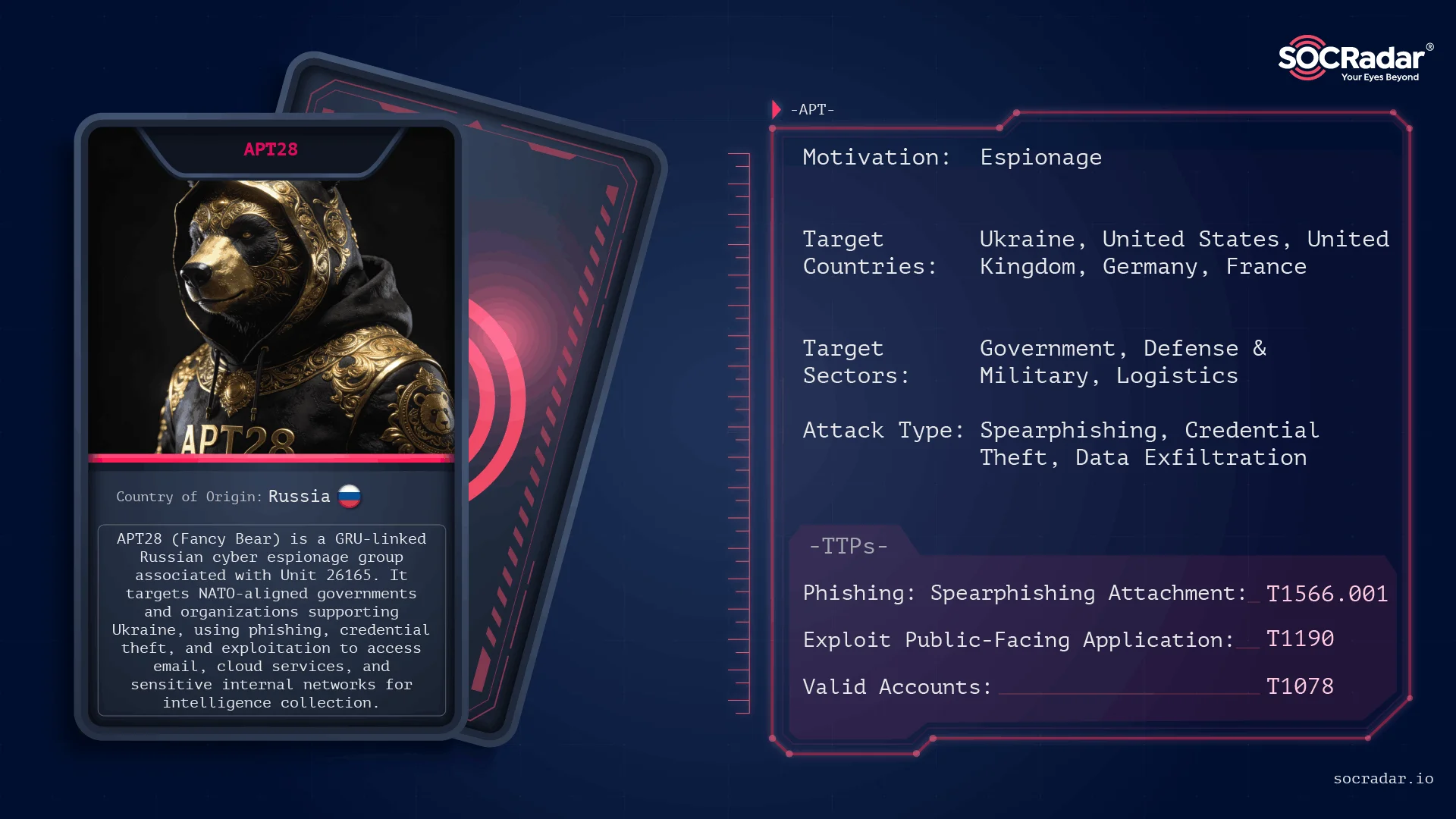
TheU.S. Department of Justice indicted six GRU officers for this attack in October 2020. APT28 (Fancy Bear), also GRU-affiliated, leaked stolen athlete medical records from the World Anti-Doping Agency during the 2016 Rio Olympics.
Hacktivism and the Hacktivist-Cybercrime Convergence
The dominant hacktivist threat actor for this tournament is NoName057(16), a pro-Russia group that has conducted over thousands of verified DDoS attacks against NATO-aligned governments and critical sectors since 2022. The group survived law enforcement takedown efforts in July 2025 (Operation Eastwood) and continues to operate.
NoName057(16) treats major international events as high-value propaganda opportunities. During the Milano-Cortina 2026 Winter Olympics (February 6 to 23), attacks peaked and concentrated on hotels, ski resort websites, consulate portals, and defense-related facilities. The U.S., Canada, and Mexico are all NATO partners or allies, making the World Cup a maximally symbolic target for this group.
The convergence of hacktivist and cybercriminal tactics is worth noting for defenders. NoName057(16) operates DDoSia as a volunteer network with a point-and-reward system, blurring the line between ideological participation and paid service. Defenders should not assume clean separation between hacktivist DDoS campaigns and financially motivated intrusion activity using the same botnets and access brokers.
Influence Operations
AI-driven disinformation targeting major sporting events has moved from experimental to operational. During the Paris 2024 Olympics, Microsoft attributed coordinated influence campaigns to two Russian operations: Storm-1679, which produced AI-generated fake terror threat content including a deepfake Tom Cruise narration of a fabricated Netflix documentary called “Olympics Has Fallen,” and Storm-1099 (Doppelganger), which ran anti-IOC messaging through fabricated news articles and social media amplification.ANSSI logged 141 cyber incidents during the Paris Games, including 22 successful intrusions and a ransomware hit on the Grand Palais.
The Milano-Cortina 2026 Winter Olympics saw an escalation. The Matryoshka network used AI voice-cloning technology to fabricate news segments mimicking CBC and Euronews broadcasts. A doctored CBC report using an AI-voiceover amassed over a million views before the network confirmed it was fake. The fabricated segments used real journalists’ voices to deliver false claims that Ukrainian athletes had been segregated in the Olympic Village due to alleged behavioral issues which is a step beyond text and image generation. Convincing synthetic audio of broadcast-quality reporting is now within reach of state-backed operators.
You can check out SOCRadar’s AI Threat Landscape Report for more detailed information on AI supported attacks
The 2026 World Cup presents a richer target for influence operations than any prior sporting event. The tournament spans three countries, involves politically significant matchups (the U.S. is both a host and a participant during an active military conflict), and coincides with a global information environment already saturated with AI-generated content.
2026 World Cup Attack Surface: Every System Threat Actors Are Targeting
The 2026 World Cup grafts a temporary tournament network onto existing stadium, municipal, and commercial infrastructure across 16 cities and three countries. Each layer presents a distinct attack surface.
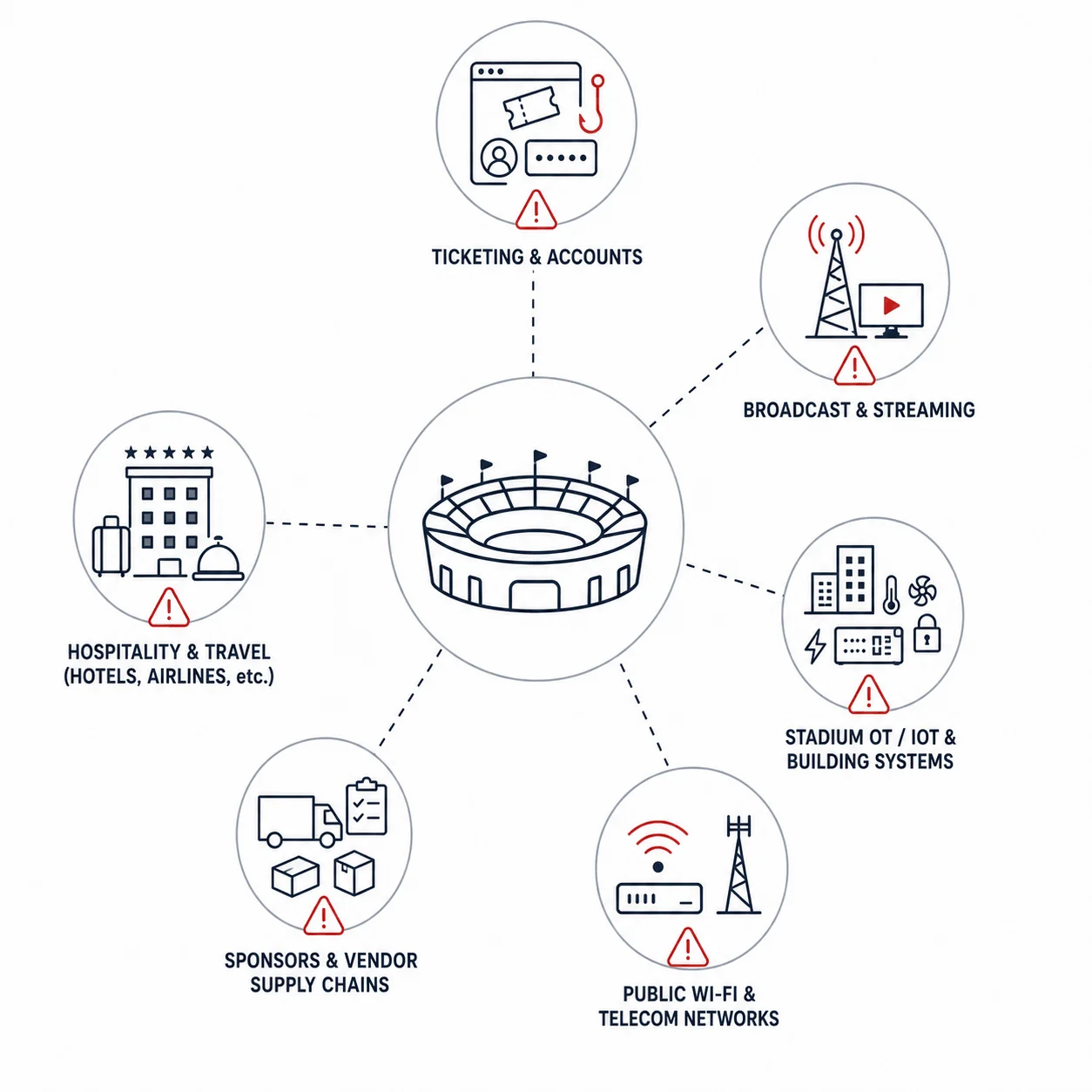
2026 World Cup Attack Surface
FIFA Ticketing Infrastructure: Phishing, Credential Theft, and Fake Resale Sites
Digital ticketing for a sold-out, high-demand event creates ideal phishing conditions. Scarcity and urgency push fans toward unofficial sources, where attackers operate cloned ticketing portals that harvest credentials, execute account takeovers, and sell tickets that do not exist. The premium hospitality segment is especially attractive because single transactions run into the thousands of dollars.
Defenders should monitor for newly registered domains combining FIFA, World Cup, host-city, and sponsor keywords, and treat any hyphenated “FIFA” variant or non-standard TLD as suspicious by default.
Broadcast and Streaming: Piracy Sites and Infrastructure Disruption
With 39 days of matches, demand for free streaming will be enormous. Pirate streaming sites are not just copyright violations; they are malware delivery platforms that use fake “watch now” overlays and codec install prompts to push infostealers and banking trojans. On the infrastructure side, broadcast production, uplink, and distribution networks are high-value targets for state actors seeking maximum disruption during a globally televised moment.
Organizations in the broadcast chain should assume they are targets for pre-positioning and conduct supply-chain audits accordingly.
Stadium OT, IoT, and Building Management Systems
Each venue overlays temporary tournament systems (Wi-Fi, digital signage, access control, point-of-sale) onto permanent building management (HVAC, fire suppression, power, lighting) that often runs on aging operational technology. Internet-exposed PLCs, default credentials, and flat network architectures create opportunities for attackers to move from IT into OT.
Venues should inventory all OT/IoT assets, segment tournament networks from building systems, remove internet-exposed controllers, and eliminate default credentials before the tournament window.
Hotels, Airlines, and Hospitality: Ransomware and Social Engineering Risks
Hospitality operations depend on interconnected systems: reservations, digital room keys, point-of-sale, loyalty programs, and identity management. A single successful social engineering call to a help desk can grant an attacker admin-level access, and ransomware during a tournament window creates maximum pressure to pay because downtime directly affects tens of thousands of guests.
Hospitality operators in host cities should implement phishing-resistant MFA, require out-of-band verification for all help desk identity requests, brief staff on vishing and deepfake voice scenarios, and pre-position DDoS mitigation on booking systems.
Sponsor and Vendor Supply Chains: The Entry Points Attackers Actually Use
The tournament’s commercial ecosystem includes hundreds of sponsors, technology vendors, food service providers, security contractors, and logistics companies. Each one holds some level of access to tournament-adjacent systems, and attackers consistently target the weakest link in the chain rather than the hardened core. A vendor with remote access to a ticketing database or a broadcast network becomes the entry point.
Organizations in the supply chain should map all third-party access, audit for overprivileged credentials, enforce least privilege, and verify that DMARC is set to “reject” on all domains to prevent business email compromise via spoofed invoices.
Public Wi-Fi and Telecom Networks at FIFA 2026 Venues
Tens of thousands of fans connecting simultaneously to venue Wi-Fi creates a large, low-sophistication attack surface. Rogue access points spoofing the official SSID can harvest credentials, intercept unencrypted traffic, and redirect users to phishing pages. On the telecom side, the infrastructure serving the tournament is itself a target: access to a telecom provider’s configuration management systems could allow an attacker to manipulate network routing or disrupt streaming services at scale.
Sixteen cities means 16 separate deployments, each with its own operator and security posture. Enforce WPA3, deploy wireless intrusion detection, pin TLS certificates in tournament apps, and conduct threat hunts on telecom infrastructure before the tournament window opens.
How to Defend Against FIFA World Cup 2026 Cyber Threats: Actionable Steps for Security Teams
The recommendations below are organized by function, with specific actions that CTI teams, SOCs, and security leadership can take before and during the tournament window.
Stand Up Tournament-Specific Domain Monitoring
This is the single highest-ROI action for most organizations. If your company is a sponsor, vendor, host-city service provider, hospitality brand, or any entity whose name might appear alongside “FIFA” or “World Cup” in a phishing lure, you need to be watching for it.
If you discover a typosquat or lookalike domain impersonating your brand, document it and report it to the FBI IC3 with the fake domain, a description of the fraudulent activity, and any associated financial transaction details.
Monitor Dark Web Markets and Infostealer Logs for Credential Exposure
Credentials are already harvested and they are being traded on Dark Web markets. These credentials are not just a consumer problem. If employees at your organization reuse passwords across personal and corporate accounts (and they do), a compromised FIFA fan account could provide the initial credential for a corporate breach via credential stuffing.
Query your threat intelligence feeds and Dark Web monitoring tools for your corporate domains appearing in infostealer logs. Cross-reference any matches. Force password resets on any accounts with confirmed credential exposure. If you are not already monitoring for your domains in stealer logs, the pre-tournament period is the time to start.
Hunt for Tournament-Themed Lures in Your Environment
World Cup-themed phishing is not limited to consumer-facing scams. Phishing campaigns with tournament lures will be targeting corporate environments with fake ticket giveaways, travel booking confirmations, and accreditation notices.
- Run a retroactive search across your email gateway, web proxy, and EDR telemetry for domains matching theFBI’s published list of 36 fraudulent domains and commonly abused TLDs such as .online, .shop, .store, .football, .xyz, .vip, .top, .icu, .one, .city.
- Search for email subjects containing World Cup, FIFA, ticket confirmation, or hospitality package keywords.
- Check for Vidar and Lumma infostealer IOCs in your EDR.
- If your organization uses mobile device management, audit for sideloaded apps that were not installed through official stores.
Review and Enforce DMARC on Your Domains
If your organization is in the tournament ecosystem (sponsor, supplier, partner, host-city government, hospitality chain), your domain is a spoofing target. In a procurement-heavy environment where invoices and payment instructions flow between dozens of vendors, a spoofed email from a trusted partner domain can redirect six- or seven-figure payments.
Check your DMARC record. If it is set to “none” or “quarantine,” move it to “reject” before the tournament window opens. Verify that SPF and DKIM are correctly configured for all sending sources. If you are a vendor receiving invoices or payment instructions from tournament-associated partners, establish out-of-band verification for any payment change request during the tournament window.
Prepare for DDoS at Scale
If your organization operates any public-facing infrastructure in a host city (government services, transportation, tourism, hospitality, event venues), assume you will be targeted. Pre-position DDoS scrubbing and CDN failover. Rate-limit API endpoints. Test your DDoS mitigation under load before the tournament starts, not during.
Harden Help Desks Against Social Engineering and Deepfakes
- Implement phishing-resistant MFA (FIDO2/WebAuthn) for all privileged accounts, not SMS-based MFA that can be bypassed via SIM swap.
- Require out-of-band identity verification for any password reset, MFA device enrollment, or access change requested over the phone.
- Brief help desk staff explicitly on deepfake audio scenarios: the caller may sound exactly like a known executive or employee.
- Establish a policy that no identity verification or access change can be completed based solely on voice recognition.
- During the tournament window, elevate the verification threshold for any request associated with tournament operations, sponsor accounts, or venue systems.
Mega-Events as Cybersecurity Stress Tests: What the Industry Should Learn from FIFA 2026
The 2026 FIFA World Cup is the latest and largest data point in a pattern that has been building with the previous mega-events. These types of major international events function as a live-fire stress test for the cybersecurity posture of the host nations, their critical infrastructure, and every organization connected to the event’s supply chain.
Security in these situations cannot be bolted on in the months before kickoff. The organizations that will weather this tournament are the ones that already had mature credential monitoring, OT segmentation, supply chain visibility, and incident response coordination in place before the World Cup became a headline. For everyone else, the following days will be a harsh audit.
The majority of direct risk from this threat landscape falls on individuals: fans, travelers, and casual viewers who lack dedicated security teams and are most exposed to phishing, ticket fraud, fake streaming sites, and credential theft.
Organizations and businesses face a different but connected risk. They become targets in the second stage of the attack chain, when credentials harvested from individuals through infostealer malware and tournament-themed phishing are reused against corporate environments via credential stuffing, account takeover, and initial access brokerage. The World Cup will be the lure.

Table Of Content
2026 FIFA World Cup Threat Landscape: The Kickoff for Cybercriminals
FIFA World Cup 2026 Cyber Threat Landscape: Who's Targeting the Tournament and Why
2026 World Cup Attack Surface: Every System Threat Actors Are Targeting
How to Defend Against FIFA World Cup 2026 Cyber Threats: Actionable Steps for Security Teams
Mega-Events as Cybersecurity Stress Tests: What the Industry Should Learn from FIFA 2026
Related Articles