

Oct 07, 2026
Aug 29, 2025
10 Mins Read
Jul 08, 2026

Summarize with:
C-Suite Cyber Risks in 2025: 20 Key Statistics for Executives and Boards
Executives remain prime targets because they sit at the intersection of influence, access, and visibility. Attackers know that breaching a C-suite’s account can open the door to seven-figure fraud, data leaks, or reputational fallout.
Even simple attempts like phishing links or fraudulent payment requests now target leaders directly. Moreover, for today’s executives, cyber risk isn’t confined to the office, it follows them into their homes, personal devices, and even family lives.

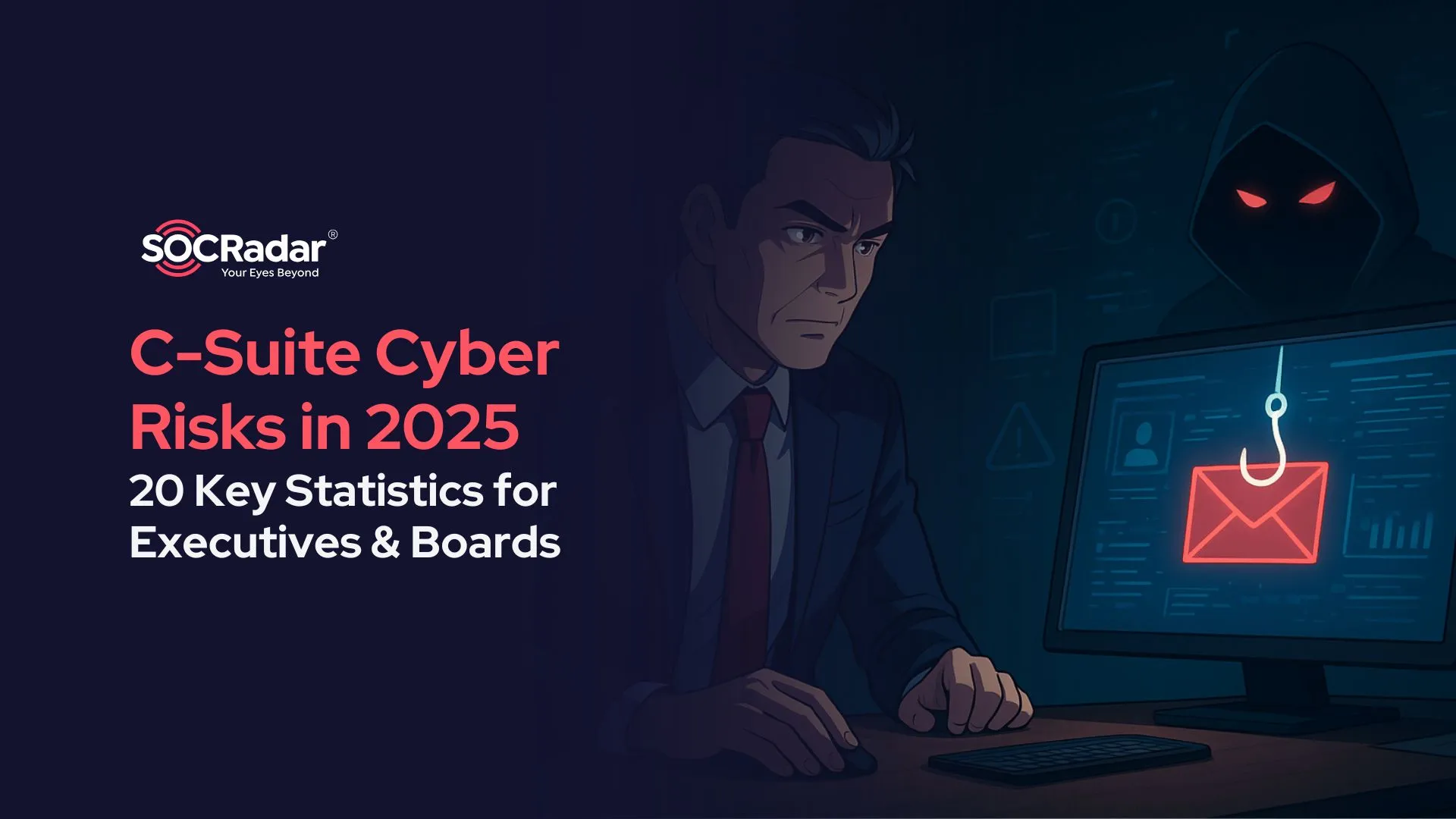
An AI illustration showing an executive at work, facing cyber threats.
To illustrate the scale and complexity of this challenge, we compiled 20 statistics every board should see in 2025. These insights span prevalence, financial impact, detection gaps, and emerging risks, helping leaders understand why executive-focused protection must become a priority.

Incident Prevalence: Who’s Being Targeted?
Executives are under constant digital siege. This section highlights how frequently leaders are being targeted, revealing the scale of the threat landscape. Identity fraud, account compromise, and breach data exposures all show how predictable and persistent this threat environment has become.
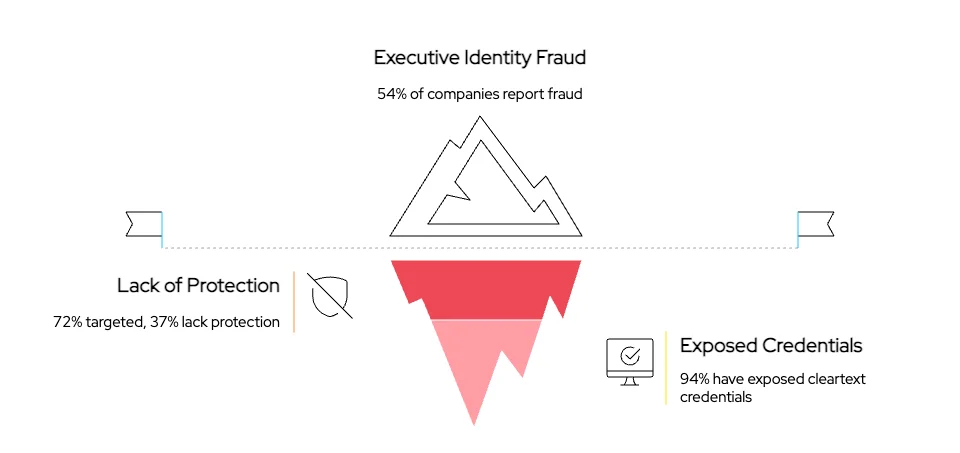
- 54% of U.S. companies report executive identity fraud. (Constella AI)
Identity-based attacks against leaders are not rare. They are becoming an everyday issue for security teams. - 72% of C-suite executives are targeted by cyberattacks, yet 37% of companies provide no additional cybersecurity protection. (GetApp)
While the majority of executives face direct threats, over a third of organizations haven’t formalized their protection strategies, leaving leadership dangerously exposed. - 94% of C-suite leaders had at least one exposed cleartext credential. (VanishID)
Executives’ credentials frequently appear in breaches, with an average of 43 exposures each – often reused across personal and professional accounts. - Over 70% of firms have executive-level or other credentials exposed on the dark web. (DeepStrike)
That means your leadership team is likely already part of the underground risk landscape, where stolen passwords, personal data, and even sensitive corporate access are traded. Without proactive dark web monitoring and executive protection strategies, these exposures can silently fuel phishing, account takeovers, and brand impersonation campaigns.
Protect Executive Credentials with Dark Web Monitoring
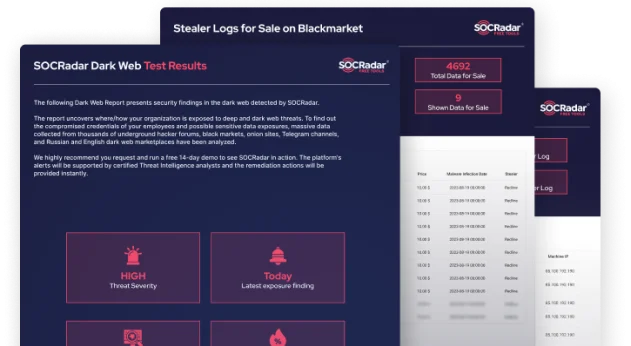
SOCRadar’s Dark Web Monitoring continuously scans underground forums, marketplaces, and leak sites for exposed executive credentials and sensitive corporate data. When stolen information appears, security teams receive real-time alerts, enabling swift remediation before adversaries can weaponize it.
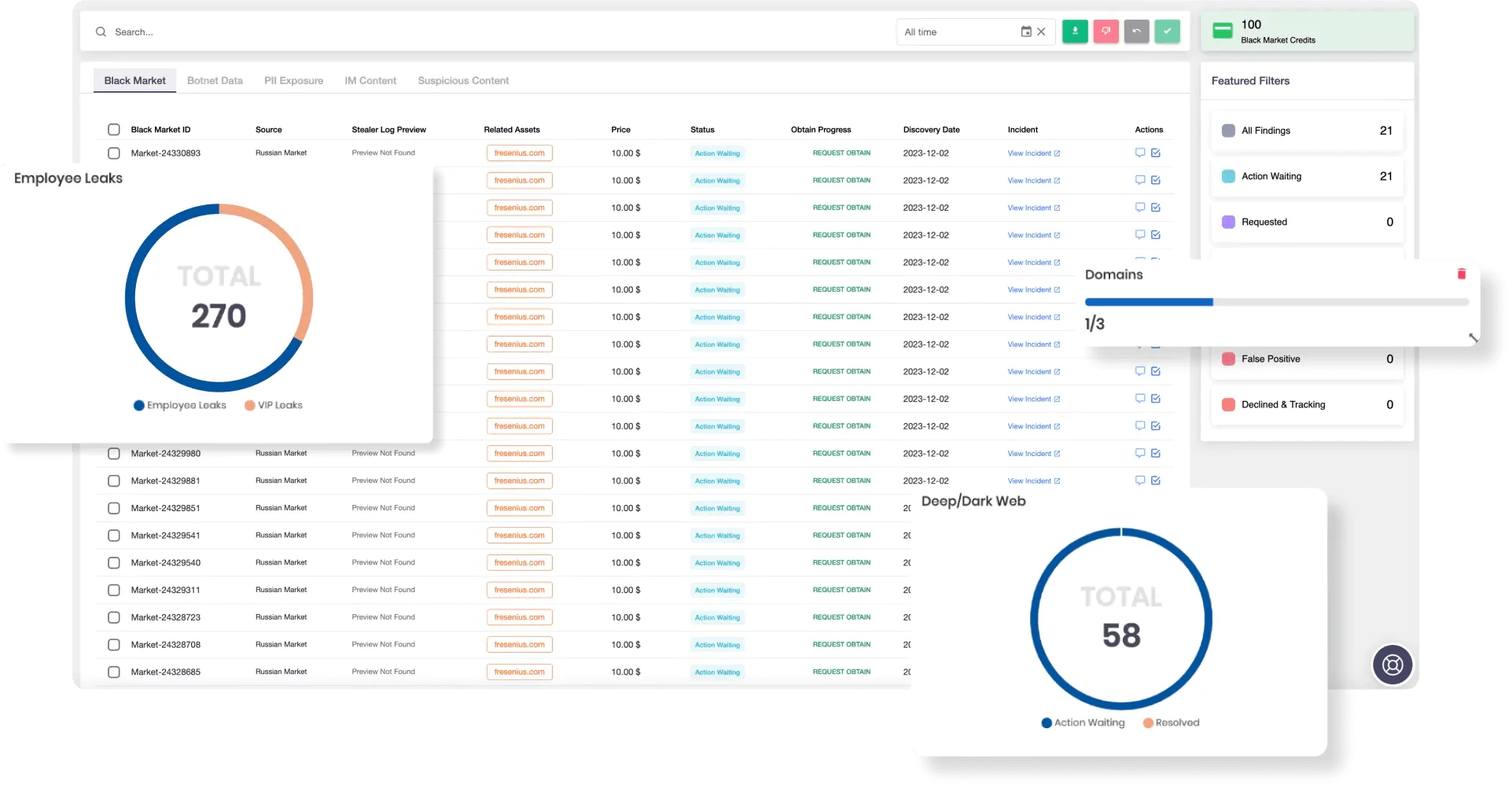
SOCRadar’s Dark Web Monitoring
With actionable intelligence, SOCRadar helps organizations stay ahead of identity theft, phishing campaigns, and other threats against executives that originate in the dark web.
Social Engineering and Emerging Attack Tactics
Some of the most dangerous threats executives face today come not from technical exploits, but from manipulation, impersonation, and psychological pressure. By combining new technologies like deepfakes with old standbys like BEC scams, adversaries ensure executives remain high-value entry points into organizations.
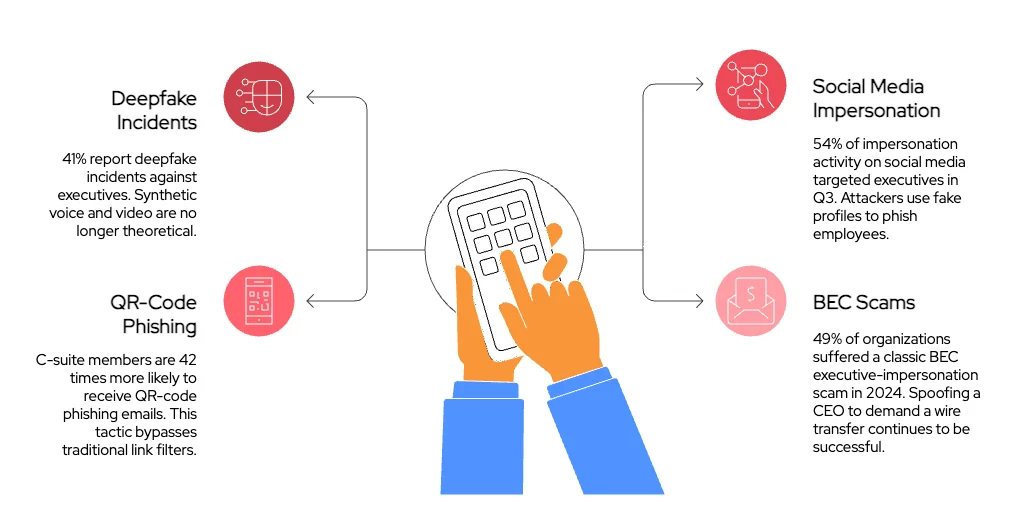
- 41% report deepfake incidents against executives.
Synthetic voice and video are no longer theoretical. Organizations have already faced payment scams and false instructions using manipulated media. (BlackCloak) - 54% of impersonation activity on social media targeted executives in Q3. (PhishLabs)
Attackers know executives are public-facing and use fake profiles to phish employees, partners, or customers at scale. - C-suite members are 42 times more likely to receive QR-code phishing emails. (Abnormal AI)
This tactic, known as “quishing,” bypasses traditional link filters and plays on executives’ reliance on quick responses via mobile devices. - 49% of organizations suffered a classic BEC executive-impersonation scam in 2024. (Truist)
The old method of spoofing a CEO or CFO to demand a wire transfer continues to be successful, proving that attackers don’t abandon what works.
Financial Impact & High-Profile Cases
Cyberattacks on executives lead to significant financial loss and reputational damage. This section looks at how costly these incidents have become, with real-world cases showing the severity of executive-targeted fraud.
- BEC scams drove $2.77B in reported U.S. losses in 2024. (IC3)
Business Email Compromise remains one of the costliest cybercrime categories, showing that attackers continue to prioritize executive and vendor impersonation for quick financial gains.
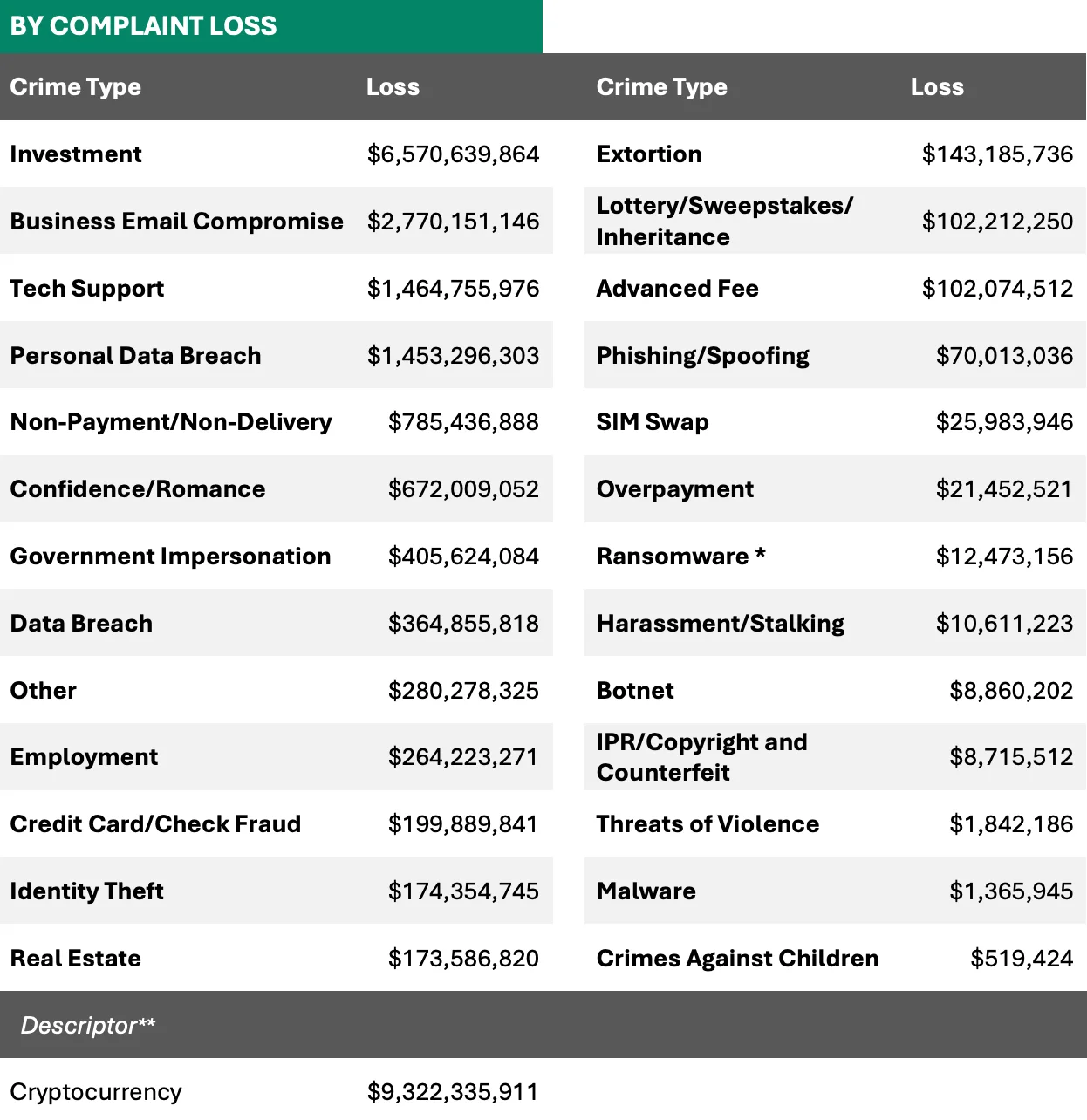
Crime types by financial loss (FBI Internet Crime Report 2024 – IC3)
- A deepfake CFO video call led to $25.6M in fraudulent transfers. (CNN)
In February 2024, scammers impersonated a finance leader on a video call to authorize major transfers, costing the organization millions. This case illustrates how sophisticated techniques are now being applied to high-value targets. - Over 105,000 deepfake CEO scams were reported in 2024, resulting in more than $200M lost in one quarter alone. (Wall Street Journal)
The scale of these incidents shows that AI-driven impersonation is no longer rare. High-profile firms across multiple sectors were hit, proving how widespread and profitable this method has become. - CDK Global suffered approximately $605M in financial losses – a considerable share may have included a $25M ransom payment. (EIMT)
This ransomware case disrupted thousands of car dealerships across North America, demonstrating how executive-level decisions and exposures can cascade into massive operational and financial fallout.
Financial losses tied to executive targeting are already measured in billions. These cases prove that while some attacks may look opportunistic, others are carefully engineered to exploit leadership access with devastating results.

Insider Risks & Governance Weaknesses
Executives can also be exposed by governance flaws and insider threats that bypass traditional defenses. The statistics below highlight overlooked weaknesses tied to policy enforcement, insider misuse, and gaps in leadership accountability.
- 83% of organizations experienced an insider attack in the last year. (DeepStrike)
Insider threats often involve privileged users with elevated access. Executives’ elevated access makes them both high-value targets and potential sources of insider risk when accounts are misused or compromised. - 50% of organizations take three days or longer to revoke access after employee departures, leaving executive credentials exposed during transitions. (IDSA)
Failure to quickly remove privileged accounts creates long-lived vulnerabilities tied to leadership changes.
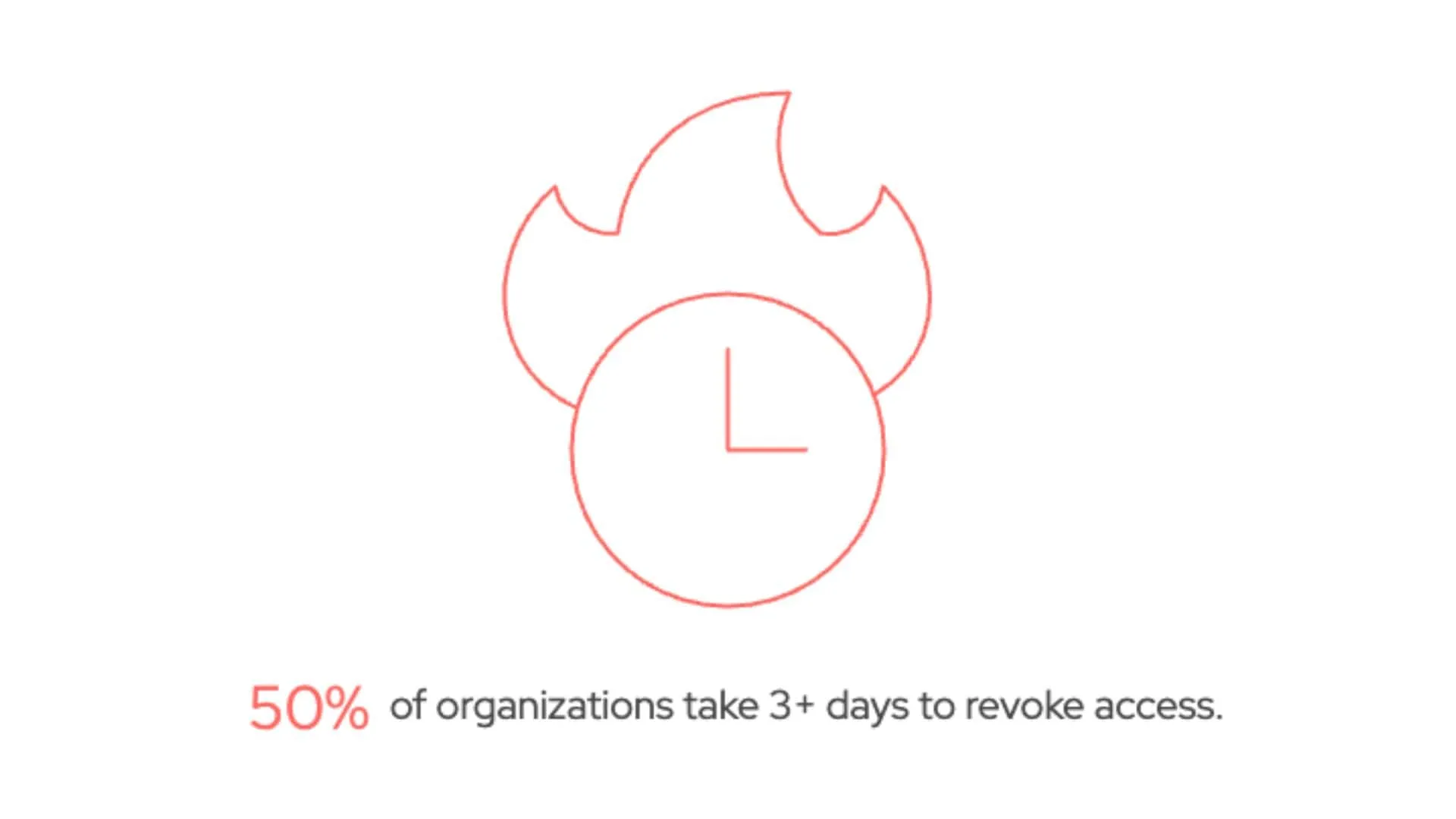
Internal governance gaps can amplify the external risks already pressing down on executives. Insider misuse, weak oversight, and poor offboarding practices leave critical holes in executive protection.
Detection and Response Gaps
When it comes to executives, many organizations struggle to keep pace with evolving threats. There might be shortcomings in training, preparation, and response capabilities, which leave leaders exposed.
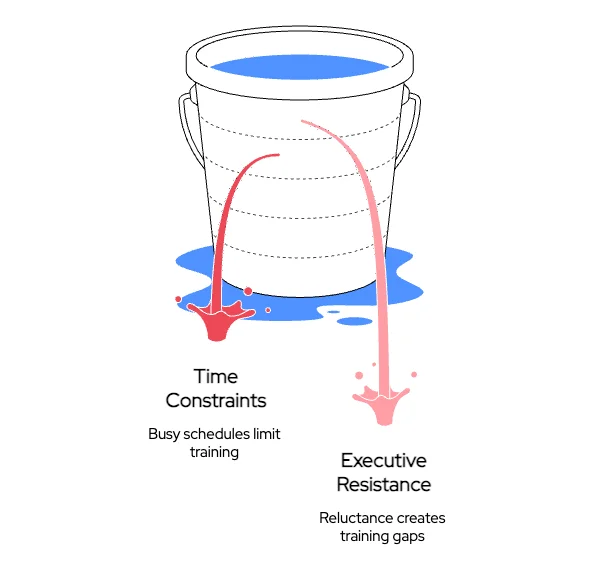
- 34% of organizations cite executive time constraints or resistance as the reason they don’t prioritize cybersecurity training for senior leaders. (DeleteMe)
Even when the need is acknowledged, practical barriers like busy schedules or reluctance can create training gaps.
- Only 29% of boards regularly review cybersecurity metrics specific to executives. (Deloitte)
Without clear oversight at the governance level, leadership exposure often goes unmeasured and unaddressed. - Half of security teams lack confidence in preventing deepfake-driven breaches. (BlackCloak)
Controls and playbooks for handling manipulated media remain immature, even as such attacks rise.
These statistics underline a troubling imbalance. Even as attacks multiply, organizations are still behind in training, monitoring, and deploying effective safeguards at the executive level.
Attitudes & AI-Driven Risks
Finally, what do security leaders themselves think about the risks? This section captures the sentiment of CISOs and other defenders, highlighting their expectations of looming attacks and the human factors that continue to drive breaches.
- 70% of CISOs believe that they will face a material cyberattack within 12 months. (Proofpoint)
Even security leaders themselves expect that their organizations will be impacted in the near term. - 74% of CISOs say human error is their greatest vulnerability. (Proofpoint)
The consensus among security leaders is clear: people, especially those with influence and authority, remain the most likely source of compromise. - 80% of CISOs now cite AI-powered cyberattacks as their top concern. (BCG/GLC)
AI-enabled threats are keeping security leaders awake, demanding immediate adjustments in strategy, budgets, and defensive architecture.
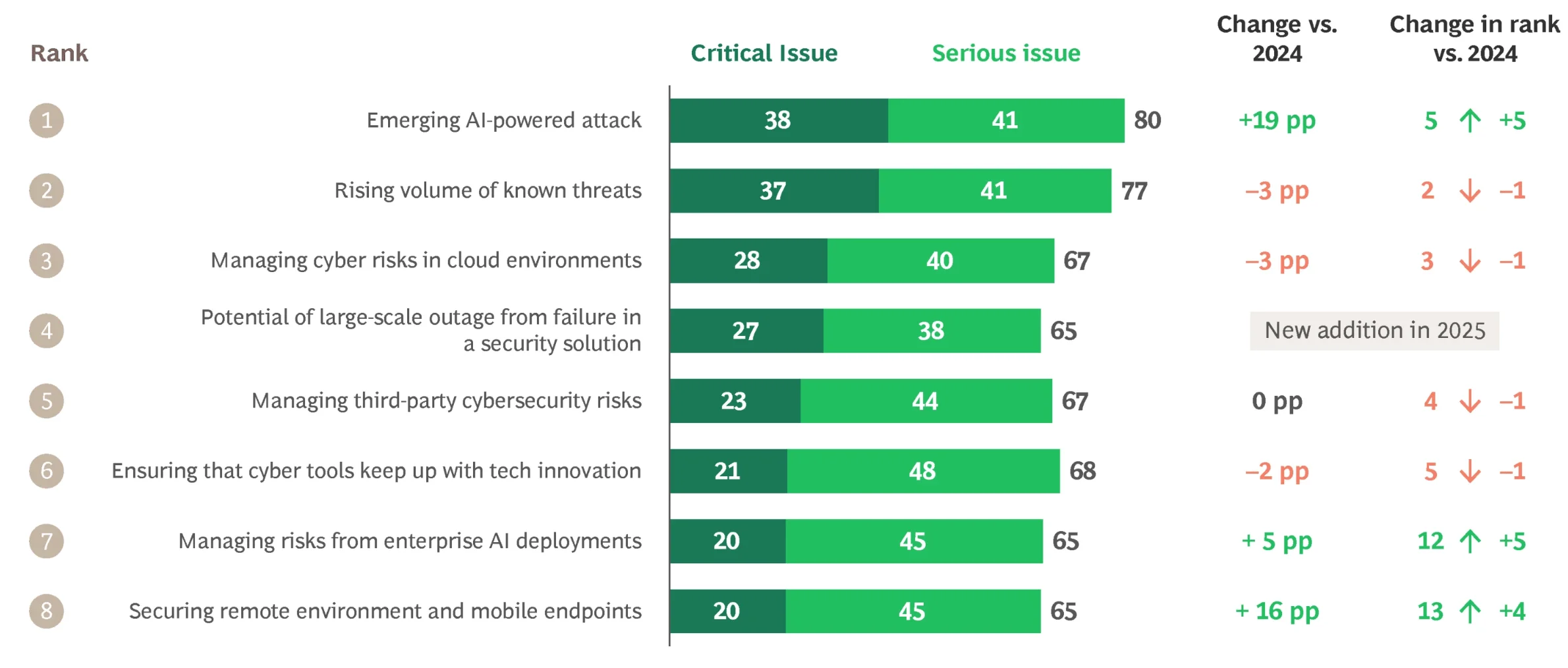
Top CISO priorities (BCG & GLG CISO Survey)
The perspective of CISOs adds an important closing layer: those closest to the problem see major risks looming and agree that leadership behavior is a critical vulnerability.
What These Numbers Tell Us
Across all of these data points, several themes stand out:
- Executives remain disproportionately targeted. Their positions of influence, financial authority, and public visibility make them predictable entry points for cybercriminals. Whether through identity theft, credential compromise, deepfake impersonation, or classic social engineering, leadership accounts are consistently singled out.
- Defenses are lagging. Despite billions in fraud losses and repeated warnings, too many organizations still lack mature executive-specific training, monitoring, and incident response.
- The financial and reputational impact is undeniable. Real-world cases from deepfake-enabled transfers to ransomware demonstrate that attacks aimed at executives routinely cost millions and cause prolonged disruption.
- AI has amplified both the scale and sophistication of threats. From synthetic voice to video impersonation, adversaries are moving faster than most defenses, forcing organizations to adopt new tools and verification processes.
- Governance and culture matter as much as technology. Insider misuse, delayed offboarding, and weak board oversight compound external risks, showing that leadership engagement is a key determinant of resilience.
Building a Resilient Executive Security Program
CISOs and security teams should treat executive protection as a business resilience issue, not just a technical one. That means:
- Running regular, executive-specific phishing and social engineering simulations.
- Extending protection programs to include family members and personal devices.
- Enforcing rigorous verification protocols for financial and sensitive requests.
- Deploying capabilities to detect and validate synthetic media in real time.
- Strengthening governance processes such as rapid access revocation and board-level oversight.
Executives are both the face and the decision-making core of the enterprise. In 2025, they are also its most exposed frontline. Closing the protection gap is fundamental to protecting reputation, trust, and financial stability.
Protect Your CEO, CFO, and C-Suite Leaders from Cyber Risks with SOCRadar
The numbers speak for themselves: executives are prime targets for phishing, deepfakes, impersonation scams, and dark web exposure. Protecting them requires proactive, specialized defenses that go beyond traditional security.
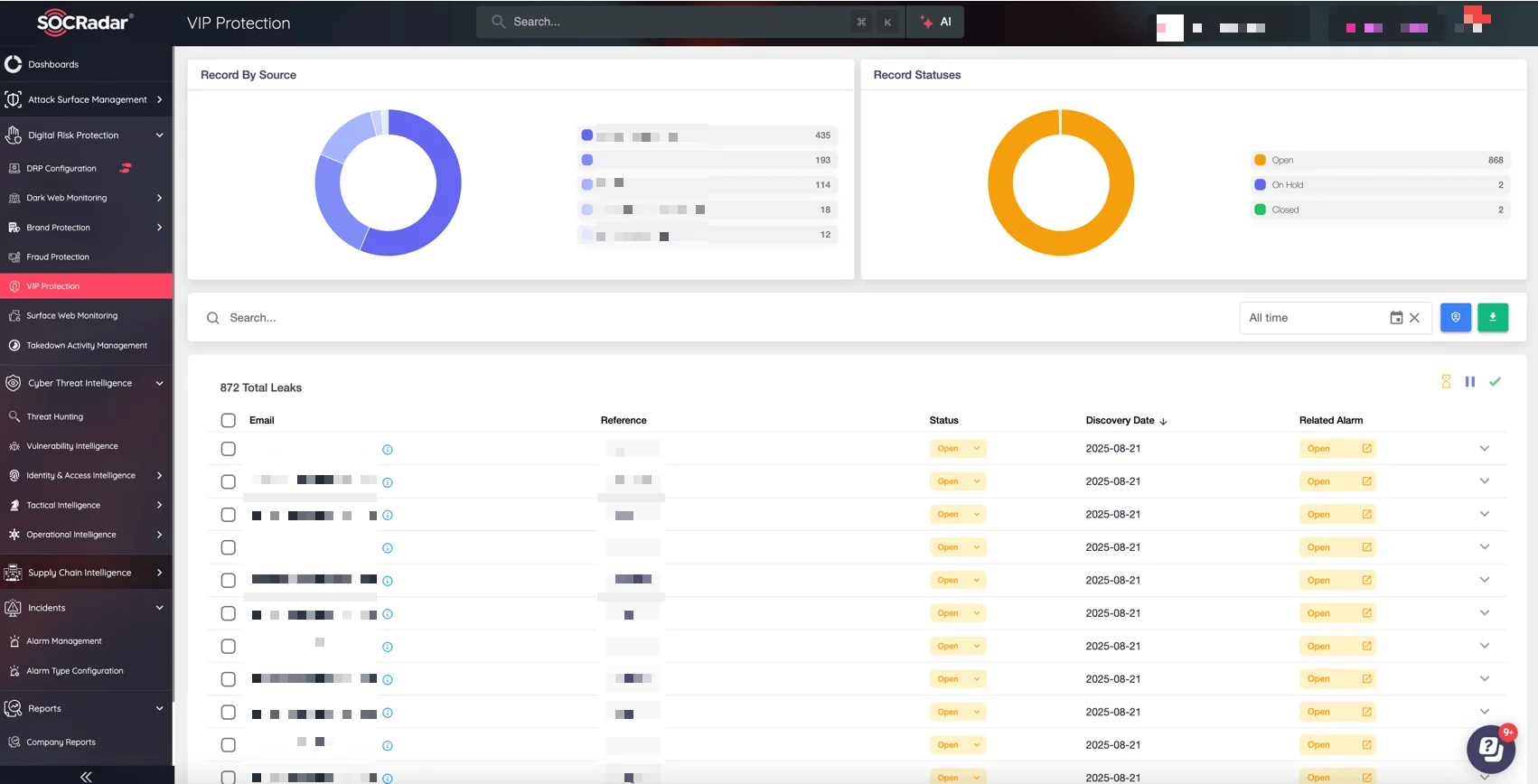
Protect your executives and brand with SOCRadar XTI
With SOCRadar, organizations can:
- Leverage Dark Web Monitoring to detect executive credentials and sensitive data circulating in underground forums and marketplaces.
- Use VIP Protection, part of the Digital Risk Protection suite, to reduce exposure of executives’ and families’ personal digital assets.
- Detect fake social media accounts, fraudulent domains, and impersonation sites targeting leadership.
- Enable rapid takedown actions via Brand Protection before adversaries exploit your brand or your executives.

Table Of Content
C-Suite Cyber Risks in 2025: 20 Key Statistics for Executives and Boards
Incident Prevalence: Who’s Being Targeted?
Social Engineering and Emerging Attack Tactics
Financial Impact & High-Profile Cases
Insider Risks & Governance Weaknesses
Detection and Response Gaps
Attitudes & AI-Driven Risks
What These Numbers Tell Us
Protect Your CEO, CFO, and C-Suite Leaders from Cyber Risks with SOCRadar
Related Articles

NetScaler C2: CVE-2026-88771 Exploitation Operation