How to Cut Through Dark Web Noise and Focus on Threats That Actually Target You
Cyber environment produces more data than security teams can realistically process. As cybercriminal operations evolve into structured, service-driven ecosystems, the Dark Web has become a central marketplace for stolen credentials, leaked databases, and illicit access. The core challenge for security operations is no longer visibility. It is prioritization.
Dark Web noise refers to recycled, outdated, exaggerated, or fabricated data that inflates alert volume without increasing defensive value. Excessive noise reduces analyst efficiency, delays incident response, and increases the risk of overlooking high-impact signals.
To operate effectively in this environment, organizations must move beyond passive collection. Structured, intelligence-led monitoring anchored to validated assets, critical infrastructure, and business context is essential. Without this shift, monitoring becomes volume-driven rather than risk-driven.
The Architecture of the Cyber Underground and the Taxonomy of Intelligence
The Dark Web operates as an access-controlled ecosystem where anonymity supports illicit trade, credential sales, ransomware negotiations, and access brokering. Unlike the surface web, it is not indexed by conventional search engines and relies on specialized access methods such as Tor. Within this environment, threat actors organize activity across forums, marketplaces, encrypted messaging platforms, and leak sites. Each channel provides a different layer of intelligence value.
Understanding these source types is critical. Without classification, monitoring efforts collapse into undifferentiated data collection.
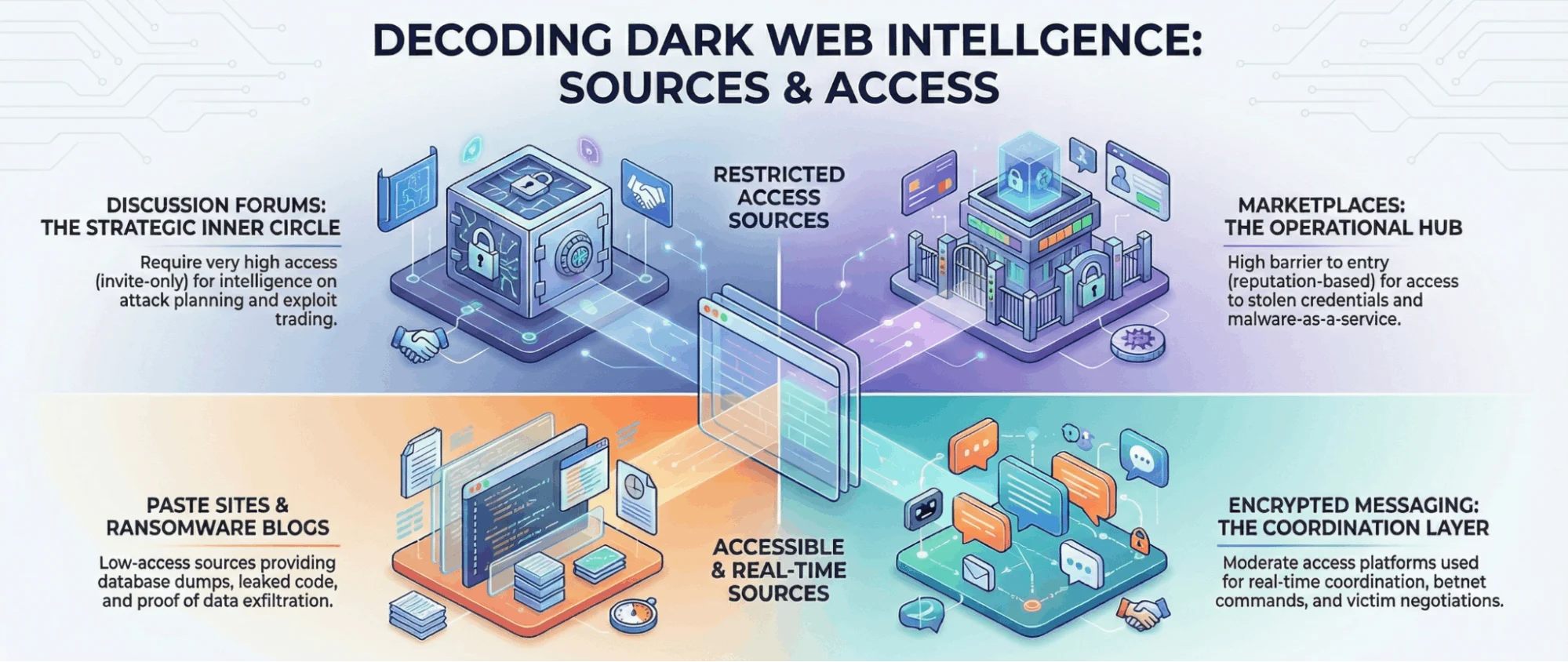
Classification of Dark Web intelligence sources
The rapid expansion of underground sources has created a data-heavy environment where raw exposure often masquerades as intelligence. Data becomes intelligence only when analysts add context, attribution, and operational relevance. Without that refinement, monitoring programs generate volume without clarity and contribute directly to alert fatigue rather than risk reduction.
The Monitoring Trap
Threat intelligence teams often respond to growing risk by expanding coverage. They add more keywords, monitor additional forums, and track more Telegram channels. This expansion frequently creates a monitoring trap. Alert volume exceeds analyst capacity, and meaningful signals disappear inside operational noise.
Dark Web noise typically falls into six recurring categories:
- Generic Data Exposure: Large credential dumps and recycled combo lists circulate repeatedly across underground communities. These datasets appear significant in size but rarely provide operational value unless directly mapped to active employees, corporate domains, or privileged accounts.
- Irrelevant Actor Chatter: Underground forums contain continuous discussions about tools, exploits, and general vulnerabilities. Without sector, region, or asset-level filtering, analysts review conversations that do not present direct organizational risk.
- Temporal Noise: Previously disclosed breaches and historical leaks resurface as new content. Without deduplication and timeline correlation, teams re-investigate incidents that were already mitigated.
- Deceptive and Synthetic Data: Threat actors frequently exaggerate breach size or publish automatically generated datasets to inflate credibility. Claims of terabyte-scale leaks often collapse under verification, revealing minimal or fabricated data.
- Market-Driven Mislabeling: Sellers repackage stale combo lists and market them as fresh infostealer logs or newly compromised databases. This mislabeling distorts risk assessment and wastes investigative effort.
- Multi-Channel Redundancy: A single campaign often spreads across dozens of Telegram groups and darknet forums simultaneously. Without cross-source correlation, monitoring systems generate duplicate alerts that artificially inflate perceived impact.
Noise does more than consume analyst time. It increases the probability of missing critical signals. While teams triage recycled datasets, they may overlook urgent exposure such as verified VPN access to corporate infrastructure being offered for sale. That type of signal requires immediate validation and incident response.

What Noise Actually Looks Like
Not all dark web noise is the same, and understanding the different types helps teams build better filters.
The most common form of Dark Web noise appears after high-profile breaches. When a major intrusion becomes public, stolen datasets rarely remain confined to a single leak post. They fragment, repackage, and circulate repeatedly across underground forums.
A practical example can be observed in activity linked to the Scattered Lapsus$ Hunters group. After their Salesforce-related intrusion, data associated with impacted organizations began surfacing across multiple hacker forums. The original breach disclosure quickly evolved into dozens of secondary posts. Different actors reposted partial datasets, repackaged archives, and rebranded the same material under new titles to attract attention or build credibility.
From a monitoring perspective, each repost looks like a fresh exposure. In reality, many of these posts reference the same underlying incident. Without correlation mechanisms, security teams receive repeated alerts for identical data. Analysts spend time revalidating previously known exposures instead of focusing on genuinely new risks.
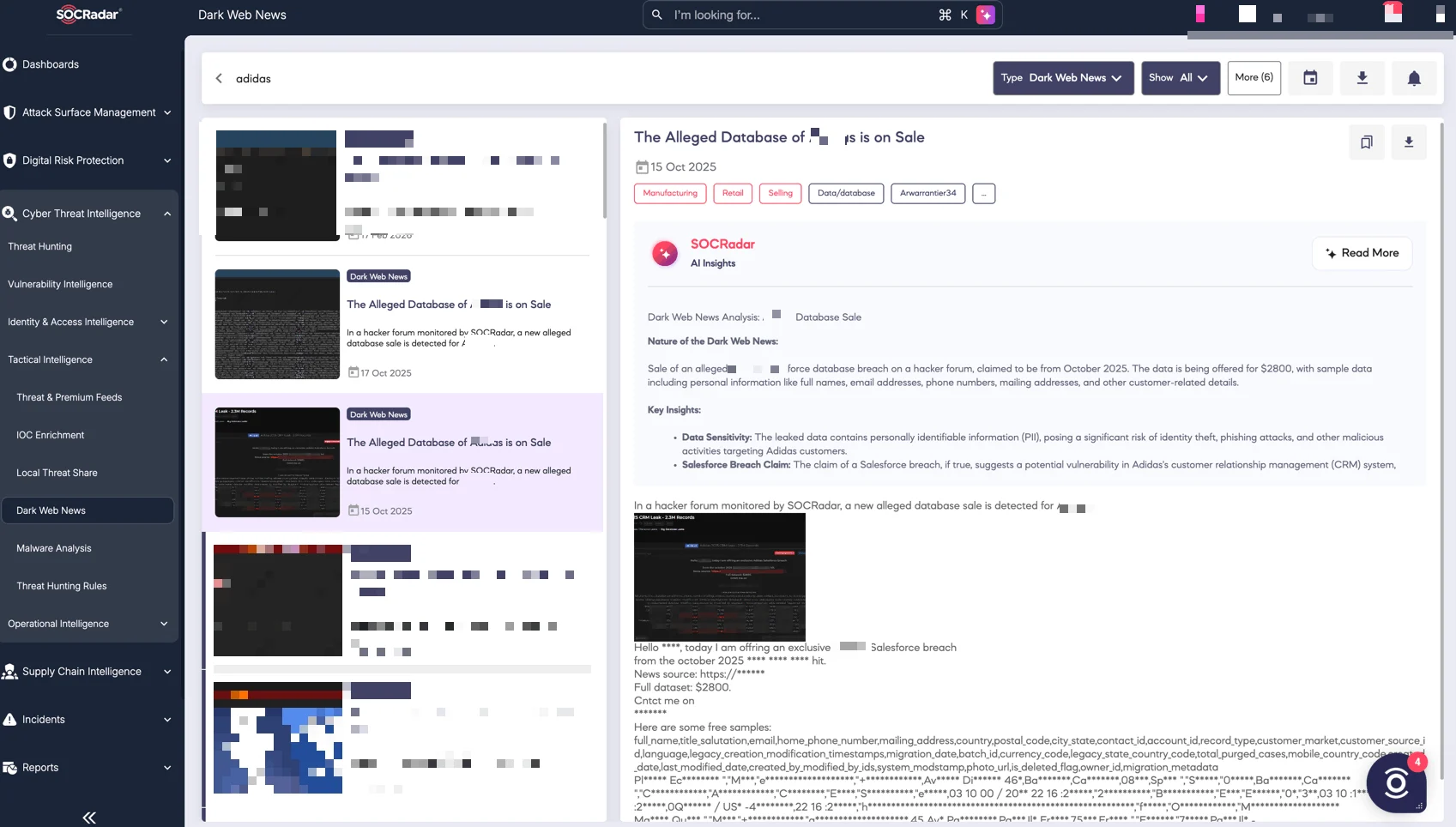
SOCRadar Dark Web News, October 15, 2025, shows the Salesforce-linked dataset offered for 2,800 USD and advertised as an exclusive breach.
This is where contextualized monitoring becomes essential. With SOCRadar’s Advanced Dark Web Monitoring capabilities, reposted datasets tied to previously identified incidents can be correlated, deduplicated, and mapped to the original breach timeline. Instead of generating separate alerts for every forum mention, the system associates related posts with the same root event, reducing noise while preserving visibility.
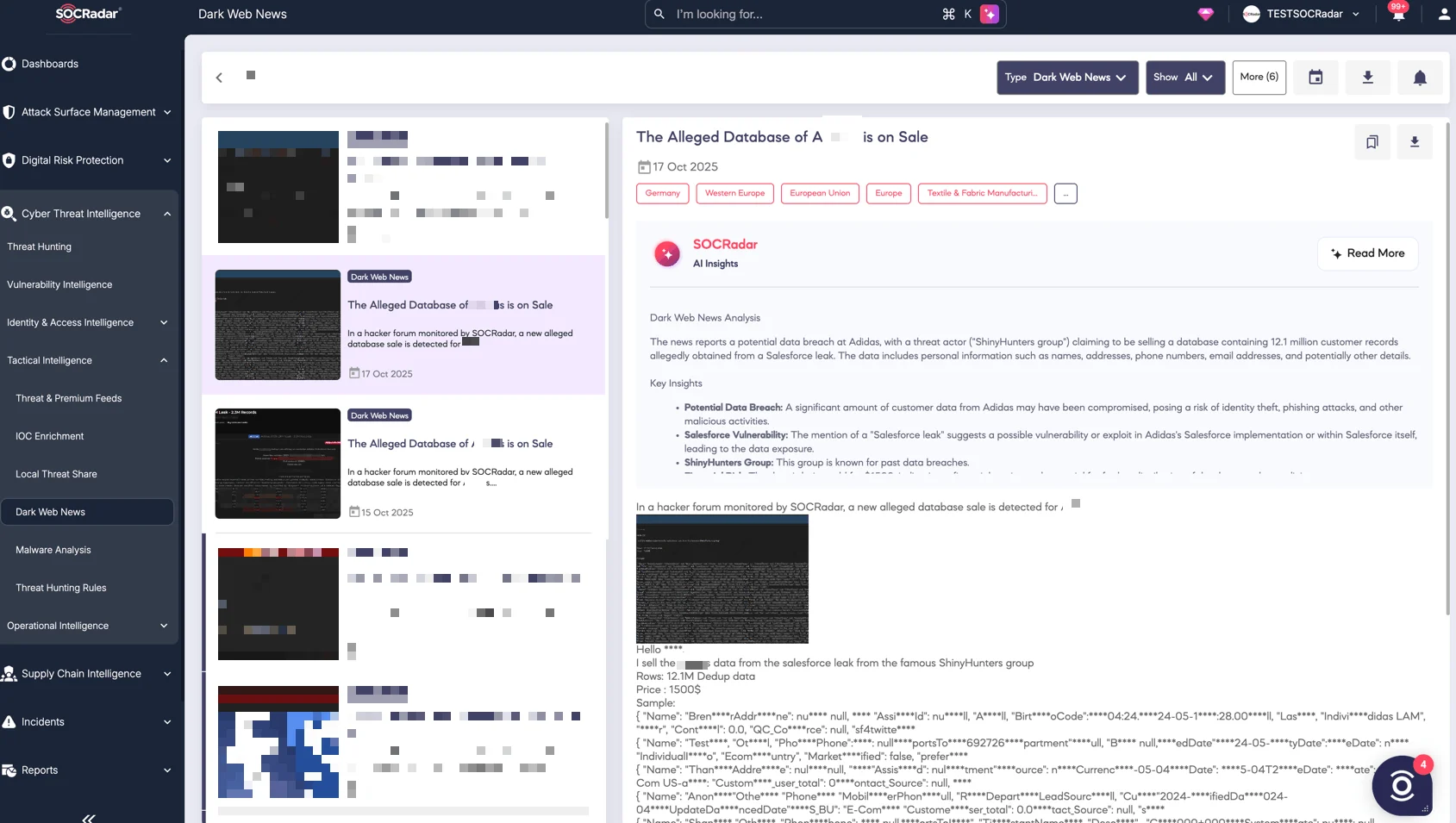
SOCRadar Dark Web News, October 17, 2025, captures the same dataset reposted on a different forum for 1,500 USD under a separate actor identity.
In the Salesforce-related case, forum chatter across multiple underground platforms was automatically linked back to the same campaign context. This prevents alert inflation while ensuring that genuinely new data additions or novel actor involvement are still surfaced.
Assessing Actor Credibility Beyond Forum Reputation
Not every leak post reflects a genuine compromise, and not every threat actor delivers what they claim. Underground ecosystems reward visibility, and visibility often encourages exaggeration. Some actors consistently publish verifiable data tied to confirmed breaches. Others recycle historical datasets, inflate breach sizes, or fabricate access claims to gain attention.
Forum reputation scores are frequently used as a shortcut for credibility assessment. However, reputation is tied to a specific platform. A high score reflects activity within that forum’s trust system, not necessarily operational capability. When a forum is disrupted, that visible reputation history disappears, even if the actor remains active.
The BreachForums takedown illustrated this dynamic. When the platform was shut down, several well-known actors migrated to alternative communities. IntelBroker, who had been highly active on BreachForums, resurfaced under the same alias on DarkForums shortly after the shutdown. This was not an isolated case. Multiple established actors followed similar paths.
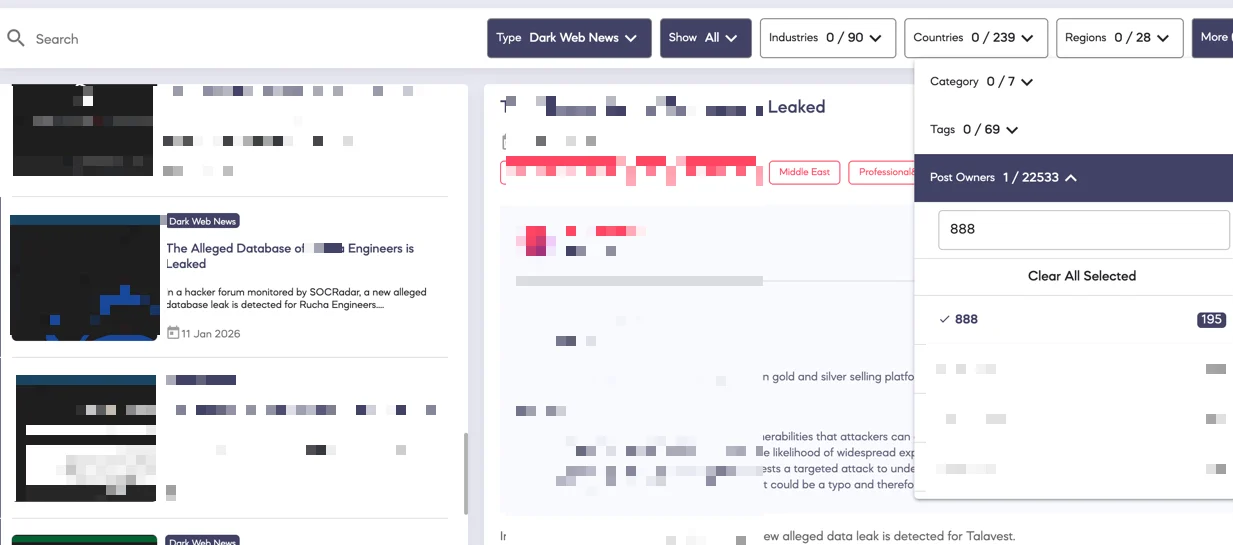
SOCRadar platform view displaying cross-forum activity of the 888 alias, highlighting identical data leak posts shared on different underground communities.
As recognizable aliases joined, DarkForums gained traction rapidly. Platform credibility increased because known actors brought behavioral continuity with them. Reputation did not transfer through forum scoring systems. It transferred through observable activity patterns.
This highlights a key analytical principle. Actor credibility should be assessed based on behavior over time rather than forum-level metrics. More reliable indicators include:
- Consistent alias usage across multiple underground platforms
- Reuse of infrastructure such as domains, wallets, or command-and-control servers
- Recurring victim targeting patterns
- Continued use of similar malware families or tradecraft
- A track record of validated breach claims
These indicators persist even when forums collapse or fragment.
Through SOCRadar’s Advanced Dark Web Monitoring capabilities, security teams can correlate actor activity across platforms, follow migration patterns after takedowns, and distinguish established operators from opportunistic resellers. By tracking actor continuity rather than relying on a single forum’s reputation system, organizations maintain analytical context even during ecosystem disruption.
Platforms change. Behavioral patterns remain. Actor credibility lives in tradecraft, not in forum badges.
This distinction between recycled exposure and active threat intelligence is critical. Without structured filtering, the underground appears louder than it actually is. With contextual correlation, analysts can focus on signals that reflect new compromise, not repeated conversation.
Searching Underground Exposure by Asset Instead of Platform
In real investigations, analysts rarely begin with a forum name. They begin with an asset. It may be a suspicious email address identified in logs, a domain observed in a paste site, or a username reused across environments. The central question is where else this asset has appeared.
Rather than searching each platform separately, teams can pivot directly from the asset itself.
For example, when an analyst queries a single email address through SOCRadar’s Threat Hunting module, the system retrieves indexed matches across monitored hacker forums, Telegram channels, Discord communities, and other dark web sources within a unified view. There is no need to manually navigate separate platforms or compare fragmented posts.
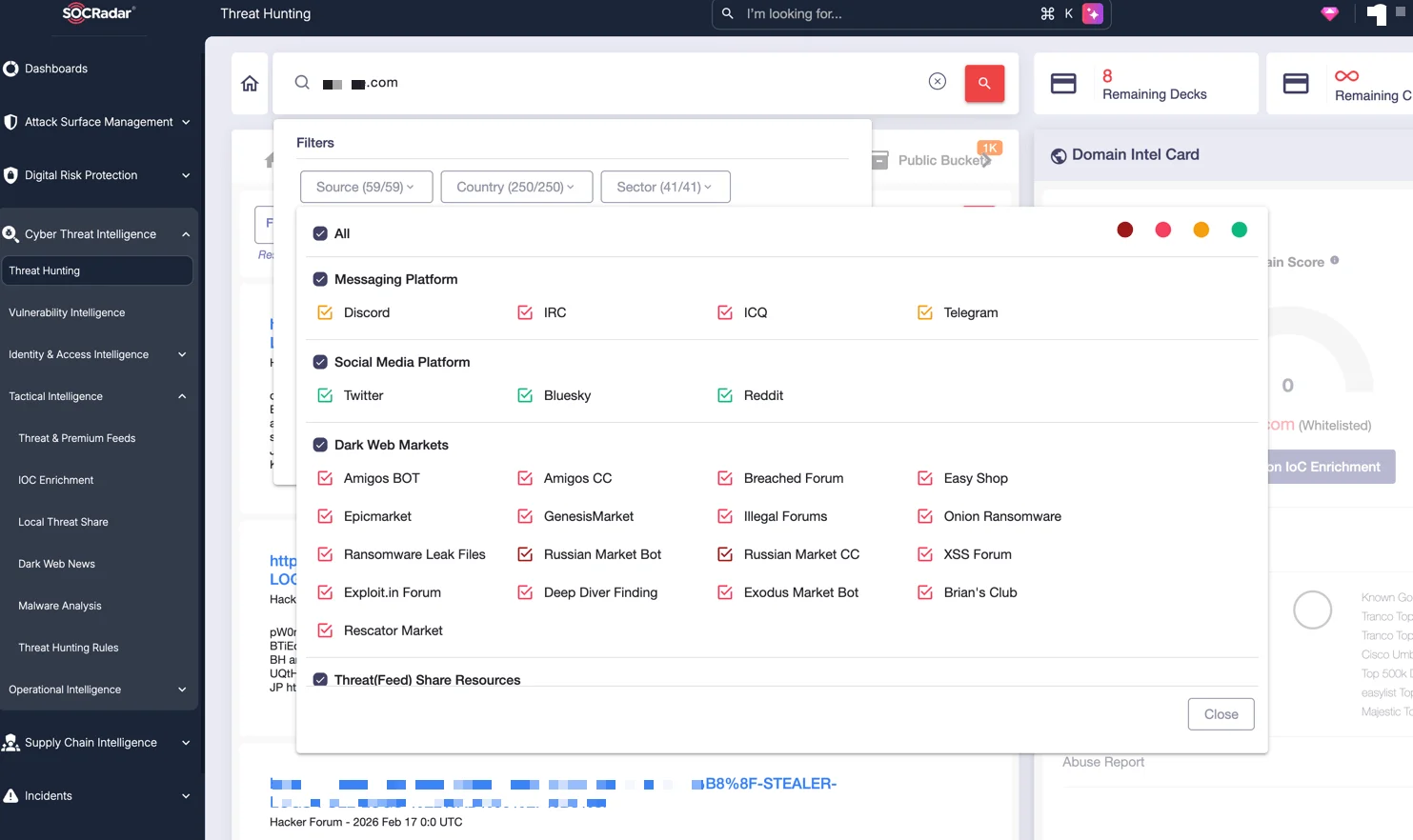
Email-based query across hacker forums and Telegram channels via SOCRadar Threat Hunting
This approach enables rapid validation:
- Determine whether the email belongs to a historical credential dump or a recently surfaced dataset
- Identify if the address is currently being advertised for sale
- Detect associations with specific threat actors or reseller accounts
- Assess whether the exposure is isolated or connected to a broader incident
The workflow becomes asset-centric rather than platform-centric. Analysts concentrate on exposure relevance and impact while the platform maps where the asset appears across the underground ecosystem.
Conclusion
Dark Web intelligence demands more than visibility. The ecosystem will continue to generate volume, exaggeration, recycled data, and shifting identities. Expanding monitoring alone does not improve security posture. Without structure, additional data only increases friction inside operations.
The distinction between noise and risk depends on context and prioritization. When monitoring aligns with validated assets, incorporates actor behavior, and correlates activity across sources, intelligence becomes actionable. Analysts stop reacting to volume and start evaluating impact.
In a high-volume Dark Web environment, precision matters more than coverage. Effective intelligence narrows focus, clarifies risk, and supports timely decisions.