CVE-2026-123903: Critical Auth Bypass Hits VMware vCenter
Broadcom has fixed CVE-2026-123903, a critical authentication bypass in VMware vCenter that a remote attacker can trigger with nothing more than network access to the appliance. The update landed on November 24, 2026, five days after Broadcom patched CVE-2026-123890, a flaw in the same directory component that a suspected China-nexus espionage group had exploited as a zero-day.
While Broadcom has not reported exploitation of the new bug, the timing still matters for vSphere teams: on VMware Cloud Foundation (VCF) and vSphere Foundation 9.x, the builds installed last week to stop the zero-day do not cover CVE-2026-123903.
What Is CVE-2026-123903?
CVE-2026-123903 (CVSS 9.8) sits in the VMware Directory Service (vmdir), the directory behind vCenter Single Sign-On (SSO) that holds the identities vCenter trusts. It requires no privileges and no user interaction, and the only stated prerequisite is network access to vCenter.
Broadcom has not published the root cause, the vulnerable function or the request sequence.
It is a different issue from CVE-2026-123890, so patches for the earlier flaw cannot be assumed to cover it.
This is the third vmdir authentication bypass Broadcom has fixed in 2026:
- CVE-2026-59309: Patched on July 29
- CVE-2026-123890: Patched on November 19 under VMSA-2026-0009 and exploited by Armory Castle since early September
- CVE-2026-123903: Patched on November 24 under VMSA-2026-0011
The earlier intrusions show what control of vCenter SSO can lead to. In the Armory Castle campaign, researchers saw the attackers add an SSO administrator, copy the directory database, forge SAML tokens and reach Active Directory files on guest VM disks. That chain describes CVE-2026-123890; nothing published so far shows the same tooling working against CVE-2026-123903.
Do Last Week’s Zero-Day Patches Cover CVE-2026-123903?
It depends on the branch. The table below compares the fixed versions Broadcom lists for the two vmdir flaws.
| Product and Branch | Fixed for CVE-2026-123890 (VMSA-2026-0009) | Fixed for CVE-2026-123903 (VMSA-2026-0011) |
|---|---|---|
| vCenter in VCF or vSphere Foundation 9.1.x | 9.1.1.0200 | 9.1.2 |
| vCenter in VCF or vSphere Foundation 9.0.x | 9.0.2.0200 | 9.0.2.0300 |
| VMware vCenter 8.0 | 8.0 U3m | 8.0 U3m |
| VMware vCenter 7.0 | No public fix; extended support customers contact Broadcom | No public fix; extended support customers contact Broadcom |
| vCenter in VCF 5.x | 5.2.5 | 5.2.5 (asynchronous patching, KB 88287) |
| Telco Cloud Platform and Telco Cloud Infrastructure | vCenter 8.0 U3m (KB 463116) | vCenter 8.0 U3m (KB 463501) |
Teams on 9.x need a second update, even if they patched for the zero-day days ago. On vCenter 8.0, Broadcom lists 8.0 U3m as the fixed release for both CVEs, so systems already on that build match the advisory’s fixed version. Confirm the exact build number rather than the update label before closing the ticket.
vCenter 7.0 remains the hardest case. Broadcom marks it affected and offers fixes only through extended support, which leaves other 7.0 deployments without a public patch for either vmdir bypass. Broadcom lists no workaround for any of the vCenter CVEs in this advisory.
What Else Does VMSA-2026-0011 Fix?
The advisory covers 23 CVEs across vCenter, ESX, Workstation, Fusion, VMware Tools and Avi Load Balancer. Broadcom has not reported any of them as exploited.
Other vCenter issues ship in the same builds as CVE-2026-123903:
- CVE-2026-123904 (CVSS 7.5): Arbitrary file write while vCenter processes certain archives, which can lead to code execution on the appliance; exploitation requires access to the backup repository
- CVE-2026-123905, CVE-2026-123906 and CVE-2026-123907 (CVSS 7.5 each): Denial-of-service flaws in vmdir
- CVE-2026-123908 (CVSS 6.7): Local privilege escalation through a vpxd service script, which requires a compromised vpxd account
- CVE-2026-123909 (CVSS 5.2): A vSphere Distributed Switch security policy that is not enforced
ESX carries the other two 9.8-rated bugs. CVE-2026-123910 is a heap out-of-bounds write and CVE-2026-123911 is a use-after-free, both in the ESX I/O filter service and both reachable over the network without authentication. Fixed builds are ESX 9.1.2, ESXi-9.0.2.0200-25953133 for 9.0.x and ESXi80U3m-25926933 for 8.0. Broadcom points ESX 8.0 users to KB 463535 for an interim measure, and its FAQ describes restricting network access to the I/O filter service as weaker than patching. Two moderate ESX 9.0.x issues, CVE-2026-123914 and CVE-2026-123915, were still marked “Patch Pending” at publication.
Workstation and Fusion receive a fix in version 26H1u1 for CVE-2026-123912, an out-of-bounds write in the XHCI USB controller rated 9.3 on those products; it also affects ESX. Removing the XHCI controller from virtual machines is discussed as a partial mitigation only.
Avi Load Balancer and VMware Tools account for the remaining nine CVEs, all lower in severity. Avi 32.1.4 fixes all eight Avi flaws, and VMware Tools 13.1.10 and 12.5.6 fix CVE-2026-123918.
How Exposed Is vCenter Right Now?
There are no reports of CVE-2026-123903 being exploited, and no public proof of concept was identified at the time of writing. Broadcom’s advisory and FAQ do not claim exploitation, and the flaw had been public for roughly a day as of November 25, 2026.
The surrounding activity is the reason to move quickly anyway. Armory Castle used a vmdir bypass for more than two months before a patch existed, and its tooling reportedly worked on vCenter instances already patched for CVE-2026-59309. A group with that level of interest in vmdir now has a fresh advisory to compare against older builds.
Two scope points help with triage. The flaw needs network reachability, so vCenter interfaces exposed beyond management networks carry the highest risk. ESX hosts are not affected by CVE-2026-123903 itself, but an attacker in control of vCenter can manage every host attached to it.
Patch Order for vSphere Administrators
Work through vCenter first, then the hosts:
- Inventory builds: List every vCenter appliance with its exact build, and flag 9.x systems sitting on 9.1.1.0200 or 9.0.2.0200 from last week’s emergency patching
- Update vCenter: Move to 9.1.2, 9.0.2.0300 or 8.0 U3m, or the VCF 5.2.5 and Telco equivalents listed above
- Update ESX: Apply the ESX builds that fix CVE-2026-123910 and CVE-2026-123911, and use KB 463535 on ESX 8.0 only as a bridge
- Plan for 7.0: Contact Broadcom if you hold an extended support contract; otherwise, schedule the upgrade and keep those appliances isolated in the meantime
Network restrictions reduce exposure while updates roll out. Limit vCenter management interfaces to dedicated administrative hosts, and review which systems can reach the vmdir RPC service on TCP port 2012, the interface abused in the CVE-2026-123890 attacks.
Because the zero-day hit the same component, a compromise review is worth running alongside patching. Useful hunting leads, drawn from the Armory Castle findings rather than from any CVE-2026-123903 indicator, include:
- SSO accounts: Administrator or machine accounts in vsphere.local that nobody on the team created
- SSH toggling: Appliance management logs showing SSH enabled and then disabled again
- ESX access: New entries in root authorized_keys and unusual root or vpxuser logins
Clean results do not prove the environment is untouched, since appliances without EDR give defenders limited telemetry. If evidence appears, rotate the vCenter STS signing certificate, the master key and SSO credentials following Broadcom guidance for your version.
Keeping Pace With Overlapping VMware Fixes
Three vmdir bypasses in four months, with fixed builds superseding each other within days, make it easy to mark vCenter as patched against the wrong advisory. SOCRadar helps teams keep both the fixes and their own exposure in view:
- Vulnerability Intelligence: Tracks CVE-2026-123903 alongside CVE-2026-123890 and CVE-2026-59309, including new fixed builds, exploitation reports, proof-of-concept claims and KEV changes
- Autonomous Exposure Management: Finds internet-facing vCenter and ESX management interfaces tied to your organization, so the appliances an unauthenticated attacker could reach today get patched or isolated first
- Dark Web Monitoring: Flags underground posts that offer vCenter exploits or sell access to virtualization infrastructure
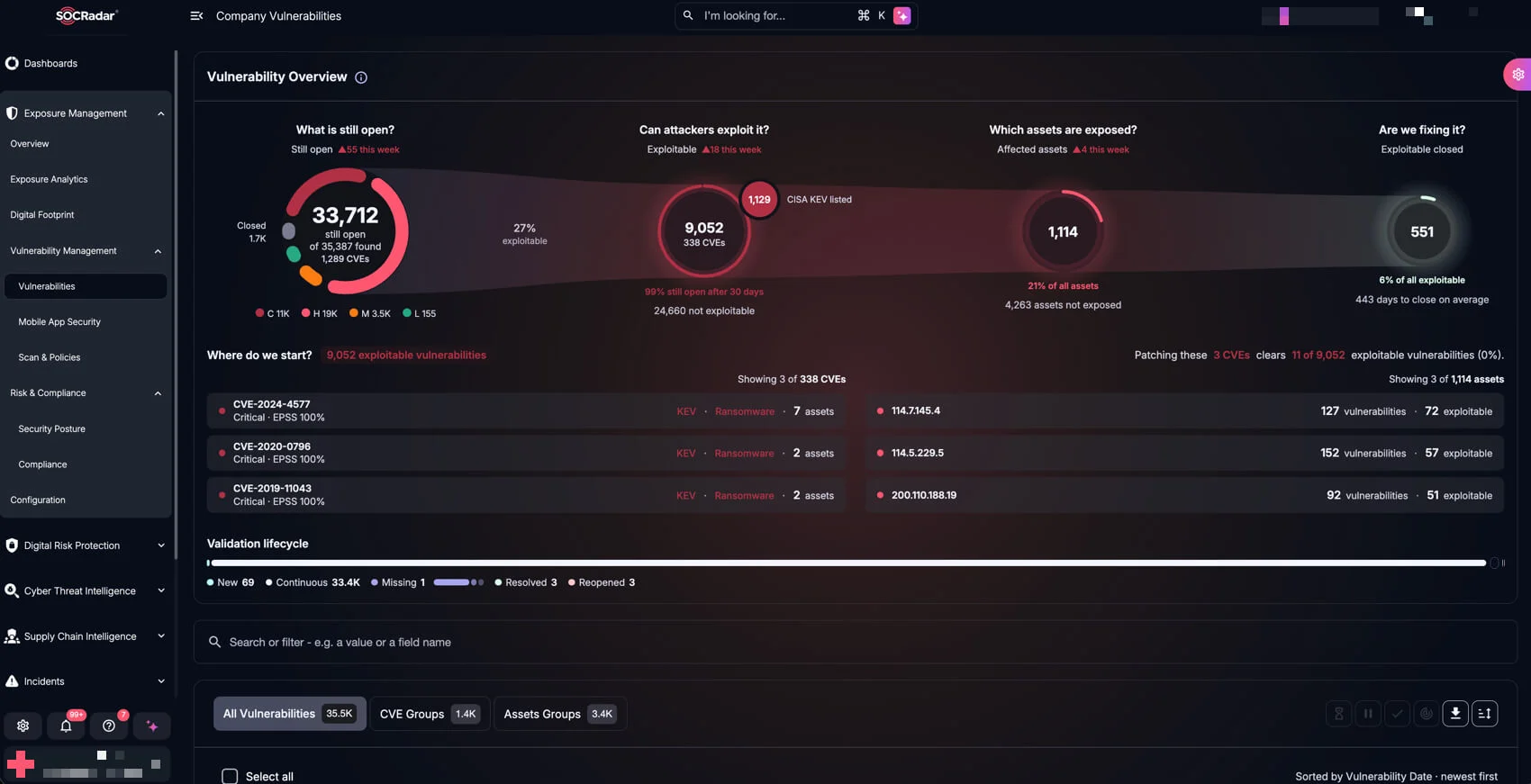
As Broadcom’s fix matrix and the exploitation picture for these vmdir flaws keep moving, SOCRadar keeps both in view so teams can act on the right build as soon as the risk changes.