
NGINX2Root: What NGINX Admins Should Know
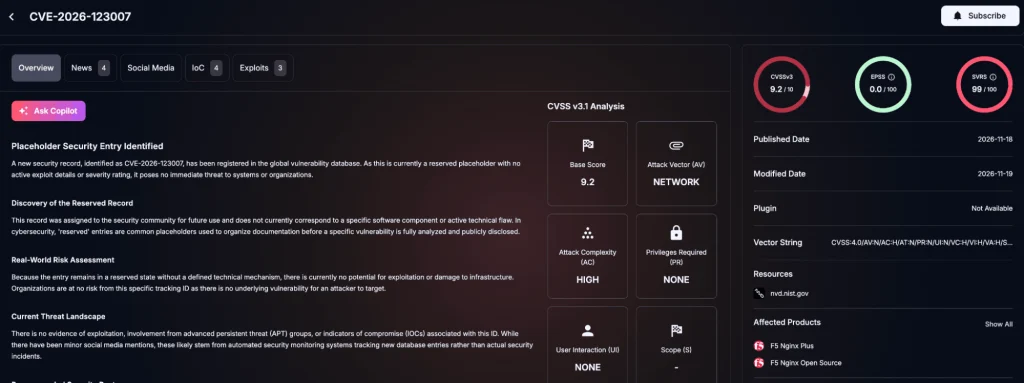
NGINX2Root is a set of five vulnerabilities in NGINX, led by CVE-2026-123007, that can let an unauthenticated attacker run code on a web server, depending on which features the server uses. The research went public on November 18, 2026, the same day F5 shipped fixed NGINX releases, and showed the flaws chained with an unpatched Linux kernel bug to take over the host.
This FAQ covers the vulnerable configurations, severity, exploit status, fixed versions and the workarounds available when patching has to wait.
Key Takeaways
- What it is: NGINX2Root is a set of five memory safety flaws in NGINX, led by CVE-2026-123007, that can give an unauthenticated attacker code execution as an NGINX worker process
- Who is affected: NGINX Open Source before 1.30.7 and 1.31.9, and NGINX Plus before 37.0.8.1 and 37.3.0.1, when HTTP/2, HTTP/3, request-time DNS resolution or the mail proxy is in use
- Severity: F5 rates all five flaws 9.2 (Critical) under CVSS v4.0
- Status: As of November 19, 2026, a public proof of concept (PoC) exists for CVE-2026-123007, and no in-the-wild exploitation has been reported
- Action: Upgrade and restart NGINX; where patching must wait, disable the affected features and block the SCTP kernel module on hosts that do not need it
NGINX2Root at a Glance
| CVE ID | CVE-2026-123007, CVE-2026-123633, CVE-2026-123634, CVE-2026-121810, CVE-2026-113425 |
| CVSS | 9.2 (Critical) under CVSS v4.0 and 8.1 (High) under CVSS v3.1 for each, assigned by F5 |
| Affected Products | NGINX Open Source, NGINX Plus |
| Affected Versions | NGINX Open Source 0.5.33 through 1.31.8, depending on the flaw and configuration; NGINX Plus R33 through R36 and 37.x builds before the fixed releases |
| Fixed In | NGINX Open Source 1.30.7 (stable) and 1.31.9 (mainline); NGINX Plus 37.0.8.1 and 37.3.0.1 |
| Exploitation Status | No in-the-wild exploitation reported as of November 19, 2026; public PoC for CVE-2026-123007 |
| Patch Available | Yes, for all five NGINX flaws; no fix yet for the chained Linux kernel SCTP bug |
| Discovered By | Xint (all five); F5 also credits other research teams for the two HTTP/2 flaws |
What Is NGINX2Root?
NGINX2Root is the name Xint gave to five memory safety vulnerabilities in NGINX, led by CVE-2026-123007, that can let an unauthenticated remote attacker run code as an NGINX worker process. The flaws sit in four features (HTTP/2, HTTP/3, the DNS resolver and the mail proxy), so exposure depends on how a server is configured.
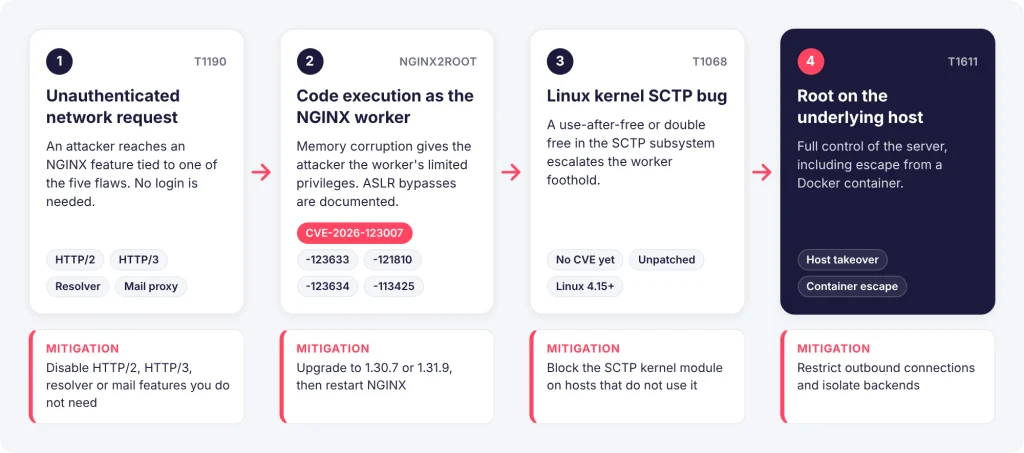
The researchers also chained an NGINX foothold with a separate Linux kernel bug to reach root on the underlying host. F5 fixed all five NGINX flaws on November 18, 2026; the kernel bug was still unpatched at disclosure.
Who Discovered NGINX2Root?
Researchers at Xint, part of security firm Theori, found the five NGINX flaws on October 11, 2026 and reported them to F5 through HackerOne on October 16, 2026. Public disclosure and F5’s fixes followed on November 18, 2026. F5 also credits other research teams for independently reporting the two HTTP/2 flaws, CVE-2026-123007 and CVE-2026-123633.
Which NGINX Configurations Are Vulnerable to NGINX2Root?
An NGINX server is exposed only when it runs an affected version and uses the feature tied to a given flaw. CVE-2026-123007 is the broadest, since it needs nothing more than HTTP/2 on a reachable listener. The other four need HTTP/2 or HTTP/3 with upstream proxying, request-time DNS resolution, or the mail proxy.
| CVE | Component and Bug Class | Required Configuration | Affected Versions | nginx.org Severity |
| CVE-2026-123007 | HTTP/2 flow control; a send-window miscount corrupts memory | HTTP/2 enabled | 1.9.5 to 1.31.8 | Major |
| CVE-2026-113425 | Mail authentication proxy; use-after-free | Mail proxy that combines proxy on and auth_http | 0.5.33 to 1.31.8 | Major |
| CVE-2026-123633 | HTTP/2 connection draining; use-after-free | HTTP/2 with proxying to a backend, while the worker is short of free connections | 1.19.7 to 1.31.8 | Medium |
| CVE-2026-121810 | HTTP/3 (QUIC) connection draining; use-after-free | HTTP/3 with proxying to a backend, while the worker is short of free connections | 1.25.0 to 1.31.8 | Medium |
| CVE-2026-123634 | DNS resolver; use-after-free | resolver with a request-derived proxy_pass target, plus SSI or mirror subrequests | 0.6.18 to 1.31.8 | Medium |
How Severe Are the NGINX2Root Vulnerabilities?
F5 scores each NGINX2Root flaw 9.2 (Critical) under CVSS v4.0 and 8.1 (High) under CVSS v3.1. The nginx.org project uses its own scale, rating CVE-2026-123007 and CVE-2026-113425 major and the other three medium. All five are reachable without authentication, but each depends on a specific feature being enabled.
F5’s vectors are CVSS:4.0/AV:N/AC:H/AT:N/PR:N/UI:N/VC:H/VI:H/VA:H/SC:N/SI:N/SA:N and CVSS:3.1/AV:N/AC:H/PR:N/UI:N/S:U/C:H/I:H/A:H. Both rate attack complexity as high.
Successful exploitation runs code with the worker process’s privileges, which are normally limited. That limit is why the kernel chain matters: it turns a worker foothold into full control of the host.
How Does NGINX2Root Lead to Root on the Host?
NGINX2Root reaches root by chaining two bugs: an NGINX flaw gives code execution as the worker, then a separate use-after-free or double free in the Linux kernel’s SCTP subsystem escalates that foothold to root. The researchers say the chain also crossed a Docker container boundary. As of November 19, 2026, the kernel bug has no CVE and no fix.
The kernel flaw affects code introduced in Linux 4.15, and most technical details are being withheld until a kernel patch ships. Hosts that do not use SCTP can block the module now to remove this escalation path. The attack maps to Exploit Public-Facing Application (T1190), Exploitation for Privilege Escalation (T1068) and Escape to Host (T1611).
Does ASLR Protect Against NGINX2Root?
Address Space Layout Randomization (ASLR) makes NGINX2Root exploits harder but does not stop them. The researchers documented ways around it, including a memory leak from CVE-2026-123007 itself, so servers with ASLR and position-independent executables (PIE) enabled remain at risk. Servers with ASLR switched off face easier exploitation and belong at the front of the patch queue.
Run sysctl kernel.randomize_va_space to check the setting, where 2 means full randomization, and look for services started with setarch -R, which disables it for a single process. CIRCL suggests auditing older distribution releases, NGINX compiled from source without hardening options, appliance firmware and outdated container images first.
Is NGINX2Root Being Exploited in the Wild?
As of November 19, 2026, no in-the-wild exploitation of NGINX2Root has been reported, and none of the five CVEs appears in CISA’s Known Exploited Vulnerabilities (KEV) catalog. That picture can change quickly: working exploit code for CVE-2026-123007 is already public, and the researchers report exploits that work against servers on major cloud platforms.
Is There a Public Proof of Concept for CVE-2026-123007?
A public PoC for CVE-2026-123007 appeared on GitHub on November 18, 2026, the day of disclosure. Its author reports full unauthenticated code execution against NGINX 1.31.8 running HTTP/2 over TLS in a Docker lab. No exploit code has been published for the other four flaws, although researchers have reproduced crashes for several of them.
Its author lists several limits. The exploit runs only on x86-64 servers with AVX-512 and a particular glibc memory-copy routine, has to get past ASLR, and sends roughly 128 GB of HTTP/2 traffic over a single connection. A proxy that terminates HTTP/2 in front of NGINX will most likely stop it. The discoverers and another research team say they hold working exploits but have withheld the final steps. Fake exploit repositories are also circulating on GitHub, so treat unvetted code with caution.
Which NGINX Versions Fix NGINX2Root?
NGINX Open Source 1.30.7 (stable) and 1.31.9 (mainline), released November 18, 2026, fix all five NGINX2Root flaws. F5 lists NGINX Plus 37.0.8.1 and 37.3.0.1 as fixed; NGINX Plus R33 through R36 have no patch, so those customers must move to a 37.x build. Restart NGINX after upgrading, because a reload does not replace the running binary.
The same release also fixes five other NGINX flaws, including CVE-2026-118899, a denial-of-service flaw in TLSv1.3 handling. Check the nginx.org advisories and F5’s notice for each CVE, and confirm distribution packages separately: Ubuntu, for example, shipped backported fixes on November 19, 2026, and its packages keep the older upstream version number.
How Can I Check If My NGINX Servers Are Affected?
Checking for NGINX2Root takes two steps: confirm whether the installed build predates the fix, then confirm whether the vulnerable features are switched on. Upstream builds before 1.30.7 and 1.31.9 are affected, but distribution packages may carry backported fixes under older version numbers, so compare against your vendor’s advisory.
- Version: Run nginx -v and match the full package version to your distribution’s advisory
- Features in use: Run nginx -T 2>/dev/null | grep -nE ‘http2|http3|quic|resolver|proxy_pass|mirror|ssi on|auth_http’ to list the directives tied to each flaw
- Bundled builds: Check container images, appliances and load balancers that ship their own NGINX, since host updates do not change them
- Kubernetes ingress: The community ingress-nginx controller is retired with no fix planned; HTTP/2 stays on unless its ConfigMap sets use-http2: “false”
- Crash signs: Run grep ‘exited on signal’ /var/log/nginx/error.log to find worker crashes that can accompany exploitation attempts
How Can I Mitigate NGINX2Root If I Cannot Patch Yet?
Until a fixed build is installed, turn off the feature behind each NGINX2Root flaw you cannot patch, following the discoverers’ guidance. Disabling HTTP/2 blocks only CVE-2026-123007 and CVE-2026-123633, so it is not a complete workaround; the HTTP/3, resolver and mail proxy paths need their own changes. Every workaround is temporary, and upgrading remains the fix.
| Feature | Temporary Change | Flaws Covered |
| HTTP/2 | Remove http2 from listen directives; on 1.25.1 and later, also set http2 off; | CVE-2026-123007, CVE-2026-123633 |
| HTTP/3 (QUIC) | Take out QUIC listeners, add http3 off; and send an Alt-Svc header set to clear so browsers stop reusing HTTP/3 | CVE-2026-121810 |
| Resolver | Point proxy_pass at a static upstream block rather than a hostname taken from the request | CVE-2026-123634 |
| Mail proxy | Keep mail listeners on the loopback address, or firewall them off from untrusted networks | CVE-2026-113425 |
Disabling HTTP/2 breaks gRPC and other HTTP/2-only clients, so test before rolling it out. Disabling mirror by itself leaves CVE-2026-123634 open, because SSI subrequests can trigger it too.
Mitigation and Recommendations for NGINX2Root
Upgrading NGINX is the only complete fix for the five NGINX2Root flaws. These steps take a team from exposure to verified remediation.
- Patch the edge first: Upgrade internet-facing NGINX servers, reverse proxies and load balancers with HTTP/2 enabled to 1.30.7 or 1.31.9, or to NGINX Plus 37.0.8.1 or 37.3.0.1
- Do a full restart: Stop and start NGINX after upgrading, since a reload keeps the old binary running
- Rebuild container images: Update base images and redeploy, since patching the host leaves the NGINX build inside an image unchanged
- Block SCTP where it is unused: Add install sctp /bin/false to a file in /etc/modprobe.d/; a module that is already loaded stays active until the host reboots or the module is removed, so check with lsmod
- Keep ASLR and PIE on: Undo any kernel.randomize_va_space=0 or setarch -R settings that switch randomization off on NGINX hosts
- Limit what a worker can reach: Allow NGINX hosts only the outbound traffic they need and keep backends on separate network segments, so a hijacked worker cannot reach much else
- Watch for warning signs: Following CIRCL‘s advisory, alert when workers crash or dump core, when an HTTP/2 connection stays open for minutes and takes in large volumes of data while the access log shows few requests, when a worker launches a shell or another program, and when an NGINX host makes outbound connections or DNS lookups it normally does not
- Track status changes: Recheck the CISA KEV catalog and your kernel vendor’s advisories, since exploitation status and the SCTP fix are still moving
How SOCRadar Can Help
SOCRadar helps teams track NGINX2Root and act on their own exposure:
- Vulnerability Intelligence: Follows CVE-2026-123007 and the other four NGINX2Root CVEs as exploitation reports, PoC releases and vendor fixes emerge, as part of the Cyber Threat Intelligence module
- Exposure Management: Finds internet-facing NGINX servers, reverse proxies and load balancers, so teams know which hosts to patch or restrict first
- Advanced Dark Web Monitoring: Surfaces attacker chatter about NGINX2Root exploits across criminal forums, marketplaces and encrypted chat channels
- Supply Chain Intelligence: Extends vulnerability monitoring to third-party vendors whose exposed NGINX services may put your organization at risk
Together, these capabilities connect NGINX2Root developments to the servers your organization actually runs, so patching starts where the risk is highest.