
Cisco Expressway RCE (CVE-2026-76466) Exploited for Root Access
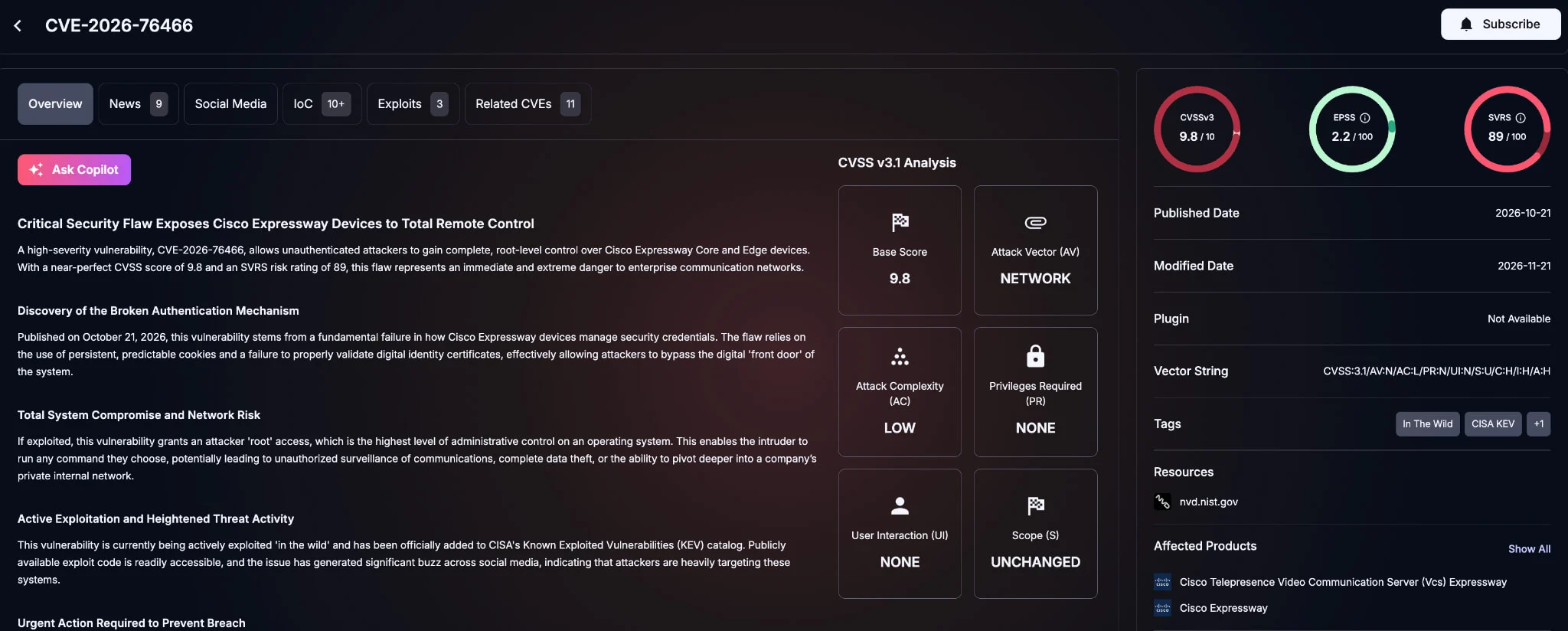
Attackers are exploiting CVE-2026-76466, a critical Cisco Expressway flaw that gives unauthenticated attackers root command execution on clustered devices. In the first public case, they moved from two internet-facing nodes into the internal network, and CISA added the flaw to its Known Exploited Vulnerabilities (KEV) catalog on November 20, 2026.
What Is CVE-2026-76466?
CVE-2026-76466 is a remote code execution vulnerability in Cisco Expressway, the gateway that extends Cisco collaboration services such as video and voice calling beyond the corporate network. Cisco disclosed it on October 21, 2026, rates it 9.8 under CVSS v3.1 and maps it to CWE-798 (Use of Hard-coded Credentials). It affects Expressway-C and Expressway-E only when they are clustered. Release X15.5.20 fixes it, and Cisco offers no workaround, so upgrading is the only vendor fix.
Persistent Cookies in the Cluster Database Service
Expressway nodes in a cluster keep their configuration in sync through a shared database service, and that service is where CVE-2026-76466 lives. Cisco’s security advisory traces the flaw to two weaknesses that work together: the database service relies on persistent cookies, and client certificates are not validated properly when TLS Verify Mode is enabled for clustering.
An attacker with network access who holds those cookies can connect to the database service, invoke specific RPC commands and execute arbitrary commands as root on the underlying operating system. No credentials or user interaction are needed.
The advisory does not publish the cookie values or the RPC sequence. Stefan Aleksic of Jane Street reported the issue.
Only Clustered Devices on Affected Releases Are Exposed
Both Expressway-C (Core) and Expressway-E (Edge) are affected, in virtual and appliance form, but only when a device runs a vulnerable release and is configured in a cluster. A standalone Expressway is not in scope for this CVE.
| Release Train | Vulnerable Releases | First Fixed Release |
|---|---|---|
| X15 | X15.5.3 and earlier | X15.5.20 |
| X14 | X14 and earlier | No fix in this train; migrate to a fixed release |
X15.5.20 also delivers Cisco’s October 2026 Security Hardening Release, which fixes eight more Expressway vulnerabilities rated up to 8.6. Those issues affect devices regardless of configuration, so standalone deployments have their own reason to upgrade.
As of November 24, 2026, Cisco’s CVE-2026-76466 advisory remains at its original October 21 version, which says Cisco PSIRT was not aware of malicious use. CISA’s KEV listing and the F6 investigation came after that statement.
A Public Exploit, Then Root on the Edge
Exploit code for CVE-2026-76466 appeared in a public GitHub repository alongside a detection script. The author reports running a command as root on a two-node Expressway-C X15.3.2 cluster, while listing other setups, including Expressway-E and X14, as untested. The repository also describes the vulnerable TLS mode differently from Cisco’s advisory, so defenders should not rule out a clustered device based on its TLS setting alone.
An investigation, published last week, describes what it calls possibly the first in-the-wild exploitation after that code became public. The victim, an unnamed organization in Russia, ran Expressway X15.5.3. The attack unfolded in three stages:
- Initial access: Attackers exploited the flaw on two internet-facing Expressway devices and executed commands as root
- Movement through the cluster: The compromised edge nodes gave them access to two more cluster nodes on the internal network
- Internal discovery and collection: Custom Python scripts scanned the network, enumerated SMB resources, interacted with SQL Server and WinRM, and reached GitLab repositories to collect credentials and sensitive data
The researchers assess, based on comments and fix notes in the code, that the scripts were possibly written with help from AI tools. F6 has not attributed the attack to any known threat actor or group.
CISA Set a Three-Day Federal Deadline
CISA added CVE-2026-76466 to the KEV catalog on November 20, 2026, together with exploited flaws in SAP NetWeaver, VMware vCenter and Apache Roller. Federal Civilian Executive Branch agencies had until November 23, 2026, to remediate. That deadline formally applies only to covered U.S. federal agencies, but the listing is a strong prioritization signal for any organization running Expressway.
KEV inclusion confirms evidence of exploitation, not its scale. The only publicly documented case so far involves four devices at a single organization, and no exposed-device count has been published.
Signs of Compromise to Look For on Expressway
These are researcher-observed indicators, not Cisco-published IOCs:
| IP address | 66.179.31[.]32 |
|---|---|
| IP address | 18.130.47[.]116 |
| Log artifact | [email protected] in erlang.log |
| File path | Python scripts in /mnt/harddisk/i{0-9}{4}[a-zA-Z]?/*.py |
Beyond those indicators, the attack chain suggests several hunting hypotheses:
- Connections to the cluster database service from addresses that are not cluster peers
- Outbound SMB, SQL Server, WinRM or GitLab traffic from Expressway nodes, which rarely need it
- Logins to GitLab or internal systems using credentials that could have been staged on or reachable from Expressway
- Unexpected files or scripts on the device file system
A clean result does not prove a device was never touched, because an attacker with root access can alter local logs.
Steps for Expressway Administrators
- Inventory every Expressway-C and Expressway-E node and confirm which ones are clustered and which release they run
- Upgrade clustered devices on X15.5.3 or earlier to X15.5.20, and plan migration for anything still on X14
- If an upgrade has to wait, consider the stopgap F6 recommends: allow TCP ports 4371 and 4372 only from trusted cluster node IPs; this is not a Cisco workaround and does not replace the patch
- Hunt for the indicators above, focusing on edge nodes that were exposed before the upgrade
- If compromise is suspected, treat the cluster as untrusted, rebuild affected nodes from known-good images, and rotate any credentials, tokens and repository secrets reachable from them
Tracking Exposure With SOCRadar
Expressway-E sits at the network edge by design, and an exploited flaw on it can open a route into internal systems. SOCRadar helps teams keep that exposure in view:
- Autonomous Exposure Management: Finds internet-facing Expressway assets that may not be tracked, including forgotten edge nodes
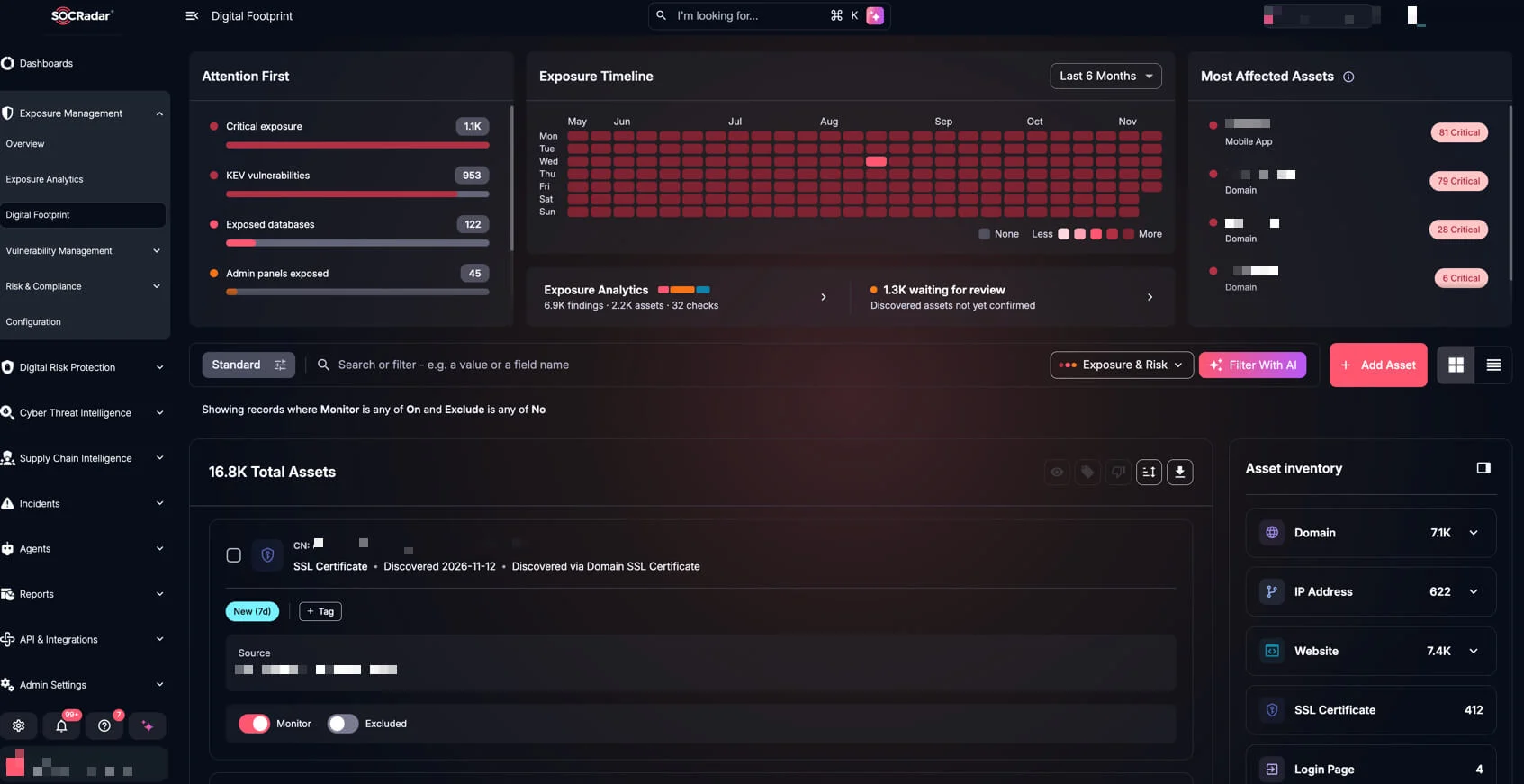
- Vulnerability Intelligence: Follows CVE-2026-76466 for exploit releases, KEV changes and new threat activity, so remediation priorities move with the evidence
- Dark Web Monitoring: Flags underground posts that claim exploit code or sell access to compromised communications infrastructure
Confirming whether a specific cluster was breached still depends on the device logs and internal telemetry described above.