FBI Investigates Nexus Claim of 153M+ Driver’s License Records
Update 7/9/2026: ShinyHunters Seeks to Purchase the Nexus Dataset
A Dark Web service called Nexus has claimed to offer access to more than 153 million driver’s license records from the United States and Canada, along with millions of other identity documents. The FBI has reportedly opened an investigation into the exposure.
The advertised totals, number of unique individuals, source of the records, and alleged method of collection remain unconfirmed. However, the scale and type of data displayed by Nexus raise serious questions about the security of identity verification systems that collect and retain government issued documents.
ShinyHunters Seeks to Purchase the Nexus Dataset
On September 5, 2026, ShinyHunters published a message addressed to “databroker1,” the alleged operator of the Nexus service, expressing interest in purchasing the claimed 153 million driver’s license records. The group said it had made several substantial offers in exchange for the dataset, although the message did not disclose a specific price.
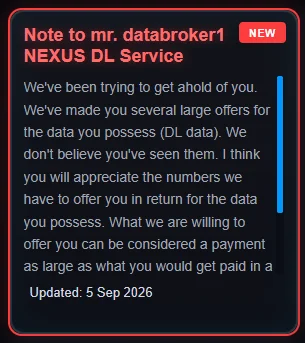
ShinyHunters’ message to “databroker1,” offering to purchase the driver’s license dataset advertised through Nexus. (SOCRadar Dark Web Team)
If ShinyHunters or another group acquires the dataset, the records could be redistributed, used in extortion campaigns, or combined with information from other breaches to support identity fraud, account recovery abuse, phishing, and impersonation. The development also means that taking the original Nexus service offline would not necessarily eliminate the exposure if copies of the collection remain available to its operator.
What Did Daily Dark Web Identify?
Daily Dark Web reported on Nexus as a newly advertised service claiming searchable access to a large collection of North American identity records.
The material advertised by Nexus reportedly included document details, photographs, barcode data, and scans of physical identity documents. Some records appeared to contain multiple versions of the same document, including front-and-back images and scans captured under different lighting conditions.
Nexus also claimed that approximately 500,000 new documents were being added daily. This figure has not been independently verified, but it raises the possibility that the service was presenting its collection as an actively updated source rather than a one time archive.
International Cyber Digest reported that the FBI opened an investigation on September 1. The post also said the Nexus collection had grown by approximately 400,000 driver’s license records within 24 hours. Neither the FBI nor any potentially affected provider has publicly confirmed the complete source or scope of the data.
What Data Does Nexus Claim to Hold?
The figures displayed by Nexus included:
- 153,347,439 driver’s license records
- 10,335,678 identification card records
- 3,304,030 travel documents and international driver’s licenses or IDs
- 579,201 medical card records
- Smaller categories involving Common Access Cards, residence cards, employment authorization documents, and uncategorized records
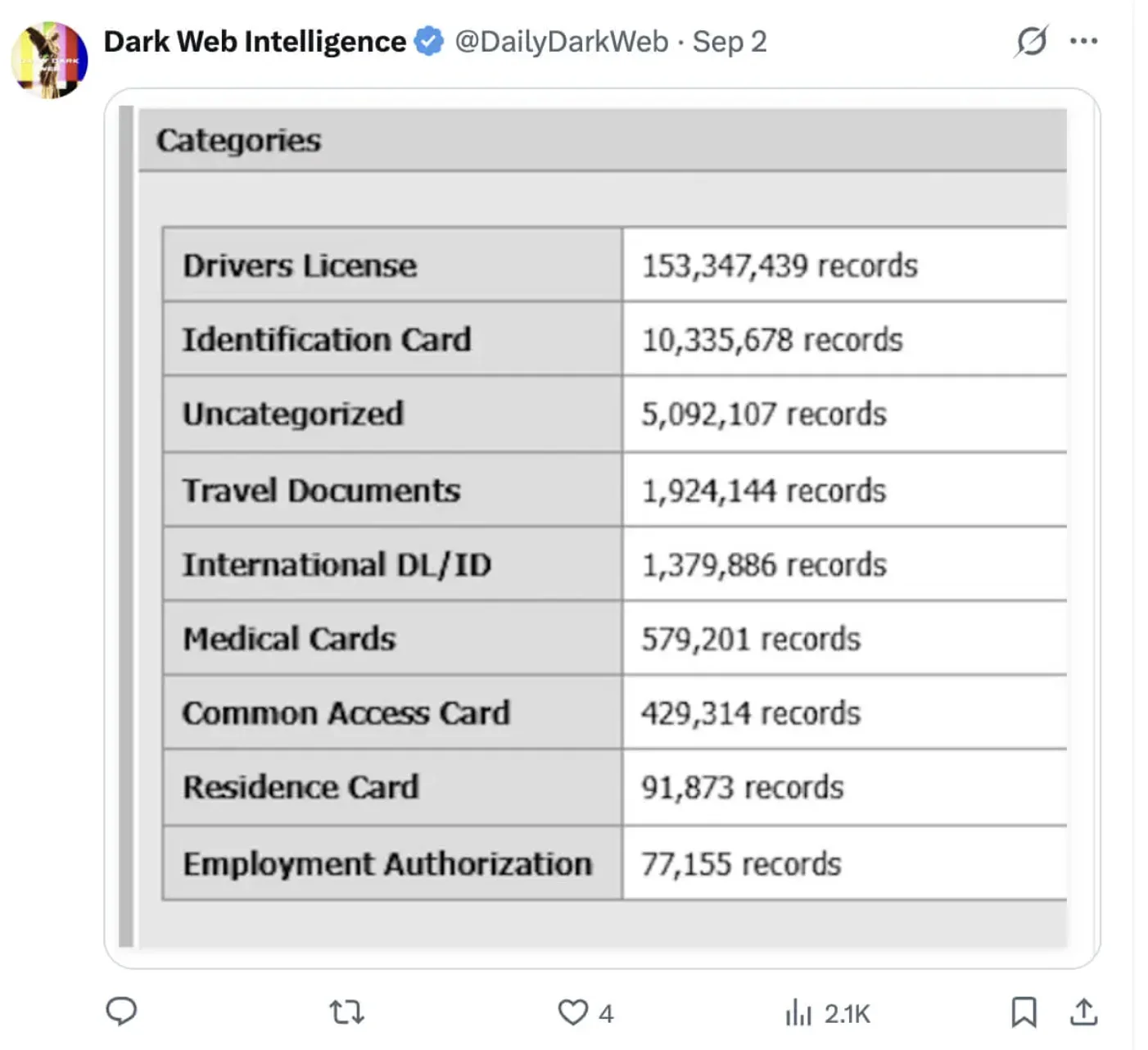
Claimed Nexus record totals shared by Daily Dark Web. The figures have not been independently verified. (Daily Dark Web)
The driver’s license and identification card categories alone exceed 163 million records. These figures should not be interpreted as a confirmed count of affected individuals. One person may appear more than once because of repeat scans, renewed documents, front-and-back images, different scan formats, or records collected through multiple transactions.
Has the Source of the Records Been Confirmed?
No affected organization has publicly confirmed that it was the source of the complete Nexus collection. The operators claimed they had maintained access to a major identity-verification company for more than a year, but that statement remains an allegation made by the service itself.
The structure of the advertised data nevertheless provides useful investigative clues. Multiple images of the same document, barcode information, specialized scans, and associated timestamps are more consistent with data produced during identity verification workflows than with a simple database containing names and license numbers.
That does not identify a particular provider. The collection could also combine information from more than one source, include duplicate or outdated material, or contain records obtained through different breaches.
Was Nexus Advertising a Live Data Feed?
Nexus presented the collection as continuously updated and claimed that approximately 500,000 documents were being added each day. Without access to the underlying systems, this claim cannot be confirmed.
Still, the possibility of continuing collection changes the response requirements. A static breach involves data that was taken during a past event. Access to a live verification pipeline could allow attackers to obtain newly submitted documents until the underlying access path is identified and closed.
Organizations investigating possible exposure should therefore examine more than stored files. Relevant areas include:
- Document scanning devices and their management systems
- Web and mobile upload paths
- Identity verification APIs and third-party integrations
- Service accounts and administrative access
- Cloud storage locations and data-transfer mechanisms
- Retention, deletion, and backup processes
- Unexpected exports or sustained outbound transfers
Deleting historical scans would not stop an attacker positioned inside an active processing pipeline from collecting new submissions.
Why Is Identity-Document Exposure Difficult to Remediate?
Passwords and access tokens can be changed quickly. Government issued documents, facial images, signatures, physical descriptions, and dates of birth are much harder to replace.
A new license number may reduce some forms of misuse, but previously exposed images may still support impersonation, social engineering, fraudulent account recovery, or attempts to bypass weak document based identity checks.
The lasting risk comes from verification reuse. The same document image may be presented to banks, telecom providers, online marketplaces, gaming services, cryptocurrency platforms, and other organizations. If those services treat possession of a convincing document scan as proof of identity, one exposure can support fraud across multiple sectors.
Why Document Scans Should Not Be Treated as Proof of Control
A document can be genuine while the person presenting it is an attacker. This distinction becomes more important when high quality front-and-back scans, barcode data, and document photographs circulate in criminal environments.
Organizations should distinguish between:
- Document authenticity: Whether the document itself appears legitimate
- Identity control: Whether the person presenting it is the rightful holder
- Transaction legitimacy: Whether the requested action matches the user’s normal behavior and risk profile
Document validation addresses only the first question. Sensitive actions require additional evidence, such as liveness checks, trusted device history, behavioral signals, transaction context, and human review.
What Should Individuals and Organizations Do?
- Watch for verified notifications: Rely on notices from confirmed providers, regulators, or law-enforcement agencies rather than unofficial breach lookup websites.
- Strengthen financial monitoring: Review credit reports and consider a credit freeze or fraud alert where available. Investigate unexpected loans, accounts, mobile service changes, or address updates.
- Harden account recovery: Do not allow a driver’s license scan alone to override MFA, reset credentials, change contact details, or remove security controls.
- Review identity-verification vendors: Assess document retention, subprocessors, administrative access, scanning-device security, breach notification requirements, and whether raw images need to be retained.
- Use layered verification: Combine document checks with liveness testing, device intelligence, behavioral analysis, transaction risk, and manual review for sensitive actions.
- Prepare for downstream fraud: Alert fraud, identity, trust-and-safety, and customer support teams to expect more convincing impersonation and recovery attempts.
- Reduce unnecessary collection: If a verified attribute is sufficient, avoid retaining the complete document image. Limiting stored data reduces the value of a future compromise.
How Can SOCRadar Support Identity Risk Monitoring?
SOCRadar Dark Web Monitoring can help organizations identify exposed identity data and criminal discussions involving their employees, executives, customers, or brands. Supply Chain Intelligence can support risk reviews involving identity-verification providers and other processors, while Digital Risk Protection can identify impersonation and fraud infrastructure that emerges around major data exposures.
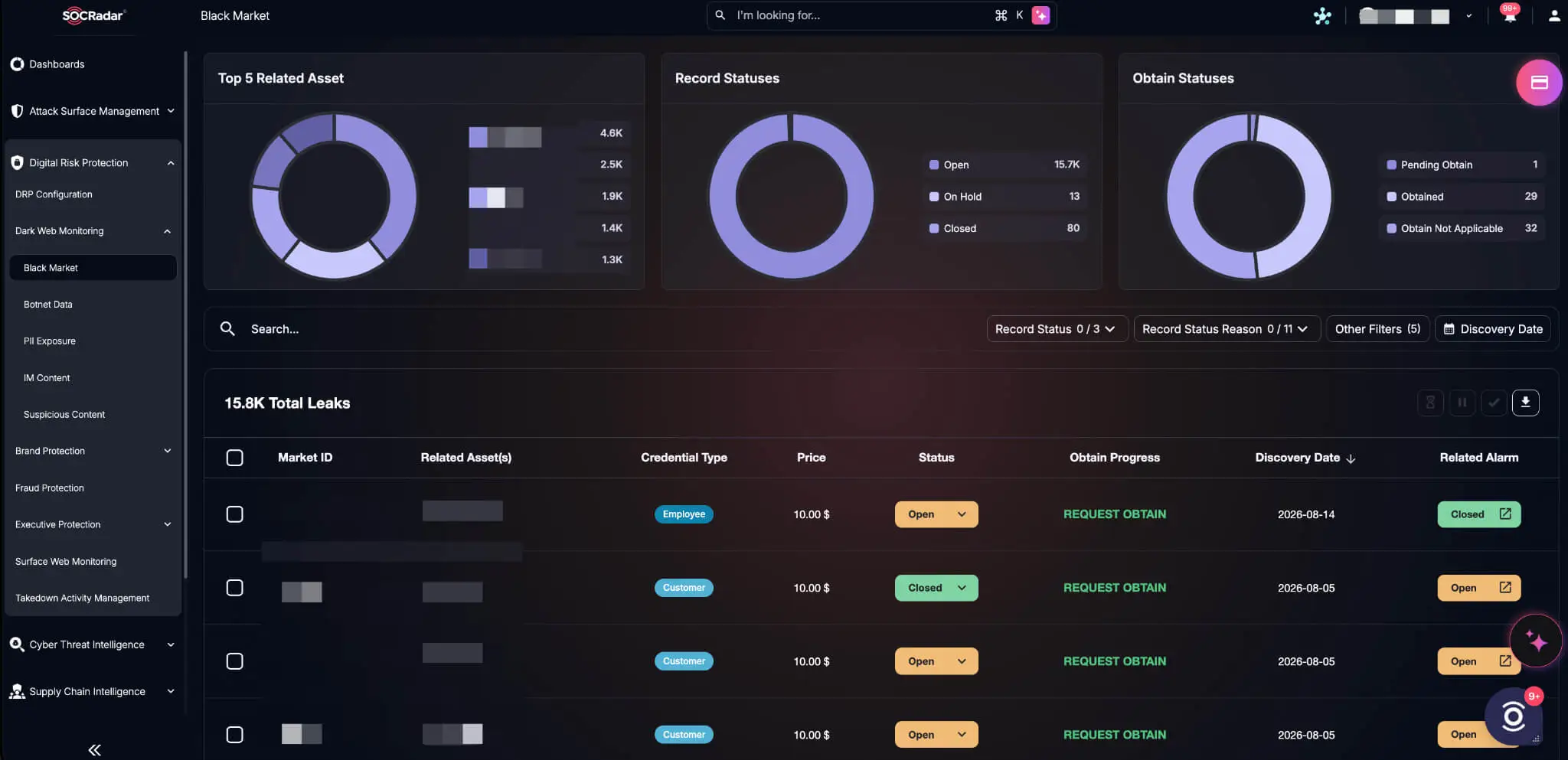
SOCRadar Dark Web Monitoring
These capabilities complement vendor investigations, identity telemetry, fraud controls, and incident-response procedures. External intelligence can provide early warning and context, but it cannot establish the complete scope of an incident before the affected organizations finish their forensic investigations.
Conclusion
Nexus’s figures and collection claims remain unverified, but the FBI investigation and ShinyHunters’ subsequent attempt to purchase the alleged dataset show that the exposure is attracting attention from both law enforcement and established cybercriminal actors.
Organizations should monitor the investigation, review their identity-verification dependencies, strengthen account-recovery controls, and reduce reliance on document scans as standalone proof of identity. The broader lesson is straightforward: collecting identity documents creates a long-term security obligation that does not end after verification is complete.
Run a free domain scan below to check for Dark Web exposure: