




Oct 13, 2026

Table Of Content
Ivanti Connect Secure Zero-Day CVE-2026-104935 Exploited in Chained Attacks
Key Takeaways
CVE-2026-104935 at a Glance
Affected and Fixed Versions
Attack Timeline
How the Exploit Chain Works
UTA0576 Post-Exploitation Activity
Anti-Forensics
Why the Integrity Checker Misses It
Possible Use of AI in Exploit Development
Ivanti Edge Devices Remain a Prime Target
Indicators of Compromise
How to Check Whether Your Appliance Was Compromised
Mitigation and Recommendations
Frequently Asked Questions
Related Articles


CVE-2026-97229: Critical GitLab RCE
Oct 13, 2026


CVE-2026-102255: Critical SonicWall SMA1000 SSRF
Oct 12, 2026

Critical Cisco NX-OS Flaws Threaten Nexus Switches
Oct 09, 2026

Oct 14, 2026
11 Mins Read

Summarize with:
Ivanti Connect Secure Zero-Day CVE-2026-104935 Exploited in Chained Attacks
Ivanti released fixes on October 13, 2026, for CVE-2026-104935, an Ivanti Connect Secure zero-day that attackers exploited before a patch existed. Volexity, which uncovered the activity during an incident investigation, tracks the attacker as UTA0576. According to the published analysis, the actor chained three vulnerabilities to move from an unauthenticated web request to root-level code execution on an ICS VPN appliance running version 22.8R2.4, which was fully patched at the time.
CVE-2026-104935 covers the first two links in the chain: an authentication bypass and a remote code execution flaw. The third, a privilege escalation flaw, has no CVE and no patch yet. Ivanti says exploitation has affected “a limited number of customers,” and the full scope is still under investigation.
The case matters for any organization running ICS at the network edge. The actor stole credentials, mapped Active Directory and sniffed internal traffic, and researchers assess with high confidence that this was preparation for lateral movement and a broader compromise of the victim network. It also defeated the tool most ICS customers rely on to check appliance integrity, which makes a quiet compromise harder to rule out.
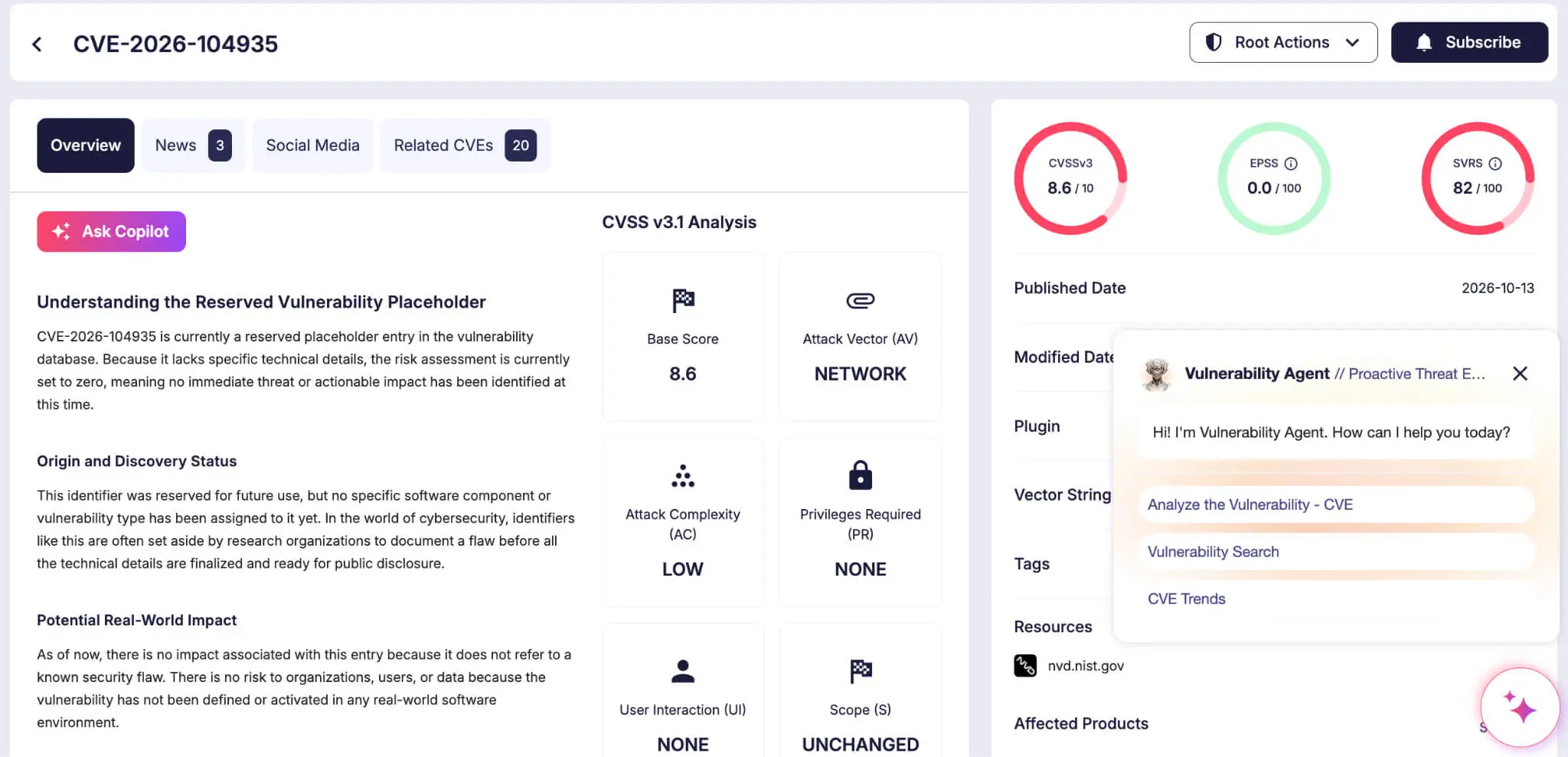
Details of CVE-2026-104935 (SOCRadar Vulnerability Intelligence)
Key Takeaways
- Exploited Zero-Day: A threat actor tracked as UTA0576 chained three Ivanti Connect Secure (ICS) zero-days to gain unauthenticated root access on a fully patched ICS 22.8R2.4 appliance
- Partial Fix: Ivanti patched the authentication bypass and remote code execution steps as CVE-2026-104935 on October 13, 2026; the privilege escalation flaw remains unpatched
- KEV Listing: CISA added CVE-2026-104935 to the Known Exploited Vulnerabilities catalog on October 13, 2026
- Detection Gap: The chain modifies code only in memory, so Ivanti’s Integrity Checker Tool does not detect it
- Credential Theft: The attacker harvested domain credentials and queried Active Directory for LAPS passwords and BitLocker recovery keys
CVE-2026-104935 at a Glance
| Attribute | Detail |
|---|---|
| CVE | CVE-2026-104935 |
| CVSS | 8.6 (CVSS v3.0) |
| Weakness | CWE-290, authentication bypass by spoofing |
| Affected Product | Ivanti Connect Secure (ICS) |
| Exploitation Status | Exploited in the wild as a zero-day; listed in CISA KEV on October 13, 2026 |
| Patch Status | Authentication bypass and RCE patched; privilege escalation flaw unpatched |
| Threat Actor | UTA0576 |
| Exploitation Discovered By | Volexity (Ivanti found part of the flaw internally in June 2026) |
Affected and Fixed Versions
Fixed versions as listed breakdown of Ivanti’s advisory:
| Affected Versions | Fixed Version |
|---|---|
| 25.1.1.1 and prior | 25.1.1.2 |
| 25.1.2.2 and prior | 25.1.3.0 or 25.1.3.1 |
| 22.8R2.4 and prior | 22.8R2.5 |
Public CVE record data lists versions before 25.1.3.0 as affected, which does not match 25.1.1.2 as a fix; confirm against Ivanti’s advisory before relying on 25.1.1.2.
Versions 22.7.x and below are not affected. The 22.7 and 22.8 code lines reach end of life on January 31, 2027, according to coverage of the advisory, and Ivanti describes 22.8 as a temporary bridge and recommends moving to 25.1.
Attack Timeline
| Date | Event |
|---|---|
| June 2026 | Ivanti finds part of the flaw during internal security checks and schedules it for a regular release |
| September 30 to October 7, 2026 | The attacker-used host, 108.165.147[.]64, runs an OpenVPN server |
| October 3, 2026 | UTA0576 begins exploiting the victim ICS appliance |
| October 5, 2026 | Investigation of suspicious activity at the victim network starts and is traced to the ICS appliance |
| October 13, 2026 | Ivanti releases patches and an advisory for CVE-2026-104935; the research is published; CISA adds the CVE to KEV |
| Pending | Ivanti fix for the privilege escalation flaw, expected in a future release |
Other reporting puts the earliest confirmed exploitation at October 1, 2026, and quotes researchers saying activity may have started in late September.
How the Exploit Chain Works
The chain has three vulnerabilities, plus a staged payload that keeps most of the attacker’s code out of the file system.
Step 1: Authentication Bypass in welcome.cgi
The public login path /dana-na/auth/url_default/welcome.cgi accepts an X-DSCGI-PATH header. The appliance checks the requested URL to decide whether authentication is required, but routes the request to whatever script the header names. By pointing the header at a protected CGI script such as wu.cgi, an unauthenticated attacker reaches code that should sit behind the login.
Step 2: Race Condition in the wu.cgi Upload Handler
The wu.cgi upload handler writes an uploaded file to /home/runtime/tmp/<MD5(filename)> before it checks whether the file is a valid ZIP archive. Invalid files are deleted, but only after a short window. The attacker uploads a Perl script with a .zip extension and, at the same time, sends several requests that use the same header trick to execute the temporary file before it disappears. When a request wins the race, the script runs as the cgi-server user.
Step 3: Staged In-Memory Payload
The Perl script runs a Bash script, which in turn runs a Python script. The Python stage is Base64-encoded and zlib-compressed and is run with exec(), so it exists only in memory.
Step 4: Privilege Escalation Through DSCache
From the cgi-server context, the payload patches the in-memory copy of /home/lib/libdsplibs.so. That patch lets it change a DSCache maintenance task so the task launches the Perl interpreter, and then ask the root-level dsinvoked service to run it.
The exploit confirms root access by reading /etc/shadow, then restores the DSCache entry, which normally points the ScriptUtil/updateOpswatSDK command at /home/bin/updateOpswatSDK.pl, and reverses the library patch.
Each command the attacker ran re-executed the full chain, and results came back in the HTTP response. There was no web shell, no first-stage malware and no separate C2 channel.
UTA0576 Post-Exploitation Activity
Researchers assess with high confidence that the operator reviewed command output and adjusted its actions, rather than running a fixed script. Observed activity included:
- Active Directory Reconnaissance: Custom LDAP tools (/tmp/ml.py, /tmp/rq5.py), run with an ICS Active Directory service account, searched for LAPS local administrator passwords, BitLocker recovery information, userPassword and unixUserPassword attributes, and logon script paths, exporting results as JSON to /tmp/
- Credential Theft: The actor extracted credentials stored on the appliance, including domain credentials used for LDAP
- Traffic Capture: A renamed tcpdump binary, /data/.icscap/dsstatmond, captured plaintext protocols such as LDAP, HTTP, FTP and telnet across eight rotating capture files; the actor parsed /data/.icscap/cap0 for TCP 389 traffic and tried to exfiltrate its first 8 KB
- Credential Harvesting From Traffic: /data/.icscap/h.py extracted plaintext LDAP credentials, HTTP Basic credentials and NTLM challenge-response material
- Kerberos Abuse: /tmp/mk.py included Kerberoasting functionality, and /tmp/rr.py tested credentials
- Configuration and Log Collection: The actor targeted /home/etc/pulse/, /home/etc/, /home/*.cfg and /home/runtime, and pulled usernames from log.events.vc0 into /tmp/pu.txt
- Network Reconnaissance and Password Spraying: The actor exfiltrated /etc/resolv.conf, resolved internal domains and ran a spraying script, sp_run.py, which produced sp_out.txt and spray_hits.json
All data left over the exploit channel itself. The operation was detected and disrupted before its final objective became clear.
Anti-Forensics
UTA0576 put real effort into hiding its tracks:
- Log Tampering: Selective removal of recent entries from /home/runtime/dlogs/debuglog and /var/log/audit/audit.log
- Payload Cleanup: Self-deletion of the root Perl payload and the Python stage’s cleanup script, removal of temporary results and the CGI source, and deletion of /tmp/rq5.py and /tmp/rr.py
- Memory Restoration: Reversal of the DSCache change and the in-memory library patch through /proc/self/mem
- Quiet Execution: Output of background cleanup redirected to /dev/null
- Masquerading: tcpdump renamed to dsstatmond and run from a hidden .icscap directory, with rotating captures that overwrote earlier traffic
Because the debug and audit logs were edited, investigators had to work with Ivanti to collect memory images, disk images and core dumps to reconstruct the chain. Memory analysis exposed the dsstatmond sniffer (PID 5012) and recovered the actor’s scripts, JSON output and PCAP files.
Why the Integrity Checker Misses It
Ivanti’s Integrity Checker Tool looks for unexpected file changes on disk. Because this chain patches library code only in memory and restores the DSCache entries it alters, “the tool does not detect any modifications.” CISA issued the same warning, noting that the tool may not detect evidence of exploitation because attacker commands run in memory. A clean Integrity Checker result does not rule out compromise, and forensic investigation is required to identify exploitation.
Possible Use of AI in Exploit Development
Researchers assess with medium confidence that UTA0576 uses large language models for exploit development and post-exploitation work. The evidence cited is the choice of a continuous exploit channel over a simple web shell, highly specific scripts with hardcoded credentials, and the overall complexity of the chain. On motive, they assess with low confidence that the actor is criminal rather than espionage-driven.
Ivanti Edge Devices Remain a Prime Target
This is not an isolated case. CISA has listed 36 Ivanti defects in KEV since late 2021, and at least six Ivanti defects have been exploited since late January 2026, per reporting on the disclosure. Ivanti found part of this flaw internally in June 2026 but said it “did not meet the threshold for an out-of-band release,” leaving a window that attackers used before the fix shipped.
Researchers note that edge devices often give attackers a foothold for pivoting into networks. One researcher warned that the trivial authentication bypass and repeatable race condition make “widespread, indiscriminate exploitation” likely as attackers study the patches.
Indicators of Compromise
Network:
- 108.165.147[.]64 (Evoxt VPS)
Request Patterns:
- High volumes of requests to /dana-na/auth/url_default/welcome.cgi
- X-DSCGI-PATH: /home/webserver/htdocs/dana/fb/smb/wu.cgi
- X-DSCGI-PATH: /home/runtime/tmp/<MD5(filename)>
Files and Directories:
- /tmp/ml.py
- /tmp/rq5.py
- /tmp/mk.py
- /tmp/rr.py
- /tmp/pu.txt
- sp_run.py
- sp_out.txt
- spray_hits.json
- /data/.icscap/h.py
- /data/.icscap/dsstatmond
- /data/.icscap/cap0 and other rotating cap* files
- /home/root/data/.icscap/cap6
Process:
- dsstatmond running from the .icscap directory
The complete indicator set is published in a public repository.
How to Check Whether Your Appliance Was Compromised
- Review Web Logs: Look for high volumes of welcome.cgi requests and for any request where the X-DSCGI-PATH header does not match the URL path, including paths beyond the two listed above
- Inspect Temporary Directories: Check /tmp/ and /home/runtime/tmp/ for unexpected scripts, JSON output or text files
- Look for the Sniffer: Check for a dsstatmond process or a hidden .icscap directory under /data/
- Compare Log Continuity: Gaps in /home/runtime/dlogs/debuglog or /var/log/audit/audit.log may indicate selective deletion
- Capture Memory: If anything looks suspicious, collect memory and network evidence, since the chain leaves little on disk
Mitigation and Recommendations
- Patch Now: Upgrade to 25.1.1.2, 25.1.3.0 or later, or 22.8R2.5, and plan migration to the 25.1 code line before 22.7 and 22.8 reach end of life
- Track the Remaining Fix: Ivanti is still developing a fix for the privilege escalation flaw; apply it as soon as it ships
- Hunt for Exploitation: Monitor for high volumes of welcome.cgi requests and for mismatches between the URL path and the X-DSCGI-PATH header
- Check Temporary Directories: Review /tmp/ for post-exploitation artifacts
- Run Forensics: If compromise is suspected, perform network and memory forensics; do not rely on the Integrity Checker Tool alone
- Assume Stored Credentials Are Exposed: On a compromised appliance, treat stored domain credentials as stolen, since UTA0576 extracted stored LDAP credentials and harvested plaintext credentials from captured traffic
Frequently Asked Questions
What Is CVE-2026-104935?
CVE-2026-104935 is an authentication bypass and remote code execution vulnerability in Ivanti Connect Secure, rated CVSS 8.6. It lets a remote, unauthenticated attacker reach protected CGI scripts and run commands as the cgi-server user. Attackers exploited it as a zero-day before Ivanti released a fix on October 13, 2026.
Is CVE-2026-104935 Being Exploited?
Yes. A threat actor tracked as UTA0576 has exploited it since early October 2026, and Ivanti says a limited number of customers were compromised. CISA added it to the Known Exploited Vulnerabilities catalog on October 13, 2026.
Which Ivanti Connect Secure Versions Are Fixed?
The fixed versions are 25.1.1.2, 25.1.3.0 or 25.1.3.1, and 22.8R2.5. Versions 22.7.x and below are not affected. Ivanti recommends moving to the 25.1 code line, since 22.7 and 22.8 reach end of life on January 31, 2027.
Does Patching Fully Close the Attack Chain?
No. The patch fixes the authentication bypass and remote code execution steps, which removes unauthenticated access to the chain. The privilege escalation flaw used to reach root is still unpatched, and Ivanti is working on a fix for a future release.
Can the Ivanti Integrity Checker Tool Detect This Attack?
Not reliably. The exploit chain changes library code only in memory and restores the configuration it modifies, so the Integrity Checker Tool does not detect it. Network and memory forensics are needed on any appliance suspected of compromise.
What Did the Attackers Steal?
The attacker extracted credentials stored on the appliance, including domain credentials used for LDAP, and harvested plaintext credentials and NTLM material from captured traffic. It also queried Active Directory for LAPS passwords and BitLocker recovery information and exfiltrated configuration data and usernames from appliance logs.
Who Is UTA0576?
UTA0576 is the designation for the unidentified threat actor that chained the Ivanti Connect Secure zero-days. Researchers assess with low confidence that the actor is criminally motivated rather than espionage-driven, and with medium confidence that it uses large language models for exploit development and post-exploitation work. The operation was disrupted, so its final objective is unknown.



